Kirjojen hintavertailu. Mukana 12 459 402 kirjaa ja 12 kauppaa.

Kirjailija

Paul A. Djupe

Kirjat ja teokset yhdessä paikassa: 7 kirjaa, julkaisuja vuosilta 1999-2023, suosituimpien joukossa The Prophetic Pulpit. Vertaile teosten hintoja ja tarkista saatavuus suomalaisista kirjakaupoista.

7 kirjaa

Kirjojen julkaisuhaarukka 1999-2023.

The Full Armor of God

The Full Armor of God

Paul A. Djupe; Andrew R. Lewis; Anand E. Sokhey

Cambridge University Press
2023
sidottu
Academic research on Christian nationalism has revealed a considerable amount about the scope of its relationships to public policy views in the US. However, work thus far has not addressed an essential question: why now? Research by the authors of this Element advances answers, showcasing how deeper engagement with 'the 3Ms' – measurement, mechanisms and mobilization – can help unpack how and why Christian nationalism has entered our politics as a partisan project. Indeed, it is difficult to understand the dynamics of Christian nationalism without reference to the parties, as it has been a worldview used to mobilize Republicans while simultaneously recruiting and demobilizing Democrats. The mechanisms of these efforts hinge on a deep desire for social dominance that is ordained by God – an order elites suggest is threatened by Democrats and 'the left.' These elite appeals can have sweeping consequences for opinion and action, including the public's support for democratic processes.
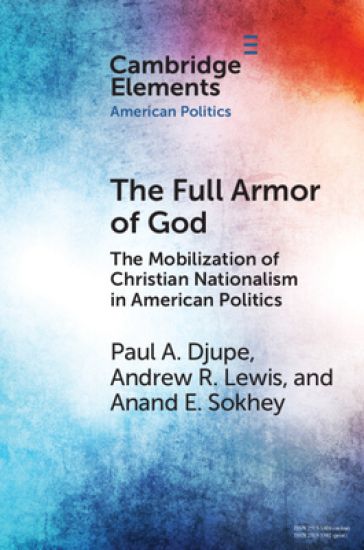
The Full Armor of God

The Full Armor of God

Paul A. Djupe; Andrew R. Lewis; Anand E. Sokhey

Cambridge University Press
2023
pokkari
Academic research on Christian nationalism has revealed a considerable amount about the scope of its relationships to public policy views in the US. However, work thus far has not addressed an essential question: why now? Research by the authors of this Element advances answers, showcasing how deeper engagement with 'the 3Ms' – measurement, mechanisms and mobilization – can help unpack how and why Christian nationalism has entered our politics as a partisan project. Indeed, it is difficult to understand the dynamics of Christian nationalism without reference to the parties, as it has been a worldview used to mobilize Republicans while simultaneously recruiting and demobilizing Democrats. The mechanisms of these efforts hinge on a deep desire for social dominance that is ordained by God – an order elites suggest is threatened by Democrats and 'the left.' These elite appeals can have sweeping consequences for opinion and action, including the public's support for democratic processes.

The Knowledge Polity

The Knowledge Polity

Paul A. Djupe; Anand Edward Sokhey; Amy Erica Smith

OXFORD UNIVERSITY PRESS INC
2022
nidottu
Drawing on surveys of diverse social science faculty, three acclaimed scholars develop a rich and sometimes surprising portrait of who produces research, teaches students, and contributes to the business of higher education - and how, when, and why. In The Knowledge Polity, Paul A. Djupe, Amy Erica Smith, and Anand Edward Sokhey envision academics as members of a polity where the primary output is knowledge and citizenship comes with rights and responsibilities. Leveraging the 2017 Professional Activity in the Social Sciences (PASS) Study, they develop a theoretically and empirically rich account of who produces knowledge, and how. The data enable an unparalleled understanding of the nature and sources of inequalities by gender and racial or ethnic identification in the disciplines of sociology and political science in the US. To explain those inequalities, the authors consider academics as embedded in institutional and social contexts-including their home lives-and carefully consider their personalities and changing compositions of the academic workforce. A comprehensive and wide-ranging analysis, this book documents patterns that have long been shrouded in anecdote and enables scholars from across the social and behavioral sciences to make empirically-grounded decisions about their individual and collective futures.
The Political Influence of Churches

The Political Influence of Churches

Paul A. Djupe; Christopher P. Gilbert

Cambridge University Press
2008
pokkari
Djupe and Gilbert investigate the political influence of church and how membership in organized religious bodies shapes the political life of members. Djupe and Gilbert's goal in this inquiry is to re-center scholarly attention on the voluntary association as an essential element of American civic and political life. They develop a theoretical framework that captures the multifaceted elements of church life that affect individual political attitudes and actions. Political information from clergy, small groups, and social networks flows plentifully in churches, but individuals process that information differently depending on their motivations related to their status in the church. Articulating a more fully specified model of how associations expose individuals to political information and norms will help us understand the political opinions and behavior of citizens and the contribution of that pattern to sustaining democracy.
The Political Influence of Churches

The Political Influence of Churches

Paul A. Djupe; Christopher P. Gilbert

Cambridge University Press
2008
sidottu
Djupe and Gilbert investigate the political influence of church and how membership in organized religious bodies shapes the political life of members. Djupe and Gilbert's goal in this inquiry is to re-center scholarly attention on the voluntary association as an essential element of American civic and political life. They develop a theoretical framework that captures the multifaceted elements of church life that affect individual political attitudes and actions. Political information from clergy, small groups, and social networks flows plentifully in churches, but individuals process that information differently depending on their motivations related to their status in the church. Articulating a more fully specified model of how associations expose individuals to political information and norms will help us understand the political opinions and behavior of citizens and the contribution of that pattern to sustaining democracy.
The Prophetic Pulpit

The Prophetic Pulpit

Paul A. Djupe; Christopher P. Gilbert

Rowman Littlefield Publishers
2003
nidottu
Despite decades of claims to the contrary, the United States remains a deeply religious nation and American religious professionals occupy a prominent role in shaping the interests and attitudes of their congregations. In this timely and groundbreaking work, Paul A. Djupe and Christopher Gilbert analyze national data from a survey of over 2,400 Episcopal and Evangelical Lutheran Church of America clergy, looking deeper into their motivations for political action. Using the survey data, the authors argue that while personal motivations are a factor, the decisions clergy make about their role in political and civic life are greatly affected by the specific needs of their congregations and communities as well as ongoing influences from their denominations. As we head into another election season, The Prophetic Pulpit highlights the importance of every player in the political arena.
Religious Institutions and Minor Parties in the United States

Religious Institutions and Minor Parties in the United States

Paul A. Djupe; Christophe P. Gilbert; Timothy R. Johnson; David Peterson

Praeger Publishers Inc
1999
sidottu
Gilbert et al. examine the impact of churches and church membership patterns on third parties and independent candidates in 20th-century U.S. politics. Candidates who choose not to run for office under the rubric of a major party face a well-known set of obstacles, yet the absence of discussion about the interconnections between religious institutions and minor parties is striking. The book presents a theoretical framework for understanding how religious institutions create, support, and sustain the political culture of local communities; by playing this role religious institutions support major parties and impede the electoral chances of political outsiders.The book's central finding is that third candidates are not privy to the ties that bind Democratic and Republican voters to their parties; one of the factors that creates and strengthens such ties is religion. Therefore, third candidates do best where church and party loyalties are weakest, or where third candidates have existing bases of support. The rare third candidate or minor party that possesses a base of support centered around a denomination or religious group can overcome such barriers. These conclusions are supported by analysis of census data, election returns, and voter surveys spanning the 20th century. Special attention is given to the 1992 and 1996 presidential candidacies of H. Ross Perot. This is an important analysis for scholars and other researchers dealing with American third parties and independent candidates and the impact of religion on politics.