
Kirjailija
Paul A. Kirschner
Kirjat ja teokset yhdessä paikassa: 12 kirjaa, julkaisuja vuosilta 2015-2025, suosituimpien joukossa Developing Curriculum for Deep Thinking. Vertaile teosten hintoja ja tarkista saatavuus suomalaisista kirjakaupoista.
12 kirjaa
Kirjojen julkaisuhaarukka 2015-2025.
Developing Curriculum for Deep Thinking
Tim Surma; Claudio Vanhees; Michiel Wils; Jasper Nijlunsing; Nuno Crato; John Hattie; Daniel Muijs; Elizabeth Rata; Dylan Wiliam; Paul A. Kirschner
Springer International Publishing AG
2025
nidottu
This open access book discusses why the seemingly straightforward strategy of teaching children how to think deeply does not work and offers an alternative way forward for the curriculum to achieve these objectives. Over the years, the role of knowledge in the curriculum has, like a pendulum, shifted between two extremes, from highly visible to virtually invisible knowledge elements. Insights from cognitive and educational psychology, sociology, and curriculum studies are used to underpin the current knowledge revival that is widely being observed in education. A knowledge-rich curriculum is proposed by the authors as not only the soundest way forward to both effectively acquire knowledge and complex cognitive skills in school, but also as a crucial lever to achieve equitable opportunities for all students. In understanding how a knowledge-rich curriculum can enhance learning, three overarching principles are discussed: (1) content-richness, (2) coherence, and (3) clarity. These principles are illustrated through practical examples from schools and educators who have effectively integrated knowledge-rich curricula.
How Learning Happens introduces 32 giants of educational research and their findings on how we learn and what we need to know to learn effectively, efficiently, and enjoyably. Many of these works have inspired researchers and teachers all around the world and have left a mark on how we teach today.Now updated to include a new section on Memory and Cognition with five new chapters, this revised second edition explores a selection of the key works on learning and teaching, chosen from the fields of educational psychology and cognitive psychology. It offers a roadmap of the most important discoveries in the way learning happens, with each chapter examining a different work and explaining its significance before describing the research, its implications for practice, and how it can be used in the classroom – including the key takeaways for teachers.Clearly divided into seven sections, the book covers:Memory and cognitionHow the brain worksPrerequisites for learningHow learning can be supportedTeacher activitiesLearning in contextCautionary talesWritten by two leading experts and illustrated by Oliver Caviglioli, this is essential reading for teachers wanting to fully engage with and understand educational research as well as undergraduate students in the fields of education, educational psychology, and the learning sciences.

How Learning Happens introduces 32 giants of educational research and their findings on how we learn and what we need to know to learn effectively, efficiently, and enjoyably. Many of these works have inspired researchers and teachers all around the world and have left a mark on how we teach today.Now updated to include a new section on Memory and Cognition with five new chapters, this revised second edition explores a selection of the key works on learning and teaching, chosen from the fields of educational psychology and cognitive psychology. It offers a roadmap of the most important discoveries in the way learning happens, with each chapter examining a different work and explaining its significance before describing the research, its implications for practice, and how it can be used in the classroom – including the key takeaways for teachers.Clearly divided into seven sections, the book covers:Memory and cognitionHow the brain worksPrerequisites for learningHow learning can be supportedTeacher activitiesLearning in contextCautionary talesWritten by two leading experts and illustrated by Oliver Caviglioli, this is essential reading for teachers wanting to fully engage with and understand educational research as well as undergraduate students in the fields of education, educational psychology, and the learning sciences.

Ten Steps to Complex Learning
Jeroen J. G. van Merriënboer; Paul A. Kirschner; Jimmy Frèrejean
TAYLOR FRANCIS LTD
2024
sidottu
Ten Steps to Complex Learning presents a path from an educational problem to a solution in a way that students, design practitioners, and researchers can understand and easily use. Students in the fields of instructional design and the learning sciences can use this book to broaden their knowledge of the design of training programs for complex learning. Practitioners can use this book as a reference guide to support their design of courses, curricula, or environments for complex learning.Driven by the acclaimed Four-Component Instructional Design (4C/ID) model, this fourth edition of Ten Steps to Complex Learning is fully revised with the latest research, featuring over 50 new references. The entire book has been updated for clarity, incorporating new colorful graphics and diagrams, and the guiding example used throughout the book is replaced with a training blueprint for the complex skill of “producing video content.” The closing chapter explores the future development of the Ten Steps, discussing changes in teacher roles and the influence of artificial intelligence.
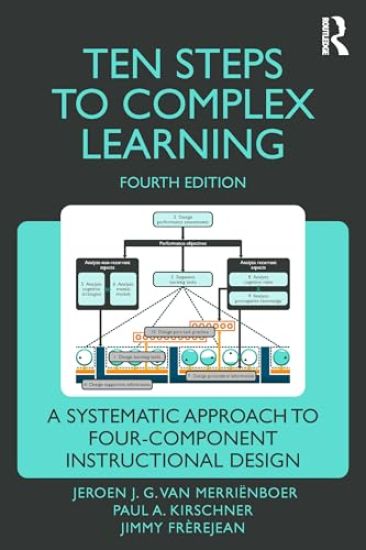
Ten Steps to Complex Learning
Jeroen J. G. van Merriënboer; Paul A. Kirschner; Jimmy Frèrejean
TAYLOR FRANCIS LTD
2024
nidottu
Ten Steps to Complex Learning presents a path from an educational problem to a solution in a way that students, design practitioners, and researchers can understand and easily use. Students in the fields of instructional design and the learning sciences can use this book to broaden their knowledge of the design of training programs for complex learning. Practitioners can use this book as a reference guide to support their design of courses, curricula, or environments for complex learning.Driven by the acclaimed Four-Component Instructional Design (4C/ID) model, this fourth edition of Ten Steps to Complex Learning is fully revised with the latest research, featuring over 50 new references. The entire book has been updated for clarity, incorporating new colorful graphics and diagrams, and the guiding example used throughout the book is replaced with a training blueprint for the complex skill of “producing video content.” The closing chapter explores the future development of the Ten Steps, discussing changes in teacher roles and the influence of artificial intelligence.

How Learning Happens introduces 28 giants of educational research and their findings on how we learn and what we need to learn effectively, efficiently, and enjoyably. Many of these works have inspired researchers and teachers all around the world and have left a mark on how we teach today. Exploring 28 key works on learning and teaching, chosen from the fields of educational psychology and cognitive psychology, the book offers a roadmap of the most important discoveries in how learning happens. Each chapter examines a different work and explains its significance before describing the research, its implications for practice, how it can be used in the classroom and the key takeaways for teachers. Clearly divided into six sections, the book covers: How the brain works and what this means for learning and teaching Prerequisites for learning How learning can be supported Teacher activities Learning in context Cautionary tales and the ten deadly sins of education. Written by two leading experts and illustrated by Oliver Caviglioli, this is essential reading for teachers wanting to fully engage with and understand educational research as well as undergraduate students in the fields of education, educational psychology and the learning sciences.
Learning and Development (L&D) programmes are too often based on fads, the latest trends or learning designers' personal preferences without critical evaluation. Evidence-Informed Learning Design allows learning professionals to move away from this type of approach by showing them how to assess and apply relevant scientific literature, learning science research and proven learning techniques to design their training in a way that will make a measurable difference to employee performance and overall business success. Packed with tips, tools and examples, Evidence-Informed Learning Design enables L&D and training professionals to save both time and money by ensuring that efforts are focused on designing learning that's proven to be effective. Covering techniques like interleaving and self-directed and self-regulated learning, as well as debunking myths and fallacies in the field, it covers how best to test, measure and reinforce learning in both online, offline and face-to-face scenarios. To ensure that employees develop the skills the business needs to succeed and that the L&D function is recognised as adding true organizational value, this book is essential reading for anyone responsible for designing learning.
Learning and Development (L&D) programmes are too often based on fads, the latest trends or learning designers' personal preferences without critical evaluation. Evidence-Informed Learning Design allows learning professionals to move away from this type of approach by showing them how to assess and apply relevant scientific literature, learning science research and proven learning techniques to design their training in a way that will make a measurable difference to employee performance and overall business success. Packed with tips, tools and examples, Evidence-Informed Learning Design enables L&D and training professionals to save both time and money by ensuring that efforts are focused on designing learning that's proven to be effective. Covering techniques like interleaving and self-directed and self-regulated learning, as well as debunking myths and fallacies in the field, it covers how best to test, measure and reinforce learning in both online, offline and face-to-face scenarios. To ensure that employees develop the skills the business needs to succeed and that the L&D function is recognised as adding true organizational value, this book is essential reading for anyone responsible for designing learning.

More Urban Myths About Learning and Education
Pedro De Bruyckere; Paul A. Kirschner; Casper Hulshof
CRC Press Inc
2019
nidottu
More Urban Myths About Learning and Education: Challenging Eduquacks, Extraordinary Claims, and Alternative Facts examines common beliefs about education and learning that are not supported by scientific evidence before using research to reveal the truth about each topic. The book comprises sections on educational approaches, curriculum, educational psychology, and educational policy, concluding with a critical look at evidence-based education itself. Does playing chess improve intelligence? Should tablets and keyboards replace handwriting? Is there any truth to the 10,000-hour rule for expertise? In an engaging, conversational style, authors Pedro De Bruyckere, Paul A. Kirschner, and Casper Hulshof tackle a set of pervasive myths, effectively separating fact from fiction in learning and education.

More Urban Myths About Learning and Education
Pedro De Bruyckere; Paul A. Kirschner; Casper Hulshof
CRC Press Inc
2019
sidottu
More Urban Myths About Learning and Education: Challenging Eduquacks, Extraordinary Claims, and Alternative Facts examines common beliefs about education and learning that are not supported by scientific evidence before using research to reveal the truth about each topic. The book comprises sections on educational approaches, curriculum, educational psychology, and educational policy, concluding with a critical look at evidence-based education itself. Does playing chess improve intelligence? Should tablets and keyboards replace handwriting? Is there any truth to the 10,000-hour rule for expertise? In an engaging, conversational style, authors Pedro De Bruyckere, Paul A. Kirschner, and Casper Hulshof tackle a set of pervasive myths, effectively separating fact from fiction in learning and education.
Urban Myths about Learning and Education
Pedro De Bruyckere; Paul A. Kirschner; Casper D. Hulshof
Academic Press Inc
2015
nidottu
Many things people commonly believe to be true about education are not supported by scientific evidence. Urban Myths about Learning and Education examines commonly held incorrect beliefs and then provides the truth of what research has shown. Each chapter examines a different myth, with sections on learning, the brain, technology, and educational policy. A final section discusses why these myths are so persistent. Written in an engaging style, the book separates fact from fiction regarding learning and education. Recognize any of these myths? People have different styles of learning Boys are naturally better at mathematics than girls We only use 10% of our brains The left half of the brain is analytical, the right half is creative Men have a different kind of brain from women We can learn while we are asleep Babies become smarter if they listen to classical music These myths and more are systematically debunked, with useful correct information about the topic in question.