Kirjojen hintavertailu. Mukana 12 390 323 kirjaa ja 12 kauppaa.

Kirjailija

Paul B. Stretesky

Kirjat ja teokset yhdessä paikassa: 12 kirjaa, julkaisuja vuosilta 2011-2025, suosituimpien joukossa Exploring Green Criminology. Vertaile teosten hintoja ja tarkista saatavuus suomalaisista kirjakaupoista.

12 kirjaa

Kirjojen julkaisuhaarukka 2011-2025.

Exploring Green Criminology

Exploring Green Criminology

Michael J. Lynch; Paul B. Stretesky

Routledge
2014
nidottu
Few criminologists have drawn attention to the fact that widespread and significant forms of harm such as green or environmental crimes are neglected by criminology. Others have suggested that green crimes present the most important challenge to criminology as a discipline. This book argues that criminology needs to take green harms more seriously and to be revolutionized so that it forms part of the solution to the large environmental problems currently faced across the world. It asks how criminology should be redesigned to consider green/environmental harm as a key area of study in an era where destruction of the earth and the world’s ecosystem is a major concern and examines why this has remained unaccomplished so far. The chapters in this book apply an environmental frame of reference underlying a green approach to issues which can be addressed from within criminology and which can encourage criminologists and environmentalists to respond and react differently to environmental crime.
Neoliberalism and Insecurity in Advanced Capitalism

Neoliberalism and Insecurity in Advanced Capitalism

Michael A. Long; Andrew S. Fullerton; Paul B. Stretesky

TAYLOR FRANCIS LTD
2025
sidottu
This book examines the relationship between neoliberalism and insecurity, beginning with the post-World War II period and continuing up through the present. Neoliberalism – the dominant political economic perspective that elevates competition above all else at both the structural and individual levels – has increased the amount of insecurity (e.g., food, energy, job) across the world. It provides a theoretical and empirical analysis of how and why neoliberalism and insecurity have become intertwined over the last half century.The book takes a novel approach to the study of neoliberalism, insecurity, and their intersection. First, in addition to examining specific types of insecurity, the overall concept of insecurity is defined and theorized as a fundamental part of neoliberal capitalism. Second, to help bypass the structural versus individual binary that has come to characterize much of the neoliberalism literature, a field-theoretic framework, heavily influenced by the work of Pierre Bourdieu, is employed.As such, it will be of great interest for researchers in neoliberalism, insecurity, and Bourdieu’s theory of practice, including advanced undergraduate students and graduate scholars from sociology, anthropology, geography, political science, and public health.
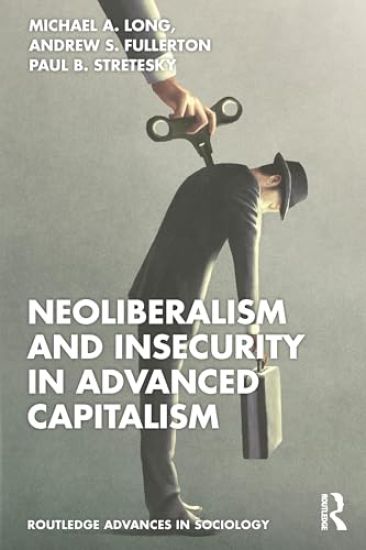
Neoliberalism and Insecurity in Advanced Capitalism

Neoliberalism and Insecurity in Advanced Capitalism

Michael A. Long; Andrew S. Fullerton; Paul B. Stretesky

TAYLOR FRANCIS LTD
2025
nidottu
This book examines the relationship between neoliberalism and insecurity, beginning with the post-World War II period and continuing up through the present. Neoliberalism – the dominant political economic perspective that elevates competition above all else at both the structural and individual levels – has increased the amount of insecurity (e.g., food, energy, job) across the world. It provides a theoretical and empirical analysis of how and why neoliberalism and insecurity have become intertwined over the last half century.The book takes a novel approach to the study of neoliberalism, insecurity, and their intersection. First, in addition to examining specific types of insecurity, the overall concept of insecurity is defined and theorized as a fundamental part of neoliberal capitalism. Second, to help bypass the structural versus individual binary that has come to characterize much of the neoliberalism literature, a field-theoretic framework, heavily influenced by the work of Pierre Bourdieu, is employed.As such, it will be of great interest for researchers in neoliberalism, insecurity, and Bourdieu’s theory of practice, including advanced undergraduate students and graduate scholars from sociology, anthropology, geography, political science, and public health.
Applying Benford's Law for Assessing the Validity of Social Science Data

Applying Benford's Law for Assessing the Validity of Social Science Data

Michael A. Long; Paul B. Stretesky; Kenneth J. Berry; Janis E. Johnston; Michael J. Lynch

Cambridge University Press
2023
sidottu
Benford's Law is a probability distribution for the likelihood of the leading digit in a set of numbers. This book seeks to improve and systematize the use of Benford's Law in the social sciences to assess the validity of self-reported data. The authors first introduce a new measure of conformity to the Benford distribution that is created using permutation statistical methods and employs the concept of statistical agreement. In a switch from a typical Benford application, this book moves away from using Benford's Law to test whether the data conform to the Benford distribution, to using it to draw conclusions about the validity of the data. The concept of 'Benford validity' is developed, which indicates whether a dataset is valid based on comparisons with the Benford distribution and, in relation to this, diagnostic procedure that assesses the impact of not having Benford validity on data analysis is devised.
Applying Benford's Law for Assessing the Validity of Social Science Data

Applying Benford's Law for Assessing the Validity of Social Science Data

Michael A. Long; Paul B. Stretesky; Kenneth J. Berry; Janis E. Johnston; Michael J. Lynch

Cambridge University Press
2023
pokkari
Benford's Law is a probability distribution for the likelihood of the leading digit in a set of numbers. This book seeks to improve and systematize the use of Benford's Law in the social sciences to assess the validity of self-reported data. The authors first introduce a new measure of conformity to the Benford distribution that is created using permutation statistical methods and employs the concept of statistical agreement. In a switch from a typical Benford application, this book moves away from using Benford's Law to test whether the data conform to the Benford distribution, to using it to draw conclusions about the validity of the data. The concept of 'Benford validity' is developed, which indicates whether a dataset is valid based on comparisons with the Benford distribution and, in relation to this, diagnostic procedure that assesses the impact of not having Benford validity on data analysis is devised.
Holiday Hunger in the UK

Holiday Hunger in the UK

Michael A. Long; Margaret Anne Defeyter; Paul B. Stretesky

TAYLOR FRANCIS LTD
2023
nidottu
This timely and much-needed book focuses on the phenomenon often referred to as "holiday hunger" in the United Kingdom. The book begins by outlining the history and scope of holiday hunger – the condition that occurs when a child’s household is, or will become, food insecure during the summer holidays. The decline of the UK welfare state and the rise of neoliberalism have created a situation where up to three million children in the UK face food insecurity during the summer months when there are extra financial pressures on the working poor and when free school meals are not available. This book details the level of childhood and household food insecurity in the UK and describes one of the main responses to holiday hunger – holiday clubs. These clubs are locally organised and funded and provide a place for children to go to eat nutritious meals for free during the school holidays. Highlighting the benefits of holiday clubs that often extend beyond food provision, this book also discusses the challenges that they face now and in the future. The book concludes with recommendations for food insecurity policy and the role of government in fighting holiday hunger. This book will be of great interest to students and scholars of food and nutrition security, social policy and public health.
Green Criminology and Green Theories of Justice

Green Criminology and Green Theories of Justice

Michael J. Lynch; Michael A. Long; Paul B. Stretesky

Springer Nature Switzerland AG
2021
nidottu
This book offers an alternative analysis of the various theories and dimensions of green and environmental justice which are rooted in political economy. Much green criminological literature sidelines political economic theoretical insights and therefore with this work the authors enrich the field by vigorously exploring such perspectives. It engages with a number of studies relevant to a political economic approach to justice in order to make two key arguments: that capitalism has produced profound ecological injustices and that the concept of ecological justice (human and ecological rights) itself needs critiquing. Green Criminology and Green Theories of Justice is a timely text which urges the field to revisit its radical roots in social justice while broadening its disciplinary horizons to include a meaningful analysis of political economy and its role in producing and responding to environmental harm andinjustice.
Holiday Hunger in the UK

Holiday Hunger in the UK

Michael A. Long; Margaret Anne Defeyter; Paul B. Stretesky

Routledge
2021
sidottu
This timely and much-needed book focuses on the phenomenon often referred to as "holiday hunger" in the United Kingdom. The book begins by outlining the history and scope of holiday hunger – the condition that occurs when a child’s household is, or will become, food insecure during the summer holidays. The decline of the UK welfare state and the rise of neoliberalism have created a situation where up to three million children in the UK face food insecurity during the summer months when there are extra financial pressures on the working poor and when free school meals are not available. This book details the level of childhood and household food insecurity in the UK and describes one of the main responses to holiday hunger – holiday clubs. These clubs are locally organised and funded and provide a place for children to go to eat nutritious meals for free during the school holidays. Highlighting the benefits of holiday clubs that often extend beyond food provision, this book also discusses the challenges that they face now and in the future. The book concludes with recommendations for food insecurity policy and the role of government in fighting holiday hunger. This book will be of great interest to students and scholars of food and nutrition security, social policy and public health.
Green Criminology and Green Theories of Justice

Green Criminology and Green Theories of Justice

Michael J. Lynch; Michael A. Long; Paul B. Stretesky

Springer Nature Switzerland AG
2020
sidottu
This book offers an alternative analysis of the various theories and dimensions of green and environmental justice which are rooted in political economy. Much green criminological literature sidelines political economic theoretical insights and therefore with this work the authors enrich the field by vigorously exploring such perspectives. It engages with a number of studies relevant to a political economic approach to justice in order to make two key arguments: that capitalism has produced profound ecological injustices and that the concept of ecological justice (human and ecological rights) itself needs critiquing. Green Criminology and Green Theories of Justice is a timely text which urges the field to revisit its radical roots in social justice while broadening its disciplinary horizons to include a meaningful analysis of political economy and its role in producing and responding to environmental harm andinjustice.
Green Criminology

Green Criminology

Michael J. Lynch; Michael A. Long; Paul B. Stretesky; Kimberly L. Barrett

University of California Press
2017
pokkari
This groundbreaking text provides an overview and assessment of green criminology as well as a call to action. Green Criminology draws attention to the ways in which the political-economic organization of capitalism causes ecological destruction and disorganization. Focusing on real-world issues of green crime and justice, chapters include political-economic examinations of ecological withdrawals, ecological additions, toxic towns, wildlife poaching and trafficking, environmental justice, environmental laws, and nongovernment environmental organizations. The book also presents an unintimidating introduction to research from the physical sciences on issues such as climate change, pollution levels, and the ecological footprint of humans, providing a truly interdisciplinary foundation for green criminological analysis. To help students succeed in the course-and to encourage them to see themselves as future green criminology researchers-end-of-chapter materials include: *Questions and Activities for Students that review topics students should be able to conceptualize and address*Lessons for Researchers that provide ideas about additional research that might be worthwhile to undertake
Exploring Green Criminology

Exploring Green Criminology

Michael J. Lynch; Paul B. Stretesky

Routledge
2014
sidottu
Few criminologists have drawn attention to the fact that widespread and significant forms of harm such as green or environmental crimes are neglected by criminology. Others have suggested that green crimes present the most important challenge to criminology as a discipline. This book argues that criminology needs to take green harms more seriously and to be revolutionized so that it forms part of the solution to the large environmental problems currently faced across the world. It asks how criminology should be redesigned to consider green/environmental harm as a key area of study in an era where destruction of the earth and the world’s ecosystem is a major concern and examines why this has remained unaccomplished so far. The chapters in this book apply an environmental frame of reference underlying a green approach to issues which can be addressed from within criminology and which can encourage criminologists and environmentalists to respond and react differently to environmental crime.
Radical and Marxist Theories of Crime

Radical and Marxist Theories of Crime

Paul B. Stretesky

Ashgate Publishing Limited
2011
sidottu
The essays selected for this volume show how radical and Marxist criminology has established itself as an influential critique since it emerged in the late 1960s. Unlike orthodox criminology which emphasizes individual level explanations of criminal behavior, radical and Marxist criminology emphasizes power inequality and structures, especially those related to class, as key factors in crime, law and justice. This collection of essays draws attention to the way in which structural forces shape and influence both individual and institutional (for example, governmental) behavior; highlights neglected crime (corporate, governmental, state-corporate and environmental) which causes more extensive damage than the street crimes examined by orthodox criminology; and discusses the ways in which law and criminal justice processes reinforce power structures and contribute to class control.