Kirjojen hintavertailu. Mukana 12 390 323 kirjaa ja 12 kauppaa.

Kirjailija

Paul Boreham

Kirjat ja teokset yhdessä paikassa: 4 kirjaa, julkaisuja vuosilta 2007-2014, suosituimpien joukossa New Technology @ Work. Vertaile teosten hintoja ja tarkista saatavuus suomalaisista kirjakaupoista.

4 kirjaa

Kirjojen julkaisuhaarukka 2007-2014.

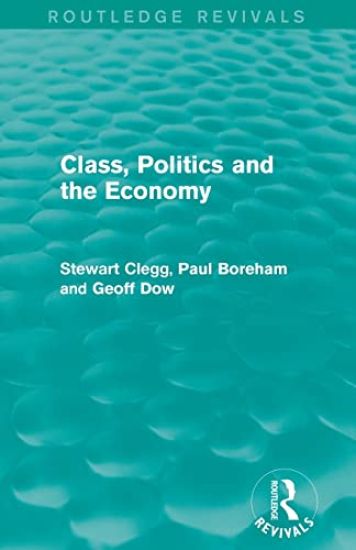
Class, Politics and the Economy (Routledge Revivals)

Class, Politics and the Economy (Routledge Revivals)

Stewart Clegg; Paul Boreham; Geoff Dow

Routledge
2014
nidottu
This study, first published in 1986, provides a systematic account of the processes and structure of class formation in the major advanced capitalist societies. The focus is on the organizational mechanisms of class cohesion and division, theoretically deriving from a neo-Marxian perspective. Chapters consider the organization and structure of the ‘corporate ruling class’, the middle class and the working class, and are brought together in an overarching analysis of the organization of class in relation to the state and the economy. This title will be of particular interest to students researching the impact of recession on societal structure and the processes of political class struggle, as well as those with a more general interest in the socio-economic theories of Marx, Engels and Weber.

Class, Politics and the Economy (Routledge Revivals)

Class, Politics and the Economy (Routledge Revivals)

Stewart Clegg; Paul Boreham; Geoff Dow

Routledge
2013
sidottu
This study, first published in 1986, provides a systematic account of the processes and structure of class formation in the major advanced capitalist societies. The focus is on the organizational mechanisms of class cohesion and division, theoretically deriving from a neo-Marxian perspective. Chapters consider the organization and structure of the ‘corporate ruling class’, the middle class and the working class, and are brought together in an overarching analysis of the organization of class in relation to the state and the economy. This title will be of particular interest to students researching the impact of recession on societal structure and the processes of political class struggle, as well as those with a more general interest in the socio-economic theories of Marx, Engels and Weber.

New Technology @ Work

New Technology @ Work

Paul Boreham; Rachel Parker; Paul Thompson; Richard Hall

Routledge
2007
sidottu
New computer and communications technologies have acted as the catalyst for a revolution in the way goods are produced and services delivered, leading to profound changes in the way work is organized and the way jobs are designed. This important book examines the nature, setting and impact of new technologies on work, organization and management. Conventional debates about new technology often invoke optimistic visions of enhanced democracy, rising skills and economic abundance; others predict darker scenarios such as the destruction of jobs through labour-eliminating devices. This book proposes an alternative perspective, arguing that technology can be powerful, but in and of itself has no independent causal powers. It considers the impact of new technologies on manufacturing, clerical, administrative and call centre employment, in both managerial and professional arenas, and introduces the growing phenomena of telework. The book also assesses the important political and economic forces that restrict or facilitate the flow of new technologies on national and global levels. New Technology @ Work is an illuminating and thought-provoking text that will prove invaluable to all serious students of business, management and technology.
New Technology @ Work

New Technology @ Work

Paul Boreham; Rachel Parker; Paul Thompson; Richard Hall

Routledge
2007
nidottu
New computer and communications technologies have acted as the catalyst for a revolution in the way goods are produced and services delivered, leading to profound changes in the way work is organized and the way jobs are designed. This important book examines the nature, setting and impact of new technologies on work, organization and management. Conventional debates about new technology often invoke optimistic visions of enhanced democracy, rising skills and economic abundance; others predict darker scenarios such as the destruction of jobs through labour-eliminating devices. This book proposes an alternative perspective, arguing that technology can be powerful, but in and of itself has no independent causal powers. It considers the impact of new technologies on manufacturing, clerical, administrative and call centre employment, in both managerial and professional arenas, and introduces the growing phenomena of telework. The book also assesses the important political and economic forces that restrict or facilitate the flow of new technologies on national and global levels. New Technology @ Work is an illuminating and thought-provoking text that will prove invaluable to all serious students of business, management and technology.