Kirjojen hintavertailu. Mukana 12 459 402 kirjaa ja 12 kauppaa.

Kirjailija

Paul C. Adams

Kirjat ja teokset yhdessä paikassa: 10 kirjaa, julkaisuja vuosilta 2005-2020, suosituimpien joukossa The Routledge Research Companion to Media Geography. Vertaile teosten hintoja ja tarkista saatavuus suomalaisista kirjakaupoista.

10 kirjaa

Kirjojen julkaisuhaarukka 2005-2020.

The Routledge Research Companion to Media Geography

The Routledge Research Companion to Media Geography

Paul C. Adams; Jim Craine

Routledge
2018
nidottu
This Companion provides an authoritative source for scholars and students of the nascent field of media geography. While it has deep roots in the wider discipline, the consolidation of media geography has started only in the past decade, with the creation of media geography’s first dedicated journal, Aether, as well as the publication of the sub-discipline’s first textbook. However, at present there is no other work which provides a comprehensive overview and grounding. By indicating the sub-discipline’s evolution and hinting at its future, this volume not only serves to encapsulate what geographers have learned about media but also will help to set the agenda for expanding this type of interdisciplinary exploration. The contributors-leading scholars in this field, including Stuart Aitken, Deborah Dixon, Derek McCormack, Barney Warf, and Matthew Zook-not only review the existing literature within the remit of their chapters, but also articulate arguments about where the future might take media geography scholarship. The volume is not simply a collection of individual offerings, but has afforded an opportunity to exchange ideas about media geography, with contributors making connections between chapters and developing common themes.
Communications/Media/Geographies

Communications/Media/Geographies

Paul C. Adams; Julie Cupples; Kevin Glynn; André Jansson; Shaun Moores

Routledge
2016
sidottu
Although there are human geographers who have previously written on matters of media and communication, and those in media and communication studies who have previously written on geographical issues, this is the first book-length dialogue in which experienced theorists and researchers from these different fields address each other directly and engage in conversation across traditional academic boundaries. The result is a compelling discussion, with the authors setting out statements of their positions before responding to the arguments made by others.One significant aspect of this discussion is a spirited debate about the sort of interdisciplinary area that might emerge as a focus for future work. Does the already-established idea of communication geography offer the best way forward? If so, what would applied or critical forms of communication geography be concerned to do? Could communication geography benefit from the sorts of conjunctural analysis that have been developed in contemporary cultural studies? Might a further way forward be to imagine an interdisciplinary field of everyday-life studies, which would draw critically on non-representational theories of practice and movement?Readers of Communications/Media/Geographies are invited to join the debate, thinking through such questions for themselves, and the themes that are explored in this book (for example, of space, place, meaning, power, and ethics) will be of interest not only to academics in human geography and in media and communication studies, but also to a wider range of scholars from across the humanities and social sciences.
The Routledge Research Companion to Media Geography

The Routledge Research Companion to Media Geography

Paul C. Adams; Jim Craine

Ashgate Publishing Limited
2014
sidottu
This Companion provides an authoritative source for scholars and students of the nascent field of media geography. While it has deep roots in the wider discipline, the consolidation of media geography has started only in the past decade, with the creation of media geography’s first dedicated journal, Aether, as well as the publication of the sub-discipline’s first textbook. However, at present there is no other work which provides a comprehensive overview and grounding. By indicating the sub-discipline’s evolution and hinting at its future, this volume not only serves to encapsulate what geographers have learned about media but also will help to set the agenda for expanding this type of interdisciplinary exploration. The contributors-leading scholars in this field, including Stuart Aitken, Deborah Dixon, Derek McCormack, Barney Warf, and Matthew Zook-not only review the existing literature within the remit of their chapters, but also articulate arguments about where the future might take media geography scholarship. The volume is not simply a collection of individual offerings, but has afforded an opportunity to exchange ideas about media geography, with contributors making connections between chapters and developing common themes.
Communications/Media/Geographies

Communications/Media/Geographies

Paul C. Adams; Julie Cupples; Kevin Glynn; André Jansson; Shaun Moores

Routledge
2018
nidottu
Although there are human geographers who have previously written on matters of media and communication, and those in media and communication studies who have previously written on geographical issues, this is the first book-length dialogue in which experienced theorists and researchers from these different fields address each other directly and engage in conversation across traditional academic boundaries. The result is a compelling discussion, with the authors setting out statements of their positions before responding to the arguments made by others.One significant aspect of this discussion is a spirited debate about the sort of interdisciplinary area that might emerge as a focus for future work. Does the already-established idea of communication geography offer the best way forward? If so, what would applied or critical forms of communication geography be concerned to do? Could communication geography benefit from the sorts of conjunctural analysis that have been developed in contemporary cultural studies? Might a further way forward be to imagine an interdisciplinary field of everyday-life studies, which would draw critically on non-representational theories of practice and movement?Readers of Communications/Media/Geographies are invited to join the debate, thinking through such questions for themselves, and the themes that are explored in this book (for example, of space, place, meaning, power, and ethics) will be of interest not only to academics in human geography and in media and communication studies, but also to a wider range of scholars from across the humanities and social sciences.
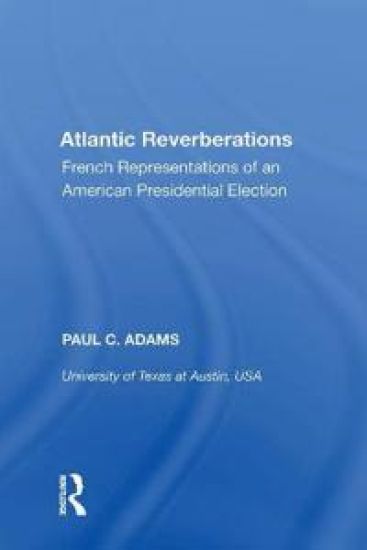
Atlantic Reverberations

Atlantic Reverberations

Paul C. Adams

Routledge
2020
nidottu
The 2004 US election provided French citizens and their media with a springboard for re-conceiving 'self' and 'other'. Given its prominent opposition to recent US foreign policy such as the invasion of Iraq, a volley of insults and caustic remarks reverberated between France and the US. French observers linked the Bush administration's policies to particular groups and regions within the US, to a democratic deficit, to a perceived threat of US collapse and to the need for a stronger Europe. By examining how the French media - newspapers, television, the internet and scholarly research - represented the election from a critical geopolitical perspective, this book provides the first major in-depth study of views of the US in contemporary foreign media.
A Guide to Luminous Places

A Guide to Luminous Places

Paul C. Adams

Independently Published
2018
nidottu
Photography BLACK AND WHITE edition: Luminous Places is a guide for personal development that can lead to finding locations, both geographical and internal, where various kinds of luminosity predominate. This is a special volume of practical information, short stories, autobiographical narratives and wilderness landscape photography. Selections of source materials and inspiration came from my website: Luminousplaces.com. This book offers much more, with new photographs, updated and edited selections, including a table of contents, reference notes and a bibliography. Today people do not have time to read as much as they would like, yet want to know, as soon as possible about useful ideas or tips. For this reason, important information is listed by titles and subjects that can be accessed directly from the table of contents. This book meets the need to find information that is to the point, easy to read, and saves time. A Bibliography and End Notes has been included for those who would like to read more about the many subjects referred to. This edition is specially designed for Kindle readers, which can also be used with Kindle software on tablets and computers. Part I Inner Luminosity covers subjects including developing personal sensitivity, food and diet, breathing and air energy, mental concentration, lucid dreaming, vivid imagination, improved memory and extraordinary states of consciousness. Part II Outer Luminosity is about personal vitality, luminous people, home improvements, high metabolism, walking, drumming, lightning, solar activity, the geomagnetic field, and much more. In addition, I have included auto-biographical narratives to provide entertaining stories relevant to the subjects discussed in both part I and II. These stories are about my inner journeys to learn and explore via hypnosis, yoga, shamanism, drumming and dreaming. Subjective experience is the basis to perceive and locate luminous places. Methods to facilitate a calm and clear inner state of awareness, essential for differentiating a very wide range of subtle feelings, are included in this guide. It takes dedicated practice to learn how to see with feeling, and in the beginning, it is difficult recognizing and distinguishing between qualities within the spectrum of invisible luminosity. Powerful spiritual and religious experiences are associated with some luminous places. Excellent examples are Jesus and the transfiguration on Mount Hermon and Moses receiving the ten commandments on Mount Sinai. Also, Mt. Shasta in California and Mt. Kailash in Tibet have facilitated spiritual experiences and revelatory insights for many people. Worldwide there exist many undiscovered luminous places capable of enhancing spiritual or religious experiences to various degrees of intensity. These blessed natural locations can open inner doors, clarify the heart, mind and soul. I hope this guide will help people find luminous places everywhere, leading to inner luminosity, insight and wellbeing. About the Author: Paul Adams has worked in electronics technology, as an associate professor, instructor at seminars and lectures, as a percussionist, a wilderness and tour guide, an art collector-salesman; he has also worked in self-storage, and as a sales associate in grocery and hardware. During his teenage years, he designed and built ham radio transmitters, receivers, and set up antenna systems used for worldwide amateur radio communications. In the field of electronic air purification technology, age 30, he received a patent, for a unique air purifier-ionizer design: operational prototypes of this device gained endorsements from distinguished professionals. In his youth, Paul was a falconer, hiking in wilderness areas searching for falcons and hawks. Prior to this, he was a volunteer for a series of hypnosis experiments at Stanford University.
Atlantic Reverberations

Atlantic Reverberations

Paul C. Adams

CRC Press Inc
2017
sidottu
The 2004 US election provided French citizens and their media with a springboard for re-conceiving 'self' and 'other'. Given its prominent opposition to recent US foreign policy such as the invasion of Iraq, a volley of insults and caustic remarks reverberated between France and the US. French observers linked the Bush administration's policies to particular groups and regions within the US, to a democratic deficit, to a perceived threat of US collapse and to the need for a stronger Europe. By examining how the French media - newspapers, television, the internet and scholarly research - represented the election from a critical geopolitical perspective, this book provides the first major in-depth study of views of the US in contemporary foreign media.
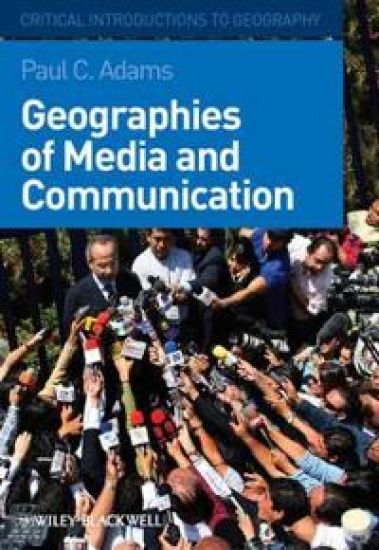
Geographies of Media and Communication

Geographies of Media and Communication

Paul C. Adams

Wiley-Blackwell (an imprint of John Wiley Sons Ltd)
2009
sidottu
Geographies of Media and Communication From the invention of the telegraph to the emergence of the Internet, communications technologies have transformed the ways that people and places relate to each other. Geographies of Media and Communication is the first textbook to treat all aspects of geography’s variegated encounter with communication. Connecting geographical ideas with communication theories such as intertextuality, audience-centered theory, and semiotics, Paul C. Adams explores media representations of places, the spatial diffusion of communication technologies, and the power of communication technologies to transform places, and to dictate who does and does not belong in them.
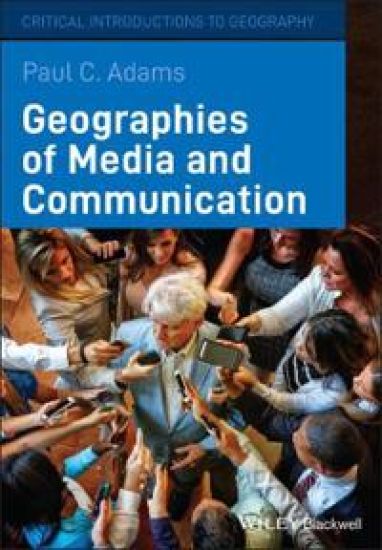
Geographies of Media and Communication

Geographies of Media and Communication

Paul C. Adams

Wiley-Blackwell (an imprint of John Wiley Sons Ltd)
2009
nidottu
Geographies of Media and Communication From the invention of the telegraph to the emergence of the Internet, communications technologies have transformed the ways that people and places relate to each other. Geographies of Media and Communication is the first textbook to treat all aspects of geography’s variegated encounter with communication. Connecting geographical ideas with communication theories such as intertextuality, audience-centered theory, and semiotics, Paul C. Adams explores media representations of places, the spatial diffusion of communication technologies, and the power of communication technologies to transform places, and to dictate who does and does not belong in them.
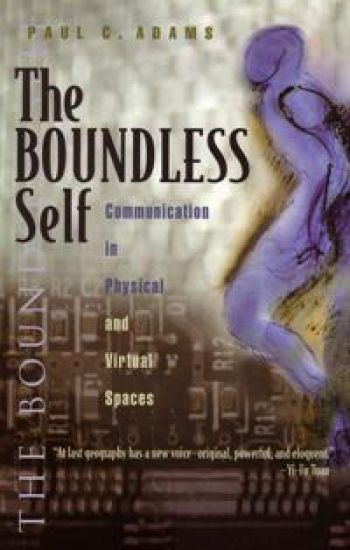
The Boundless Self

The Boundless Self

Paul C. Adams

Syracuse University Press
2005
sidottu
Using the body as an axis for geographical theory, this book argues that communication empowers self to constantly transcend its physical limits. It urges complete review of personal borders in space and time based on symbols, signs and signals that redefine ties to the tangible world, i.e., ""Dear John"" letters, layout of furniture in rooms, or chronic illness. Paul C. Adams shows how vehicular transit has altered traditional modalities like walking or biking while navigation of space and virtual space has led to ""boundary blurring."" He covers transforming moments in communication from the rise of writing to invention of the printing press, telephone, and electronic media. To better understand human geography, he also plumbs the relation of space and time to notions of romance, identity, and meaning. Citing geographers throughout the ages and the effects of mercantile, industrial, and current global economies, The Boundless Self is sure to provoke thought and theory among geographers, communicators, and scholars alike.