Kirjojen hintavertailu. Mukana 12 595 353 kirjaa ja 12 kauppaa.

Kirjailija

Paul E. Peterson

Kirjat ja teokset yhdessä paikassa: 21 kirjaa, julkaisuja vuosilta 1981-2025, suosituimpien joukossa New American Democracy, The, Alternate Edition, Unbound (for Books a la Carte Plus). Vertaile teosten hintoja ja tarkista saatavuus suomalaisista kirjakaupoista.

Mukana myös kirjoitusasut: Paul E Peterson

21 kirjaa

Kirjojen julkaisuhaarukka 1981-2025.

Commodity Derivatives

Commodity Derivatives

Paul E. Peterson

TAYLOR FRANCIS LTD
2025
sidottu
Commodity Derivatives: A Guide for Future Practitioners describes the origins and uses of these important markets. Commodities are often used as inputs in the production of other products, and commodity prices are notoriously volatile. Derivatives include forwards, futures, options, and swaps; all are types of contracts that allow buyers and sellers to establish the price at one time and exchange the commodity at another.This straightforward book provides the necessary theoretical background and covers the practical applications that employers expect new hires to understand. Detailed examples are provided for using derivatives to manage prices by hedging, while strategies are presented for speculating on derivatives. This book also examines the impact of basis behavior on hedging results, and shows how the basis can be bought and sold like a commodity. Examples are coordinated across chapters using consistent prices and formats, and industry terminology is used so students can become familiar with standard terms and concepts. This second edition has been fully revised, and includes new chapters on futures pricing and risk measures for commodity markets, as well as expanded material on commodity swaps.A test bank of questions and problems also accompanies this edition, which instructors can use for homework assignments, review purposes, or exams. This book is essential reading for students planning careers as commodity merchandisers, traders, and related industry positions.
Commodity Derivatives

Commodity Derivatives

Paul E. Peterson

TAYLOR FRANCIS LTD
2025
nidottu
Commodity Derivatives: A Guide for Future Practitioners describes the origins and uses of these important markets. Commodities are often used as inputs in the production of other products, and commodity prices are notoriously volatile. Derivatives include forwards, futures, options, and swaps; all are types of contracts that allow buyers and sellers to establish the price at one time and exchange the commodity at another.This straightforward book provides the necessary theoretical background and covers the practical applications that employers expect new hires to understand. Detailed examples are provided for using derivatives to manage prices by hedging, while strategies are presented for speculating on derivatives. This book also examines the impact of basis behavior on hedging results, and shows how the basis can be bought and sold like a commodity. Examples are coordinated across chapters using consistent prices and formats, and industry terminology is used so students can become familiar with standard terms and concepts. This second edition has been fully revised, and includes new chapters on futures pricing and risk measures for commodity markets, as well as expanded material on commodity swaps.A test bank of questions and problems also accompanies this edition, which instructors can use for homework assignments, review purposes, or exams. This book is essential reading for students planning careers as commodity merchandisers, traders, and related industry positions.
Commodity Derivatives

Commodity Derivatives

Paul E. Peterson

Routledge
2018
sidottu
Commodity Derivatives: A Guide for Future Practitioners describes the origins and uses of these important markets. Commodities are often used as inputs in the production of other products, and commodity prices are notoriously volatile. Derivatives include forwards, futures, options, and swaps; all are types of contracts that allow buyers and sellers to establish the price at one time and exchange the commodity at another.These contracts can be used to establish a price now for a purchase or sale that will occur later, or establish a price later for a purchase or sale now. This book provides detailed examples for using derivatives to manage prices by hedging, using futures, options, and swaps. It also presents strategies for using derivatives to speculate on price levels, relationships, volatility, and the passage of time. Finally, because the relationship between a commodity price and a derivative price is not constant, this book examines the impact of basis behaviour on hedging results, and shows how the basis can be bought and sold like a commodity.The material in this book is based on the author’s 30-year career in commodity derivatives, and is essential reading for students planning careers as commodity merchandisers, traders, and related industry positions. Not only does it provide them with the necessary theoretical background, it also covers the practical applications that employers expect new hires to understand. Examples are coordinated across chapters using consistent prices and formats, and industry terminology is used so students can become familiar with standard terms and concepts. This book is organized into 18 chapters, corresponding to approximately one chapter per week for courses on the semester system.

Commodity Derivatives

Commodity Derivatives

Paul E. Peterson

Routledge
2018
nidottu
Commodity Derivatives: A Guide for Future Practitioners describes the origins and uses of these important markets. Commodities are often used as inputs in the production of other products, and commodity prices are notoriously volatile. Derivatives include forwards, futures, options, and swaps; all are types of contracts that allow buyers and sellers to establish the price at one time and exchange the commodity at another.These contracts can be used to establish a price now for a purchase or sale that will occur later, or establish a price later for a purchase or sale now. This book provides detailed examples for using derivatives to manage prices by hedging, using futures, options, and swaps. It also presents strategies for using derivatives to speculate on price levels, relationships, volatility, and the passage of time. Finally, because the relationship between a commodity price and a derivative price is not constant, this book examines the impact of basis behaviour on hedging results, and shows how the basis can be bought and sold like a commodity.The material in this book is based on the author’s 30-year career in commodity derivatives, and is essential reading for students planning careers as commodity merchandisers, traders, and related industry positions. Not only does it provide them with the necessary theoretical background, it also covers the practical applications that employers expect new hires to understand. Examples are coordinated across chapters using consistent prices and formats, and industry terminology is used so students can become familiar with standard terms and concepts. This book is organized into 18 chapters, corresponding to approximately one chapter per week for courses on the semester system.

Teachers versus the Public

Teachers versus the Public

Paul E. Peterson; Michael Henderson; Martin R. West

Brookings Institution
2014
nidottu
"A comprehensive exploration of 21st Century school politics, Teachers versus the Public offers the first comparison of the education policy views of both teachers and the public as a whole, and reveals a deep, broad divide between the opinions held by citizens and those who teach in the public schools. Among the findings:• Divisions between teachers and the public are wider and deeper than differences between other groups often thought to contest school policy, such as Republicans and Democrats, the young and the old, the rich and the poor, or African Americans and whites.• The teacher-public gap is widest on such issues as merit pay, teacher tenure reform, impact of teacher unions, school vouchers, charter schools, and requirements to test students annually.• Public support for school vouchers for all students, charter schools, and parent trigger laws increases sharply when people are informed of the national ranking of student performance in their local school district.• Public willingness to give local schools high marks, its readiness to support higher spending levels, and its support for teacher unions all decline when the public learns the national ranking of their local schools.• On most issues, teacher opinion does not change in response to new information nearly as much as it does for the public as a whole. In fact, the gap between what teachers and the public think about school reform grows even wider when both teachers and the public are given more information about current school performance, current expenditure levels, and current teacher pay.The book provides the first experimental study of public and teacher opinion. Using a recently developed research strategy, the authors ask differently worded questions about the same topic to randomly chosen segments of representative groups of citizens. This approach allows them to identify the impact on public opinion of new information on issues such as student performance and school expenditures in each respondent's community.The changes in public opinion when citizens receive information about school performance are largest in districts that perform below the national average. Altogether, the results indicate that support for many school reforms would increase if common core state standards were established and implemented in such a way as to inform the public about the quality of their local schools. These and many other findings illuminate the distance between teacher opinions and those of the public at large.About the Research: In partnership with the Harvard Program on Education Policy and Governance and the journal, Education Next, authors Paul E. Peterson, Martin West and Michael Henderson surveyed nationally representative samples of teachers and the public as a whole annually between 2007 and 2013."
Endangering Prosperity

Endangering Prosperity

Eric A. Hanushek; Paul E. Peterson; Ludger Woessmann

Brookings Institution
2013
nidottu
"The relative deficiencies of U.S. public schools are a serious concern to parents and policymakers. But they should be of concern to all Americans, as a globalizing world introduces new competition for talent, markets, capital, and opportunity. In Endangering Prosperity, a trio of experts on international education policy compares the performance of American schools against that of other nations. The net result is a mixed but largely disappointing picture that clearly shows where improvement is most needed. The authors' objective is not to explain the deep causes of past failures but to document how dramatically the U.S. school system has failed its students and its citizens. It is a wake-up call for structural reform. To move forward to a different and better future requires that we understand just how serious a situation America faces today.For example, the authors consider the Programme for International Student Assessment (PISA), an international mathematics examination. America is stuck in the middle of average scores, barely beating out European countries whose national economies are in the red zone. U.S. performance as measured against stronger economies is even weaker—in total, 32 nations outperformed the United States. The authors also delve into comparative reading scores. A mere 31 percent of U.S. students in the class of 2011 could perform at the ""proficient"" level as measured by the National Assessment of Educational Progress (NAEP) program, compared with South Korea's result of 47 percent. And while some observers may downplay the significance of cross-globe comparisons, they should note that Canadian students are dramatically outpacing their U.S. counterparts as well.Clearly something is wrong with this picture, and this book clearly explicates the costs of inaction. The time for incremental tweaking the system is long past—wider, deeper, and more courageous steps are needed, as this book amply demonstrates with accessible prose, supported with hard data that simply cannot be ignored."
Saving Schools

Saving Schools

Paul E. Peterson

The Belknap Press
2011
nidottu
Saving Schools traces the story of the rise, decline, and potential resurrection of American public schools through the lives and ideas of six mission-driven reformers: Horace Mann, John Dewey, Martin Luther King Jr., Albert Shanker, William Bennett, and James Coleman. Yet schools did not become the efficient, egalitarian, and high-quality educational institutions these reformers envisioned. Indeed, the unintended consequences of their legacies shaped today’s flawed educational system, in which political control of stagnant American schools has shifted away from families and communities to larger, more centralized entities—initially to bigger districts and eventually to control by states, courts, and the federal government.Peterson’s tales help to explain how nation building, progressive education, the civil rights movement, unionization, legalization, special education, bilingual teaching, accountability, vouchers, charters, and homeschooling have, each in a different way, set the stage for a new era in American education.Now, under the impact of rising cost, coupled with the possibilities unleashed by technological innovation, schooling may be transformed through virtual learning. The result could be a personalized, customized system of education in which families have greater choice and control over their children’s education than at any time since our nation was founded.
The CME Group Risk Management Handbook

The CME Group Risk Management Handbook

John W. Labuszewski; John E. Nyhoff; Richard Co; Paul E. Peterson; Leo Melamed

JOHN WILEY SONS INC
2010
sidottu
Invaluable insights on trading today's futures market The CME Risk Management Handbook provides an accessible overview of the futures market in today's electronic world of trading. Page by page, it outlines the various CME products currently available and explains how those products can be used to manage risk. Financial professionals around the world will find this book to be a comprehensive reference to the most widely used risk management, trading, and hedging strategies. Editors John Labuszewski and John Nyhoff–two of the most highly-regarded names in futures and options research and risk management–put this discipline in perspective and offer readers invaluable insights into successfully operating within this environment. Chicago Mercantile Exchange Inc. is an international marketplace that brings together buyers and sellers on its trading floors and GLOBEX around-the-clock electronic trading platform. CME offers futures contracts and options on futures, primarily in four product areas: interest rates, stock indexes, foreign exchange, and commodities. John W. Labuszewski, MBA, is a Director of Clearing Development at CME. John Nyhoff, MBA, is a Director of Financial Research and Development at CME.
The Education Gap

The Education Gap

William G. Howell; Paul E. Peterson

Brookings Institution
2006
nidottu
"The voucher debate has been both intense and ideologically polarizing, in good part because so little is known about how voucher programs operate in practice. In The Education Gap, William Howell and Paul Peterson report new findings drawn from the most comprehensive study on vouchers conducted to date. Added to the paperback edition of this groundbreaking volume are the authors' insights into the latest school choice developments in American education, including new voucher initiatives, charter school expansion, and public-school choice under No Child Left Behind. The authors review the significance of state and federal court decisions as well as recent scholarly debates over choice impacts on student performance. In addition, the authors present new findings on which parents choose private schools and the consequences the decision has for their children's education. Updated and expanded, The Education Gap remains an indispensable source of original research on school vouchers. ""This is the most important book ever written on the subject of vouchers.""—John E. Brandl, dean, Hubert H. Humphrey Institute of Public Affairs, University of Minnesota ""The Education Gap will provide an important intellectual battleground for the debate over vouchers for years to come.""—Alan B. Krueger, Princeton University ""Must reading for anyone interested in the battle over vouchers in America.""—John Witte, University of Wisconsin"
Business Ethics

Business Ethics

Paul E Peterson; O.C. Ferrell

Routledge
2004
sidottu
The many recent high profile corporate scandals highlight the need for companies to do a better job of integrating ethics and responsibility into business decisions - and for business schools to integrate ethics awareness and training into their curricula. This volume sets the agenda for business ethics and corporate responsibility in the future. It brings together ideas, challenges, and proposed solutions for thinking about - and implementing - effective ethics programs in business schools and business organizations. Edited by two highly regarded business educators, and featuring contributions by leading scholars and administrators, Business Ethics: New Challenges for Business Schools and Corporate Leaders covers all dimensions of ethical decision making - individual, organizational, and societal. The thirteen original chapters offer new and emerging perspectives for creating ethical business leadership and developing organizational ethics initiatives.
Our Schools and Our Future

Our Schools and Our Future

Paul E Peterson

Hoover Institution Press,U.S.
2003
sidottu
This book assesses the changes that have occurred in the twenty years since A Nation at Risk, which urged major reforms in American education, was issued by the National Education Commission. It offers recommendations based on three core principles—accountability, choice, and transparency—that can reinvigorate the system and rekindle America's confidence in public education.
Public Broadcasting and the Public Interest

Public Broadcasting and the Public Interest

Michael P. McCauley; B. Lee Artz; DeeDee Halleck; Paul E Peterson

Routledge
2002
sidottu
As federal funding for public broadcasting wanes and support from corporations and an elite group of viewers and listeners rises, public broadcasting's role as vox populi has come under threat. With contributions from key scholars from a wide variety of disciplines, this volume examines the crisis facing public broadcasting today by analyzing the institution's development, its presentday operations, and its prospects for the future. Covering everything from globalization and the rise of the Internet, to key issues such as race and class, to specific subjects such as advertising, public access, and grassroots radio, Public Broadcasting and the Public Interest provides a fresh and original look at a vital component of our mass media.
Public Broadcasting and the Public Interest

Public Broadcasting and the Public Interest

Michael P. McCauley; B. Lee Artz; DeeDee Halleck; Paul E Peterson

Routledge
2002
nidottu
As federal funding for public broadcasting wanes and support from corporations and an elite group of viewers and listeners rises, public broadcasting's role as vox populi has come under threat. With contributions from key scholars from a wide variety of disciplines, this volume examines the crisis facing public broadcasting today by analyzing the institution's development, its presentday operations, and its prospects for the future. Covering everything from globalization and the rise of the Internet, to key issues such as race and class, to specific subjects such as advertising, public access, and grassroots radio, Public Broadcasting and the Public Interest provides a fresh and original look at a vital component of our mass media.
The Social Security Primer

The Social Security Primer

Paul E Peterson

Routledge
1999
sidottu
Offers a clear understanding of what Social Security has accomplished in the past, challenges it now faces, and possibilities for the future. Outlines the full spectrum of current issues, policies, benefits, and proposed reforms.
The Price of Federalism

The Price of Federalism

Paul E. Peterson

Brookings Institution
1995
nidottu
"What is the price of federalism? Does it result in governmental interconnections that are too complex? Does it create overlapping responsibilities? Does it perpetuate social inequalities? Does it stifle economic growth?To answer these questions, Paul Peterson sets forth two theories of federalism: functional and legislative. Functional theory is optimistic. It says that each level of the federal system is well designed to carry out the tasks for which it is mainly responsible. State and local governments assume responsibility for their area's physical and social development; the national government cares for the needy and reduces economic inequities. Legislative theory, in contrast, is pessimistic: it says that national political leaders, responding to electoral pressures, misuse their power. They shift unpopular burdens to lower levels of government while spending national dollars on popular government programs for which they can claim credit.Both theories are used to explain different aspects of American federalism. Legislative theory explains why federal grants have never been used to equalize public services. Elected officials cannot easily justify to their constituents a vote to shift funds away from the geographic area they represent. The overall direction that American federalism has taken in recent years is better explained by functional theory. As the costs of transportation and communication have declined, labor and capital have become increasingly mobile, placing states and localities in greater competition with one another. State and local governments are responding to these changes by overlooking the needs of the poor, focusing instead on economic development. As a further consequence, older, big cities of the Rust Belt, inefficient in their operations and burdened by social responsibilities, are losing jobs and population to the suburban communities that surround them.Peterson recommends that the national government adopt policies that take into account the economic realities identified by functional theory. The national government should give states and localities responsibility for most transportation, education, crime control, and other basic governmental programs. Welfare, food stamps, the delivery of medical services, and other social policies should become the primary responsibility of the national government."
Welfare Magnets

Welfare Magnets

Paul E. Peterson; Mark C. Rom

Brookings Institution
1990
nidottu
"""The best way of handling the question of how much to give the poor, politicians have discovered, is to avoid doing anything about it at all,"" note Paul Peterson and Mark Rom. The issue of the minimum people need in order to live decently is so difficult that Congress has left this crucial question to the states—even though the federal government foots three-fourths of the bill for about 15 million Americans who receive cash and food stamp benefits.The states differ widely in their assessment of what a family needs to meet a reasonable standard of living, and the interstate differences in welfare benefits cannot be explained by variations in wage levels or costs of living. The states with higher welfare benefits act as magnets by attracting or retaining poor people. In the competition to avoid becoming welfare havens, states have cut welfare benefits in real dollars by more than one-third since 1970. The authors propose the establishment of a minimum federal welfare standard, which would both reduce the interstate variation in welfare benefits and stem their overall decline.Peterson and Rom develop their argument in four steps. First they show how the politics of welfare magnets works in a case study of policymaking in Wisconsin. Second, they present their analysis of the overall magnet effect in American state politics, finding evidence that states with high welfare benefits experiencing disproportionate growth in their poverty rates make deeper welfare cuts. Third, they describe the process by which the current system came into being, identifying the reform efforts and political crises that have contributed to the centralization of welfare policy as well as the regional, partisan, and group interests that have resisted these changes. Finally, the authors propose a practical step that can go a long way toward achieving a national welfare standard; then assess it's cost, benefits, and political feasibility."
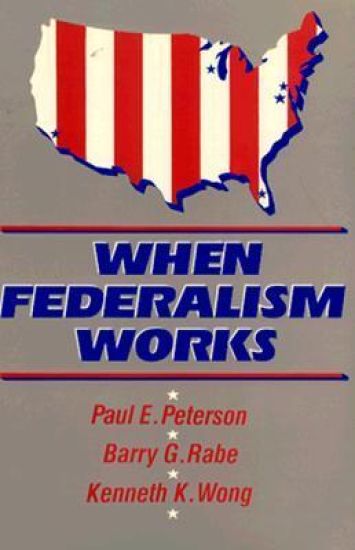
When Federalism Works

When Federalism Works

Paul E. Peterson; Barry G. Rabe; Kenneth K. Wong

Brookings Institution
1986
nidottu
"Twenty years ago cooperative federalism, in the form of federal grant-in-aid programs administered by state and local governments, was applauded almost without reservation as the best means of helping the handicapped, the educationally disadvantaged, the poor, and other groups with special needs. More recently these same programs have been criticized for excessive regulations and red tape, bureaucratic ineptitude, and high cost. The criticisms have been used to justify efforts to curb federal domestic spending and terminate many grants-in-aid.In When Federalism Works, Paul E. Peterson, Barry G. Rabe, and Kenneth K. Wong examine the new conventional wisdom about federal grants. Through documentary research and hundreds of interviews with local, state, and federal administrators and elected officials, they consider the implementation and operation of federal programs for education, health care, and housing in four urban areas to learn which programs worked, when, and why. Why did rent subsidy programs encounter seemingly endless difficulties, while special education was a notable success? Why did compensatory education fare better in Milwaukee than in Baltimore? Among the factors the authors find significant are the extent to which a program is directed toward groups in need, the political and economic circumstances of the area in which it is implemented, and the degree of professionalism among those who administer it at all levels of government. When Federalism Works provides a solid introduction to the most important grant-in-aid programs of the past twenty years and a thoughtful assessment of where they might be going."
The Politics of School Reform, 1870 - 1940

The Politics of School Reform, 1870 - 1940

Paul E. Peterson

University of Chicago Press
1985
nidottu
Was school reform in the decades following the Civil War an upper-middle-class effort to maintain control of the schools? Was public education simply a vehicle used by Protestant elites to impose their cultural ideas upon recalcitrant immigrants? In The Politics of School Reform, 1870-1940, Paul E. Peterson challenges such standard, revisionist interpretations of American educational history. Urban public schools, he argues, were part of a politically pluralistic society. Their growth--both in political power and in sheer numbers--had as much to do with the demands and influence of trade unions, immigrant groups, and the public more generally as it did with the actions of social and economic elites. Drawing upon rarely examined archival data, Peterson demonstrates that widespread public backing for the common school existed in Atlanta, Chicago, and San Francisco. He finds little evidence of systematic discrimination against white immigrants, at least with respect to classroom crowding and teaching assignments. Instead, his research uncovers solid trade union and other working-class support for compulsory education, adequate school financing, and curricular modernization. Urban reformers campaigned assiduously for fiscally sound, politically strong public schools. Often they had at least as much support from trade unionists as from business elites. In fact it was the business-backed machine politicians--from San Francisco's William Buckley to Chicago's Edward Kelly--who deprived the schools of funds. At a time when public schools are being subjected to searching criticism and when new educational ideas are gaining political support, The Politics of School Reform, 1870-1940 is a timely reminder of the strength and breadth of those groups that have always supported "free" public schools.