
Kirjojen hintavertailu. Mukana 12 307 503 kirjaa ja 12 kauppaa.

Kirjailija

Paul Glasziou

Kirjat ja teokset yhdessä paikassa: 2 kirjaa, julkaisuja vuosilta 2001-2018, suosituimpien joukossa Evidence-Based Medicine. Vertaile teosten hintoja ja tarkista saatavuus suomalaisista kirjakaupoista.

2 kirjaa

Kirjojen julkaisuhaarukka 2001-2018.

Evidence-Based Medicine

Evidence-Based Medicine

Sharon E. Straus; Paul Glasziou; W. Scott Richardson; R. Brian Haynes

Elsevier Health Sciences
2018
nidottu
Now in its fifth edition, this classic introduction to the practice and teaching of evidence-based medicine is written for busy clinicians at any stage of their career who want to learn how to practise and teach evidence-based medicine (EBM). It is short and practical, emphasizing direct clinical application of EBM and tactics to practise and teach EBM in real-time. The online toolkit includes Critical appraisal worksheets, Educational prescription, Pocket Cards, EBM calculators, Educational Prescriptions, Clinical Questions log, Self evaluations. Thoroughly updated with examples from latest evidence/studies. Revised electronic ancillaries, now available online Expanded coverage of audit and measuring quality improvement. Teaching moments now indexed for easy reference. New contributing authors Reena Pattani and Areti Angeliki Veroniki
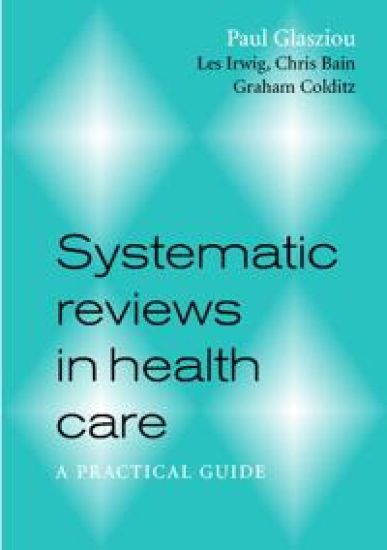
Systematic Reviews in Health Care

Systematic Reviews in Health Care

Paul Glasziou; Les Irwig; Chris Bain; Graham Colditz

Cambridge University Press
2001
pokkari
What do we do if different studies appear to give different answers? When applying research to questions for individual patients or for health policy, one of the challenges is interpreting such apparently conflicting research. A systematic review is a method to systematically identify relevant research, appraise its quality, and synthesize the results. The last two decades have seen increasing interest and developments in methods for doing high quality systematic reviews. Part I of this book provides a clear introduction to the concepts of reviewing, and lucidly describes the difficulties and traps to avoid. A unique feature of the book is its description, in Part II, of the different methods needed for different types of health care questions: frequency of disease, prognosis, diagnosis, risk, and management. As well as illustrative examples, there are exercises for each of the sections. This is essential reading for those interested in synthesizing health care research.