Kirjojen hintavertailu. Mukana 12 522 906 kirjaa ja 12 kauppaa.

Kirjailija

Paul H. Robinson

Kirjat ja teokset yhdessä paikassa: 16 kirjaa, julkaisuja vuosilta 1997-2024, suosituimpien joukossa Confronting Failures of Justice. Vertaile teosten hintoja ja tarkista saatavuus suomalaisista kirjakaupoista.

Mukana myös kirjoitusasut: Paul H Robinson

16 kirjaa

Kirjojen julkaisuhaarukka 1997-2024.

Confronting Failures of Justice

Confronting Failures of Justice

Paul H. Robinson; Jeffrey Seaman; Muhammad Sarahne

ROWMAN LITTLEFIELD
2024
nidottu
Most murderers and rapists escape justice. This horrifying fact has gone largely unexamined until now. In seventeen chapters, this groundbreaking book tours nearly the entire criminal justice system, examining the rules and practices that regularly produce failures of justice in serious criminal cases. Justice-frustrating rules usually exist for a reason, and each chapter outlines the interests at stake and different views on balancing them. It then describes the nature and extent of justice failures in present practice, providing numerous real-world examples of how the existing rules produce damaging results. Finally, each chapter reviews proposed and implemented reforms that could balance the competing interests in a less justice-frustrating manner and recommends one—sometimes completely original—reform to improve the system. A systematic study of justice failures is long overdue. As this book discusses, regular failures of justice in serious criminal cases undermine deterrence and the criminal justice system’s credibility with the community as a moral authority. The damage caused by unpunished crime is immense and, even worse, falls primarily on vulnerable minority communities. Now for the first time, students, researchers, policymakers, and citizens have a resource that explains why justice failures occur and what can be done about them. The book make no assumption that the reader has a background in criminal law, but it can also serve as the textbook for a course on criminal justice. There are many good books focused on the problem of injustice, when the system punishes wrongly. But there is also a desperate need to examine when and why the system fails to appropriately punish crime and what can be done to reduce such justice failures. Getting away with murder and rape is the norm in America today. This book aims to change that.
Confronting Failures of Justice

Confronting Failures of Justice

Paul H. Robinson; Jeffrey Seaman; Muhammad Sarahne

ROWMAN LITTLEFIELD
2024
sidottu
Most murderers and rapists escape justice. This horrifying fact has gone largely unexamined until now. In seventeen chapters, this groundbreaking book tours nearly the entire criminal justice system, examining the rules and practices that regularly produce failures of justice in serious criminal cases. Justice-frustrating rules usually exist for a reason, and each chapter outlines the interests at stake and different views on balancing them. It then describes the nature and extent of justice failures in present practice, providing numerous real-world examples of how the existing rules produce damaging results. Finally, each chapter reviews proposed and implemented reforms that could balance the competing interests in a less justice-frustrating manner and recommends one—sometimes completely original—reform to improve the system. A systematic study of justice failures is long overdue. As this book discusses, regular failures of justice in serious criminal cases undermine deterrence and the criminal justice system’s credibility with the community as a moral authority. The damage caused by unpunished crime is immense and, even worse, falls primarily on vulnerable minority communities. Now for the first time, students, researchers, policymakers, and citizens have a resource that explains why justice failures occur and what can be done about them. The book make no assumption that the reader has a background in criminal law, but it can also serve as the textbook for a course on criminal justice. There are many good books focused on the problem of injustice, when the system punishes wrongly. But there is also a desperate need to examine when and why the system fails to appropriately punish crime and what can be done to reduce such justice failures. Getting away with murder and rape is the norm in America today. This book aims to change that.
American Criminal Law

American Criminal Law

Paul H. Robinson; Sarah M. Robinson

TAYLOR FRANCIS LTD
2022
sidottu
This coursebook offers an exciting new approach to teaching criminal law to graduate and undergraduate students, and indeed to the general public. Each well-organized and student-friendly chapter offers historical context, tells the story of a principal historic case, provides a modern case that contrasts with the historic, explains the legal issue at the heart of both cases, includes a unique mapping feature describing the range of positions on the issue among the states today, examines a key policy question on the topic, and provides an aftermath that reports the final chapter to the historic and modern case stories. By embedding sophisticated legal doctrine and analysis in real-world storytelling, the book provides a uniquely effective approach to teaching American criminal law in programs on criminal justice, political science, public policy, history, philosophy, and a range of other fields.
American Criminal Law

American Criminal Law

Paul H. Robinson; Sarah M. Robinson

TAYLOR FRANCIS LTD
2022
nidottu
This coursebook offers an exciting new approach to teaching criminal law to graduate and undergraduate students, and indeed to the general public. Each well-organized and student-friendly chapter offers historical context, tells the story of a principal historic case, provides a modern case that contrasts with the historic, explains the legal issue at the heart of both cases, includes a unique mapping feature describing the range of positions on the issue among the states today, examines a key policy question on the topic, and provides an aftermath that reports the final chapter to the historic and modern case stories. By embedding sophisticated legal doctrine and analysis in real-world storytelling, the book provides a uniquely effective approach to teaching American criminal law in programs on criminal justice, political science, public policy, history, philosophy, and a range of other fields.
Justice, Liability, and Blame

Justice, Liability, and Blame

Paul H. Robinson

Routledge
2020
nidottu
This book examines shared intuitive notions of justice among laypersons and compares the discovered principles to those instantiated in American criminal codes. It reports eighteen original studies on a wide range of issues that are central to criminal law formulation.
Crimes That Changed Our World

Crimes That Changed Our World

Paul H. Robinson; Sarah M. Robinson

Rowman Littlefield
2019
nidottu
Can crime make our world safer? Crimes are the worst of humanity’s wrongs but, oddly, they sometimes “trigger” improvement in our lives. Crimes That Changed Our World explores some of the most important trigger cases of the past century, revealing much about how change comes to our modern world. The exact nature of the crime-outrage-reform dynamic can take many forms, and Paul and Sarah Robinson explore those differences in the cases they present. Each case is in some ways unique but there are repeating patterns that can offer important insights about what produces change and how in the future we might best manage it. Sometimes reform comes as a society wrestles with a new and intolerable problem. Sometimes it comes because an old problem from which we have long suffered suddenly has an apparent solution provided by technology or some other social or economic advance. Or, sometimes the engine of reform kicks into gear simply because we decide as a society that we are no longer willing to tolerate a long-standing problem and are now willing to do something about it. As the amazing and often touching stories that the Robinsons present make clear, the path of progress is not just a long series of course corrections; sometimes it is a quick turn or an unexpected lurch. In a flash we can suddenly feel different about present circumstances, seeing a need for change and can often, just as suddenly, do something about it. Every trigger crime that appears in Crimes That Changed Our World highlights a societal problem that America has chosen to deal with, each in a unique way. But what these extraordinary, and sometime unexpected, cases have in common is that all of them describe crimes that changed our world.
Justice, Liability, and Blame

Justice, Liability, and Blame

Paul H. Robinson

Routledge
2019
sidottu
Drafters of legal codes often implicitly or explicitly seek to incorporate community standards. To what extent have they succeeded? This book examines shared intuitive notions of justice among laypersons and compares the discovered principles to those instantiated in current American criminal codes. After discussion of the proper role of community views in formulating legal doctrine, Robinson and Darley report eighteen original studies on a wide range of issues in dispute among legal theorists. The authors compare lay intuitions and code provisions on such questions as the justified use of force, insanity, causation, complicity, risk-creation, omission liability, culpability requirements, duress, entrapment, multiple offenses, and criminalization matters such as felony-murder and sexual offenses. Many important differences between the legal code and community views are found, and the authors discuss the implications of those differences. One implication is the possibility that such conflicts could lead to reduced compliance as the code loses its moral authority with the community.
Mapping American Criminal Law

Mapping American Criminal Law

Paul H. Robinson; Tyler Scot Williams

Praeger Publishers Inc
2018
sidottu
Containing 40 visually coded maps of the fifty states, this book offers an unprecedented look at America's diverse legal landscape.This first-of-its-kind volume sketches the diversity implicit in United States criminal law doctrine through its examination of a range of criminal laws pertaining to murder, sexual assault, drug offenses, the insanity defense, and more and the way in which different states deal with those issues. In addition to providing insights into the most widely invoked standards in criminal law, it raises awareness of the enormous discrepancies among the criminal laws of states, documenting them using dozens of visually coded maps that showcase geographic, political, and socioeconomic differences to explain patterns of agreement and disagreement. Mapping American Criminal Law: Variations Across the 50 States is for political scientists, criminologists, sociologists, legal scholars, policy advisors, legislators, lawyers, judges, and scholars and students of these fields. In addition, each chapter is highly accessible to laypersons and includes an explanation of the subject matter as well as explanations of the various approaches to criminal law taken by states.
Pirates, Prisoners, and Lepers

Pirates, Prisoners, and Lepers

Paul H. Robinson; Sarah M. Robinson

Potomac Books Inc
2015
sidottu
It has long been held that humans need government to impose social order on a chaotic, dangerous world. How, then, did early humans survive on the Serengeti Plain, surrounded by faster, stronger, and bigger predators in a harsh and forbidding environment? Pirates, Prisoners, and Lepers examines an array of natural experiments and accidents of human history to explore the fundamental nature of how human beings act when beyond the scope of the law. Pirates of the 1700s, the leper colony on Molokai Island, prisoners of the Nazis, hippie communes of the 1970s, shipwreck and plane crash survivors, and many more diverse groups—they all existed in the absence of formal rules, punishments, and hierarchies. Paul and Sarah Robinson draw on these real-life stories to suggest that humans are predisposed to be cooperative, within limits. What these "communities" did and how they managed have dramatic implications for shaping our modern institutions. Should today's criminal justice system build on people's shared intuitions about justice? Or are we better off acknowledging this aspect of human nature but using law to temper it? Knowing the true nature of our human character and our innate ideas about justice offers a roadmap to a better society.
The Structure and Limits of Criminal Law
This volume brings together a collection of essays, many of them scholarly classics, which form part of the debates on three questions central to criminal law theory. The first of these questions is: what conduct should be necessary for criminal liability, and what sufficient? The answer to this question has wider implications for the debate about morality enforcement given the concern that the ’harm principle’ may have collapsed under its own weight. Secondly, essays address the question of what culpability should be necessary for criminal liability, and what sufficient? Here, the battles continue over whether the formulation of doctrines - such as the insanity defense, criminal negligence, strict liability, and others - should ignore or minimize the extent of an offender's blameworthiness in the name of effective crime-control. Or, are methods of accommodating the tension now in sight? Finally, essays consider the question of how criminal law rules should be best organized into a coherent and clarifying doctrinal structure. The structure grown by the common law process competes not only with that of modern comprehensive codifications, such as the America Law Institute's Model Penal Code, but also with alternative structures imagined but not yet tried.
Intuitions of Justice and the Utility of Desert

Intuitions of Justice and the Utility of Desert

Paul H. Robinson

Oxford University Press Inc
2013
sidottu
Research suggests that people of all demographics have nuanced and sophisticated notions of justice. In this intriguing new book, Paul H. Robinson demonstrates that judicial decisions that deviate from public conceptions of justice and desert can seriously undermine the American criminal justice system's integrity and legitimacy by failing to recognize or meet the needs of the communities it serves. Intuitions of Justice and the Utility of Desert sketches the contours of a wide range of lay conceptions of justice, touching many if not most of the issues that penal code drafters or policy makers must face, including normative crime control, universal understandings of justice, culpability, principles of adjudication, grading sentencing, justification defenses, and judicial discretion. Robinson warns that compromising the American criminal justice system to satisfy other interests can uncover hidden the costs incurred when a community's notions about justice are not reflected in its criminal laws. By ignoring the intuitions of justice held by the communities they serve, legislators, policymakers, and judges undermine the relevance of the criminal justice system and reduce its strength and legitimacy, creating a gap between what justice a community needs and what justice a court or law prescribes.
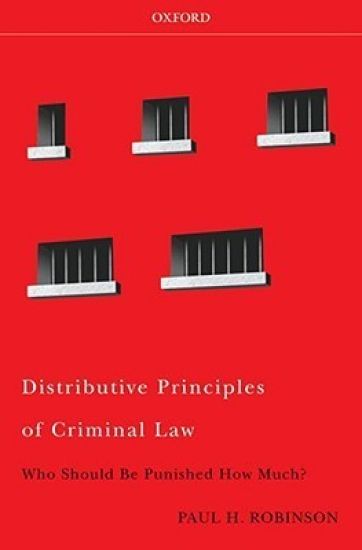
Distributive Principles of Criminal Law

Distributive Principles of Criminal Law

Paul H Robinson

Oxford University Press Inc
2008
sidottu
The rules governing who will be punished and how much determine a society's success in two of its most fundamental functions: doing justice and protecting citizens from crime. Drawing from the existing theoretical literature and adding to it recent insights from the social sciences, Paul Robinson describes the nature of the practical challenge in setting rational punishment principles, how past efforts have failed, and the alternatives that have been tried. He ultimately proposes a principle for distributing criminal liability and punishment that will be most likely to do justice and control crime. Paul Robinson, is one of the world's leading criminal law experts. He has been writing about criminal liability and punishment issues for three decades, and has published dozens of influential articles in the best scholarly journals. This long-awaited volume is a brilliant synthesis of social science research and legal reasoning that brings together three decades of work in a compelling line of argument that addresses all of the important issues in assessing liability and punishment.
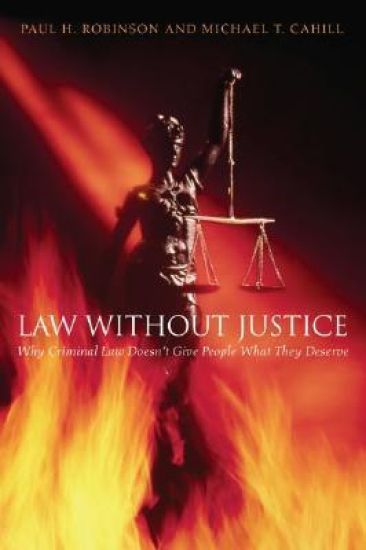
Law without Justice

Law without Justice

Paul H. Robinson; Michael T. Cahill

Oxford University Press Inc
2006
sidottu
If an innocent person is sent to prison or if a killer walks free, we are outraged. The legal system assures us, and we expect and demand, that it will seek to "do justice" in criminal cases. So why, for some cases, does the criminal law deliberately and routinely sacrifice justice? In this unflinching look at American criminal law, Paul Robinson and Michael Cahill demonstrate that cases with unjust outcomes are not always irregular or unpredictable. Rather, the criminal law sometimes chooses not to give defendants what they deserve: that is, unsatisfying results occur even when the system works as it is designed to work. The authors find that while some justice-sacrificing doctrines serve their intended purpose, many others do not, or could be replaced by other, better rules that would serve the purpose without abandoning a just result. With a panoramic view of the overlapping and often competing goals that our legal institutions must balance on a daily basis, Law without Justice challenges us to restore justice to the criminal justice system.
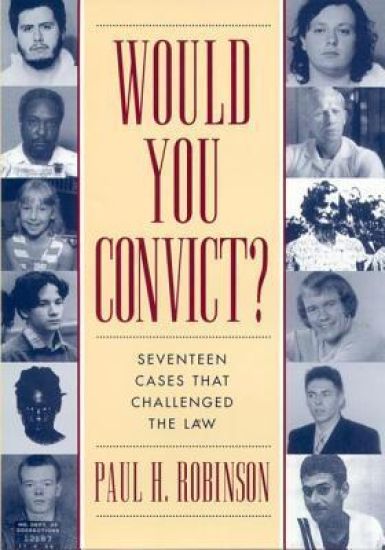
Would You Convict?

Would You Convict?

Paul H. Robinson

New York University Press
2001
pokkari
An illuminating exercise that challenges the reader's beliefs about the justice system A police trooper inspects a car during a routine traffic stop and finds a vast cache of weapons, complete with automatic rifles, thousands of rounds of ammunition, and black ski masks-a veritable bank robber's kit. Should the men in the car be charged? If so, with what? A son neglects to care for his elderly mother, whose emaciated form is discovered shortly before she dies a painful death. Is the son's neglect punishable, and if so how? A career con man writes one bad check too many and is sentenced to life in prison-for a check in the amount of $129.75. Is this just? A thief steals a backpack, only to find it contains a terrorist bomb. He alerts the police and saves lives, transforming himself from petty criminal to national hero. These are just a few of the many provocative cases that Paul Robinson presents and unravels in Would You Convict? Judging crimes and meting out punishment has long been an informal national pasttime. High-profile crimes or particularly brutal ones invariably prompt endless debate, in newspapers, on television, in coffee shops, and on front porches. Our very nature inclines us to be armchair judges, freely waving our metaphorical gavels and opining as to the innocence or guilt-and suitable punishment-of alleged criminals. Confronting this impulse, Paul Robinson here presents a series of unusual episodes that not only challenged the law, but that defy a facile or knee-jerk verdict. Narrating the facts in compelling, but detached detail, Robinson invites readers to sentence the transgressor (or not), before revealing the final outcome of the case. The cases described in Would You Convict? engage, shock, even repel. Without a doubt, they will challenge you and your belief system. And the way in which juries and judges have resolved them will almost certainly surprise you.
Would You Convict?

Would You Convict?

Paul H. Robinson

New York University Press
1999
sidottu
An illuminating exercise that challenges the reader's beliefs about the justice system A police trooper inspects a car during a routine traffic stop and finds a vast cache of weapons, complete with automatic rifles, thousands of rounds of ammunition, and black ski masks-a veritable bank robber's kit. Should the men in the car be charged? If so, with what? A son neglects to care for his elderly mother, whose emaciated form is discovered shortly before she dies a painful death. Is the son's neglect punishable, and if so how? A career con man writes one bad check too many and is sentenced to life in prison-for a check in the amount of $129.75. Is this just? A thief steals a backpack, only to find it contains a terrorist bomb. He alerts the police and saves lives, transforming himself from petty criminal to national hero. These are just a few of the many provocative cases that Paul Robinson presents and unravels in Would You Convict? Judging crimes and meting out punishment has long been an informal national pasttime. High-profile crimes or particularly brutal ones invariably prompt endless debate, in newspapers, on television, in coffee shops, and on front porches. Our very nature inclines us to be armchair judges, freely waving our metaphorical gavels and opining as to the innocence or guilt-and suitable punishment-of alleged criminals. Confronting this impulse, Paul Robinson here presents a series of unusual episodes that not only challenged the law, but that defy a facile or knee-jerk verdict. Narrating the facts in compelling, but detached detail, Robinson invites readers to sentence the transgressor (or not), before revealing the final outcome of the case. The cases described in Would You Convict? engage, shock, even repel. Without a doubt, they will challenge you and your belief system. And the way in which juries and judges have resolved them will almost certainly surprise you.
Structure and Function in Criminal Law

Structure and Function in Criminal Law

Paul H. Robinson

Clarendon Press
1997
sidottu
Professor Robinson provides a new critique of the often neglected problem of classification within the criminal law. He presents a discussion of the present conceptual framework of the law, and offers explanations of how and why formal structures do not match the operation of law in practice. In this scholarly exposition of applied criminal theory, Robinson argues that the current operational structure of the criminal law fails to take account of its different functions. He goes on to suggest new sample codes of criminal conduct and criminal adjudication which mark a real departure from the pragmatic approach which presently dominates code-making. This rounded exploration of the structure of systems of criminal law is an important work for law teachers and policy makers world-wide.