Kirjojen hintavertailu. Mukana 12 390 323 kirjaa ja 12 kauppaa.

Kirjailija

Paul Krugman

Kirjat ja teokset yhdessä paikassa: 50 kirjaa, julkaisuja vuosilta 1989-2025, suosituimpien joukossa End This Depression Now. Vertaile teosten hintoja ja tarkista saatavuus suomalaisista kirjakaupoista.

50 kirjaa

Kirjojen julkaisuhaarukka 1989-2025.

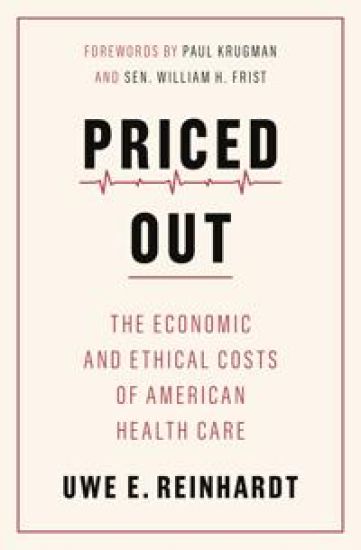
Priced Out

Priced Out

Uwe E. Reinhardt; Paul Krugman; Sen. William H. Frist

Princeton University Press
2020
pokkari
From a giant of health care policy, an engaging and enlightening account of why American health care is so expensive—and why it doesn't have to beUwe Reinhardt was a towering figure and moral conscience of health care policy in the United States and beyond. Famously bipartisan, he advised presidents and Congress on health reform and originated central features of the Affordable Care Act. In Priced Out, Reinhardt offers an engaging and enlightening account of the U.S. health care system, explaining why it costs so much more and delivers so much less than the systems of every other advanced country, why this situation is morally indefensible, and how we might improve it. Drawing on the best evidence, he guides readers through the chaotic, secretive, and inefficient way America pays for health care, dispelling the confusion, ignorance, myths, and misinformation that hinder effective reform.
Arguing with Zombies

Arguing with Zombies

Paul Krugman

WW Norton Co
2020
sidottu
There is no better guide than Paul Krugman to basic economics, the ideas that animate much of our public policy. Likewise, there is no better foe of zombie economics, the misunderstandings that just won’t die. Arguing with Zombies is Krugman “the most hated and most admired columnist in the US” (Martin Wolf, Financial Times) at his best, turning readers into intelligent consumers of the daily news with quick, vivid sketches of the key concepts behind taxes, health care, international trade and more. In this new book, in which he builds on and expands his The New York Times columns and other writings, “the most celebrated economist of his generation” (The Economist), offers short, accessible chapters on topics including the European Union and Brexit, the fight for national health care in the United States, the financial meltdown of 2007–2008, the attack on Social Security and the fraudulent argument—the ultimate zombie—that tax cuts for the rich will benefit all.
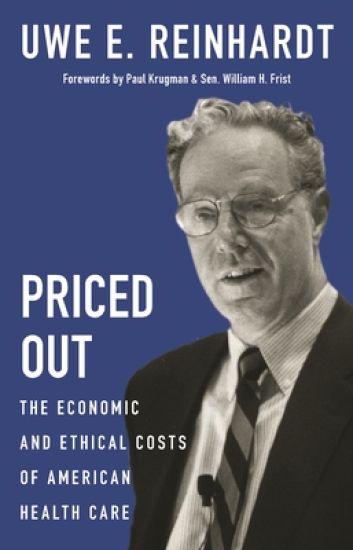
Priced Out

Priced Out

Uwe E. Reinhardt; Paul Krugman; Sen. William H. Frist

PRINCETON UNIVERSITY PRESS
2019
sidottu
From a giant of health care policy, an engaging and enlightening account of why American health care is so expensive—and why it doesn't have to beUwe Reinhardt was a towering figure and moral conscience of health care policy in the United States and beyond. Famously bipartisan, he advised presidents and Congress on health reform and originated central features of the Affordable Care Act. In Priced Out, Reinhardt offers an engaging and enlightening account of today's U.S. health care system, explaining why it costs so much more and delivers so much less than the systems of every other advanced country, why this situation is morally indefensible, and how we might improve it.The problem, Reinhardt says, is not one of economics but of social ethics. There is no American political consensus on a fundamental question other countries settled long ago: to what extent should we be our brothers' and sisters' keepers when it comes to health care? Drawing on the best evidence, he guides readers through the chaotic, secretive, and inefficient way America finances health care, and he offers a penetrating ethical analysis of recent reform proposals. At this point, he argues, the United States appears to have three stark choices: the government can make the rich help pay for the health care of the poor, ration care by income, or control costs. Reinhardt proposes an alternative path: that by age 26 all Americans must choose either to join an insurance arrangement with community-rated premiums, or take a chance on being uninsured or relying on a health insurance market that charges premiums based on health status.An incisive look at the American health care system, Priced Out dispels the confusion, ignorance, myths, and misinformation that hinder effective reform.
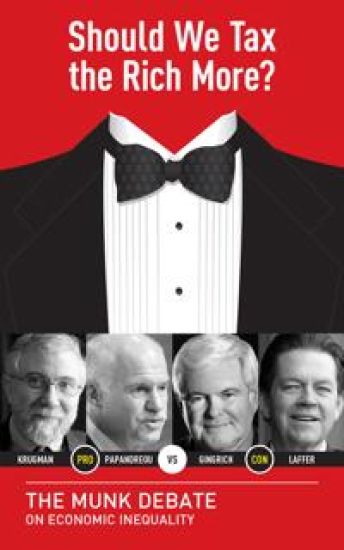
Should We Tax the Rich More?

Should We Tax the Rich More?

George Papandreou; Newt Gingrich; Arthur Laffer; Paul Krugman

House of Anansi Press Ltd ,Canada
2013
pokkari
As middle-class incomes stagnate in advanced economies while the rich experience record income gains, the eleventh semi-annual Munk Debate pits wealth redistribution supporters Paul Krugman and George Papandreou against Newt Gingrich and Arthur Laffer to debate taxation — should the rich pay more? For some the answer is obvious: redistribute the wealth of the top income earners who have enjoyed, for almost a generation, the lion’s share of all income gains. Imposing higher taxes on the wealthy is the best way for countries such as Canada to reinvest in their social safety nets, education, and infrastructure while protecting the middle class. Others argue that anemic economic growth, not income inequality, is the real problem facing advanced countries. In a globalized economy, raising taxes on society’s wealth creators leads to capital flight, falling government revenues, and less money for the poor. These same voices contend that lowering taxes on everyone stimulates innovation and investment, fuelling future prosperity. In this edition of the Munk Debates — Canada’s premier international debate series — Nobel Prize–winning economist Paul Krugman and former Prime Minster of Greece George Papandreou square off against former Speaker of the U.S. House of Representatives Newt Gingrich and famed economist Arthur Laffer to debate if the rich should bear the brunt of higher taxes. For the first time ever, this stimulating debate, which will take place in front of a sold-out audience, will be available in print. With advanced countries facing overextended social services, crumbling infrastructure, and sluggish economic growth, the Munk Debate on economic inequality tackles the essential public policy issue: Should we tax the rich more?
End This Depression Now!

End This Depression Now!

Paul Krugman

WW Norton Co
2013
nidottu
The Great Recession is more than four years old—and counting. Yet, as Paul Krugman points out in this powerful volley, "Nations rich in resources, talent, and knowledge—all the ingredients for prosperity and a decent standard of living for all—remain in a state of intense pain." How bad have things gotten? How did we get stuck in what now can only be called a depression? And above all, how do we free ourselves? Krugman pursues these questions with his characteristic lucidity and insight. He has a powerful message for anyone who has suffered over these past four years—a quick, strong recovery is just one step away, if our leaders can find the "intellectual clarity and political will" to end this depression now.
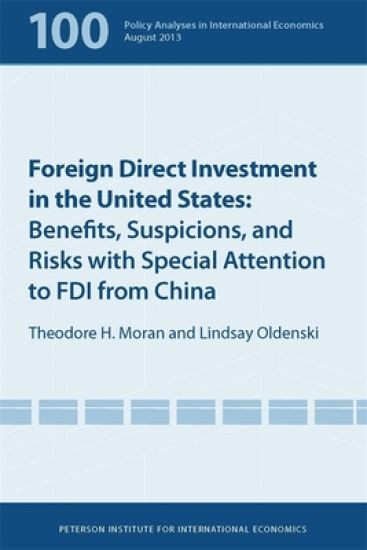
Foreign Direct Investment in the United States – Benefits, Suspicions, and Risks with Special Attention to FDI from China

Foreign Direct Investment in the United States – Benefits, Suspicions, and Risks with Special Attention to FDI from China

Edward Graham; Theodore Moran; Lindsay Oldenski; Paul Krugman

The Peterson Institute for International Economics
2012
nidottu
Americans have long been ambivalent toward foreign direct investment in the United States. Foreign multinational corporations may be a source of capital, technology, and jobs. But what are the implications for US workers, firms, communities, and consumers as the United States remains the most popular destination for foreign multinational investment? Theodore H. Moran and Lindsay Oldenski find that foreign multinational firms that invest in the United States are, alongside US-headquartered American multinationals, the most productive and highest-paying segment of the US economy. These firms conduct more research and development, provide more value added to US domestic inputs, and export more goods and services than other firms in the US economy. The superior technology and management techniques they employ spill over horizontally and vertically to improve the performance of local firms and workers. As the United States wants not only to expand employment but also create well-paying jobs that reverse the falling earnings that many US workers and middle class families have suffered in recent decades, it is more important than ever to enhance the United States as a destination for multinational investors.
End This Depression Now!

End This Depression Now!

Paul Krugman

WW Norton Co
2012
sidottu
The Great Recession is more than four years old—and counting. Yet, as Paul Krugman points out in this powerful volley, "Nations rich in resources, talent, and knowledge—all the ingredients for prosperity and a decent standard of living for all—remain in a state of intense pain." How bad have things gotten? How did we get stuck in what now can only be called a depression? And above all, how do we free ourselves? Krugman pursues these questions with his characteristic lucidity and insight. He has a powerful message for anyone who has suffered over these past four years—a quick, strong recovery is just one step away, if our leaders can find the "intellectual clarity and political will" to end this depression now.
North America's Lost Decade?

North America's Lost Decade?

Paul Krugman; David Rosenberg; Lawrence Summers; Ian Bremmer

House of Anansi Press Ltd ,Canada
2012
pokkari
As stock markets gyrate, Europe lurches from crisis to crisis, and recovery in the United States slows, the future of the North American economy is more uncertain than ever. Can individual entrepreneurship, corporate innovation, and governments create a new era of sustained economic growth? Or, will the ongoing financial crisis, political dysfunction in the United States, and the rise of emerging nations erode living standards in North America for the long term? In this edition of the Munk Debates -- Canada's premier international debate series -- Nobel Prize-winning economist Paul Krugman and Chief Economist and Strategist at Gluskin Sheff + Associates David Rosenberg square off against former director of President Obama’s National Economic Council Lawrence Summers and bestselling author Ian Bremmer to tackle the resolution: Be it resolved North America faces a Japan-style era of high unemployment and slow growth.
Fuzzy Math

Fuzzy Math

Paul Krugman

WW NORTON CO
2010
nidottu
With huge budget surpluses just ahead, the question of whether to cut taxes has shifted to when? and by how much? With Fuzzy Math, Paul Krugman dissects the Bush tax proposal and shows us who wins, who loses, and how quickly the tax cuts will consume the surplus. Always the equal-opportunity critic when it comes to faulty economics, Krugman also tucks into the Democratic alternatives to the Bush plan. This little book packs a big wallop. Together with major media appearances, it puts Krugman's wisdom and steely-eyed analysis firmly at the center of the debate about how to spend upwards of $2 trillion. It may very well change the course of history.
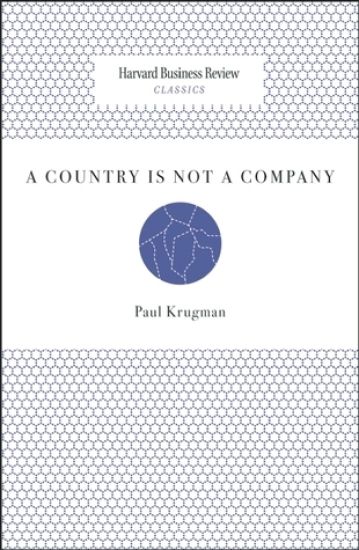
A Country Is Not a Company

A Country Is Not a Company

Paul Krugman

Harvard Business Review Press
2009
pokkari
Nobel-Prize-winning economist Paul Krugman argues that business leaders need to understand the differences between economic policy on the national and international scale and business strategy on the organizational scale. Economists deal with the closed system of a national economy, whereas executives live in the open-system world of business. Moreover, economists know that an economy must be run on the basis of general principles, but businesspeople are forever in search of the particular brilliant strategy. Krugman's article serves to elucidate the world of economics for businesspeople who are so close to it and yet are continually frustrated by what they see. Since 1922, Harvard Business Review has been a leading source of breakthrough management ideas-many of which still speak to and influence us today. The Harvard Business Review Classics series now offers readers the opportunity to make these seminal pieces a part of your permanent management library. Each highly readable volume contains a groundbreaking idea that continues to shape best practices and inspire countless managers around the world-and will have a direct impact on you today and for years to come.
The Return of Depression Economics and the Crisis of 2008
In this major bestseller, Paul Krugman warns that, like diseases that have become resistant to antibiotics, the economic maladies that caused the Great Depression have made a comeback. He lays bare the 2008 financial crisis the greatest since the 1930s tracing it to the failure of regulation to keep pace with an out-of-control financial system. He also tells us how to contain the crisis and turn around a world economy sliding into a deep recession. Brilliantly crafted in Krugman s trademark style lucid, lively, and supremely informed this new edition of The Return of Depression Economics has become an instant classic. A hard-hitting new foreword takes the paperback edition right up to the present moment.
The Conscience of a Liberal

The Conscience of a Liberal

Paul Krugman

W. W. Norton Company
2009
nidottu
In this "clear, provocative" (Boston Globe) New York Times bestseller, Paul Krugman, today's most widely read economist, examines the past eighty years of American history, from the reforms that tamed the harsh inequality of the Gilded Age and the 1920s to the unraveling of that achievement and the reemergence of immense economic and political inequality since the 1970s. Seeking to understand both what happened to middle-class America and what it will take to achieve a "new New Deal," Krugman has created his finest book to date, a "stimulating manifesto" offering "a compelling historical defense of liberalism and a clarion call for Americans to retake control of their economic destiny" (Publishers Weekly)."As Democrats seek a rationale not merely for returning to power, but for fundamentally changing--or changing back--the relationship between America's government and its citizens, Mr. Krugman's arguments will prove vital in the months and years ahead." --Peter Beinart, New York Times
The Return of Depression Economics

The Return of Depression Economics

Paul Krugman

Allen Lane
2008
isokokoinen pokkari
Paul Krugman, winner of the 2008 Nobel Prize in economics, shows how today's crisis parallels the events that caused the Great Depression - and explains what it will take to avoid catastrophe.In 1999, in The Return of Depression Economics, Paul Krugman surveyed the economic crises that had swept across Asia and Latin America, and warned that those crises were a warning for all of us: like diseases that have become resistant to antibiotics, the economic maladies that caused the Great Depression were making a comeback.In the years that followed, as Wall Street boomed and financial wheeler-dealers made vast profits, the international crises of the 1990s faded from memory. But now depression economics has come to America: when the great housing bubble of the mid-2000s burst, the U.S. financial system proved as vulnerable as those of developing countries caught up in earlier crises - and a replay of the 1930s seems all too possible. In this new, greatly updated edition of The Return of Depression Economics, Krugman shows how the failure of regulation to keep pace with an increasingly out-of-control financial system set the United States, and the world as a whole, up for the greatest financial crisis since the 1930s. He also lays out the steps that must be taken to contain the crisis, and turn around a world economy sliding into a deep recession. Brilliantly crafted in Krugman's trademark style-lucid, lively, and supremely informed - this new edition of The Return of Depression Economics will become an instant cornerstone of the debate over how to respond to the crisis.
The Return of Depression Economics and the Crisis of 2008
In 1999, in The Return of Depression Economics, Paul Krugman surveyed the economic crises that had swept across Asia and Latin America, and pointed out that those crises were a warning for all of us: like diseases that have become resistant to antibiotics, the economic maladies that caused the Great Depression were making a comeback. In the years that followed, as Wall Street boomed and financial wheeler-dealers made vast profits, the international crises of the 1990s faded from memory. But now depression economics has come to America: when the great housing bubble of the mid-2000s burst, the U.S. financial system proved as vulnerable as those of developing countries caught up in earlier crises and a replay of the 1930s seems all too possible. In this new, greatly updated edition of The Return of Depression Economics, Krugman shows how the failure of regulation to keep pace with an increasingly out-of-control financial system set the United States, and the world as a whole, up for the greatest financial crisis since the 1930s. He also lays out the steps that must be taken to contain the crisis, and turn around a world economy sliding into a deep recession. Brilliantly crafted in Krugman's trademark style--lucid, lively, and supremely informed--this new edition of The Return of Depression Economics will become an instant cornerstone of the debate over how to respond to the crisis.