Kirjojen hintavertailu. Mukana 12 304 655 kirjaa ja 12 kauppaa.

Kirjailija

Paul M. Salmon

Kirjat ja teokset yhdessä paikassa: 17 kirjaa, julkaisuja vuosilta 2009-2025, suosituimpien joukossa Human Factors Methods and Accident Analysis. Vertaile teosten hintoja ja tarkista saatavuus suomalaisista kirjakaupoista.

17 kirjaa

Kirjojen julkaisuhaarukka 2009-2025.

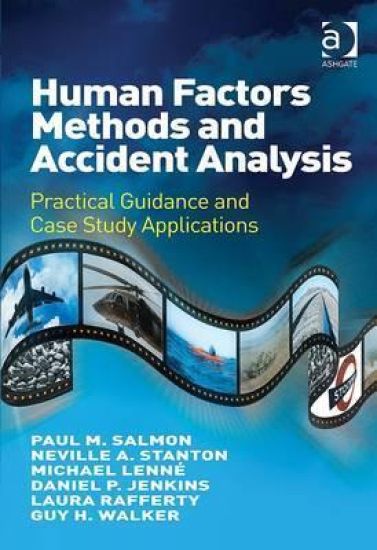
Human Factors Methods and Accident Analysis

Human Factors Methods and Accident Analysis

Paul M. Salmon; Neville A. Stanton; Michael Lenné; Daniel P. Jenkins; Laura Rafferty; Guy H. Walker

Ashgate Publishing Limited
2011
sidottu
This book provides an overview of, and practical guidance on, the range of human factors (HF) methods that can be used for the purposes of accident analysis and investigation in complex sociotechnical systems. Human Factors Methods and Accident Analysis begins with an overview of different accident causation models and an introduction to the concepts of accident analysis and investigation. It then presents a discussion focussing on the importance of, and difficulties associated with, collecting appropriate data for accident analysis purposes. Following this, a range of HF-based accident analysis methods are described, as well as step-by-step guidance on how to apply them. To demonstrate how the different methods are applied, and what the outputs are, the book presents a series of case study applications across a range of safety critical domains. It concludes with a chapter focussing on the data challenges faced when collecting, coding and analysing accident data, along with future directions in the area. Human Factors Methods and Accident Analysis is the first book to offer a practical guide for investigators, practitioners and researchers wishing to apply accident analysis methods. It is also unique in presenting a series of novel applications of accident analysis methods, including HF methods not previously used for these purposes (e.g. EAST, critical path analysis), as well as applications of methods in new domains.
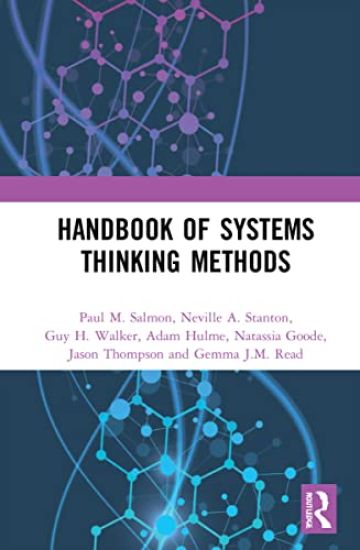
Handbook of Systems Thinking Methods

Handbook of Systems Thinking Methods

Paul M. Salmon; Neville A. Stanton; Guy H. Walker; Adam Hulme; Natassia Goode; Jason Thompson; Gemma J.M. Read

TAYLOR FRANCIS LTD
2025
nidottu
The systems thinking philosophy has become popular in human factors and ergonomics and safety science. These methods are being used to understand and resolve complex societal problems in areas such as transport safety, workplace safety, medication error, disaster management, child abuse, financial crises, terrorism, climate change and public health and wellbeing. This handbook presents practical step-by-step guidance for practitioners and researchers wishing to use these methods to tackle complex problems. Each method includes an example case study which demonstrates how the method can be applied and how the results can be interpreted and translated into practical recommendations.The book presents practical guidance on state-of-the-art systems thinking methods and offers case study applications describing systems thinking methods in novel areas. It explains how to translate the outputs of systems thinking methods in practice and introduces systems thinking with an overview of Human Factors and Ergonomics applications.This book will serve as a great reference for students and engineers in the field of systems engineering, complex systems and the design and development of systems, including ergonomics/human factors and systems engineers, designers, architects, industrial engineers, project management engineers, reliability engineers, risk engineers, software engineers and computer engineers.
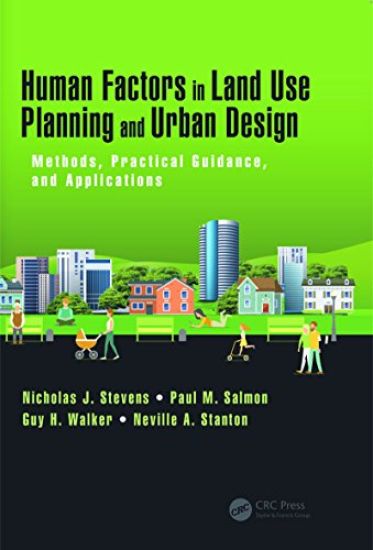
Human Factors in Land Use Planning and Urban Design

Human Factors in Land Use Planning and Urban Design

Nicholas J. Stevens; Paul M. Salmon; Guy H. Walker; Neville A. Stanton

TAYLOR FRANCIS LTD
2023
nidottu
The integration of Human Factors in Land Use Planning and Urban Design (LUP & UD) is an exciting and emerging interdisciplinary field. This book offers practical guidance on a range of Human Factors methods that can be used to rigorously and reliably explore LUP & UD.It provides new ways to interpret urban space and detail context sensitive analysis for the interpretation and design of our surroundings. The methodologies outlined allow for the consideration of the technical aspects of the built environment with the necessary experience and human centered approaches to our urban and regional settings. This book describes 30 Human Factors methods for use in the LUP & UD context. While it explores theory, it also focuses on the question of what Human Factors methods are; their advantages and disadvantages; step-by-step guidance on how to carry them out; and case studies to guide the reader. Describes the practice and processes associated with urban and regional strategic planning Constructed so that students, practitioners, and researchers with an interest in one particular area of Human Factors can read the chapters independently from one another
Handbook of Systems Thinking Methods

Handbook of Systems Thinking Methods

Paul M. Salmon; Neville A. Stanton; Guy H. Walker; Adam Hulme; Natassia Goode; Jason Thompson; Gemma J.M. Read

TAYLOR FRANCIS LTD
2022
sidottu
The systems thinking philosophy has become popular in human factors and ergonomics and safety science. These methods are being used to understand and resolve complex societal problems in areas such as transport safety, workplace safety, medication error, disaster management, child abuse, financial crises, terrorism, climate change and public health and wellbeing. This handbook presents practical step-by-step guidance for practitioners and researchers wishing to use these methods to tackle complex problems. Each method includes an example case study which demonstrates how the method can be applied and how the results can be interpreted and translated into practical recommendations.The book presents practical guidance on state-of-the-art systems thinking methods and offers case study applications describing systems thinking methods in novel areas. It explains how to translate the outputs of systems thinking methods in practice and introduces systems thinking with an overview of Human Factors and Ergonomics applications.This book will serve as a great reference for students and engineers in the field of systems engineering, complex systems and the design and development of systems, including ergonomics/human factors and systems engineers, designers, architects, industrial engineers, project management engineers, reliability engineers, risk engineers, software engineers and computer engineers.
Distributed Situation Awareness in Road Transport

Distributed Situation Awareness in Road Transport

Paul M. Salmon; Gemma Jennie Megan Read; Guy H. Walker; Michael G. Lenné; Neville A. Stanton

Ashgate Publishing Limited
2018
sidottu
How can we design transport environments that cater to the situation awareness needs of different end-users? This book answers this question by showcasing how state-of-the-art human factors theory and methods can be used to understand how situation awareness differs across drivers, cyclists, motorcyclists, and pedestrians and creates new designs that cater to these diverse situation awareness needs. Written by experts in the field and based on a major program of work funded by the Australian Research Council, this book outlines the distributed situation awareness model and provides practical guidance on how to study situation awareness naturalistically and how to create designs that support, rather than hinder, situation awareness. The book closes by outlining outline a generic framework to support similar applications in other areas, and discusses future applications in areas such as vehicle automation, artificial intelligence, and cybersecurity.Features Challenges traditional road safety analysis, design processes and conventions Outlines a novel on-road study methodology for analyzing naturalistic interactions among drivers, cyclists, motorcyclists and pedestrians Presents a review of state-of-the-art situation awareness theory and methods Provides practical guidance on a series of human factors methods Describes a framework to support the design of transport environments Evaluates new intersection concepts that encompass features designed to prevent collisions at intersections
Vehicle Feedback and Driver Situation Awareness

Vehicle Feedback and Driver Situation Awareness

Guy H. Walker; Neville A. Stanton; Paul M. Salmon

CRC Press
2018
sidottu
A potentially troubling aspect of modern vehicle design – some would argue - is a trend for isolating the driver and reducing vehicle feedback, usually in the name of comfort and refinement but increasingly because of automation. There is little doubt cars have become more civilised over the years, yet despite this, the consequences of driver behaviour remain to a large extent anecdotal. Readers will have heard such anecdotes for themselves. They usually take the form of drivers of a certain age recalling their first cars from the 1970s or 80s, in which "doing 70 mph really felt like it". The question is whether such anecdotes actually reflect a bigger, more significant issue that could be better understood. Related questions have been explored in other domains such as aviation, where the change to ‘fly-by-wire’ did indeed bring about some occasionally serious performance issues that were not anticipated. Despite some clear parallels, automotive systems have been left relatively unstudied. The research described in this book aims to explore precisely these issues from a Human Factors perspective. This means connecting the topics of vehicle feel, vehicle dynamics, and automotive engineering with the latest research on driver situation awareness. The problem is explored experimentally from a variety of theoretical viewpoints but the outcomes are consistently practical. Here we have a promising new avenue along which the driver experience can be enhanced in novel and insightful ways. Tools and templates are provided so that engineers and designers can try different ways to boost vehicle safety, efficiency and enjoyment from a human-centered perspective.Association of American Publishers (AAP) Finalist for the 2019 PROSE AwardFeatures Diagnosis of how vehicle feel impacts driver situation awareness, and how this could aid future vehicle designsMulti-theory approach to driver situation awareness, and how different views of this important concept give rise to different insightsComprehensive analysis of situation awareness in driving, the information requirements of drivers, and how these needs can be supportedPractical descriptions of how state-of-science Human Factors methods have been applied in practice
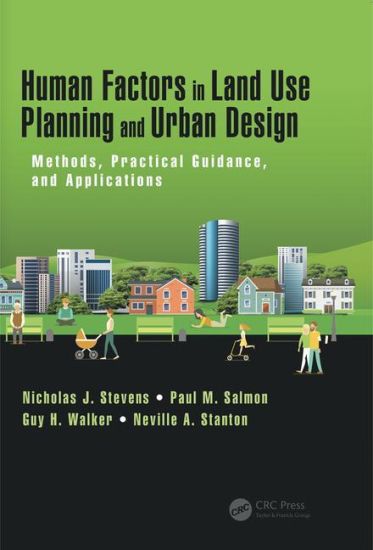
Human Factors in Land Use Planning and Urban Design

Human Factors in Land Use Planning and Urban Design

Nicholas J. Stevens; Paul M. Salmon; Guy H. Walker; Neville A. Stanton

CRC Press
2018
sidottu
The integration of Human Factors in Land Use Planning and Urban Design (LUP & UD) is an exciting and emerging interdisciplinary field. This book offers practical guidance on a range of Human Factors methods that can be used to rigorously and reliably explore LUP & UD.It provides new ways to interpret urban space and detail context sensitive analysis for the interpretation and design of our surroundings. The methodologies outlined allow for the consideration of the technical aspects of the built environment with the necessary experience and human centered approaches to our urban and regional settings. This book describes 30 Human Factors methods for use in the LUP & UD context. While it explores theory, it also focuses on the question of what Human Factors methods are; their advantages and disadvantages; step-by-step guidance on how to carry them out; and case studies to guide the reader. Describes the practice and processes associated with urban and regional strategic planning Constructed so that students, practitioners, and researchers with an interest in one particular area of Human Factors can read the chapters independently from one another
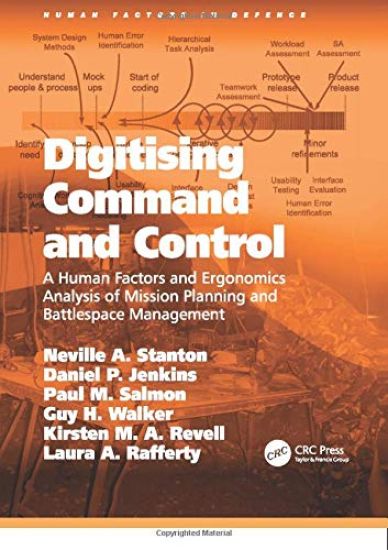
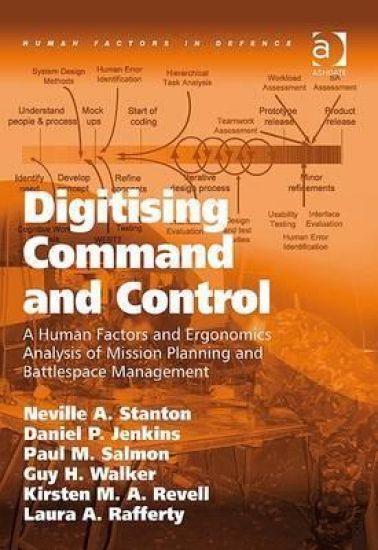
Digitising Command and Control

Digitising Command and Control

Neville A. Stanton; Daniel P. Jenkins; Paul M. Salmon; Guy H. Walker; Kirsten M. A. Revell; Laura A. Rafferty

CRC Press
2017
nidottu
This book presents a human factors and ergonomics evaluation of a digital Mission Planning and Battle-space Management (MP/BM) system. An emphasis was placed on the activities at the Brigade (Bde) and the Battle Group (BG) headquarters (HQ) levels. The analysts distributed their time evenly between these two locations. The human factors team from Brunel University, as part of the HFI DTC, undertook a multi-faceted approach to the investigation, including: - observation of people using the traditional analogue MP/BM processes in the course of their work - cognitive work analysis of the digital MP/BM system - analysis of the tasks and goal structure required by the digital MP/BM - assessment against a usability questionnaire - analysis of the distributed situation awareness - an environmental survey. The book concludes with a summary of the research project's findings and offers many valuable insights. For example, the recommendations for short-term improvements in the current generation of digital MP/BM system address general design improvements, user-interface design improvements, hardware improvements, infrastructure improvements and support improvements. In looking forward to the next generation digital MP/BM systems, general human factors design principles are presented and human factors issues in digitising mission planning are considered.
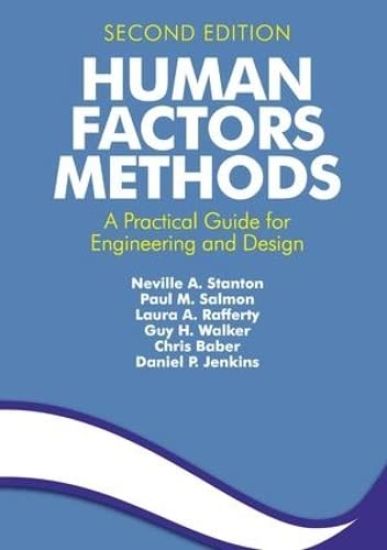
Human Factors Methods

Human Factors Methods

Neville A. Stanton; Paul M. Salmon; Laura A. Rafferty; Guy H. Walker; Chris Baber; Daniel P. Jenkins

Ashgate Publishing Limited
2013
sidottu
This second edition of Human Factors Methods: A Practical Guide for Engineering and Design now presents 107 design and evaluation methods as well as numerous refinements to those that featured in the original. The book has been carefully designed to act as an ergonomics methods manual, aiding both students and practitioners. The eleven sections represent the different categories of ergonomics methods and techniques that can be used in the evaluation and design process. Offering a 'how-to' text on a substantial range of ergonomics methods that can be used in the design and evaluation of products and systems, it is a comprehensive point of reference for all these methods. An overview of the methods is presented in chapter one, with a methods matrix showing which can be used in conjunction. The following chapters detail the methods showing how to apply them in practice. Flowcharts, procedures and examples cover the requirements of a diverse audience and varied applications of the methods. The final chapter, a new addition, illustrates the EAST method, which integrates several well-known methods into a teamwork analysis approach.
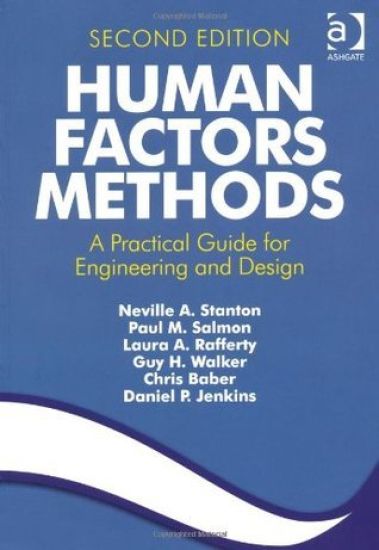
Human Factors Methods

Human Factors Methods

Neville A. Stanton; Paul M. Salmon; Laura A. Rafferty; Guy H. Walker; Chris Baber; Daniel P. Jenkins

Ashgate Publishing Limited
2013
nidottu
This second edition of Human Factors Methods: A Practical Guide for Engineering and Design now presents 107 design and evaluation methods as well as numerous refinements to those that featured in the original. The book has been carefully designed to act as an ergonomics methods manual, aiding both students and practitioners. The eleven sections represent the different categories of ergonomics methods and techniques that can be used in the evaluation and design process. Offering a 'how-to' text on a substantial range of ergonomics methods that can be used in the design and evaluation of products and systems, it is a comprehensive point of reference for all these methods. An overview of the methods is presented in chapter one, with a methods matrix showing which can be used in conjunction. The following chapters detail the methods showing how to apply them in practice. Flowcharts, procedures and examples cover the requirements of a diverse audience and varied applications of the methods. The final chapter, a new addition, illustrates the EAST method, which integrates several well-known methods into a teamwork analysis approach.
Digitising Command and Control

Digitising Command and Control

Neville A. Stanton; Daniel P. Jenkins; Paul M. Salmon; Guy H. Walker; Kirsten M. A. Revell; Laura A. Rafferty

Ashgate Publishing Limited
2009
sidottu
This book presents a human factors and ergonomics evaluation of a digital Mission Planning and Battle-space Management (MP/BM) system. An emphasis was placed on the activities at the Brigade (Bde) and the Battle Group (BG) headquarters (HQ) levels. The analysts distributed their time evenly between these two locations. The human factors team from Brunel University, as part of the HFI DTC, undertook a multi-faceted approach to the investigation, including: - observation of people using the traditional analogue MP/BM processes in the course of their work - cognitive work analysis of the digital MP/BM system - analysis of the tasks and goal structure required by the digital MP/BM - assessment against a usability questionnaire - analysis of the distributed situation awareness - an environmental survey. The book concludes with a summary of the research project's findings and offers many valuable insights. For example, the recommendations for short-term improvements in the current generation of digital MP/BM system address general design improvements, user-interface design improvements, hardware improvements, infrastructure improvements and support improvements. In looking forward to the next generation digital MP/BM systems, general human factors design principles are presented and human factors issues in digitising mission planning are considered.
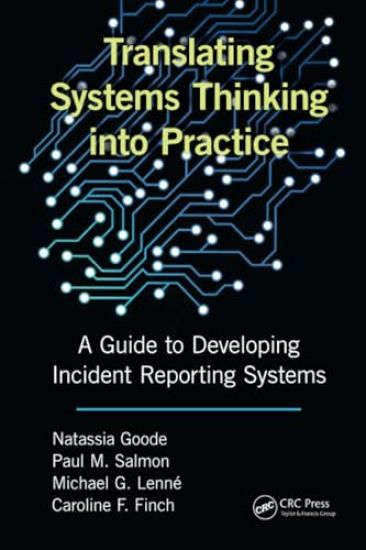
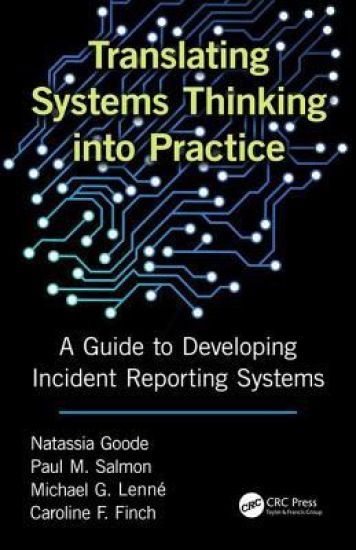
Translating Systems Thinking into Practice

Translating Systems Thinking into Practice

Natassia Goode; Paul M. Salmon; Michael Lenne; Caroline Finch

TAYLOR FRANCIS LTD
2024
nidottu
Systems thinking tells us that human error, violations and technology failures result from poorly designed and managed work systems. To help us understand and prevent injuries and incidents, incident reporting systems must be capable of collecting data on contributory factors from across the overall work system, in addition to factors relating to the immediate context of the event (e.g. front-line workers, environment, and equipment).This book describes how to design a practical, usable incident reporting system based on this approach. The book contains all the information needed to effectively design and implement a new incident reporting system underpinned by systems thinking. It also provides guidance on how to evaluate and improve existing incident reporting systems so they are practical for users, collect good quality data, and reflect the principles of systems thinking.FeaturesHighlights the key principles of systems thinking for designing incident reporting systems Outlines a process for developing and testing incident reporting systems Describes how to evaluate incident reporting systems to ensure they are practical, usable, and collect good quality data Provides detailed guidance on how to analyze incident data, and translate the findings into appropriate incident prevention strategies
Translating Systems Thinking into Practice

Translating Systems Thinking into Practice

Natassia Goode; Paul M. Salmon; Michael Lenne; Caroline Finch

CRC Press
2018
sidottu
Systems thinking tells us that human error, violations and technology failures result from poorly designed and managed work systems. To help us understand and prevent injuries and incidents, incident reporting systems must be capable of collecting data on contributory factors from across the overall work system, in addition to factors relating to the immediate context of the event (e.g. front-line workers, environment, and equipment).This book describes how to design a practical, usable incident reporting system based on this approach. The book contains all the information needed to effectively design and implement a new incident reporting system underpinned by systems thinking. It also provides guidance on how to evaluate and improve existing incident reporting systems so they are practical for users, collect good quality data, and reflect the principles of systems thinking.Features Highlights the key principles of systems thinking for designing incident reporting systems Outlines a process for developing and testing incident reporting systems Describes how to evaluate incident reporting systems to ensure they are practical, usable, and collect good quality data Provides detailed guidance on how to analyze incident data, and translate the findings into appropriate incident prevention strategies
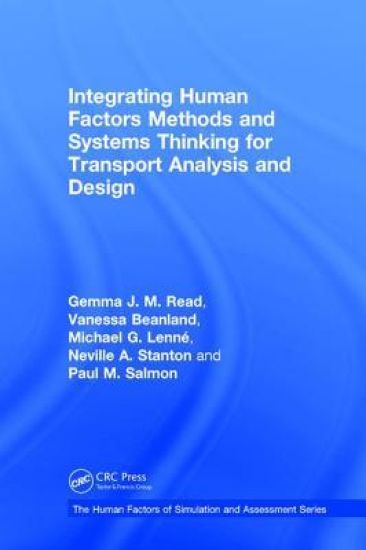
Integrating Human Factors Methods and Systems Thinking for Transport Analysis and Design

Integrating Human Factors Methods and Systems Thinking for Transport Analysis and Design

Gemma J. M. Read; Vanessa Beanland; Michael G. Lenné; Neville A. Stanton; Paul M. Salmon

CRC Press
2017
nidottu
Governments and road safety agencies around the world have either introduced or are considering 'safe system' strategies, a long overdue acknowledgement that different elements of the road system contribute to road safety outcomes. Human factors approaches have a leading role here in both conceptualising the road system as a complex sociotechnical system and in providing practical approaches to support true systems-based countermeasures. This book illustrates the potential for integrating contemporary systems-based human factors methods with modern day driving-assessment methods, such as vehicle instrumentation and driving simulation, to understand and enhance performance in modern day road-transport systems. The book outlines why a fundamental paradigm shift is needed in the way these systems are designed and operated, and illustrates how a wide range of accepted human-factors approaches can be applied successfully to road transport to revolutionise the countermeasure design process. The practical illustrations of these human factors methods are applied to a long-standing road and rail safety issue: rail level crossings, where the road and rail systems intersect. The final chapter of the book highlights the utility of the human factors approach to reducing road trauma and discusses future applications of the approach.
Integrating Human Factors Methods and Systems Thinking for Transport Analysis and Design

Integrating Human Factors Methods and Systems Thinking for Transport Analysis and Design

Gemma J. M. Read; Vanessa Beanland; Michael G. Lenné; Neville A. Stanton; Paul M. Salmon

Ashgate Publishing Limited
2017
sidottu
Governments and road safety agencies around the world have either introduced or are considering 'safe system' strategies, a long overdue acknowledgement that different elements of the road system contribute to road safety outcomes. Human factors approaches have a leading role here in both conceptualising the road system as a complex sociotechnical system and in providing practical approaches to support true systems-based countermeasures. This book illustrates the potential for integrating contemporary systems-based human factors methods with modern day driving-assessment methods, such as vehicle instrumentation and driving simulation, to understand and enhance performance in modern day road-transport systems. The book outlines why a fundamental paradigm shift is needed in the way these systems are designed and operated, and illustrates how a wide range of accepted human-factors approaches can be applied successfully to road transport to revolutionise the countermeasure design process. The practical illustrations of these human factors methods are applied to a long-standing road and rail safety issue: rail level crossings, where the road and rail systems intersect. The final chapter of the book highlights the utility of the human factors approach to reducing road trauma and discusses future applications of the approach.
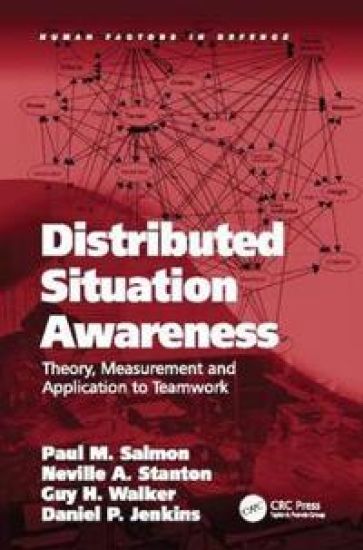
Distributed Situation Awareness

Distributed Situation Awareness

Paul M. Salmon; Neville A. Stanton; Daniel P. Jenkins

CRC Press
2017
nidottu
Having an accurate understanding of what is going on is a key commodity for teams working within military systems. 'Situation awareness' (SA) is the term that is used within human factors circles to describe the level of awareness that operators have of the situation that they are engaged in; it focuses on how operators develop and maintain a sufficient understanding of 'what is going on' in order to achieve success in task performance. Over the past two decades, the construct has become a fundamental theme within the areas of system design and evaluation and has received considerable attention from the human factors research community. Despite this, there is still considerable debate over how SA operates in complex collaborative systems and how SA achievement and maintenance is best supported through system, procedure and interface design. This book focuses on the recently developed concept of distributed situation awareness, which takes a systems perspective on the concept and moves the focus on situation awareness out of the heads of individual operators and on to the overall joint cognitive system consisting of human and technological agents. Situation awareness is viewed as an emergent property of collaborative systems, something that resides in the interaction between elements of the system and not in the heads of individual operators working in that system. The first part of the book presents a comprehensive review and critique of existing SA theory and measurement approaches, following which a novel model for complex collaborative systems, the distributed SA model, and a new modelling procedure, the propositional network approach, are outlined and demonstrated. The next part focuses on real-world applications of the model and modelling procedure, and presents four case studies undertaken in the land warfare, multinational warfare and energy distribution domains. Each case study is described in terms of the domain in question, the methodology employed, and the findings derived in relation to situation awareness theory. The third and final part of the book then concentrates on theoretical development, and uses the academic literature and the findings from the case study applications to validate and extend the distributed SA model described at the beginning of the book. In closing, the utility of the distributed SA model and modeling procedure are outlined and a series of initial guidelines for supporting distributed SA through system design are articulated.
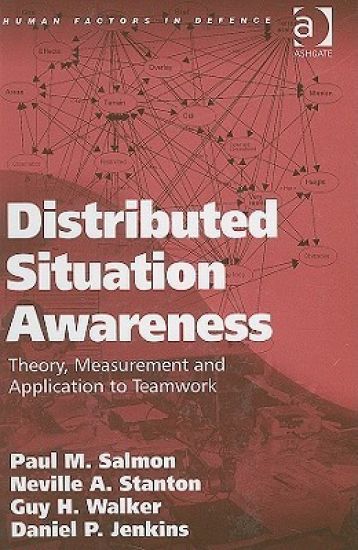
Distributed Situation Awareness

Distributed Situation Awareness

Paul M. Salmon; Neville A. Stanton; Daniel P. Jenkins

Ashgate Publishing Limited
2009
sidottu
Having an accurate understanding of what is going on is a key commodity for teams working within military systems. 'Situation awareness' (SA) is the term that is used within human factors circles to describe the level of awareness that operators have of the situation that they are engaged in; it focuses on how operators develop and maintain a sufficient understanding of 'what is going on' in order to achieve success in task performance. Over the past two decades, the construct has become a fundamental theme within the areas of system design and evaluation and has received considerable attention from the human factors research community. Despite this, there is still considerable debate over how SA operates in complex collaborative systems and how SA achievement and maintenance is best supported through system, procedure and interface design. This book focuses on the recently developed concept of distributed situation awareness, which takes a systems perspective on the concept and moves the focus on situation awareness out of the heads of individual operators and on to the overall joint cognitive system consisting of human and technological agents. Situation awareness is viewed as an emergent property of collaborative systems, something that resides in the interaction between elements of the system and not in the heads of individual operators working in that system. The first part of the book presents a comprehensive review and critique of existing SA theory and measurement approaches, following which a novel model for complex collaborative systems, the distributed SA model, and a new modelling procedure, the propositional network approach, are outlined and demonstrated. The next part focuses on real-world applications of the model and modelling procedure, and presents four case studies undertaken in the land warfare, multinational warfare and energy distribution domains. Each case study is described in terms of the domain in question, the methodology employed, and the findings derived in relation to situation awareness theory. The third and final part of the book then concentrates on theoretical development, and uses the academic literature and the findings from the case study applications to validate and extend the distributed SA model described at the beginning of the book. In closing, the utility of the distributed SA model and modeling procedure are outlined and a series of initial guidelines for supporting distributed SA through system design are articulated.