Kirjojen hintavertailu. Mukana 12 595 353 kirjaa ja 12 kauppaa.

Kirjailija

Paul Pierson

Kirjat ja teokset yhdessä paikassa: 10 kirjaa, julkaisuja vuosilta 1995-2025, suosituimpien joukossa American Amnesia: How the War on Government Led Us to Forget What Made America Prosper. Vertaile teosten hintoja ja tarkista saatavuus suomalaisista kirjakaupoista.

10 kirjaa

Kirjojen julkaisuhaarukka 1995-2025.

Partisan Nation

Partisan Nation

Paul Pierson; Eric Schickler

THE UNIVERSITY OF CHICAGO PRESS
2025
nidottu
A provocative exploration of how America’s democratic crisis is rooted in a dangerous mismatch between our Constitution and today’s nationalized, partisan politics. The ground beneath American political institutions has moved, with national politics subsuming and transforming the local. As a result, American democracy is in trouble. In this paradigm-shifting book, political scientists Paul Pierson and Eric Schickler bring a sharp new perspective to today’s challenges. Attentive to the different coalitions, interests, and incentives that define the Democratic and Republican parties, they show how contemporary polarization emerged in a rapidly nationalizing country and how it differs from polarization in past eras. In earlier periods, three key features of the political landscape—state parties, interest groups, and media—varied locally and reinforced the nation’s stark regional diversity. But this began to change in the 1960s as the two parties assumed clearer ideological identities and the power of the national government expanded, raising the stakes of conflict. Together with technological and economic change, these developments have reconfigured state parties, interest groups, and media in self-reinforcing ways. The result is that today’s polarization is self-perpetuating—and intensifying. Partisan Nation offers a powerful caution. As a result of this polarization, America’s political system is distinctly and acutely vulnerable to an authoritarian movement emerging in the contemporary Republican Party, which has both the motive and the means to exploit America’s unusual Constitutional design. Combining the precision and acuity characteristic of their earlier work, Pierson and Schickler explain what these developments mean for American governance and democracy.
Partisan Nation

Partisan Nation

Paul Pierson; Eric Schickler

THE UNIVERSITY OF CHICAGO PRESS
2024
sidottu
A provocative exploration of how America’s democratic crisis is rooted in a dangerous mismatch between our Constitution and today’s nationalized, partisan politics. The ground beneath American political institutions has moved, with national politics subsuming and transforming the local. As a result, American democracy is in trouble. In this paradigm-shifting book, political scientists Paul Pierson and Eric Schickler bring a sharp new perspective to today’s challenges. Attentive to the different coalitions, interests, and incentives that define the Democratic and Republican parties, they show how contemporary polarization emerged in a rapidly nationalizing country and how it differs from polarization in past eras. In earlier periods, three key features of the political landscape—state parties, interest groups, and media—varied locally and reinforced the nation’s stark regional diversity. But this began to change in the 1960s as the two parties assumed clearer ideological identities and the power of the national government expanded, raising the stakes of conflict. Together with technological and economic change, these developments have reconfigured state parties, interest groups, and media in self-reinforcing ways. The result is that today’s polarization is self-perpetuating—and intensifying. Partisan Nation offers a powerful caution. As a result of this polarization, America’s political system is distinctly and acutely vulnerable to an authoritarian movement emerging in the contemporary Republican Party, which has both the motive and the means to exploit America’s unusual Constitutional design. Combining the precision and acuity characteristic of their earlier work, Pierson and Schickler explain what these developments mean for American governance and democracy.
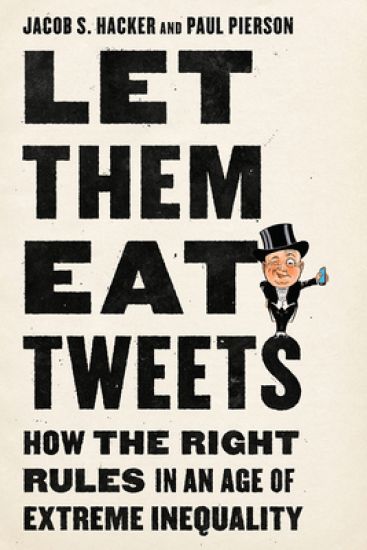
Let Them Eat Tweets: How the Right Rules in an Age of Extreme Inequality

Let Them Eat Tweets: How the Right Rules in an Age of Extreme Inequality

Jacob S. Hacker; Paul Pierson

Liveright Publishing Corporation
2021
nidottu
In Let Them Eat Tweets, best-selling political scientists Jacob S. Hacker and Paul Pierson argue that despite the rhetoric of Donald Trump, Josh Hawley, and other right-wing "populists," the Republican Party came to serve its plutocratic masters to a degree without precedent in modern global history. To maintain power while serving the 0.1 percent, the GOP has relied on increasingly incendiary racial and cultural appeals to its almost entirely white base. Calling this dangerous hybrid "plutocratic populism," Hacker and Pierson show how, over the last forty years, reactionary plutocrats and right-wing populists have become the two faces of a party that now actively undermines democracy to achieve its goals against the will of the majority of Americans. Based on decades of research and featuring a new epilogue about the intensification of GOP radicalism after the 2020 election, Let Them Eat Tweets authoritatively explains the doom loop of tax cutting and fearmongering that defines the Republican Party--and reveals how the rest of us can fight back.
Let Them Eat Tweets: How the Right Rules in an Age of Extreme Inequality

Let Them Eat Tweets: How the Right Rules in an Age of Extreme Inequality

Jacob S. Hacker; Paul Pierson

Liveright Publishing Corporation
2020
sidottu
The Republican Party appears to be divided between a tax-cutting old guard and a white-nationalist vanguard--and with Donald Trump's ascendance, the upstarts seem to be winning. Yet how are we to explain that, under Trump, the plutocrats have gotten almost everything they want, including a huge tax cut for corporations and the wealthy, regulation-killing executive actions, and a legion of business-friendly federal judges? Does the GOP represent "forgotten" Americans? Or does it represent the superrich?In Let Them Eat Tweets, best-selling political scientists Jacob S. Hacker and Paul Pierson offer a definitive answer: the Republican Party serves its plutocratic masters to a degree without precedent in modern global history. Conservative parties, by their nature, almost always side with the rich. But when faced with popular resistance, they usually make concessions, allowing some policies that benefit the working and middle classes. After all, how can a political party maintain power in a democracy if it serves only the interests of a narrow and wealthy slice of society?Today's Republicans have shown the way, doubling down on a truly radical, elite-benefiting economic agenda while at the same time making increasingly incendiary racial and cultural appeals to their almost entirely white base. Telling a forty-year story, Hacker and Pierson demonstrate that since the early 1980s, when inequality started spiking, extreme tax cutting, union busting, and deregulation have gone hand in hand with extreme race-baiting, outrage stoking, and disinformation. Instead of responding to the real challenges facing voters, the Republican Party offers division and distraction--most prominently, in the racist, nativist bile of the president's Twitter feed.As Hacker and Pierson argue, Trump isn't a break with the GOP's recent past. On the contrary, he embodies its tightening embrace of plutocracy and right-wing extremism--a dynamic Hacker and Pierson call "plutocratic populism." As Trump and his far-right allies spew hatred and lies, Republicans in Congress and in statehouses attack social programs and funnel more and more money to the top 0.1 percent of Americans. Far from being at war with each other, reactionary plutocrats and right-wing populists have become the two faces of a party that now actively undermines democracy to achieve its goals against the will of the majority of Americans.Drawing on decades of research, Hacker and Pierson authoritatively explain the doom loop of tax cutting and fearmongering that characterizes our era--and reveal how we can fight back.
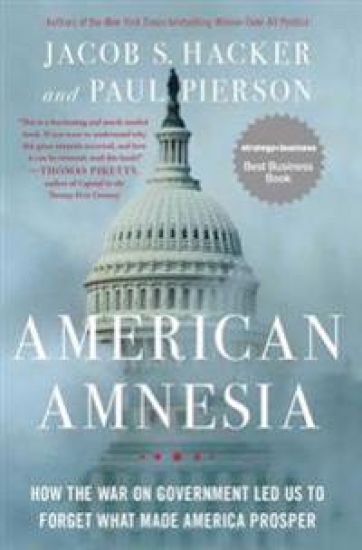
American Amnesia: How the War on Government Led Us to Forget What Made America Prosper
A "provocative" (Kirkus Reviews), timely, and topical work that examines what's good for American business and what's good for Americans--and why those interests are misaligned. In American Amnesia, bestselling political scientists Jacob S. Hacker and Paul Pierson trace the economic and political history of the United States over the last century and show how a viable mixed economy has long been the dominant engine of America's prosperity. We have largely forgotten this reliance, as many political circles and corporate actors have come to mistakenly see government as a hindrance rather than the propeller it once was. "American Amnesia" is more than a rhetorical phrase; elites have literally forgotten, or at least forgotten to talk about, the essential role of public authority in achieving big positive-sum bargains in advanced societies. The mixed economy was the most important social innovation of the twentieth century. It spread a previously unimaginable level of broad prosperity. It enabled steep increases in education, health, longevity, and economic security. And yet, extraordinarily, it is anathema to many current economic and political elites. Looking at this record of remarkable accomplishment, they recoil in horror. And as the advocates of anti-government free market fundamentalist have gained power, they are hell-bent on scrapping the instrument of nearly a century of unprecedented economic and social progress. In the American Amnesia, Hacker and Pierson explain the full "story of how government helped make America great, how the enthusiasm for bashing government is behind its current malaise, and how a return to effective government is the answer the nation is looking for" (The New York Times).
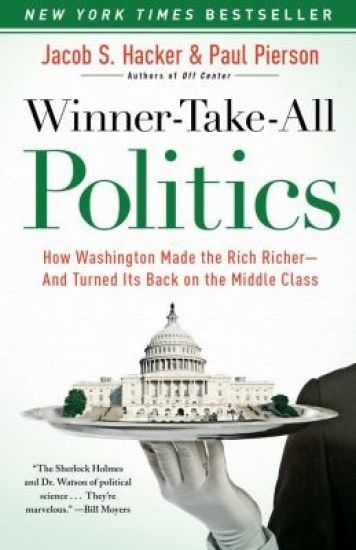
Winner-Take-All Politics: How Washington Made the Rich Richer--And Turned Its Back on the Middle Class
This acclaimed paradigm-shifting work identifies the real culprit behind one of the great economic crises of our time--the growing inequality of incomes between the vast majority of Americans and the richest of the rich. A groundbreaking work that identifies the real culprit behind one of the great economic crimes of our time-- the growing inequality of incomes between the vast majority of Americans and the richest of the rich. We all know that the very rich have gotten a lot richer these past few decades while most Americans haven't. In fact, the exorbitantly paid have continued to thrive during the current economic crisis, even as the rest of Americans have continued to fall behind. Why do the "haveit- alls" have so much more? And how have they managed to restructure the economy to reap the lion's share of the gains and shift the costs of their new economic playground downward, tearing new holes in the safety net and saddling all of us with increased debt and risk? Lots of so-called experts claim to have solved this great mystery, but no one has really gotten to the bottom of it--until now. In their lively and provocative Winner-Take-All Politics, renowned political scientists Jacob S. Hacker and Paul Pierson demonstrate convincingly that the usual suspects--foreign trade and financial globalization, technological changes in the workplace, increased education at the top--are largely innocent of the charges against them. Instead, they indict an unlikely suspect and take us on an entertaining tour of the mountain of evidence against the culprit. The guilty party is American politics. Runaway inequality and the present economic crisis reflect what government has done to aid the rich and what it has not done to safeguard the interests of the middle class. The winner-take-all economy is primarily a result of winner-take-all politics. In an innovative historical departure, Hacker and Pierson trace the rise of the winner-take-all economy back to the late 1970s when, under a Democratic president and a Democratic Congress, a major transformation of American politics occurred. With big business and conservative ideologues organizing themselves to undo the regulations and progressive tax policies that had helped ensure a fair distribution of economic rewards, deregulation got under way, taxes were cut for the wealthiest, and business decisively defeated labor in Washington. And this transformation continued under Reagan and the Bushes as well as under Clinton, with both parties catering to the interests of those at the very top. Hacker and Pierson's gripping narration of the epic battles waged during President Obama's first two years in office reveals an unpleasant but catalyzing truth: winner-take-all politics, while under challenge, is still very much with us. Winner-Take-All Politics--part revelatory history, part political analysis, part intellectual journey-- shows how a political system that traditionally has been responsive to the interests of the middle class has been hijacked by the superrich. In doing so, it not only changes how we think about American politics, but also points the way to rebuilding a democracy that serves the interests of the many rather than just those of the wealthy few.
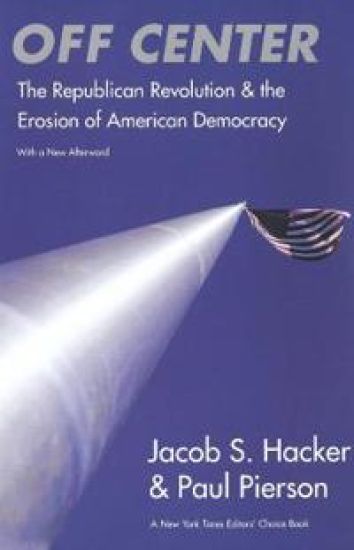
Off Center

Off Center

Jacob S. Hacker; Paul Pierson

Yale University Press
2006
pokkari
A timely investigation of the most innovative recent urban housing constructionsThe Republicans who run American government today have defied the normal laws of political gravity. They have ruled with the slimmest of majorities and yet have transformed the nation’s governing priorities. They have strayed dramatically from the moderate middle of public opinion and yet have faced little public backlash. Again and again, they have sided with the affluent and ideologically extreme while paying little heed to the broad majority of Americans. And much more often than not, they have come out on top. This book shows why—and why this troubling state of affairs can and must be changed.Written in a highly accessible style by two professional political scientists, Off Center tells the story of a deliberative process restricted and distorted by party chieftains, of unresponsive power brokers subverting the popular will, and of legislation written by and for powerful interests and deliberately designed to mute popular discontent. In the best tradition of engaged social science, Off Center is a powerful and informed critique that points the way toward a stronger foundation for American democracy.
Politics in Time

Politics in Time

Paul Pierson

Princeton University Press
2004
pokkari
This groundbreaking book represents the most systematic examination to date of the often-invoked but rarely examined declaration that "history matters." Most contemporary social scientists unconsciously take a "snapshot" view of the social world. Yet the meaning of social events or processes is frequently distorted when they are ripped from their temporal context. Paul Pierson argues that placing politics in time--constructing "moving pictures" rather than snapshots--can vastly enrich our understanding of complex social dynamics, and greatly improve the theories and methods that we use to explain them. Politics in Time opens a new window on the temporal aspects of the social world. It explores a range of important features and implications of evolving social processes: the variety of processes that unfold over significant periods of time, the circumstances under which such different processes are likely to occur, and above all, the significance of these temporal dimensions of social life for our understanding of important political and social outcomes. Ranging widely across the social sciences, Pierson's analysis reveals the high price social science pays when it becomes ahistorical. And it provides a wealth of ideas for restoring our sense of historical process. By placing politics back in time, Pierson's book is destined to have a resounding and enduring impact on the work of scholars and students in fields from political science, history, and sociology to economics and policy analysis.
Dismantling the Welfare State?

Dismantling the Welfare State?

Paul Pierson

Cambridge University Press
1995
pokkari
This book offers a careful examination of the politics of social policy in an era of austerity and conservative governance. Focusing on the administrations of Ronald Reagan and Margaret Thatcher, Pierson provides a compelling explanation for the welfare state’s durability and for the few occasions where each government was able to achieve significant cutbacks. The programmes of the modern welfare state - the ‘policy legacies’ of previous governments - generally proved resistant to reform. Hemmed in by the political supports that have developed around mature social programmes, conservative opponents of the welfare state were successful only when they were able to divide the supporters of social programmes, compensate those negatively affected, or hide what they were doing from potential critics. The book will appeal to those interested in the politics of neo-conservatism as well as those concerned about the development of the modern welfare state. It will attract readers in the fields of comparative politics, public policy, and political economy.