Kirjojen hintavertailu. Mukana 12 587 770 kirjaa ja 12 kauppaa.

Kirjailija

Paul Pop

Kirjat ja teokset yhdessä paikassa: 6 kirjaa, julkaisuja vuosilta 2004-2018, suosituimpien joukossa Fault-Tolerant Digital Microfluidic Biochips. Vertaile teosten hintoja ja tarkista saatavuus suomalaisista kirjakaupoista.

6 kirjaa

Kirjojen julkaisuhaarukka 2004-2018.

Microfluidic Very Large Scale Integration (VLSI)

Microfluidic Very Large Scale Integration (VLSI)

Paul Pop; Wajid Hassan Minhass; Jan Madsen

Springer International Publishing AG
2018
nidottu
This book presents the state-of-the-art techniques for the modeling, simulation, testing, compilation and physical synthesis of mVLSI biochips. The authors describe a top-down modeling and synthesis methodology for the mVLSI biochips, inspired by microelectronics VLSI methodologies. They introduce a modeling framework for the components and the biochip architecture, and a high-level microfluidic protocol language. Coverage includes a topology graph-based model for the biochip architecture, and a sequencing graph to model for biochemical application, showing how the application model can be obtained from the protocol language. The techniques described facilitate programmability and automation, enabling developers in the emerging, large biochip market.

Fault-Tolerant Digital Microfluidic Biochips

Fault-Tolerant Digital Microfluidic Biochips

Paul Pop; Mirela Alistar; Elena Stuart; Jan Madsen

Springer International Publishing AG
2016
nidottu
This book describes for researchers in the fields of compiler technology, design and test, and electronic design automation the new area of digital microfluidic biochips (DMBs), and thus offers a new application area for their methods. The authors present a routing-based model of operation execution, along with several associated compilation approaches, which progressively relax the assumption that operations execute inside fixed rectangular modules. Since operations can experience transient faults during the execution of a bioassay, the authors show how to use both offline (design time) and online (runtime) recovery strategies. The book also presents methods for the synthesis of fault-tolerant application-specific DMB architectures.· Presents the current models used for the research on compilation and synthesis techniques of DMBs in a tutorial fashion; · Includes a set of “benchmarks”, which are presented in great detail and includes the source code of most of the techniques presented, including solutions to the basic compilation and synthesis problems;· Discusses several new research problems in detail, using numerous examples.
Microfluidic Very Large Scale Integration (VLSI)

Microfluidic Very Large Scale Integration (VLSI)

Paul Pop; Wajid Hassan Minhass; Jan Madsen

Springer International Publishing AG
2016
sidottu
This book presents the state-of-the-art techniques for the modeling, simulation, testing, compilation and physical synthesis of mVLSI biochips. The authors describe a top-down modeling and synthesis methodology for the mVLSI biochips, inspired by microelectronics VLSI methodologies. They introduce a modeling framework for the components and the biochip architecture, and a high-level microfluidic protocol language. Coverage includes a topology graph-based model for the biochip architecture, and a sequencing graph to model for biochemical application, showing how the application model can be obtained from the protocol language. The techniques described facilitate programmability and automation, enabling developers in the emerging, large biochip market.
Fault-Tolerant Digital Microfluidic Biochips

Fault-Tolerant Digital Microfluidic Biochips

Paul Pop; Mirela Alistar; Elena Stuart; Jan Madsen

Springer International Publishing AG
2015
sidottu
This book describes for researchers in the fields of compiler technology, design and test, and electronic design automation the new area of digital microfluidic biochips (DMBs), and thus offers a new application area for their methods. The authors present a routing-based model of operation execution, along with several associated compilation approaches, which progressively relax the assumption that operations execute inside fixed rectangular modules. Since operations can experience transient faults during the execution of a bioassay, the authors show how to use both offline (design time) and online (runtime) recovery strategies. The book also presents methods for the synthesis of fault-tolerant application-specific DMB architectures.· Presents the current models used for the research on compilation and synthesis techniques of DMBs in a tutorial fashion; · Includes a set of “benchmarks”, which are presented in great detail and includes the source code of most of the techniques presented, including solutions to the basic compilation and synthesis problems;· Discusses several new research problems in detail, using numerous examples.
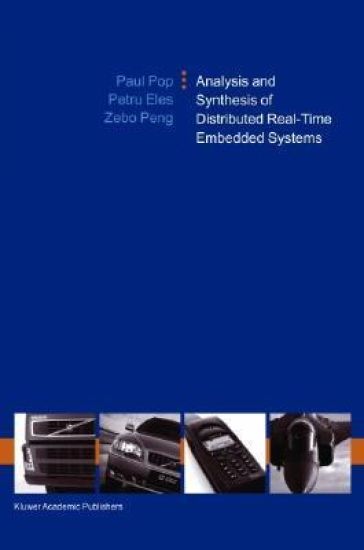
Analysis and Synthesis of Distributed Real-Time Embedded Systems

Analysis and Synthesis of Distributed Real-Time Embedded Systems

Paul Pop; Petru Eles; Zebo Peng

Springer-Verlag New York Inc.
2011
nidottu
Embedded computer systems are now everywhere: from alarm clocks to PDAs, from mobile phones to cars, almost all the devices we use are controlled by embedded computers. An important class of embedded computer systems is that of hard real-time systems, which have to fulfill strict timing requirements. As real-time systems become more complex, they are often implemented using distributed heterogeneous architectures. Analysis and Synthesis of Distributed Real-Time Embedded Systems addresses the design of real-time applications implemented using distributed heterogeneous architectures. The systems are heterogeneous not only in terms of hardware components, but also in terms of communication protocols and scheduling policies. Regarding this last aspect, time-driven and event-driven systems, as well as a combination of the two, are considered. Such systems are used in many application areas like automotive electronics, real-time multimedia, avionics, medical equipment, and factory systems. The proposed analysis and synthesis techniques derive optimized implementations that fulfill the imposed design constraints. An important part of the implementation process is the synthesis of the communication infrastructure, which has a significant impact on the overall system performance and cost. Analysis and Synthesis of Distributed Real-Time Embedded Systems considers the mapping and scheduling tasks within an incremental design process. To reduce the time-to-market of products, the design of real-time systems seldom starts from scratch. Typically, designers start from an already existing system, running certain applications, and the design problem is to implement new functionality on top of this system. Supporting such an incremental design process provides a high degree of flexibility, and can result in important reductions of design costs. Analysis and Synthesis of Distributed Real-Time Embedded Systems will be of interest to advanced undergraduates, graduate students, researchers and designers involved in the field of embedded systems.
Analysis and Synthesis of Distributed Real-Time Embedded Systems

Analysis and Synthesis of Distributed Real-Time Embedded Systems

Paul Pop; Petru Eles; Zebo Peng

Springer-Verlag New York Inc.
2004
sidottu
Embedded computer systems are now everywhere: from alarm clocks to PDAs, from mobile phones to cars, almost all the devices we use are controlled by embedded computers. An important class of embedded computer systems is that of hard real-time systems, which have to fulfill strict timing requirements. As real-time systems become more complex, they are often implemented using distributed heterogeneous architectures. Analysis and Synthesis of Distributed Real-Time Embedded Systems addresses the design of real-time applications implemented using distributed heterogeneous architectures. The systems are heterogeneous not only in terms of hardware components, but also in terms of communication protocols and scheduling policies. Regarding this last aspect, time-driven and event-driven systems, as well as a combination of the two, are considered. Such systems are used in many application areas like automotive electronics, real-time multimedia, avionics, medical equipment, and factory systems. The proposed analysis and synthesis techniques derive optimized implementations that fulfill the imposed design constraints. An important part of the implementation process is the synthesis of the communication infrastructure, which has a significant impact on the overall system performance and cost. Analysis and Synthesis of Distributed Real-Time Embedded Systems considers the mapping and scheduling tasks within an incremental design process. To reduce the time-to-market of products, the design of real-time systems seldom starts from scratch. Typically, designers start from an already existing system, running certain applications, and the design problem is to implement new functionality on top of this system. Supporting such an incremental design process provides a high degree of flexibility, and can result in important reductions of design costs. Analysis and Synthesis of Distributed Real-Time Embedded Systems will be of interest to advanced undergraduates, graduate students, researchers and designers involved in the field of embedded systems.