Kirjojen hintavertailu. Mukana 12 595 353 kirjaa ja 12 kauppaa.

Kirjailija

Paul R. Kleindorfer

Kirjat ja teokset yhdessä paikassa: 6 kirjaa, julkaisuja vuosilta 1992-2018, suosituimpien joukossa Coordinating Aggregate and Detailed Scheduling Decisions in the one Machine Job-shop; I-theory. Vertaile teosten hintoja ja tarkista saatavuus suomalaisista kirjakaupoista.

Mukana myös kirjoitusasut: Paul R Kleindorfer

6 kirjaa

Kirjojen julkaisuhaarukka 1992-2018.

Coordinating Aggregate and Detailed Scheduling Decisions in the one Machine Job-shop; I-theory
This work has been selected by scholars as being culturally important, and is part of the knowledge base of civilization as we know it. This work was reproduced from the original artifact, and remains as true to the original work as possible. Therefore, you will see the original copyright references, library stamps (as most of these works have been housed in our most important libraries around the world), and other notations in the work.This work is in the public domain in the United States of America, and possibly other nations. Within the United States, you may freely copy and distribute this work, as no entity (individual or corporate) has a copyright on the body of the work.As a reproduction of a historical artifact, this work may contain missing or blurred pages, poor pictures, errant marks, etc. Scholars believe, and we concur, that this work is important enough to be preserved, reproduced, and made generally available to the public. We appreciate your support of the preservation process, and thank you for being an important part of keeping this knowledge alive and relevant.
The Economics of Postal Service

The Economics of Postal Service

Michael A. Crew; Paul R. Kleindorfer

Springer-Verlag New York Inc.
2012
nidottu
Postal service has received considerably less attention in the economics literature than traditional public utilities. Postal service is facing some very important challenges arising out of the increasingly high-tech nature of postal service, the entry of competition into the business, and new attitudes on the part of government to postal service. In the United Kingdom and Germany the increased interest in privatization and recognition of the benefits of competition are likely to have an impact on postal service. These challenges mean that postal managers must learn new ways of doing business, not just in successfully introducing new hardware and in new internal operating procedures, but also in the development of new pricing and costing methodologies and in the introduction of new management information systems. In order to deal with these new developments managers need a solid foundation in applied microeconomic theory as it relates to postal service. This book encompasses the theoretical foundation for postal policy, particularly with regard to pricing, service quality, and competitive issues.
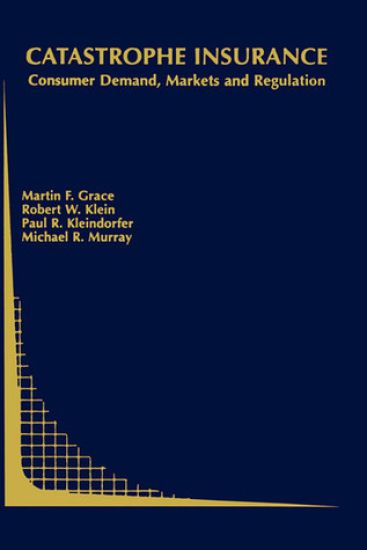
Catastrophe Insurance

Catastrophe Insurance

Martin F. Grace; Robert W. Klein; Paul R. Kleindorfer; Michael R. Murray

Springer-Verlag New York Inc.
2012
nidottu
1. THE PROBLEM OF CATASTROPHE RISK The risk of large losses from natural disasters in the U.S. has significantly increased in recent years, straining private insurance markets and creating troublesome problems for disaster-prone areas. The threat of mega-catastrophes resulting from intense hurricanes or earthquakes striking major population centers has dramatically altered the insurance environment. Estimates of probable maximum losses (PMLs) to insurers from a mega­ catastrophe striking the U.S. range up to $100 billion depending on the location and intensity of the event (Applied Insurance Research, 2001).1 A severe disaster could have a significant financial impact on the industry (Cummins, Doherty, and Lo, 2002; Insurance Services Office, 1996a). Estimates of industry gross losses from the terrorist attack on September 11, 2001 range from $30 billion to $50 billion, and the attack's effect on insurance markets underscores the need to understand the dynamics of the supply of and the demand for insurance against extreme events, including natural disasters. Increased catastrophe risk poses difficult challenges for insurers, reinsurers, property owners and public officials (Kleindorfer and Kunreuther, 1999). The fundamental dilemma concerns insurers' ability to handle low-probability, high-consequence (LPHC) events, which generates a host of interrelated issues with respect to how the risk of such events are 1 These probable maximum loss (PML) estimates are based on a SOD-year "return" period.
Catastrophe Insurance

Catastrophe Insurance

Martin F. Grace; Robert W. Klein; Paul R. Kleindorfer; Michael R. Murray

Springer-Verlag New York Inc.
2003
sidottu
1. THE PROBLEM OF CATASTROPHE RISK The risk of large losses from natural disasters in the U.S. has significantly increased in recent years, straining private insurance markets and creating troublesome problems for disaster-prone areas. The threat of mega-catastrophes resulting from intense hurricanes or earthquakes striking major population centers has dramatically altered the insurance environment. Estimates of probable maximum losses (PMLs) to insurers from a mega­ catastrophe striking the U.S. range up to $100 billion depending on the location and intensity of the event (Applied Insurance Research, 2001).1 A severe disaster could have a significant financial impact on the industry (Cummins, Doherty, and Lo, 2002; Insurance Services Office, 1996a). Estimates of industry gross losses from the terrorist attack on September 11, 2001 range from $30 billion to $50 billion, and the attack's effect on insurance markets underscores the need to understand the dynamics of the supply of and the demand for insurance against extreme events, including natural disasters. Increased catastrophe risk poses difficult challenges for insurers, reinsurers, property owners and public officials (Kleindorfer and Kunreuther, 1999). The fundamental dilemma concerns insurers' ability to handle low-probability, high-consequence (LPHC) events, which generates a host of interrelated issues with respect to how the risk of such events are 1 These probable maximum loss (PML) estimates are based on a SOD-year "return" period.
Decision Sciences

Decision Sciences

Paul R. Kleindorfer; Howard G. Kunreuther; Paul J. H. Schoemaker

Cambridge University Press
1993
sidottu
This long-awaited textbook provides a unified perspective of a rich and varied field. It recognises that in order to develop strategies for improving the decision-making process one needs to understand how decisions are made in practice and in what ways behaviour differs from guidelines implied by normative theories of choice. It is the interplay between descriptive, normative, and prescriptive analysis that gives this book a special flavour. Using a set of illustrative examples, Decision Sciences synthesises current research about different types of decision making, including individual, group, organisational, and societal. Special attention is given to the linkage between problem finding and problem solving. The principal message emerging from the book is that decision making entails a complex set of processes that need to be understood in order to develop sound prescriptions or policy advice.
The Economics of Postal Service

The Economics of Postal Service

Michael A. Crew; Paul R. Kleindorfer

Springer
1992
sidottu
Postal service has received considerably less attention in the economics literature than traditional public utilities. Postal service is facing some very important challenges arising out of the increasingly high-tech nature of postal service, the entry of competition into the business, and new attitudes on the part of government to postal service. In the United Kingdom and Germany the increased interest in privatization and recognition of the benefits of competition are likely to have an impact on postal service. These challenges mean that postal managers must learn new ways of doing business, not just in successfully introducing new hardware and in new internal operating procedures, but also in the development of new pricing and costing methodologies and in the introduction of new management information systems. In order to deal with these new developments managers need a solid foundation in applied microeconomic theory as it relates to postal service. This book encompasses the theoretical foundation for postal policy, particularly with regard to pricing, service quality, and competitive issues.