Kirjojen hintavertailu. Mukana 12 390 323 kirjaa ja 12 kauppaa.

Kirjailija

Paul Ricoeur

Kirjat ja teokset yhdessä paikassa: 64 kirjaa, julkaisuja vuosilta 1976-2026, suosituimpien joukossa Reflections on the Just. Vertaile teosten hintoja ja tarkista saatavuus suomalaisista kirjakaupoista.

Mukana myös kirjoitusasut: Paul Ricœur

64 kirjaa

Kirjojen julkaisuhaarukka 1976-2026.

Das Bose: Eine Herausforderung Fur Philosophie Und Theologie
Woher kommt das Bose? Wie kommt es, dass wir Boses tun? Diese Fragen haben Paul Ricoeur (1913-2005) - den Philosophen und Theologen, der sich selbst nie als solchen bezeichnet hat - seit seinen fruhesten Arbeiten begleitet. Der vorliegende Essay, entstanden aus einem Referat, das Ricoeur 1985 an der Theologischen Fakultat Lausanne gehalten hat, kann stellvertretend fur seine Beschaftigung mit diesen Fragen stehen. Angesichts dessen, was das 20. Jahrhundert an Bosem hervorgebracht hat, beleuchtet Ricoeur hier in einer exemplarischen Tiefe die verschiedenen religiosen, mythologischen und philosophischen Diskurse uber das Bose. Er zeigt, wie die traditionelle Theodizee, aber auch wie Kant, Hegel oder Barth versucht haben, das Problem, das die Existenz des Bosen bedeutet, zu losen. Ricoeur selbst pladiert fur eine Weisheit, die auf die (An-)Klage verzichtet. Paul Ricoeur, 1913-2005, franzosischer Philosoph, war zuletzt Professor an der Universitat Paris-Nanterre und Lehrstuhlnachfolger von Paul Tillich an der University of Chicago. Neben existenz- und geschichtsphilosophischen Forschungen widmete er sich intensiv dem Problem der Sprache.
Minne, historia, glömska

Minne, historia, glömska

Paul Ricoeur

Bokförlaget Daidalos
2005
nidottu
»Arbetet innefattar tre tematiskt och metodiskt strikt avgränsade delar. Den första, som tar upp minnet och minnesfenomenen, präglas av en fenomenologi i den husserlska bemärkelsen av termen. Den andra, som ägnas historien, faller under en historievetenskapernas epistemologi. Den tredje, som kulminerar i en meditation över glömskan, har som ram en hermeneutik rörande den historiska betingelsen för de mänskliga varelser som vi är. Dessa tre delar utgör dock inte tre böcker. I likhet med tre master som bär sammanflätade, men åtskilda segel, tillhör de samma farkost på en och samma seglats. En gemensam problematik genomlöper nämligen minnesfenomenologin, historieepistemologin och den historiska betingelsens hermeneutik: problematiken kring representationen av det förflutna. * Jag är alltjämt oroad över anblicken av alltför mycket minne på det ena hållet och alltför mycket glömska på det andra, för att inte tala om inflytandet från allmänna minneshögtider och missbruk av minne och av glömska. Idén om en det rättmätiga minnets politik är följaktligen ett av mina teman på samhällsområdet.» Paul Ricoeur
The Conflict of Interpretations

The Conflict of Interpretations

Paul Ricoeur

Continuum International Publishing Group Ltd.
2004
nidottu
Paul Ricoeur (1913-) is Professor Emeritus of Philosophy at the University of Chicago and Dean of the Faculty of Letters and Human Sciences at the University of Paris X, Nanterre. One of the foremost contemporary French philosophers, his work is influenced by Husserl, Marcel and Jaspers and is particularly concerned with symbolism, the creation of meaning and the interpretation of texts. The Conflict of Interpretations ranges across an astonishing diversity of fields: structuralism, linguistics, psychoanalysis, religion and faith. The essays it comprises are bound together by Ricoeur's customary concern for interpretation and language and all bear the stamp of the systematic and critical thinking which has become his hallmark in contemporary philosophy. Edited by Don Ihde
The Just

The Just

Paul Ricoeur

University of Chicago Press
2003
nidottu
The essays in this collection by the noted French philosopher Paul Ricoeur grew out of a series of invited lectures given in France on the question of the nature of justice and the law at the Institut des Hautes Etudes pour a Justice in Paris. Gathered under the title "The Just", the essays represent a sustained reflection on the relation between the concept of the juridical - as embedded in written laws, tribunals, judges and verdicts - and the philosophical concept of right, situated between moral theory and politics. In political philosophy, Ricoeur argues, the question of right is obscured by the haunting presence of historical evil. In a philosophy of right, on the other hand, the leading theme is peace. Building on the framework established in his earlier work, "Oneself as Another", Ricoeur shifts his focus from political considerations to those having to do with the juridical dimension of the problem of justice. Fleshing out this framework, Ricoeur revisits the work of Plato, Aristotle and Kant in his engagements with contemporary thinkers, particularly John Rawls, Michael Walzer, Hannah Arendt and Ronald Dworkin. His thought ranges from conceptual analysis, to the theory of law, and finally to the act of judging, exploring the ideas of sanction, rehabilitation, pardon and the status of conscience in relation to the demands of the law. A valuable work for understanding the development of Ricoeur's hermeneutic philosophy and the literary and religious dimensions of his thought, "The Just" should also be of interest to scholars interested in matters of ethics, law and justice.
Thinking Biblically – Exegetical and Hermeneutical Studies

Thinking Biblically – Exegetical and Hermeneutical Studies

André Lacocque; Paul Ricoeur; David Pellauer

University of Chicago Press
2003
nidottu
This study discusses six crucial passages from the Old Testament, offering a commentary and new insights into their meaning. Employing a historical-critical method, the text takes account of archaeological, philological and historical research. This method is expanded to include the dynamic tradition of reading Scripture, including developments subsequent to the production of the original literary text. Also taken into account is the relation between the texts and the historical communities who read and interpreted them, together with philosophical speculation. The commentaries highlight the metaphorical structure of the passages and how they have served as catalysts for philosophical thinking from the Greeks to the modern age. Reading the Bible through different but complementary perspectives, the book seeks to reveal the familiar texts as vibrant, philosophically consequential and endlessly absorbing. The passages discussed are: the story of Adam and Eve; the commandment "thou shalt not kill"; "the valley of dry bones" passage from Ezekiel; Psalm 22; the "Song of Songs"; and the naming of God in Exodus 3;14.
The Rule of Metaphor

The Rule of Metaphor

Paul Ricoeur

Routledge
2003
nidottu
Paul Ricoeur is widely regarded as one of the most distinguished philosophers of our time. In The Rule of Metaphor he seeks 'to show how language can extend itself to its very limits, forever discovering new resonances within itself'. Recognizing the fundamental power of language in constructing the world we perceive, it is a fruitful and insightful study of how language affects how we understand the world, and is also an indispensable work for all those seeking to retrieve some kind of meaning in uncertain times.
The Philosophy of Paul Ricoeur, Volume 22

The Philosophy of Paul Ricoeur, Volume 22

Paul Ricoeur; Lewis Edwin Hahn

Open Court Publishing Co ,U.S.
1998
pokkari
Paul Ricoeur is widely regarded as the foremost living phenomenologist. His writings cover a wide range of topics, from the history of philosophy, literary criticism and aesthetics, to metaphysics, ethics, religion, semiotics, linguistic structuralism, the humanistic sciences, psychoanalysis, Marxism, guilt and evil, and conflicts of interpretation. In similar format to the preceding 21 volumes of the "Library of Living Philosophers", this book contains Ricoeur's intellectual autobiography, critical essays by 25 leading philosophers, and Ricoeur's replies to these criticisms.
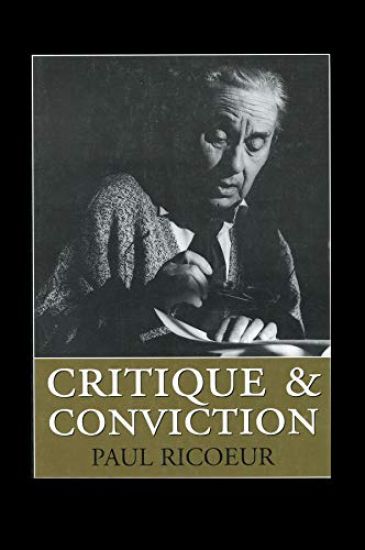
Critique and Conviction

Critique and Conviction

Paul Ricoeur

Columbia University Press
1998
sidottu
Criticism and Conviction offers a rare opportunity to share personally in the intellectual life and journey of the eminent philosopher Paul Ricoeur. Internationally known for his influential works in hermeneutics, theology, psychoanalysis, and aesthetics, until now, Ricoeur has been conspicuously silent on the subject of himself. In this book-a conversation about his life and work with Francois Azouvi and Marc de Launay-Ricoeur reflects on a variety of philosophical, social, religious, and cultural topics, from the paradoxes of political power to the relationship between life and art, and life and death. In the first of eight conversations, Ricoeur traces the trajectory of his life, recounting the origins of his convictions and the development of his intellect against the tragic events of the twentieth century. Declaring himself the "son of a victim of the First World War," Ricoeur, an orphan, sketches his early years in the house of stern but loving grandparents, and the molding of his intellect under the tutelage of Roland Dalbiez, Gabriel Marcel, and Andre Philip. Ricoeur tells the intriguing story of his capture and five-year imprisonment by the Germans during World War II, where he and his compatriots fashioned an intellectual life complete with a library and lectures, and where he, amazingly, was able to continue his dissertation research. Elegantly interweaving anecdotal with philosophical meditations, Ricoeur recounts his relationships with some of the twentieth century's greatest figures, such as Heidegger, Jaspers, and Eliade. He also shares his views on French philosophers and explains his tumultuous relationship with Jacques Lacan. And while expressing his deepest respect for the works of Claude Levi-Strauss and Michel Foucault, Ricoeur reserves his greatest admiration for the narratologist Algirdas Julien Greimas. Ricoeur also explores the relationship between the philosophical and religious domains, attempting to reconcile the two poles in his thought. And readers who have struggled with Ricoeur's work will be grateful for these illuminating discussions that provide an invaluable key to his writings on language and narrative, especially those on metaphor and time. Spontaneous and lively, Criticism and Conviction is a passionate confirmation of Ricoeur's eloquence, lucidity, and intellectual rigor, and affirms his position as one of this century's greatest thinkers. It is an essential book for anyone interested in philosophy and literary criticism.
Critique and Conviction

Critique and Conviction

Paul Ricoeur

Polity Press
1997
nidottu
In this new book Paul Ricoeur - one of the greatest contemporary philosophers - offers a personal reflection on his life and on the themes which have preoccupied him over the course of his career. Ranging across topics in ethics and metaphysics, psychoanalysis and hermeneutics, history, politics and religion, Critique and Conviction provides unique insight into the ideas and sources of influence which have shaped Ricoeur's philosophical approach and defined his core concerns. Ricoeur also discusses in detail a number of topics about which he has not written extensively before, including questions of aesthetics and current affairs. This remarkable testimony by one of the leading philosophers of the twentieth century will be of great interest to students of philosophy, theology, literary theory and social and political theory.
Critique and Conviction

Critique and Conviction

Paul Ricoeur

Polity Press
1997
sidottu
In this new book Paul Ricoeur - one of the greatest contemporary philosophers - offers a personal reflection on his life and on the themes which have preoccupied him over the course of his career. Ranging across topics in ethics and metaphysics, psychoanalysis and hermeneutics, history, politics and religion, Critique and Conviction provides unique insight into the ideas and sources of influence which have shaped Ricoeur's philosophical approach and defined his core concerns. Ricoeur also discusses in detail a number of topics about which he has not written extensively before, including questions of aesthetics and current affairs. This remarkable testimony by one of the leading philosophers of the twentieth century will be of great interest to students of philosophy, theology, literary theory and social and political theory.
Key to Husserl's Ideas 1

Key to Husserl's Ideas 1

Paul Ricoeur

Fordham University Press
1996
nidottu
In 1950, Paul Ricoeur published his translation of Edmund Husserl's "Ideen I" under the title "Idees directrices pour une phenomenologie". It became the handbook and key to the father of phemenology. This combination of Husserl and Ricoeur should be of interest to both professors and students.
Oneself as Another

Oneself as Another

Paul Ricoeur

University of Chicago Press
1995
nidottu
Paul Ricoeur has been hailed as one of the most important thinkers of the century. Oneself as Another, the clearest account of his "philosophical ethics," substantiates this position and lays the groundwork for a metaphysics of morals. Focusing on the concept of personal identity, Ricoeur develops a hermeneutics of the self that charts its epistemological path and ontological status.
From Text to Action: Essays in Hermeneutics Vol 2

From Text to Action: Essays in Hermeneutics Vol 2

Paul Ricoeur; Kathleen Blamey

Northwestern University Press
1991
nidottu
With his writings on phenomenology, psychoanalysis, Marxism, ideology, and religion, Paul Ricoeur has single-handedly redefined and revitalized the hermeneutic tradition. From Text to Action is an essential companion to the now classic The Conflict of Interpretations. Here, Ricoeur continues and extends his project of constructing a general theory of interpretation, positioning his work in relation to its own philosophical background: Hegel, Husserl, Gadamer, and Weber. He also responds to contemporary figures like K.O. Apel and Jurgen Habermas, connecting his own theorization of ideology to their version of ideology critique.
A Ricoeur Reader

A Ricoeur Reader

Paul Ricoeur

University of Toronto Press
1991
pokkari
Paul Ricoeur is one of the most important modern literary theorists and a philosopher of world renown. This collection brings together his published articles, papers, reviews, and interviews that focus on literary theory and criticism. The first of four sections includes early pieces that explore the philosophical foundations for a post-structural hermeneutics. The second contains reviews and essays in which Ricoeur engages in debate over some of the central themes of literary theory, including figuration/configuration and narrativity. In the third section are later essays on post-structuralist hermeneutics, and in the fourth, interviews in which he discusses text, language, and myths. Mario Valdés provides an introduction to the literary theories of Paul Ricoeur and the works in this collection particularly. He also includes a complete bibliography of Ricoeur's works that have appeared in English.