Kirjojen hintavertailu. Mukana 12 390 323 kirjaa ja 12 kauppaa.

Kirjailija

Paul Routledge

Kirjat ja teokset yhdessä paikassa: 10 kirjaa, julkaisuja vuosilta 1993-2026, suosituimpien joukossa Wilson. Vertaile teosten hintoja ja tarkista saatavuus suomalaisista kirjakaupoista.

10 kirjaa

Kirjojen julkaisuhaarukka 1993-2026.

Wilson

Wilson

Paul Routledge

Haus Publishing
2006
nidottu
Harold Wilson held out the promise of technology and of 'the Britain that is going to be forged in the white heat of this revolution'. A balance of payment crisis, leading to devaluation in 1967, frustrated the fulfilment of his prime ministerial promises. Meanwhile foreign affairs were dominated by the issue of Rhodesia, in which Wilson took a personal initiative in diplomacy with Ian Smith but failed to make any progress.
For The Love of Canals

For The Love of Canals

Paul Routledge

Mirror Books
2026
sidottu
"Most canals still in existence - two thousand miles of them - were built more than two hundred years ago, before the advent of steam railways began to make them redundant before their time. It is remarkable how many survive, often a tribute to the immense amount of hard work with picks and shovels, just like the original navvies, of volunteers who restored abandoned waterways." For the Love of Canals begins in Paul's previous home in Dudswell Wharf, where he lived hard by "the Cut", as canal folk know the waterway, just north of the historic Hertfordshire town of Berkhamsted. Paul's first encounter with canals goes all the way back to his childhood, in the coal mining country of west Yorkshire. Just over the hill from his home town of Normanton lay the Aire and Calder Navigation Canal, a prince among waterways, that served the collieries of half the country. From these early beginnings, he graduated to cycling the entire lengths of several canals in southern England, on his folding Brompton, and in later years walking many more across the country. For the Love of Canals brings readers on a journey round Britain's canals, their history, their rise, decline and rebirth, their role in trade, their romance, their dark narrative of crime, their future in the gentrification of homes by "the Cut" that were once deeply unfashionable but now highly sought-after, their sport and wildlife and most of all their sheer fun and pleasure, on the towpath, on board and in art, film and books.
For the Love of Trains

For the Love of Trains

Paul Routledge

Reach plc
2025
sidottu
Coincides with the 200th anniversary of the modern railway“As a railwayman’s son I am chuffed to write a book in celebration of trains for the bicentenary year of the world’s first public railway. Covering every aspect from the Victorian railway mania, the heyday and end of steam, the railway at war and my boyhood passion of trainspotting, to the triumph and debacle of HS1 and HS2.”Dedicated ‘Puffer Nutter’ Paul Routledge has loved trains all his life. Whether it’s chugging along on a scenic steam railway or whizzing through towns and fields to the other side of the country, for Paul it has never lost its magic.A journalist for nearly 60 years years and Daily Mirror columnist for 27 of those, Paul has written regularly about the joys of train travel.Now the country is set to celebrate the 200th anniversary of the modern railway – The Stockton & Darlington Railway opened on September 27, 1825 – when better to pen a love letter to trains?Looking at everything from the earliest days, fascinating stories, famous faces and future of the railways, Paul’s ode to trains is a must-read for any railway fan as well as those enthusiastic amateurs who just want to know a little more about transport they possibly take for granted.
Space Invaders

Space Invaders

Paul Routledge

Pluto Press
2017
pokkari
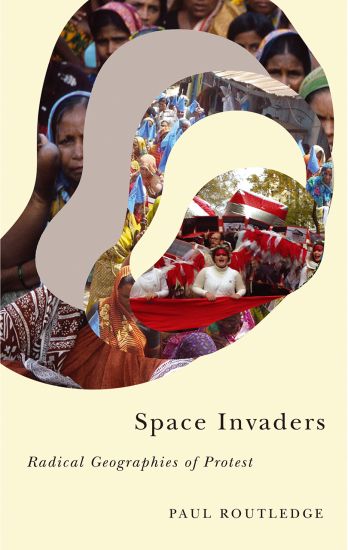
Space Invaders argues for the importance of a radical geographic perspective in enabling us to make sense of protests and social movements around the world. Under conditions of increasing global economic inequalities, we are witnessing the flourishing of grassroots people's movements fighting for improved rights. Whether it be the alter-globalisation mobilisations of the turn of the century, the flurry of Occupy protests, or the current wave of anti-austerity mobilisations taking place, there is a geographical logic to all forms of protest whether that be through transforming landscapes, occupying enemy territory or developing solidarity and communication networks. Paul Routledge takes a primarily auto-ethnographical perspective, drawing upon his extensive experience over the past thirty years working with various forms of protest in Europe, Asia and Latin America, to provide an account of how a radical geographical imagination can inform our understanding and the prosecution of protest.
Space Invaders

Space Invaders

Paul Routledge

Pluto Press
2017
sidottu
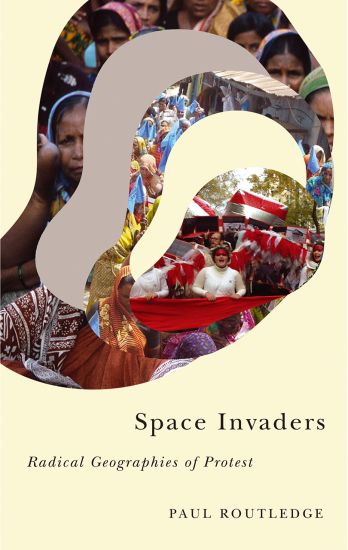
Space Invaders argues for the importance of a radical geographic perspective in enabling us to make sense of protests and social movements around the world. Under conditions of increasing global economic inequalities, we are witnessing the flourishing of grassroots people's movements fighting for improved rights. Whether it be the alter-globalisation mobilisations of the turn of the century, the flurry of Occupy protests, or the current wave of anti-austerity mobilisations taking place, there is a geographical logic to all forms of protest whether that be through transforming landscapes, occupying enemy territory or developing solidarity and communication networks. Paul Routledge takes a primarily auto-ethnographical perspective, drawing upon his extensive experience over the past thirty years working with various forms of protest in Europe, Asia and Latin America, to provide an account of how a radical geographical imagination can inform our understanding and the prosecution of protest.
Global Justice Networks

Global Justice Networks

Paul Routledge; Andrew Cumbers

Manchester University Press
2016
nidottu
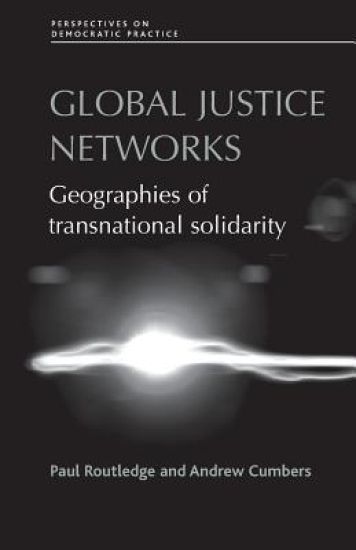
This book provides a critical investigation of what has been termed the ‘global justice movement’. Through a detailed study of a grassroots peasants’ network in Asia (People’s Global Action), an international trade union network (the International Federation of Chemical, Energy, Mining and General Workers) and the Social Forum process, it analyses some of the global justice movement’s component parts, operational networks and their respective dynamics, strategies and practices. The authors argue that the emergence of new globally-connected forms of collective action against neoliberal globalisation are indicative of a range of place-specific forms of political agency that coalesce across geographic space at particular times, in specific places, and in a variety of ways. Rather than being indicative of a coherent ‘movement’, the authors argue that such forms of political agency contain many political and geographical fissures and fault-lines, and are best conceived of as ‘global justice networks’: overlapping, interacting, competing, and differentially-placed and resourced networks that articulate demands for social, economic and environmental justice. Such networks, and the social movements that comprise them, characterise emergent forms of trans-national political agency. The authors argue that the role of key geographical concepts of space, place and scale are crucial to an understanding of the operational dynamics of such networks. Such an analysis challenges key current assumptions in the literature about the emergence of a global civil society.
Global Justice Networks

Global Justice Networks

Paul Routledge; Andrew Cumbers

Manchester University Press
2009
sidottu
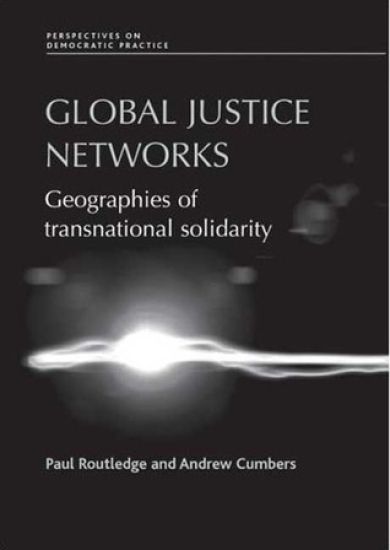
This book provides a critical investigation of what has been termed the ‘global justice movement’. Through a detailed study of a grassroots peasants’ network in Asia (People’s Global Action), an international trade union network (the International Federation of Chemical, Energy, Mining and General Workers) and the Social Forum process, it analyses some of the global justice movement’s component parts, operational networks and their respective dynamics, strategies and practices. The authors argue that the emergence of new globally-connected forms of collective action against neoliberal globalisation are indicative of a range of place-specific forms of political agency that coalesce across geographic space at particular times, in specific places, and in a variety of ways. Rather than being indicative of a coherent ‘movement’, the authors argue that such forms of political agency contain many political and geographical fissures and fault-lines, and are best conceived of as ‘global justice networks’: overlapping, interacting, competing, and differentially-placed and resourced networks that articulate demands for social, economic and environmental justice. Such networks, and the social movements that comprise them, characterise emergent forms of trans-national political agency. The authors argue that the role of key geographical concepts of space, place and scale are crucial to an understanding of the operational dynamics of such networks. Such an analysis challenges key current assumptions in the literature about the emergence of a global civil society.This book is relevant to United Nations Sustainable Development Goal 16, Peace, justice and strong institutions
Public Servant, Secret Agent

Public Servant, Secret Agent

Paul Routledge

HARPERCOLLINS PUBLISHERS
2003
nidottu
The first biography of Airey Neave, Colditz escapee, MI6 officer, mastermind of Margaret Thatcher's leadership campaign and on the verge of being her first Secretary of State for Northern Ireland when he was brutally murdered in the palace of Westminster by the INLA.
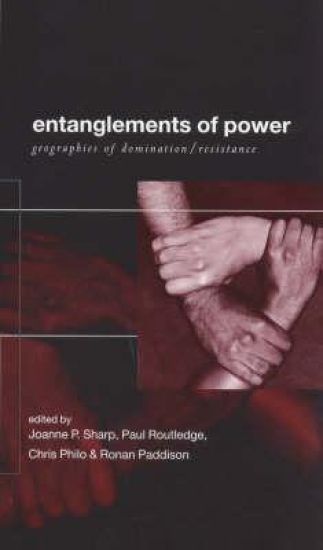
Entanglements of Power

Entanglements of Power

Ronan Paddison; Chris Philo; Paul Routledge; Joanne Sharp

Routledge
1999
nidottu
This book argues that practices of resistance cannot be separated from practices of domination, and that they are always entangled in some configuration. They are inextricably linked, such that one always bears at least a trace of the other that contaminates or subverts it. The team of contributors explore themes of identity, embodiment, organisation, colonialism, and political transformation, examining them from historical, contemporary and more abstract perspectives within a wide geographical and cultural spectrum. Case studies include German Reunification; Jamaican Yardies on British Television; Victorian Sexuality and Moralisation in Cremorne Gardens; Ethnicity, Gender and Nation in Ecuador; Sport as Power; the film Falling Down. Entanglements of Power presents an exciting and challenging account of the symbiotic relationship between domination and resistance, and contextualises this within the parameters of geography with a rich body of case-study material and a respected team of contributors.
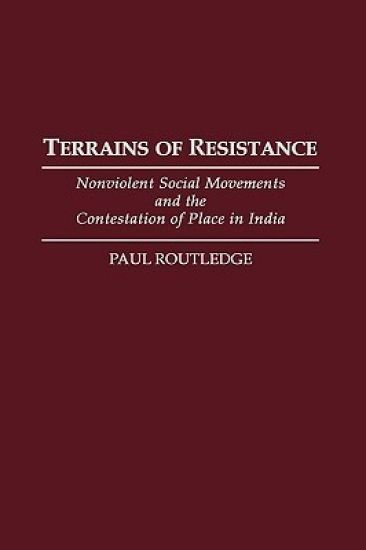
Terrains of Resistance

Terrains of Resistance

Paul Routledge

Praeger Publishers Inc
1993
sidottu
Drawing from the field of political sociology, geography, anthropology, and peace studies, Routledge explores how peasant communities in rural India form effective resistance movements against displacement, dislocation, and cultural destruction engendered by the development process. He shows how the Baloapal movement--resisting a missile base--and the Chipko movement--resisting a program of deforestation--offer rich lessons in development strategies, nonviolent sanctions, and grassroots social change. The sanctions chosen by the movements are shown to be of particular importance and to have emerged from the participants' profound sense of place. Core beliefs, traditional values, and common goals are summoned to inspire beleaguered communities and are employed to resist outside domination and despoliation. Terrains of Resistance, accordingly, marks sites of conflict in specific times and places at the essential levels of belief and culture. They juxtapose the state's coercive power in support of development against the ingenuity and tenacity of grassroots movements. A highly informed, well written work showing the potential for nonviolent sanctions throughout the developing world, and the possible implications of continued grassroots mobilizations. This book will be of particular interest to students of social movements and Indian politics and to political scientists, sociologists, geographers, and anthropologists.