Kirjojen hintavertailu. Mukana 12 595 353 kirjaa ja 12 kauppaa.
Kirjailija
Paul S. Muhly
Kirjat ja teokset yhdessä paikassa: 2 kirjaa, julkaisuja vuosilta 1995-1999, suosituimpien joukossa Hilbert Modules over Operator Algebras. Vertaile teosten hintoja ja tarkista saatavuus suomalaisista kirjakaupoista.
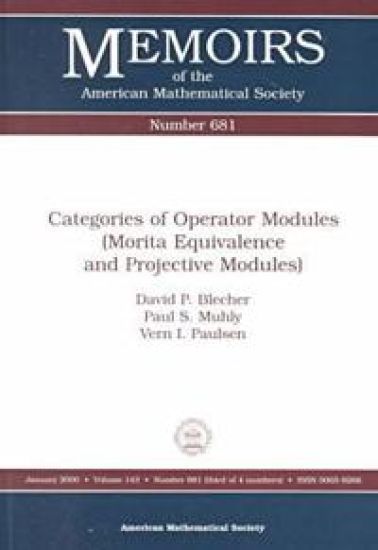
We employ recent advances in the theory of operator spaces, also known as quantized functional analysis, to provide a context in which one can compare categories of modules over operator algebras that are not necessarily self-adjoint. We focus our attention on the category of Hilbert modules over an operator algebra and on the category of operator modules over an operator algebra. The module operations are assumed to be completely bounded - usually, completely contractive. We develop the notion of a Morita context between two operator algebras $A$ and $B$. This is a system $(A,B,{}_{A}X_{B},{}_{B} Y_{A},(\cdot,\cdot),[\cdot,\cdot])$ consisting of the algebras, two bimodules $_{A}X_{B$ and $_{B}Y_{A}$ and pairings $(\cdot,\cdot)$ and $[\cdot,\cdot]$ that induce (complete) isomorphisms between the (balanced) Haagerup tensor products, $X \otimes_{hB} {} Y$ and $Y \otimes_{hA} {} X$, and the algebras, $A$ and $B$, respectively.Thus, formally, a Morita context is the same as that which appears in pure ring theory. The subtleties of the theory lie in the interplay between the pure algebra and the operator space geometry.Our analysis leads to viable notions of projective operator modules and dual operator modules. We show that two C$^*$-algebras are Morita equivalent in our sense if and only if they are $C^{\ast}$-algebraically strong Morita equivalent, and moreover the equivalence bimodules are the same. The distinctive features of the non-self-adjoint theory are illuminated through a number of examples drawn from complex analysis and the theory of incidence algebras over topological partial orders. Finally, an appendix provides links to the literature that developed since this Memoir was accepted for publication.