Kirjojen hintavertailu. Mukana 12 595 353 kirjaa ja 12 kauppaa.

Kirjailija

Paul Smeyers

Kirjat ja teokset yhdessä paikassa: 17 kirjaa, julkaisuja vuosilta 1998-2014, suosituimpien joukossa Educational Research: the Educationalization of Social Problems. Vertaile teosten hintoja ja tarkista saatavuus suomalaisista kirjakaupoista.

17 kirjaa

Kirjojen julkaisuhaarukka 1998-2014.

Understanding Education and Educational Research

Understanding Education and Educational Research

Paul Smeyers; Richard Smith

Cambridge University Press
2014
sidottu
Educational research is widely believed to be essentially empirical, consisting mainly of collecting and analysing data, with randomised control trials as the 'gold standard'. This book argues that good educational research is often philosophical in nature. Offering a critical overview of the current state of educational research, the authors argue that there are two factors in particular that distort it. One is that throughout the world it is expected to serve the interests of the state in securing educational improvements, as measured by standardised examination results, and to demonstrate 'scientific' credentials sufficient to guarantee absence of ideological bias and carry conviction. The other is that learning to do educational research is generally seen as a matter of being trained in empirical 'research methods'. The authors demonstrate, by contrast, that good educational research needs the rigorous thinking characteristic of philosophy, and that philosophical treatments themselves sometimes constitute such research.
Understanding Education and Educational Research

Understanding Education and Educational Research

Paul Smeyers; Richard Smith

Cambridge University Press
2014
pokkari
Educational research is widely believed to be essentially empirical, consisting mainly of collecting and analysing data, with randomised control trials as the 'gold standard'. This book argues that good educational research is often philosophical in nature. Offering a critical overview of the current state of educational research, the authors argue that there are two factors in particular that distort it. One is that throughout the world it is expected to serve the interests of the state in securing educational improvements, as measured by standardised examination results, and to demonstrate 'scientific' credentials sufficient to guarantee absence of ideological bias and carry conviction. The other is that learning to do educational research is generally seen as a matter of being trained in empirical 'research methods'. The authors demonstrate, by contrast, that good educational research needs the rigorous thinking characteristic of philosophy, and that philosophical treatments themselves sometimes constitute such research.
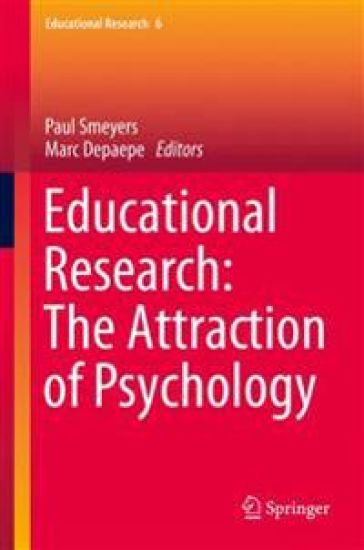
Educational Research: The Attraction of Psychology
The closely argued and provocative contributions to this volume challenge psychology’s hegemony as an interpretive paradigm in a range of social contexts such as education and child development. They start from the core observation that modern psychology has successfully penetrated numerous domains of society in its quest to develop a properly scientific methodology for analyzing the human mind and behaviour. For example, educational psychology continues to hold a central position in the curricula of trainee teachers in the US, while the language of developmental psychology holds primal sway over our understanding of childrearing and the parent-child relationship.Questioning the default position of modern psychology as a way of conceptualizing human relations, this collection of papers reexamines key assumptions that include psychology’s self-image as a ‘scientific’ discipline. Authors also argue that the dogma of neuropsychology in education has demoted concepts such as ‘emotion’, ‘feeling’ and ‘relationship’, so that they are now ’blind spots’ in educational theory. Other chapters offer a cautionary analysis of how misshapen notions of psychology can legitimize eugenics (as in Nazi Germany) and poison racial attitudes. Above all, has psychology, with its focus on individual merit, been complicit in hiding the impacts of power and privilege in education? This bracing new volume adopts a broader definition of education and childrearing that admits the essential contribution of the humanities to the proper study of mankind.This publication, as well as the ones that are mentioned in the preliminary pages of this work, were realized by the Research Community (FWO Vlaanderen / Research Foundation Flanders, Belgium) Philosophy and History of the Discipline of Education: Faces and Spaces of Educational Research.
Educational Research - the Ethics and Aesthetics of Statistics
Statistics are everywhere. Their power and their undoubted efficacy in many areas have given rise to faith in measurement and metrics. More of them will tell us all that we need to know. Their use carries with it a number of presuppositions: that reality can be satisfactorily represented and that it can be controlled or the risks managed. The papers in this book interpret the ethics and aesthetics of statistics in terms of representation, visualisation and accessibility, focus on the appeal of ‘simplicity’, of technical languages, numbers, diagrams and pictures, and pay attention to their connection with action plans. The book explores what has made educational researchers dependent on statistics, and deals with their use in areas such as the prevalence of maltreatment of children, European citizenship, well-being and happiness, illegal migrants, and university expansion. There is discussion of how the quest for more and better statistics finds its voice in policy initiatives that become slogans, and how public opinion polls are used to rationalise political decision-making. Can a more limited and modest use be made of statistics which does not deflect attention away from education’s core business and which does not destroy the local practical knowledge that on which good education is based? ‘Smeyers and Depaepe continue to bring together a significant international group of educational philosophers and historians on topics of importance to researchers. This fifth volume in their series takes up the ‘gold standard’ use of statistics in case studies not contributed elsewhere. I highly recommend this text to counter a current over-emphasis on technique in research methodology. Use of statistics remains but herein under new, insightful conceptualizations.’ Lynda Stone, Philosophy of Education, University of North Carolina at Chapel Hill, USA ‘Once again, Depaepe and Smeyers succeeded in bringing together distinguished international andcross-disciplinary scholars exploring very timely and critical issues in current educational research. This is a groundbreaking book on a theme that can’t be ignored by educational researchers and those interested in a better understanding of the culture of science and science as culture. Moreover, the present book instigates to study history of educational research, a limited but developing field, and invites reflection to those who are sometimes too reliant on number crunching as a mode of interpretation and rather credulous in the acceptance of institutional records. Frank Simon, Faculty of Psychology and Educational Sciences, Ghent University, Belgium
Linear Isentropic Oscillations of Stars

Linear Isentropic Oscillations of Stars

Paul Smeyers; Tim Van Hoolst

Springer-Verlag Berlin and Heidelberg GmbH Co. K
2013
nidottu
This monograph attempts to provide a systematic and consistent survey of the fundamentals of the theory of free, linear, isentropic oscillations in spherically symmetric, gaseous equilibrium stars, whose structure is affected neither by axial rotation, nor by the tidal action of a companion, nor by a magnetic eld. Three parts can be distinguished. The rst part, consisting of Chaps.1-8, covers the basic concepts and equations, the distinction between spheroidal and toroidal normal modes, the solution of Poisson's differential equation for the perturbation of the gravitational potential, and Hamilton's variational principle. The second part, consisting of Chaps.9-13,is devotedto the possible existenceof waves propagating in the radial direction, the origin and classi cation of normal modes, the comple- ness of the normal modes, and the relation between the local stability with respect to convection and the global stability of a star. In the third part, Chaps.14-18 c- tain asymptoticrepresentationsof normalmodes. Chapter 19 deals with slow period changes in rapidly evolving pulsating stars. The theory is developed within the framework of the Newtonian theory of gr- itation and the hydrodynamics of compressible uids. It is described in its present status, with inclusion of open questions. We give preference to the use of the adjective "isentropic" above that of the adjective "adiabatic", since, from a thermodynamic point of view, these stellar - cillations are described as reversible adiabatic processes and thus as processes that take place at constant entropy.
Educational Research: The Attraction of Psychology
The closely argued and provocative contributions to this volume challenge psychology’s hegemony as an interpretive paradigm in a range of social contexts such as education and child development. They start from the core observation that modern psychology has successfully penetrated numerous domains of society in its quest to develop a properly scientific methodology for analyzing the human mind and behaviour. For example, educational psychology continues to hold a central position in the curricula of trainee teachers in the US, while the language of developmental psychology holds primal sway over our understanding of childrearing and the parent-child relationship.Questioning the default position of modern psychology as a way of conceptualizing human relations, this collection of papers reexamines key assumptions that include psychology’s self-image as a ‘scientific’ discipline. Authors also argue that the dogma of neuropsychology in education has demoted concepts such as ‘emotion’, ‘feeling’ and ‘relationship’, so that they are now ’blind spots’ in educational theory. Other chapters offer a cautionary analysis of how misshapen notions of psychology can legitimize eugenics (as in Nazi Germany) and poison racial attitudes. Above all, has psychology, with its focus on individual merit, been complicit in hiding the impacts of power and privilege in education? This bracing new volume adopts a broader definition of education and childrearing that admits the essential contribution of the humanities to the proper study of mankind.This publication, as well as the ones that are mentioned in the preliminary pages of this work, were realized by the Research Community (FWO Vlaanderen / Research Foundation Flanders, Belgium) Philosophy and History of the Discipline of Education: Faces and Spaces of Educational Research.
Educational Research - the Ethics and Aesthetics of Statistics
Statistics are everywhere. Their power and their undoubted efficacy in many areas have given rise to faith in measurement and metrics. More of them will tell us all that we need to know. Their use carries with it a number of presuppositions: that reality can be satisfactorily represented and that it can be controlled or the risks managed. The papers in this book interpret the ethics and aesthetics of statistics in terms of representation, visualisation and accessibility, focus on the appeal of ‘simplicity’, of technical languages, numbers, diagrams and pictures, and pay attention to their connection with action plans. The book explores what has made educational researchers dependent on statistics, and deals with their use in areas such as the prevalence of maltreatment of children, European citizenship, well-being and happiness, illegal migrants, and university expansion. There is discussion of how the quest for more and better statistics finds its voice in policy initiatives that become slogans, and how public opinion polls are used to rationalise political decision-making. Can a more limited and modest use be made of statistics which does not deflect attention away from education’s core business and which does not destroy the local practical knowledge that on which good education is based? ‘Smeyers and Depaepe continue to bring together a significant international group of educational philosophers and historians on topics of importance to researchers. This fifth volume in their series takes up the ‘gold standard’ use of statistics in case studies not contributed elsewhere. I highly recommend this text to counter a current over-emphasis on technique in research methodology. Use of statistics remains but herein under new, insightful conceptualizations.’ Lynda Stone, Philosophy of Education, University of North Carolina at Chapel Hill, USA ‘Once again, Depaepe and Smeyers succeeded in bringing together distinguished international andcross-disciplinary scholars exploring very timely and critical issues in current educational research. This is a groundbreaking book on a theme that can’t be ignored by educational researchers and those interested in a better understanding of the culture of science and science as culture. Moreover, the present book instigates to study history of educational research, a limited but developing field, and invites reflection to those who are sometimes too reliant on number crunching as a mode of interpretation and rather credulous in the acceptance of institutional records. Frank Simon, Faculty of Psychology and Educational Sciences, Ghent University, Belgium
Linear Isentropic Oscillations of Stars

Linear Isentropic Oscillations of Stars

Paul Smeyers; Tim Van Hoolst

Springer-Verlag Berlin and Heidelberg GmbH Co. K
2010
sidottu
This monograph attempts to provide a systematic and consistent survey of the fundamentals of the theory of free, linear, isentropic oscillations in spherically symmetric, gaseous equilibrium stars, whose structure is affected neither by axial rotation, nor by the tidal action of a companion, nor by a magnetic eld. Three parts can be distinguished. The rst part, consisting of Chaps.1-8, covers the basic concepts and equations, the distinction between spheroidal and toroidal normal modes, the solution of Poisson's differential equation for the perturbation of the gravitational potential, and Hamilton's variational principle. The second part, consisting of Chaps.9-13,is devotedto the possible existenceof waves propagating in the radial direction, the origin and classi cation of normal modes, the comple- ness of the normal modes, and the relation between the local stability with respect to convection and the global stability of a star. In the third part, Chaps.14-18 c- tain asymptoticrepresentationsof normalmodes. Chapter 19 deals with slow period changes in rapidly evolving pulsating stars. The theory is developed within the framework of the Newtonian theory of gr- itation and the hydrodynamics of compressible uids. It is described in its present status, with inclusion of open questions. We give preference to the use of the adjective "isentropic" above that of the adjective "adiabatic", since, from a thermodynamic point of view, these stellar - cillations are described as reversible adiabatic processes and thus as processes that take place at constant entropy.
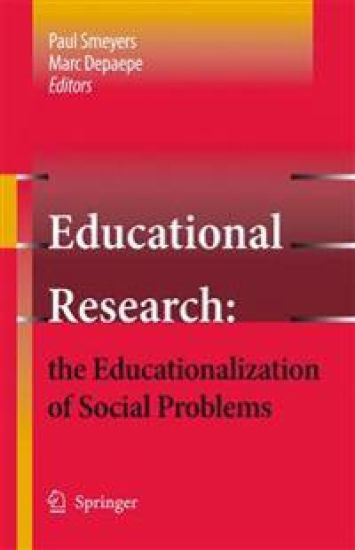
Educational Research: the Educationalization of Social Problems
Pushing ‘social’ responsibilities on schools is a process that has been underway for a long time. This phenomenon has been studied more in Europe than in North America and the U.K. and has been labelled Pädagogisierung. The editors have chosen to use ‘Educationalization’ to identify the overall orientation or trend toward thinking about education as the focal point for addressing or solving larger human problems. The term describes these phenomena as a sub-process of the ‘modernization’ of society, but it also has negative connotations, such as increased dependence, patronization, and pampering. In this book distinguished philosophers and historians of education focus on ‘educationalization’ to expand its meaning through an engagement with educational theory. Topics discussed are the family and the child, the ‘learning society’, citizenship education, widening participation in higher education, progressive education, and schooling movements such as No Child Left Behind. ‘Smeyers’ and Depaepe's book offers great insights into one of the most ambivalent phenomena of today's educational world and especially educational policy. The contributions assembled represent perspectives of some of the most respected scholars in the field. Their manifold critiques of the educationalization of social problems are rather convincing. Our time is definitely ripe for such analysis!’ Roland Reichenbach, Center for Educational Studies, University of Basel, Switzerland ‘This is a challenging, critical and analytical treatment of the tendency of contemporary administrations to overburden educational institutions with the expectation that they will provide the solutions to an increasingly diverse range of social and economic problems. It brings together the theoretical resources of a distinguished international group of philosophers and historians of education and deserves the carefulattention of educational policy makers, practitioners and researchers alike.’ David Bridges, Von Hügel Institute, St Edmund’s College, Cambridge, England This publication is realized by the Research Community (FWO-Vlaanderen / Research Foundation Flanders, Belgium) Philosophy and History of the Discipline of Education: Evaluation and Evolution of the Criteria for Educational Research. Also realized by the Research Community are Educational Research: Why ‘What Works’ Doesn’t Work (2006) and Educational Research: Networks and Technologies (2007).
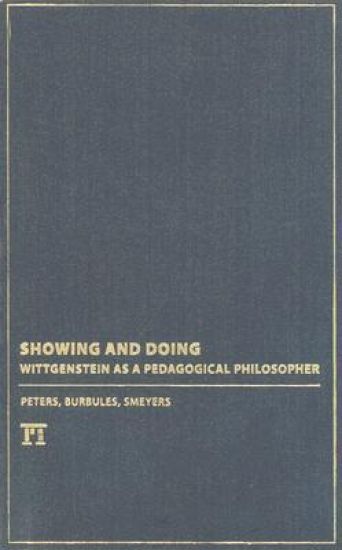
Showing and Doing

Showing and Doing

Michael A. Peters; Nicholas C. Burbules; Paul Smeyers

Paradigm
2010
nidottu
Three prominent Wittgenstein scholars introduce the broad educational significance of Ludwig Wittgenstein's work to a wider audience of educational researchers and practitioners through provocative, innovative, and playful readings of his work. They vividly demonstrate the influence of his thinking and its centrality to understanding our contemporary condition. Wittgenstein fundamentally shaped contemporary theories of language, representation, cognition, and learning. The book also traces the "pedagogical turn" of his thinking during the period from 1920 to 1926. What is most radical about Wittgenstein's later work is that it suggests learning and initiation into practices are fundamental to understanding his philosophy. The book not only provides a new and fresh interpretation of Wittgenstein's thought but also explores a new way of thinking about education as a way of revealing the educational dimension of philosophical problems.
Educational Research: the Educationalization of Social Problems
Pushing ‘social’ responsibilities on schools is a process that has been underway for a long time. This phenomenon has been studied more in Europe than in North America and the U.K. and has been labelled Pädagogisierung. The editors have chosen to use ‘Educationalization’ to identify the overall orientation or trend toward thinking about education as the focal point for addressing or solving larger human problems. The term describes these phenomena as a sub-process of the ‘modernization’ of society, but it also has negative connotations, such as increased dependence, patronization, and pampering. In this book distinguished philosophers and historians of education focus on ‘educationalization’ to expand its meaning through an engagement with educational theory. Topics discussed are the family and the child, the ‘learning society’, citizenship education, widening participation in higher education, progressive education, and schooling movements such as No Child Left Behind. ‘Smeyers’ and Depaepe's book offers great insights into one of the most ambivalent phenomena of today's educational world and especially educational policy. The contributions assembled represent perspectives of some of the most respected scholars in the field. Their manifold critiques of the educationalization of social problems are rather convincing. Our time is definitely ripe for such analysis!’ Roland Reichenbach, Center for Educational Studies, University of Basel, Switzerland ‘This is a challenging, critical and analytical treatment of the tendency of contemporary administrations to overburden educational institutions with the expectation that they will provide the solutions to an increasingly diverse range of social and economic problems. It brings together the theoretical resources of a distinguished international group of philosophers and historians of education and deserves the carefulattention of educational policy makers, practitioners and researchers alike.’ David Bridges, Von Hügel Institute, St Edmund’s College, Cambridge, England This publication is realized by the Research Community (FWO-Vlaanderen / Research Foundation Flanders, Belgium) Philosophy and History of the Discipline of Education: Evaluation and Evolution of the Criteria for Educational Research. Also realized by the Research Community are Educational Research: Why ‘What Works’ Doesn’t Work (2006) and Educational Research: Networks and Technologies (2007).
Showing and Doing

Showing and Doing

Michael A. Peters; Nicholas C. Burbules; Paul Smeyers

Paradigm
2008
sidottu
Three prominent Wittgenstein scholars introduce the broad educational significance of Ludwig Wittgenstein's work to a wider audience of educational researchers and practitioners through provocative, innovative, and playful readings of his work. They vividly demonstrate the influence of his thinking and its centrality to understanding our contemporary condition. Wittgenstein fundamentally shaped contemporary theories of language, representation, cognition, and learning. The book also traces the "pedagogical turn" of his thinking during the period from 1920 to 1926. What is most radical about Wittgenstein's later work is that it suggests learning and initiation into practices are fundamental to understanding his philosophy. The book not only provides a new and fresh interpretation of Wittgenstein's thought but also explores a new way of thinking about education as a way of revealing the educational dimension of philosophical problems.
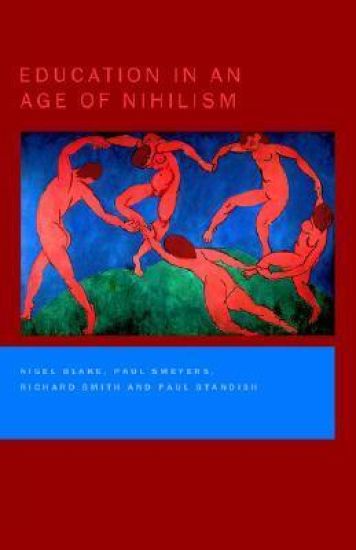
Education in an Age of Nihilism

Education in an Age of Nihilism

Nigel Blake; Paul Smeyers; Richard Smith; Paul Standish

Routledge Falmer
2000
nidottu
This book addresses concerns about educational and moral standards in a world increasingly characterised by nihilism. On the one hand there is widespread anxiety that standards are falling; on the other, new machinery of accountability and inspection to show that they are not. The authors in this book state that we cannot avoid nihilism if we are simply laissez-faire about values, neither can we reduce them to standards of performance, nor must we return to traditional values. They state that we need to create a new set of values based on a critical assessment of contemporary practice in the light of a number of philosophical texts that address the question of nihilism, including the work of Nietzsche.
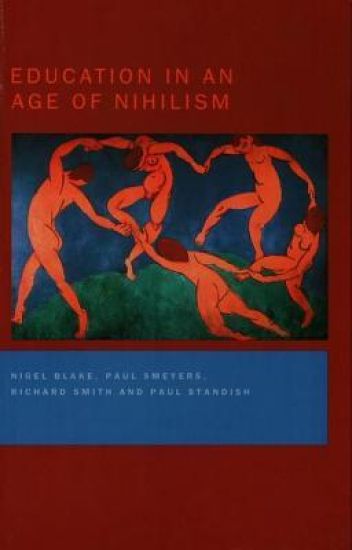
Education in an Age of Nihilism

Education in an Age of Nihilism

Nigel Blake; Paul Smeyers; Richard Smith; Paul Standish

Routledge Falmer
2000
sidottu
This book addresses concerns about educational and moral standards in a world increasingly characterised by nihilism. On the one hand there is widespread anxiety that standards are falling; on the other, new machinery of accountability and inspection to show that they are not. The authors in this book state that we cannot avoid nihilism if we are simply laissez-faire about values, neither can we reduce them to standards of performance, nor must we return to traditional values. They state that we need to create a new set of values based on a critical assessment of contemporary practice in the light of a number of philosophical texts that address the question of nihilism, including the work of Nietzsche.
Nietzsche's Legacy for Education

Nietzsche's Legacy for Education

James Marshall; Michael Peters; Paul Smeyers

Praeger Publishers Inc
2000
sidottu
Despite being one of the greatest educators of the 19th century (perhaps of the modern period) and one of the greatest moral philosophers of all time, Nietzsche's educational thought and works, with some notable exceptions, have been ignored, or remain hidden and obscured. This was true of his philosophy as a whole and its recent reception, first by French poststructuralist thinkers during the 1960s and 1970s, and later by English-speaking philosophers in the 1980s. The controversy surrounding Nietzsche involves not only his style (his way of doing philosophy) and the radical nature of his inquiries, but also the history of Nietzscheanism, the politicization of the Nietzsche archive, and his appropriation by the Nazis.This international collection is unique in that it draws upon these recent developments in the interpretation of thought and the question of defining value in the era of postmodernity. The essays address a range of topics, including the history of the reception of Nietzsche's work, Nietzsche's early educational writings, genealogy as method, ethics and difference, democracy, Nietzsche's notion of self and its importance for education, the arts, the limits of academic life, Nietzsche's critique of liberal education, Irigaray's Nietzsche, and Nietzsche's critique of modernity and the question of nihilism.
Thinking Again

Thinking Again

Nigel P. Blake; Paul Smeyers; Richard Smith; Paul Standish

Praeger Publishers Inc
1998
sidottu
The 'postmodern condition,' in which instrumentalism usurps all other considerations, has produced a kind of intellectual paralysis in the world of education. It is difficult to take issue with such shibboleths of our time as 'standards', 'effectiveness' or 'quality', or the transmission of a nation's 'heritage', yet many people sense that important values are being lost as the education systems of the developed world increasingly devote themselves to managerialism and 'performativity', the quest for efficiency and effectiveness that can be quantified.This book shows how a sustained and telling critique of current educational policy and practice can be developed from the writings of such postmodern thinkers as Lyotard, Derrida, Foucault, and Lacan. These thinkers show us new directions, making what has become over-familiar in education seem strange, and they shake us out of established ways of thinking and writing. The book reveals how very different certain aspects of education—for instance, literacy, moral education (in the home as well as the school), curriculum policy and planning—look in the light of these ideas. The book makes many of the central ideas of postmodern theory accessible by demonstrating their relevance to familiar aspects of the practice of education.
Thinking Again

Thinking Again

Nigel P. Blake; Paul Smeyers; Richard Smith; Paul Standish

Praeger Publishers Inc
1998
nidottu
The 'postmodern condition,' in which instrumentalism usurps all other considerations, has produced a kind of intellectual paralysis in the world of education. It is difficult to take issue with such shibboleths of our time as 'standards', 'effectiveness' or 'quality', or the transmission of a nation's 'heritage', yet many people sense that important values are being lost as the education systems of the developed world increasingly devote themselves to managerialism and 'performativity', the quest for efficiency and effectiveness that can be quantified. This book shows how a sustained and telling critique of current educational policy and practice can be developed from the writings of such postmodern thinkers as Lyotard, Derrida, Foucault, and Lacan. These thinkers show us new directions, making what has become over-familiar in education seem strange, and they shake us out of established ways of thinking and writing. The book reveals how very different certain aspects of education—for instance, literacy, moral education (in the home as well as the school), curriculum policy and planning—look in the light of these ideas. The book makes many of the central ideas of postmodern theory accessible by demonstrating their relevance to familiar aspects of the practice of education.