Kirjojen hintavertailu. Mukana 12 595 353 kirjaa ja 12 kauppaa.

Kirjailija

Paul Spickard

Kirjat ja teokset yhdessä paikassa: 9 kirjaa, julkaisuja vuosilta 2000-2022, suosituimpien joukossa Almost All Aliens. Vertaile teosten hintoja ja tarkista saatavuus suomalaisista kirjakaupoista.

9 kirjaa

Kirjojen julkaisuhaarukka 2000-2022.

Almost All Aliens

Almost All Aliens

Paul Spickard; Francisco Beltrán; Laura Hooton

Routledge
2022
sidottu
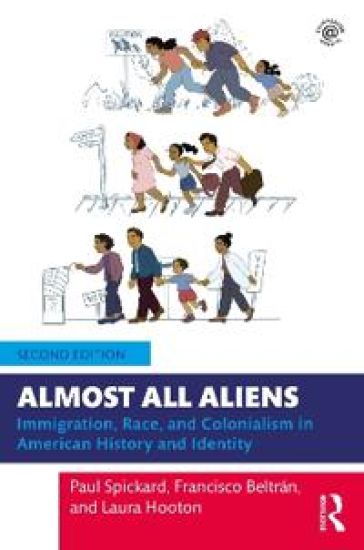
Almost All Aliens offers a unique reinterpretation of immigration in the history of the United States. Setting aside the European migrant-centered melting-pot model of immigrant assimilation, Paul Spickard, Francisco Beltrán, and Laura Hooton put forward a fresh and provocative reconceptualization that embraces the multicultural, racialized, and colonially inflected reality of immigration that has always existed in the United States. Their astute study illustrates the complex relationship between ethnic identity and race, slavery, and colonial expansion. Examining the lives of those who crossed the Atlantic, as well as those who crossed the Pacific, the Caribbean, and the North American Borderlands, Almost All Aliens provides a distinct, inclusive, and critical analysis of immigration, race, and identity in the United States from 1600 until the present. The second edition updates Almost All Aliens through the first two decades of the twenty-first century, recounting and analyzing the massive changes in immigration policy, the reception of immigrants, and immigrant experiences that whipsawed back and forth throughout the era. It includes a new final chapter that brings the story up to the present day. This book will appeal to students and researchers alike studying the history of immigration, race, and colonialism in the United States, as well as those interested in American Identity, especially in the context of the early twenty-first century.
Almost All Aliens

Almost All Aliens

Paul Spickard; Francisco Beltrán; Laura Hooton

Routledge
2022
nidottu
Almost All Aliens offers a unique reinterpretation of immigration in the history of the United States. Setting aside the European migrant-centered melting-pot model of immigrant assimilation, Paul Spickard, Francisco Beltrán, and Laura Hooton put forward a fresh and provocative reconceptualization that embraces the multicultural, racialized, and colonially inflected reality of immigration that has always existed in the United States. Their astute study illustrates the complex relationship between ethnic identity and race, slavery, and colonial expansion. Examining the lives of those who crossed the Atlantic, as well as those who crossed the Pacific, the Caribbean, and the North American Borderlands, Almost All Aliens provides a distinct, inclusive, and critical analysis of immigration, race, and identity in the United States from 1600 until the present. The second edition updates Almost All Aliens through the first two decades of the twenty-first century, recounting and analyzing the massive changes in immigration policy, the reception of immigrants, and immigrant experiences that whipsawed back and forth throughout the era. It includes a new final chapter that brings the story up to the present day. This book will appeal to students and researchers alike studying the history of immigration, race, and colonialism in the United States, as well as those interested in American Identity, especially in the context of the early twenty-first century.
Race in Mind

Race in Mind

Paul Spickard

University of Notre Dame Press
2015
nidottu
These essays analyze how race affects people's lives and relationships in all settings, from the United States to Great Britain and from Hawai?i to Chinese Central Asia. They contemplate the racial positions in various societies of people called Black and people called White, of Asians and Pacific Islanders, and especially of those people whose racial ancestries and identifications are multiple. Here for the first time are Spickard's trenchant analyses of the creation of race in the South Pacific, of DNA testing for racial ancestry, and of the meaning of multiplicity in the age of Barack Obama.
Race and Immigration in the United States
Race and Immigration in the United States is a collection of the very best of the new generation of scholarship in the field of immigration history. The traditional Ellis Island model of immigrant assimilation is no longer adequate to understand American history. A more subtle model is needed – one which does not exclude peoples of color from view, nor treat the experiences of European immigrants as a template for the experiences of non-white migrants. In this important collection, Paul Spickard draws together essays that illuminate the crucial differences that race makes in the study of American history. Bringing the insight of ethnic studies scholarship into the history of immigration, Race and Immigration in the United States is an essential collection for anyone studying ethnicity and immigration in American history.
Race and Immigration in the United States
Race and Immigration in the United States is a collection of the very best of the new generation of scholarship in the field of immigration history. The traditional Ellis Island model of immigrant assimilation is no longer adequate to understand American history. A more subtle model is needed – one which does not exclude peoples of color from view, nor treat the experiences of European immigrants as a template for the experiences of non-white migrants. In this important collection, Paul Spickard draws together essays that illuminate the crucial differences that race makes in the study of American history. Bringing the insight of ethnic studies scholarship into the history of immigration, Race and Immigration in the United States is an essential collection for anyone studying ethnicity and immigration in American history.
Japanese Americans

Japanese Americans

Paul Spickard

Rutgers University Press
2008
nidottu
Since 1855, nearly a half a million Japanese immigrants have settled in the United States, the majority arriving between 1890 and 1924 during the great wave of immigration to Hawai'i and the mainland. Today, more than one million Americans claim Japanese ancestry. They came to study and to work, and found jobs as farm laborers, cannery workers, and railroad workers. Many settled permanently, formed communities, and sent for family members in Japan. While they worked hard, established credit associations and other networks, and repeatedly distinguished themselves as entrepreneurs, they also encountered harsh discrimination. Nowhere was this more evident than on the West coast during World War II, when virtually the entire population of Japanese Americans was forced into internment camps solely on the basis of their ethnicity.In this concise history, Paul Spickard traces the struggles and achievements of Japanese Americans in claiming their place in American society. He outlines three forces shaping ethnic groups in general: shared interests, shared institutions, and shared culture, and chronicles the Japanese American experience within this framework, showing how these factors created and nurtured solidarity.
Is Lighter Better?

Is Lighter Better?

Joanne L. Rondilla; Paul Spickard

Rowman Littlefield Publishers
2007
sidottu
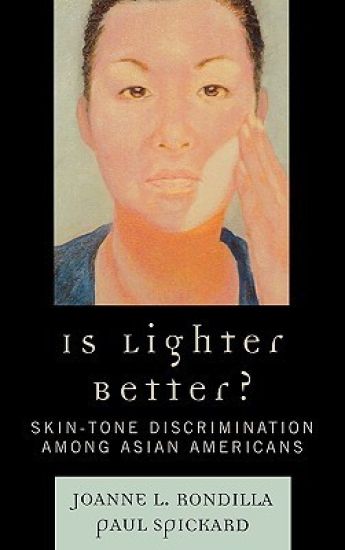
Colorism is defined as "discriminatory treatment of individuals falling within the same 'racial' group on the basis of skin color." In other words, some people, particularly women, are treated better or worse on account of the color of their skin relative to other people who share their same racial category. Colorism affects Asian Americans from many different backgrounds and who live in different parts of the United States. Is Lighter Better? discusses this often-overlooked topic. Joanne L. Rondilla and Paul Spickard ask important questions such as: What are the colorism issues that operate in Asian American communities? Are they the same issues for all Asian Americans—for women and for men, for immigrants and the American born, for Chinese, Filipinos, Koreans, Vietnamese, and other Asian Americans? Do they reflect a desire to look like White people, or is some other motive at work? Including numerous stories about and by people who have faced discrimination in their own lives, this book is an invaluable resource for people interested in colorism among Asian Americans.
Is Lighter Better?

Is Lighter Better?

Joanne L. Rondilla; Paul Spickard

Rowman Littlefield Publishers
2007
nidottu
Colorism is defined as "discriminatory treatment of individuals falling within the same 'racial' group on the basis of skin color." In other words, some people, particularly women, are treated better or worse on account of the color of their skin relative to other people who share their same racial category. Colorism affects Asian Americans from many different backgrounds and who live in different parts of the United States. Is Lighter Better? discusses this often-overlooked topic. Joanne L. Rondilla and Paul Spickard ask important questions such as: What are the colorism issues that operate in Asian American communities? Are they the same issues for all Asian Americans—for women and for men, for immigrants and the American born, for Chinese, Filipinos, Koreans, Vietnamese, and other Asian Americans? Do they reflect a desire to look like White people, or is some other motive at work? Including numerous stories about and by people who have faced discrimination in their own lives, this book is an invaluable resource for people interested in colorism among Asian Americans.
We Are A People

We Are A People

Paul Spickard

Temple University Press,U.S.
2000
pokkari
As the twentieth century closes, ethnicity stands out as a powerful force for binding people together in a sense of shared origins and worldview. But this emphasis on a people's uniqueness can also develop into a distorted rationale for insularity, inter-ethnic animosity, or, as we have seen in this century, armed conflict. Ethnic identity clearly holds very real consequences for individuals and peoples, yet there is not much agreement on what exactly it is or how it is formed. The growing recognition that ethnicity is not fixed and inherent, but elastic and constructed, fuels the essays in this collection. Regarding identity as a dynamic, on-going, formative and transformative process, We Are a People considers narrative -- the creation and maintenance of a common story -- as the keystone in building a sense of peoplehood. Myths of origin, triumph over adversity, migration, and so forth, chart a group's history, while continual additions to the larger narrative stress moving into the future as a people. Still, there is more to our stories as individuals and groups. Most of us are aware that we take on different roles and project different aspects of ourselves depending on the situation. Some individuals who have inherited multiple group affiliations from their families view themselves not as this or that but all at once. So too with ethnic groups. The so-called hyphenated Americans are not the only people in the world to recognize or embrace their plurality. This relatively recent acknowledgment of multiplicity has potentially wide implications, destabilizing the limited (and limiting) categories inscribed in, for example, public policy and discourse on race relations. We Are a People is a path-breaking volume, boldly illustrating how ethnic identity works in the real world.