

Kirjailija
Paul Willis
Kirjat ja teokset yhdessä paikassa: 16 kirjaa, julkaisuja vuosilta 1978-2023, suosituimpien joukossa Learning to Labor: How Working-Class Kids Get Working-Class Jobs. Vertaile teosten hintoja ja tarkista saatavuus suomalaisista kirjakaupoista.
16 kirjaa
Kirjojen julkaisuhaarukka 1978-2023.

This book analyses modernity and tradition in China today and how they combine in striking ways in the Chinese school. Paul Willis – the leading ethnographer and author of Learning to Labour – shows how China has undergone an internal migration not only of masses of workers but also of a mental and ideological kind to new cultural landscapes of meaning, which include worship of the glorified city, devotion to consumerism, and fixation upon the smartphone and the internet. Massive educational expansion has been a precondition for explosive economic growth and technical development, but at the same time the school provides a cultural stage for personal and collective experience. In its closed walls and the inescapability of its ‘scores’, an astonishing drama plays out between the new and the old, with a tapestry of intricate human meanings woven of small tragedies and triumphs, secret promises and felt betrayals, helping to produce not only exam results but cultural orientations and occupational destinies. By exploring the cultural dimension of everyday experience as it is lived out in the school, this book sheds new light on the enormous transformations that have swept through China and created the kind of society that it is today: a society that is obsessed with the future and at the same time structured by and in continuous dialogue with its past.
This book analyses modernity and tradition in China today and how they combine in striking ways in the Chinese school. Paul Willis – the leading ethnographer and author of Learning to Labour – shows how China has undergone an internal migration not only of masses of workers but also of a mental and ideological kind to new cultural landscapes of meaning, which include worship of the glorified city, devotion to consumerism, and fixation upon the smartphone and the internet. Massive educational expansion has been a precondition for explosive economic growth and technical development, but at the same time the school provides a cultural stage for personal and collective experience. In its closed walls and the inescapability of its ‘scores’, an astonishing drama plays out between the new and the old, with a tapestry of intricate human meanings woven of small tragedies and triumphs, secret promises and felt betrayals, helping to produce not only exam results but cultural orientations and occupational destinies. By exploring the cultural dimension of everyday experience as it is lived out in the school, this book sheds new light on the enormous transformations that have swept through China and created the kind of society that it is today: a society that is obsessed with the future and at the same time structured by and in continuous dialogue with its past.

In his fifth collection of poetry, Deer at Twilight, Paul J. Willis offers a vividly imagistic insight into the depths of nature within and around the state of Washington.Walking on Water, Pyramid LakeThese particular bugs can do it, dimpling the surface with their feet, and no one has built a church in their name. Other bugs swim underwater with abandon, with no blue ribbons to show for it. That leaves the rest of us to perform our daily miracles without applause. This rock, forexample,sheared flat by who knows what torturous force, left to host its lime-green share of crustose lichen, that concoction of algae and fungi which long ago, not even listening to Rodney King, decided we can get along if we just try.
This book which has now established itself as a classic study of working class boys describes how Paul Willis followed a group of 'lads' as they passed through the last two years of school and into work. The book explains that for 'the lads' it is their own culture which blocks teaching and prevents the realisation of liberal education aims. This culture exposes some of the contradictions within these formal aims and actually supplies the operational criteria by which a future in wage labour is judged. Paul Willis explores how their own culture can guide working class lads on to the shop floor. This is an uncompromising book which has provoked considerable discussion and controversy in educational circles throughout the world - it has been translated into Finnish, German, French, Swedish, Japanese and Spanish.
Learning to Labor: How Working-Class Kids Get Working-Class Jobs
Paul Willis
Columbia University Press
2017
nidottu
A landmark work in sociology, cultural studies, and ethnography since its publication in 1977, Paul Willis's Learning to Labor is a provocative and troubling account of how education links culture and class in the reproduction of social hierarchy. Willis observed a working-class friendship group in an English industrial town in the West Midlands in their final years at school. These "lads" rebelled against the rules and values of the school, creating their own culture of opposition. Yet this resistance to official norms, Willis argues, prepared these students for working-class employment. Rebelling against authority made the lads experience the constraints that held them in subordinate class positions as choices of their own volition. Learning to Labor demonstrates the pervasiveness of class in lived experience. Its detailed and sympathetic ethnography emphasizes subjectivity and the role of working-class people in making their culture. Willis shows how resistance does not simply challenge the social order, but also constitutes it. The lessons of Learning to Labor apply as much to the United States as to the United Kingdom, especially the finding that education, rather than helping overcome hierarchies, can often perpetuate them, which is of renewed relevance at a time when education is trumpeted as meritocratic and a panacea for inequality.


Paul Willis aims to renew and develop the ethnographic craft across the disciplines. He shows that ethnographic practice and the ethnographic imagination are vital to understanding the creativity and irreducibility of experience in all aspects of social and cultural practice.
This book which has now established itself as a classic study of working class boys describes how Paul Willis followed a group of 'lads' as they passed through the last two years of school and into work. The book explains that for 'the lads' it is their own culture which blocks teaching and prevents the realisation of liberal education aims. This culture exposes some of the contradictions within these formal aims and actually supplies the operational criteria by which a future in wage labour is judged. Paul Willis explores how their own culture can guide working class lads on to the shop floor. This is an uncompromising book which has provoked considerable discussion and controversy in educational circles throughout the world - it has been translated into Finnish, German, French, Swedish, Japanese and Spanish.

Public relations professionals are operating in an increasingly challenging and complex environment. Pressures from outside the organisation include new accountabilities, empowered stakeholders, increased public cynicism and a new communication landscape. Internally, there are increasing demands to demonstrate a strategic contribution, alongside a requirement to coach and counsel senior managers exposed to these environmental pressures. This revised and updated edition provides a framework to enable public relations professionals to clearly articulate and demonstrate their own contribution to organisational effectiveness, while also setting out the specific capabilities public relations leaders must exhibit to operate at the highest levels of the organisation. This edition further develops the pioneering approach to integrating thinking around public relations, leadership, and strategy. It has been updated comprehensively to address contemporary developments and introduce new research and fresh perspectives from the authors. New to this edition are insights from Chief Executives on what they expect from public relations leaders and a comprehensive set of capabilities which scope the demanding role of professionals at the top of their game.Concise and practical, this textbook is suitable for MBA and other postgraduate and executive education qualifications in Public Relations and Corporate Communications – especially for those students who wish to pursue a successful career as a professional public relations specialist, able to operate strategically at the top of successful organisations.

Public relations professionals are operating in an increasingly challenging and complex environment. Pressures from outside the organisation include new accountabilities, empowered stakeholders, increased public cynicism and a new communication landscape. Internally, there are increasing demands to demonstrate a strategic contribution, alongside a requirement to coach and counsel senior managers exposed to these environmental pressures. This revised and updated edition provides a framework to enable public relations professionals to clearly articulate and demonstrate their own contribution to organisational effectiveness, while also setting out the specific capabilities public relations leaders must exhibit to operate at the highest levels of the organisation. This edition further develops the pioneering approach to integrating thinking around public relations, leadership, and strategy. It has been updated comprehensively to address contemporary developments and introduce new research and fresh perspectives from the authors. New to this edition are insights from Chief Executives on what they expect from public relations leaders and a comprehensive set of capabilities which scope the demanding role of professionals at the top of their game.Concise and practical, this textbook is suitable for MBA and other postgraduate and executive education qualifications in Public Relations and Corporate Communications – especially for those students who wish to pursue a successful career as a professional public relations specialist, able to operate strategically at the top of successful organisations.
Public relations is operating in an increasingly challenging and complex environment. Pressures from outside the organisation include new accountabilities, empowered stakeholders, increased public cynicism and a new communication landscape. Internally, there are increasing demands to demonstrate a return on investment, alongside a requirement to coach and counsel senior managers exposed to these environmental pressures. This context requires public relations professionals to be able to clearly articulate and demonstrate their own contribution to organisational effectiveness. This textbook provides public relations leaders with a framework to do this, as well as a checklist of essential capabilities which they must acquire and exhibit if they are to operate at the highest levels of any organisation.This short textbook is suitable for aspiring practitioners, MBA and other masters qualifications in public relations - especially for those students who wish to pursue a successful career as a professional PR specialist able to operate strategically at the top of successful organisations.
As zero-tolerance discipline policies have been instituted at high schools across the country, police officers are employed with increasing frequency to enforce behavior codes and maintain order, primarily at poorly performing, racially segregated urban schools. Actions that may once have sent students to the detention hall or resulted in their suspension may now introduce them to the criminal justice system. In Police in the Hallways, Kathleen Nolan explores the impact of policing and punitive disciplinary policies on the students and their educational experience. Through in-depth interviews with and observations of students, teachers, administrators, and police officers, Nolan offers a rich and nuanced account of daily life at a Bronx high school where police patrol the hallways and security and discipline fall under the jurisdiction of the NYPD. She documents how, as law enforcement officials initiate confrontations with students, small infractions often escalate into “police matters” that can lead to summonses to criminal court, arrest, and confinement in juvenile detention centers. Nolan follows students from the classroom and the cafeteria to the detention hall, the dean’s office, and the criminal court system, clarifying the increasingly intimate relations between the school and the criminal justice system. Placing this trend within the context of recent social and economic changes, as well as developments within criminal justice and urban school reform, she shows how this police presence has created a culture of control in which penal management overshadows educational innovation. Police in the Hallways also examines the prevalent forms of oppositional behavior through which students express their frustrations and their deep sense of exclusion. With compassion and clear-eyed analysis, Nolan sounds a warning about this alarming convergence of prison and school cultures and the negative impact that it has on the real lives of low-income students of color-and, in turn, on us all.
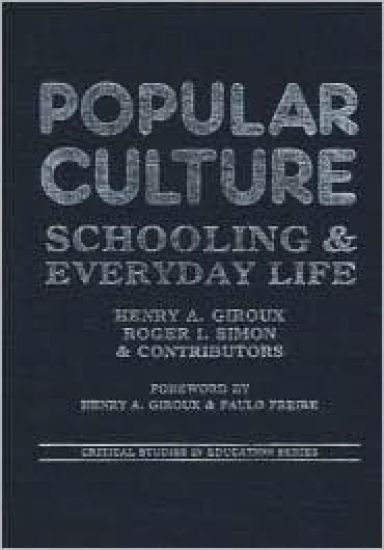
Popular Culture
Stanley Aronowitz; Robert W. Connell; Philip Corrigan; Elizabeth Ellsworth; Henry A. Giroux; Lawrence Grossberg; Peter McLaren; Roger Simon; Paul Smith; Richard Smith; Mimi White; Paul Willis
Praeger Publishers Inc
1989
sidottu
Illuminating one of the most pervasive issues of our time, Popular Culture is the first book to link the importance and implications of popular culture with pedagogical practice. It shows how cultural forms such as Hollywood films, pop music, soap operas, and televangelism are organized by gender, age, class, race, and ethnicity, thus providing the contradictory text that both enables and disables emancipatory interest, so fundamental to the formation of self and society. What emerges is a redefinition of the very notion of popular culture.