Kirjojen hintavertailu. Mukana 12 297 380 kirjaa ja 12 kauppaa.

Kirjailija

Paul Woodruff

Kirjat ja teokset yhdessä paikassa: 15 kirjaa, julkaisuja vuosilta 1983-2024, suosituimpien joukossa Surviving Technology. Vertaile teosten hintoja ja tarkista saatavuus suomalaisista kirjakaupoista.

15 kirjaa

Kirjojen julkaisuhaarukka 1983-2024.

Surviving Technology

Surviving Technology

Paul Woodruff

Tibidabo Publishing, Inc.
2024
pokkari
Technology has been changing our lives from the beginning of human history. Now Artificial Intelligence threatens to accelerate and intensify this change. These changes will be of familiar kinds, but their range and pace is frightening to many people, with good reason. I have studied change and resistance to change in the realm of theater. The arts of theater call for people to pay attention to each other. Because paying attention is fundamental to human life, I have argued that theater itself is fundamental to being human (The Necessity of Theater, 2008). In this book I take on a set of challenges we face from technology, using theater as a microcosm for the larger issues. Our history provides models for dealing with Artificial Intelligence. Sometimes our ancestors caved in to new technologies, sometimes they resisted. The reasons behind their choices are important for us today. So are the strategies they used when they decided to resist. In successive chapters I deal with the necessity of paying attention to each other, and then the necessities of preserving truth, freedom, and the quest for wisdom. In the last chapter I show how we can rescue our heritage from innovations of technology by translating it into forms that are alive for us.
Living Toward Virtue

Living Toward Virtue

Paul Woodruff

OXFORD UNIVERSITY PRESS INC
2023
sidottu
In Living toward Virtue, Paul Woodruff shows how we can set about living ethically through self-questioning, which enables us to avoid moral injury by getting clear about what we are doing and why we are doing it. Self-questioning also helps us recognize the limits of our knowledge and so to avoid the danger of self-righteousness. Using real-life examples, Woodruff shows how we can nurture our souls, enjoy a virtuous happiness, and avoid moral injury as much as possible. This is in the spirit of Socrates, who urged everyone to commit to a lifelong activity of self-examination. By contrast, modern philosophers who follow Aristotle in ethics have mostly taught that living well depends on having virtues that are robust traits of character. Traits are not reliable in all situations, however, and they do not help us make hard decisions. Having a trait is no substitute for the activity we need to practice in order to live toward virtue. Written for anyone interested in answers to ancient questions about how to live ethically, as well as those engaged with current debates, Living Toward Virtue represents the culmination of decades of scholarship by one of its most distinguished figures.
The Garden of Leaders

The Garden of Leaders

Paul Woodruff

Oxford University Press Inc
2019
sidottu
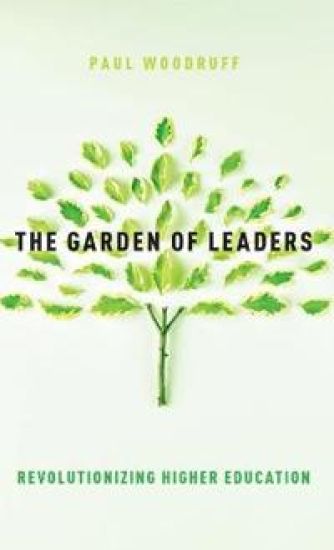
The Garden of Leaders explores two related questions: What is leadership? And what sort of education could prepare young people to be leaders? Paul Woodruff argues that higher education--particularly but not exclusively in the liberal arts--should set its main focus on cultivating leadership in students. Woodruff advances a new view of liberal arts education that places leadership at the root of everything it does, so that students will be prepared to lead in their lives and careers--and not necessarily in management roles. Woodruff views the contemporary university as sorely lacking an emphasis on leadership, and presents three core sets of recommendations for how they can and should foster it. First, Woodruff posits co-curricular groups, activities, and projects as essential activities for students to gain confidence and leadership skills. Administrations should encourage students to engage in activities outside the classroom, convert coached sports teams into student-led clubs as far as possible, and discourage social organizations that are segregated by race or sex. Second, Woodruff advocates for a different curriculum for all undergraduates, no matter their major-arguing that they need to be taught leadership in the forms of key skills including communication (including good writing, listening, and speaking), as well as exposure to key material in history literature, social science, and ethics. Students should be asked to consider the hardest ethical dilemmas that leaders face, toggling between Machiavelli and great ethical thinkers such as Confucius and Socrates. Third, Woodruff calls for the teaching methods used by instructors to re-orient themselves around the question of leadership, particularly by emphasizing teamwork. Professors should respect their students' independence, avoid tyrannical teaching, and remember that all teachers teach ethics simply by the examples they set in dealing with students. Whether in engineering, music, or classics, The Garden of Leaders advances leadership as a core value that should be at the heart of the educational enterprise-contending that while a college campus can be many things, it should at the very least be a ground upon which new leaders can grow.
Reverence

Reverence

Paul Woodruff

Oxford University Press Inc
2014
nidottu
Reverence is an ancient virtue that survives among us in half-forgotten patterns of civility and moments of inarticulate awe. Reverence gives meaning to much that we do, yet the word has almost passed out of our vocabulary. Reverence, says philosopher and classicist Paul Woodruff, begins in an understanding of human limitations. From this grows the capacity to be in awe of whatever we believe lies outside our control -- God, truth, justice, nature, even death. It is a quality of character that is especially important in leadership and in teaching, although it figures in virtually every human relationship. It transcends religious boundaries and can be found outside religion altogether. Woodruff draws on thinking about this lost virtue in ancient Greek and Chinese traditions and applies lessons from these highly reverent cultures to today's world. The book covers reverence in a variety of contexts -- the arts, leadership, teaching, warfare, and the home -- and shows how essential a quality it is to a well-functioning society. First published by Oxford University Press in 2001, this new edition of Reverence is revised and expanded. It contains two new chapters, one on the sacred and one on compassion, and an epilogue focused on renewing reverence in our own lives.
The Ajax Dilemma

The Ajax Dilemma

Paul Woodruff

Oxford University Press Inc
2014
nidottu
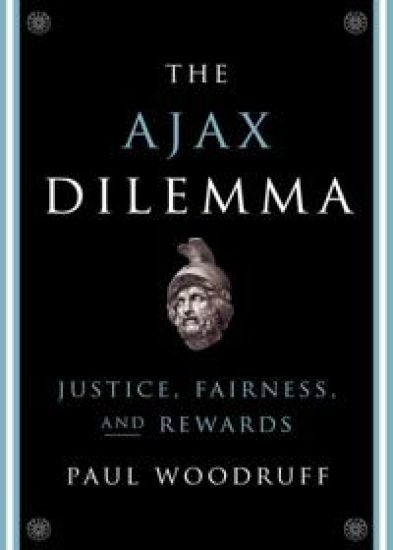
We live in a world where CEOs give themselves million dollar bonuses even as their companies go bankrupt and ordinary workers are laid off; where athletes make millions while teachers struggle to survive; a world, in short, where rewards are often unfairly meted out. In The Ajax Dilemma, Paul Woodruff examines one of today's most pressing moral issues: how to distribute rewards and public recognition without damaging the social fabric. How should we honor those whose behavior and achievement is essential to our overall success? Is it fair or right to lavish rewards on the superstar at the expense of the hardworking rank-and-file? How do we distinguish an impartial fairness from what is truly just? Woodruff builds his answer to these questions around the ancient conflict between Ajax and Odysseus over the armor of the slain warrior Achilles. King Agamemnon arranges a speech contest to decide the issue. Ajax, the loyal workhorse, loses the contest, and the priceless armor, to Odysseus, the brilliantly deceptive strategist who will lead the Greeks to victory. Deeply insulted, Ajax goes on a rampage and commits suicide, and in his rage we see the resentment of every loyal worker who has been passed over in favor of those who are more gifted, or whose skills are more highly valued. How should we deal with the "Ajax dilemma"? Woodruff argues that while we can never create a perfect system for distributing just rewards, we can recognize the essential role that wisdom, compassion, moderation, and respect must play if we are to restore the basic sense of justice on which all communities depend. This short, thoughtful book, written with Woodruff's characteristic elegance, investigates some of the most bitterly divisive issues in American today.
The Necessity of Theater

The Necessity of Theater

Paul Woodruff

Oxford University Press Inc
2010
nidottu
What is unique and essential about theater? What separates it from other arts? Do we need "theater" in some fundamental way? The art of theater, as Paul Woodruff says in this elegant and unique book, is as necessary - and as powerful - as language itself. Defining theater broadly, including sporting events and social rituals, he treats traditional theater as only one possibility in an art that - at its most powerful - can change lives and (as some peoples believe) bring a divine presence to earth. The Necessity of Theater analyzes the unique power of theater by separating it into the twin arts of watching and being watched, practiced together in harmony by watchers and the watched. Whereas performers practice the art of being watched - making their actions worth watching, and paying attention to action, choice, plot, character, mimesis, and the sacredness of performance space - audiences practice the art of watching: paying close attention. A good audience is emotionally engaged as spectators; their engagement takes a form of empathy that can lead to a special kind of human wisdom. As Plato implied, theater cannot teach us transcendent truths, but it can teach us about ourselves. Characteristically thoughtful, probing, and original, Paul Woodruff makes the case for theater as a unique form of expression connected to our most human instincts. The Necessity of Theater should appeal to anyone seriously interested or involved in theater or performance more broadly.
The Necessity of Theater

The Necessity of Theater

Paul Woodruff

Oxford University Press Inc
2008
sidottu
What is unique and essential about theatre? What separates it from other arts? Do we need 'theatre' in some fundamental way? The art of theatre, as Paul Woodruff says in this elegant and unique book, is as necessary-and as powerful-as language itself. Defining theatre broadly, including sporting events and social rituals, he treats traditional theatre as only one possibility in an art that-at its most powerful-can change lives and (as some peoples believe) bring a divine presence to earth. The Necessity of Theater analyzes the unique power of theatre by separating it into the twin arts of watching and being watched, practiced together in harmony by watchers and the watched. Whereas performers practice the art of being watched-making their actions worth watching, and paying attention to action, choice, plot, character, mimesis, and the sacredness of performance space-audiences practice the art of watching: paying close attention. A good audience is emotionally engaged as spectators; their engagement takes a form of empathy that can lead to a special kind of human wisdom. As Plato implied, theatre cannot teach us transcendent truths, but it can teach us about ourselves. Characteristically thoughtful, probing, and original, Paul Woodruff makes the case for theatre as a unique form of expression connected to our most human insticts. The Necessity of Theater should appeal to anyone seriously interested or involved in theatre or performance more broadly.
First Democracy

First Democracy

Paul Woodruff

Oxford University Press Inc
2006
nidottu
Americans have an unwavering faith in democracy and are ever eager to import it to nations around the world. But how democratic is our own "democracy"? If you can vote, if the majority rules, if you have elected representatives--does this automatically mean that you have a democracy? In this eye-opening look at an ideal that we all take for granted, classical scholar Paul Woodruff offers some surprising answers to these questions. Drawing on classical literature, philosophy, and history--with many intriguing passages from Sophocles, Aesop, and Plato, among others--Woodruff immerses us in the world of ancient Athens to uncover how the democratic impulse first came to life. The heart of the book isolates seven conditions that are the sine qua non of democracy: freedom from tyranny (including the tyranny of majority rule), harmony (the blending of different views), the rule of law, natural equality, citizen wisdom, reasoning without knowledge, and general education. He concludes that a true democracy must be willing to invite everyone to join in government. It must respect the rule of law so strongly that even the government is not above the law. True democracy must be mature enough to accept changes that come from the people. And it must be willing to pay the price of education for thoughtful citizenship. Ancient Athens didn't always live up to these ideals. Nor does modern America. If we learn anything from the story of Athens, Woodruff concludes, it should be this--never lose sight of the ideals of democracy. This compact, eloquent book illuminates these ideals and lights the way as we struggle to keep democracy alive at home and around the world.
First Democracy

First Democracy

Paul Woodruff

Oxford University Press Inc
2005
sidottu
A study of the concept and practice of democracy examines how the democratic impulse first came to life in ancient Athens, as well as the seven conditions that are necessary to democracy.
Oedipus Tyrannus

Oedipus Tyrannus

Paul Woodruff

Hackett Publishing Co, Inc
2000
pokkari
Weineck and Wooduff's collaboration on this translation of Sophocles' classic work combines an intimate knowledge of the theatre with an ear for the spoken word. It features extensive anotation and stage directions.
Bacchae

Bacchae

Euripides; Paul Woodruff

Hackett Publishing Co, Inc
1998
pokkari
This translation with notes is primarily for classroom use. It aims to be true to the basic meaning of the text and tries to bring across some of the beauty of the poetry as well as the rhetorical power of the dialogue and speeches.
Bacchae

Bacchae

Euripides; Paul Woodruff

Focus Publishing/R Pullins Co
1998
nidottu
This is an English translation of Euripides' tragedy The Bacchae based on the mythological story of King Pentheus of Thebes. Focus Classical Library provides close translations with notes and essays to provide access to understanding Greek culture.