Kirjojen hintavertailu. Mukana 12 595 353 kirjaa ja 12 kauppaa.
Kirjailija
Paulo Novais
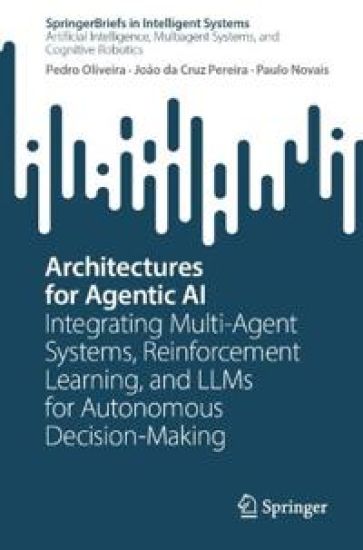
Kirjat ja teokset yhdessä paikassa: 4 kirjaa, julkaisuja vuosilta 2014-2026, suosituimpien joukossa Architectures for Agentic AI. Vertaile teosten hintoja ja tarkista saatavuus suomalaisista kirjakaupoista.
This book explores the application of generative Large Language Models (LLMs) for extracting and analyzing data from natural language artefacts. Unlike traditional uses of LLMs, such as translation and summarization, this book focuses on utilizing these models to convert unstructured text into data that can be processed through the data science pipeline to generate actionable insights. The content is designed for professionals in diverse fields including cognitive science, linguistics, management, and information systems. It combines insights from both industry and academia to provide a comprehensive understanding of how LLMs can be effectively used for natural language analytics (NLA). The book details practical methodologies for implementing LLMs locally using open-source tools, ensuring data privacy and feasibility without the need for expensive infrastructure. Key topics include interpretant, mindset and cultural analysis, emphasizing the use of LLMs to derive soft data—qualitative information crucial for nuanced decision-making. The text also outlines the technical aspects of LLMs, including their architecture, token embeddings, and the differences between encoder-based and decoder-based models. By providing a case study and practical examples, the authors show how LLMs can be used to meet various analytical needs, making this book a valuable resource for anyone looking to integrate advanced natural language processing techniques into their data analysis workflows.
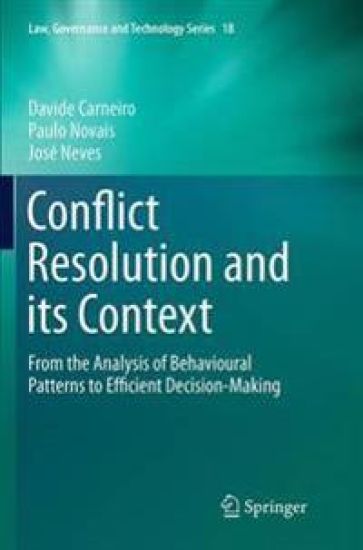
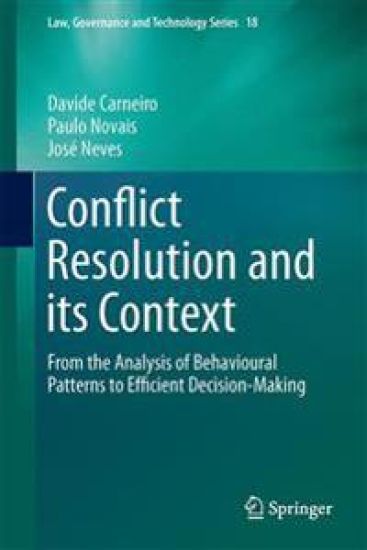
This book studies how technological solutions can be used to alleviate the current state of legal systems, with their clogged up courtrooms and inefficient conflict resolution methods. It reviews the shortcomings and disadvantages of traditional and alternative conflict resolution methods and turns to Artificial Intelligence for problem-solving techniques and solutions. The book is divided into four parts. The first part presents a general and systematic analysis of the current state of the legal systems, identifying the main problems and their causes. It then moves on to present UM Court: a framework for testing and prototyping conflict resolution services. This framework was developed with the objective of using Artificial Intelligence techniques to build a service environment for conflict resolution. The third part of the book takes a step into the future by analyzing the use of Intelligent Environments in the support of conflict management and resolution. It describes the approach taken and the experiments performed in the Intelligent Systems Lab of the University of Minho. The final part of the book contains the conclusions and shows the potential advantages of the use of Intelligent Environments as a way to implement better conflict resolution procedures (virtual or real), in which all the participants have access to more and better information and are able to take better informed decisions.
This book studies how technological solutions can be used to alleviate the current state of legal systems, with their clogged up courtrooms and inefficient conflict resolution methods. It reviews the shortcomings and disadvantages of traditional and alternative conflict resolution methods and turns to Artificial Intelligence for problem-solving techniques and solutions. The book is divided into four parts. The first part presents a general and systematic analysis of the current state of the legal systems, identifying the main problems and their causes. It then moves on to present UM Court: a framework for testing and prototyping conflict resolution services. This framework was developed with the objective of using Artificial Intelligence techniques to build a service environment for conflict resolution. The third part of the book takes a step into the future by analyzing the use of Intelligent Environments in the support of conflict management and resolution. It describes the approach taken and the experiments performed in the Intelligent Systems Lab of the University of Minho. The final part of the book contains the conclusions and shows the potential advantages of the use of Intelligent Environments as a way to implement better conflict resolution procedures (virtual or real), in which all the participants have access to more and better information and are able to take better informed decisions.