Kirjojen hintavertailu. Mukana 12 553 731 kirjaa ja 12 kauppaa.

Kirjailija

Payal Arora

Kirjat ja teokset yhdessä paikassa: 6 kirjaa, julkaisuja vuosilta 2010-2024, suosituimpien joukossa Dot Com Mantra. Vertaile teosten hintoja ja tarkista saatavuus suomalaisista kirjakaupoista.

6 kirjaa

Kirjojen julkaisuhaarukka 2010-2024.

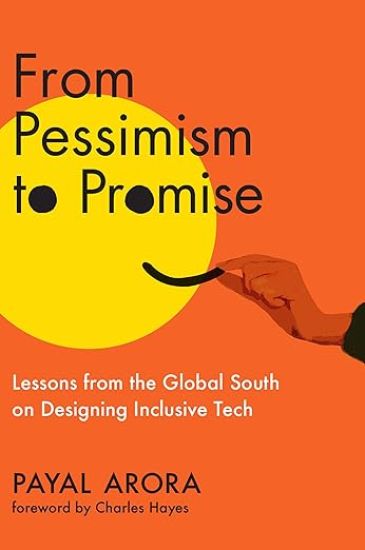
From Pessimism to Promise

From Pessimism to Promise

Payal Arora; Charles Hayes

MIT PRESS LTD
2024
sidottu
A radical paradigm shift in the way we think about AI and tech, taking hope and inspiration from the aspirational users of new technologies around the world. When it comes to tech, the mainstream headlines are bleak: Algorithms control and oppress. AI will destroy democracy and our social fabric, and possibly even drive us to extinction. While legitimate concerns drive these fears, we need to equally account for the fact that tech affords young people something incredibly valuable a rare space for self-actualization. In From Pessimism to Promise, award-winning author Payal Arora explains that, outside the West, where most of the world s youth reside, there is a significant different outlook on tech: in fact, there is a contagion of optimism toward all things digital. These users, especially those in marginalized contexts, are full of hope for new tech. As AI disrupts sectors across industries, education, and beyond, who better to shine the light forward, Arora argues, than the Global South, the navigator of all manner of forced disruptions, leapfrogging obstructive systems, norms, and practices to rapidly reinvent itself? Drawing on field insights in diverse global contexts such as Brazil, India, and Bangladesh, Payal describes what drives Gen Z to embrace new technologies. From Pessimism to Promise discusses the shift to relationally-driven approaches to design; how to create 'algorithms of aspiration'; how to reimagine the digital space for sex, pleasure, and care; and, what we can learn from feminist digital activists and women s collectives in the Global South on shared digital provenance and value, as well as indigenous approaches to sustainability, that challenges sacred ideas on degrowth, circular economy, and the doughnut economy. Arora also takes heart in the power in numbers, as the users from the majority world infuse algorithms with everyday aspirations, pushing for a new digital order. Timely and urgent, From Pessimism to Promise makes a deeply compelling case that it is not naive to be optimistic about our digital future. On the contrary, it is our moral imperative to design with hope.
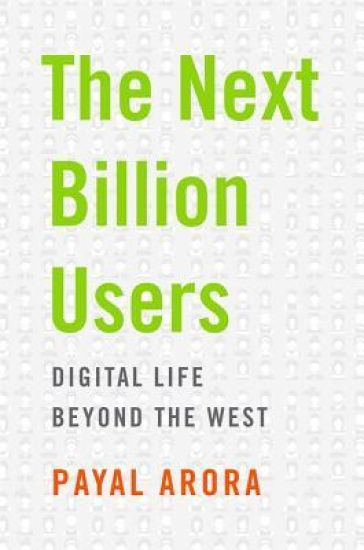
The Next Billion Users

The Next Billion Users

Payal Arora

Harvard University Press
2019
sidottu
A digital anthropologist examines the online lives of millions of people in China, India, Brazil, and across the Middle East—home to most of the world’s internet users—and discovers that what they are doing is not what we imagine.New-media pundits obsess over online privacy and security, cyberbullying, and revenge porn, but do these things really matter in most of the world? The Next Billion Users reveals that many assumptions about internet use in developing countries are wrong.After immersing herself in factory towns, slums, townships, and favelas, Payal Arora assesses real patterns of internet usage in India, China, South Africa, Brazil, and the Middle East. She finds Himalayan teens growing closer by sharing a single computer with common passwords and profiles. In China’s gaming factories, the line between work and leisure disappears. In Riyadh, a group of young women organizes a YouTube fashion show.Why do citizens of states with strict surveillance policies appear to care so little about their digital privacy? Why do Brazilians eschew geo-tagging on social media? What drives young Indians to friend “foreign” strangers on Facebook and give “missed calls” to people? The Next Billion Users answers these questions and many more. Through extensive fieldwork, Arora demonstrates that the global poor are far from virtuous utilitarians who mainly go online to study, find jobs, and obtain health information. She reveals habits of use bound to intrigue everyone from casual internet users to developers of global digital platforms to organizations seeking to reach the next billion internet users.
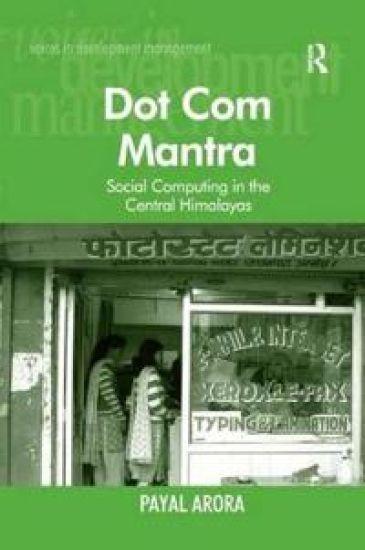
Dot Com Mantra

Dot Com Mantra

Payal Arora

Routledge
2016
nidottu
Billions of dollars are being spent nationally and globally on providing computing access to digitally disadvantaged groups and cultures with an expectation that computers and the Internet can lead to higher socio-economic mobility. This ethnographic study of social computing in the Central Himalayas, India, investigates alternative social practices with new technologies and media amongst a population that is for the most part undocumented. In doing so, this book offers fresh and critical perspectives in areas of contemporary debate: informal learning with computers, cyberleisure, gender access and empowerment, digital intermediaries, and glocalization of information and media.
The Leisure Commons

The Leisure Commons

Payal Arora

Routledge
2016
nidottu
There is much excitement about Web 2.0 as an unprecedented, novel, community-building space for experiencing, producing, and consuming leisure, particularly through social network sites. What is needed is a perspective that is invested in neither a utopian or dystopian posture but sees historical continuity to this cyberleisure geography. This book investigates the digital public sphere by drawing parallels to another leisure space that shares its rhetoric of being open, democratic, and free for all: the urban park. It makes the case that the history and politics of public parks as an urban commons provides fresh insight into contemporary debates on corporatization, democratization and privatization of the digital commons. This book takes the reader on a metaphorical journey through multiple forms of public parks such as Protest Parks, Walled Gardens, Corporate Parks, Fantasy Parks, and Global Parks, addressing issues such as virtual activism, online privacy/surveillance, digital labor, branding, and globalization of digital networks. Ranging from the 19th century British factory garden to Tokyo Disneyland, this book offers numerous spatial metaphors to bring to life aspects of new media spaces. Readers looking for an interdisciplinary, historical and spatial approach to staid Web 2.0 discourses will undoubtedly benefit from this text.
The Leisure Commons

The Leisure Commons

Payal Arora

Routledge
2014
sidottu
There is much excitement about Web 2.0 as an unprecedented, novel, community-building space for experiencing, producing, and consuming leisure, particularly through social network sites. What is needed is a perspective that is invested in neither a utopian or dystopian posture but sees historical continuity to this cyberleisure geography. This book investigates the digital public sphere by drawing parallels to another leisure space that shares its rhetoric of being open, democratic, and free for all: the urban park. It makes the case that the history and politics of public parks as an urban commons provides fresh insight into contemporary debates on corporatization, democratization and privatization of the digital commons. This book takes the reader on a metaphorical journey through multiple forms of public parks such as Protest Parks, Walled Gardens, Corporate Parks, Fantasy Parks, and Global Parks, addressing issues such as virtual activism, online privacy/surveillance, digital labor, branding, and globalization of digital networks. Ranging from the 19th century British factory garden to Tokyo Disneyland, this book offers numerous spatial metaphors to bring to life aspects of new media spaces. Readers looking for an interdisciplinary, historical and spatial approach to staid Web 2.0 discourses will undoubtedly benefit from this text.
Dot Com Mantra

Dot Com Mantra

Payal Arora

Ashgate Publishing Limited
2010
sidottu
Billions of dollars are being spent nationally and globally on providing computing access to digitally disadvantaged groups and cultures with an expectation that computers and the Internet can lead to higher socio-economic mobility. This ethnographic study of social computing in the Central Himalayas, India, investigates alternative social practices with new technologies and media amongst a population that is for the most part undocumented. In doing so, this book offers fresh and critical perspectives in areas of contemporary debate: informal learning with computers, cyberleisure, gender access and empowerment, digital intermediaries, and glocalization of information and media.