Kirjojen hintavertailu. Mukana 12 595 353 kirjaa ja 12 kauppaa.

Kirjailija

Pedro Luengo

Kirjat ja teokset yhdessä paikassa: 6 kirjaa, julkaisuja vuosilta 2018-2024, suosituimpien joukossa A Fortified Sea. Vertaile teosten hintoja ja tarkista saatavuus suomalaisista kirjakaupoista.

6 kirjaa

Kirjojen julkaisuhaarukka 2018-2024.

A Fortified Sea

A Fortified Sea

Mónica Cejudo Collera; Pedro Cruz Freire; María Mercedes Fernández Martín; Manuel Gámez Casado; Aaron Graham; Francisco Javier Herrera García; Nuria Hinarejos Martín; Ignacio J. López-Hernández; Pedro Luengo; Alfredo J. Morales; José Miguel Morales Folguera; Juan Miguel Muñoz Corbalán; Jesús María Ruiz Carrasco; Germán Segura García; Gene Allen Smith; Christopher K. Waters

THE UNIVERSITY OF ALABAMA PRESS
2024
sidottu
A multidisciplinary examination of the role of military forts in the Caribbean during the age of European colonial expansionA Fortified Sea illuminates the key role of military forts in the greater Caribbean during the long eighteenth century. The historical Caribbean, with its multiple contested boundaries at the periphery of European western expansion, typically has been analyzed as part of an empire. European powers, including Spain, the Netherlands, England, and Denmark, carved up the Caribbean Sea into a cultural patchwork. These varied cultural contexts were especially evident during regional and national conflicts throughout the eighteenth century and prompted the construction of more fortifications to protect imperial interests. The emergence of Anglo-American colonies during the eighteenth century and later the United States gradually altered previous geopolitical balances, redefining the cultural and geopolitical boundaries of the region. This collection of essays incorporates several historiographical traditions—from Spanish to American—all portraying the borderland as a breakthrough contested cultural, social, economic, and military boundary. A multinational roster of contributors approaches topics through a war studies lens as well as architecturally and historically, enriching a usually monothematic view. As well, discussion of cultural management of the historical remains of forts shows local communities trying to preserve and interpret the role of forts in society. Part I defines the training of military engineers in Spain. Part II engages with British defensive military plans and settlements in the Caribbean and shows how the British dealt with the rhetorical image of the empire. Part III clarifies the building processes of fortifications in Santiago de Cuba, Cartagena de Indias, Havana, and Veracruz, among other places. Copious period maps complement the prodigious research. The book will appeal to readers interested in the history of the Caribbean, military history, and European imperial expansion.
A Fortified Sea

A Fortified Sea

Mónica Cejudo Collera; Pedro Cruz Freire; María Mercedes Fernández Martín; Manuel Gámez Casado; Aaron Graham; Francisco Javier Herrera García; Nuria Hinarejos Martín; Ignacio J. López-Hernández; Pedro Luengo; Alfredo J. Morales; José Miguel Morales Folguera; Juan Miguel Muñoz Corbalán; Jesús María Ruiz Carrasco; Germán Segura García; Gene Allen Smith; Christopher K. Waters

THE UNIVERSITY OF ALABAMA PRESS
2024
nidottu
A multidisciplinary examination of the role of military forts in the Caribbean during the age of European colonial expansionA Fortified Sea illuminates the key role of military forts in the greater Caribbean during the long eighteenth century. The historical Caribbean, with its multiple contested boundaries at the periphery of European western expansion, typically has been analyzed as part of an empire. European powers, including Spain, the Netherlands, England, and Denmark, carved up the Caribbean Sea into a cultural patchwork. These varied cultural contexts were especially evident during regional and national conflicts throughout the eighteenth century and prompted the construction of more fortifications to protect imperial interests. The emergence of Anglo-American colonies during the eighteenth century and later the United States gradually altered previous geopolitical balances, redefining the cultural and geopolitical boundaries of the region. This collection of essays incorporates several historiographical traditions—from Spanish to American—all portraying the borderland as a breakthrough contested cultural, social, economic, and military boundary. A multinational roster of contributors approaches topics through a war studies lens as well as architecturally and historically, enriching a usually monothematic view. As well, discussion of cultural management of the historical remains of forts shows local communities trying to preserve and interpret the role of forts in society. Part I defines the training of military engineers in Spain. Part II engages with British defensive military plans and settlements in the Caribbean and shows how the British dealt with the rhetorical image of the empire. Part III clarifies the building processes of fortifications in Santiago de Cuba, Cartagena de Indias, Havana, and Veracruz, among other places. Copious period maps complement the prodigious research. The book will appeal to readers interested in the history of the Caribbean, military history, and European imperial expansion.Contributors MÓnica Cejudo Collera / Pedro Cruz Freire / MarÍa Mercedes FernÁndez MartÍn / Aaron Graham / Manuel GÁmez Casado / Francisco Javier Herrera GarcÍa / Nuria Hinarejos MartÍn / Pedro Luengo / Ignacio J. LÓpez-HernÁndez / JosÉ Miguel Morales Folguera / Alfredo J. Morales / Juan Miguel MuÑoz CorbalÁn / JesÚs Maria Ruiz Carrasco / GermÁn Segura GarcÍa / Gene Allen Smith / Christopher K. Waters
Manila, 1645

Manila, 1645

Pedro Luengo

TAYLOR FRANCIS LTD
2022
nidottu
Manila, 1645 reconstructs what the city of Manila was like before the earthquakes of the mid-seventeenth century.The book demonstrates the importance of addressing the history of Southeast Asia as a multi-layered framework, rather than a series of entangled histories. In doing so, Manila is contextualized not merely as a Spanish settlement connected to New Spain via America, but instead within Southeast Asia, situated between the Chinese and the Sulú Seas, and located in the centre of commercial routes used by Armenian, Dutch, and Portuguese traders. This historical and geographical context is crucial to understanding later cultural dialogues. Urban planning, housing and architecture, and social networks in the city are also examined. The book will appeal to students and scholars interested in early modern history, global history and architectural history.
Global architecture for eighteenth-century Beijing

Global architecture for eighteenth-century Beijing

Pedro Luengo

LIVERPOOL UNIVERSITY PRESS
2022
nidottu
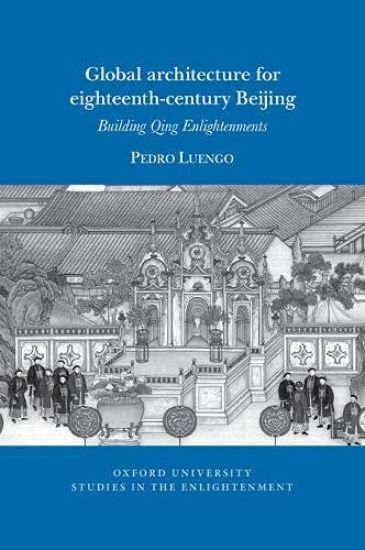
This book reinterprets architecture in Beijing during the reigns of the Kangxi (1661-1722), Yongzheng (1723-1735) and Qianlong (1736-1795) emperors in the eighteenth century. More specifically, it views the building processes of the four churches and the Western palaces in the Yuánmíng Yuán garden as an example of cultural dialogue in the context of the Enlightenment. The study is based firstly on archival sources from different institutions from around the globe, using Big Data to manage them. Secondly, it places increased emphasis on architectural remains, preserved both in international collections as well as at archaeological sites. To take advantage of these remains, some were recorded using close-range photogrammetry. Digital sunlight analyses of the buildings’ interiors were also carried out. From these emerging technologies, as well as written sources, it becomes possible first to reinterpret Beijing as an imperial capital where religious tolerance and cosmopolitanism were increasing, and second to re-evaluate the entire Yuánmíng Yuán Garden complex as a miniature version of Beijing. This approach makes for easier subsequent comparisons with other imperial capitals of the time, such as London, Paris and Istanbul. As such, this study reveals a largely neglected chapter in the global history of architecture, while simultaneously offering a crucial re-examination of the existing architectural remains.
Manila, 1645

Manila, 1645

Pedro Luengo

Routledge
2020
sidottu
Manila, 1645 reconstructs what the city of Manila was like before the earthquakes of the mid-seventeenth century.The book demonstrates the importance of addressing the history of Southeast Asia as a multi-layered framework, rather than a series of entangled histories. In doing so, Manila is contextualized not merely as a Spanish settlement connected to New Spain via America, but instead within Southeast Asia, situated between the Chinese and the Sulú Seas, and located in the centre of commercial routes used by Armenian, Dutch, and Portuguese traders. This historical and geographical context is crucial to understanding later cultural dialogues. Urban planning, housing and architecture, and social networks in the city are also examined. The book will appeal to students and scholars interested in early modern history, global history and architectural history.
The Convents of Manila

The Convents of Manila

Pedro Luengo

University of the Philippines Press
2018
nidottu
This book aims to give a new perspective on the architecture and its global reference developed in Manila during the Iberian Union (1580–1640). More specifically, it focuses on the building processes of convents inside Intramuros, including the structures built by the same religious provinces in Mexico. The research is based both on the review of new archival sources from around the world and on fieldwork at the construction remains in Manila, concluding that, for the various traditions significantly contributing to its architecture, the city must be considered as an example of global hybridization during this period. The convents of Manila are not just a marginal consequence of the New Spanish traditions but a phenomenon of globalization, part of Philippine history.