
Kirjojen hintavertailu. Mukana 12 215 744 kirjaa ja 12 kauppaa.

Kirjailija

Peggy Kamuf

Kirjat ja teokset yhdessä paikassa: 11 kirjaa, julkaisuja vuosilta 1997-2018, suosituimpien joukossa The Marrano Specter. Vertaile teosten hintoja ja tarkista saatavuus suomalaisista kirjakaupoista.

11 kirjaa

Kirjojen julkaisuhaarukka 1997-2018.

Literature and the Remains of the Death Penalty

Literature and the Remains of the Death Penalty

Peggy Kamuf

Fordham University Press
2018
pokkari
Why have generations of philosophers failed or refused to articulate a rigorous challenge to the death penalty, when literature has been rife with death penalty abolitionism for centuries? In this book, Peggy Kamuf explores why any properly philosophical critique of capital punishment in the West must confront the literary as that which exceeds the logical demands of philosophy. Jacques Derrida has written that "the modern history of the institution named literature in Europe over the last three or four centuries is contemporary with and indissociable from a contestation of the death penalty." How, Kamuf asks, does literature contest the death penalty today, particularly in the United States where it remains the last of its kind in a Western nation that professes to be a democracy? What resources do fiction, narrative, and poetic language supply in the age of the remains of the death penalty? Following a lucid account of Derrida's approach to the death penalty, Kamuf pursues this question across several literary texts. In reading Orwell's story "A Hanging," Kamuf explores the relation between literary narration and the role of the witness, concluding that such a witness needs the seal of literary language in order to account for the secret of the death penalty. The next chapter turns to the American scene with Robert Coover's 1977 novel The Public Burning, which restages the executions of Julius and Ethel Rosenberg as an outlandish public spectacle in Times Square. Because this fictional device reverses the drive toward secrecy that, beginning in the mid-nineteenth century, put an end to public executions in the West, Kamuf reads the novel in a tension with the current tendency in the U.S. to shore up and protect remaining death penalty practices through increasingly pervasive secrecy measures. A reading of Norman Mailer's 1979 novel The Executioner's Song, shows the breakdown of any firm distinction between suicide and capital execution and explores the essential affinity between traditional narrative structure, which is plotted from the end, and the "plot" of a death penalty. Final readings of Kafka, Derrida, and Baudelaire consider the relation between literature and law, showing how performative literary language can "play the law. "A brief conclusion, titled "Postmortem," reflects on the condition of literature as that which survives the death penalty. A major contribution to the field of law and society, this book makes the case for literature as a space for contesting the death penalty, a case that scholars and activists working across a range of traditions will need to confront.

Literature and the Remains of the Death Penalty

Literature and the Remains of the Death Penalty

Peggy Kamuf

FORDHAM UNIVERSITY PRESS
2018
sidottu
Why have generations of philosophers failed or refused to articulate a rigorous challenge to the death penalty, when literature has been rife with death penalty abolitionism for centuries? In this book, Peggy Kamuf explores why any properly philosophical critique of capital punishment in the West must confront the literary as that which exceeds the logical demands of philosophy. Jacques Derrida has written that "the modern history of the institution named literature in Europe over the last three or four centuries is contemporary with and indissociable from a contestation of the death penalty." How, Kamuf asks, does literature contest the death penalty today, particularly in the United States where it remains the last of its kind in a Western nation that professes to be a democracy? What resources do fiction, narrative, and poetic language supply in the age of the remains of the death penalty? Following a lucid account of Derrida's approach to the death penalty, Kamuf pursues this question across several literary texts. In reading Orwell's story "A Hanging," Kamuf explores the relation between literary narration and the role of the witness, concluding that such a witness needs the seal of literary language in order to account for the secret of the death penalty. The next chapter turns to the American scene with Robert Coover's 1977 novel The Public Burning, which restages the executions of Julius and Ethel Rosenberg as an outlandish public spectacle in Times Square. Because this fictional device reverses the drive toward secrecy that, beginning in the mid-nineteenth century, put an end to public executions in the West, Kamuf reads the novel in a tension with the current tendency in the U.S. to shore up and protect remaining death penalty practices through increasingly pervasive secrecy measures. A reading of Norman Mailer's 1979 novel The Executioner's Song, shows the breakdown of any firm distinction between suicide and capital execution and explores the essential affinity between traditional narrative structure, which is plotted from the end, and the "plot" of a death penalty. Final readings of Kafka, Derrida, and Baudelaire consider the relation between literature and law, showing how performative literary language can "play the law. "A brief conclusion, titled "Postmortem," reflects on the condition of literature as that which survives the death penalty. A major contribution to the field of law and society, this book makes the case for literature as a space for contesting the death penalty, a case that scholars and activists working across a range of traditions will need to confront.
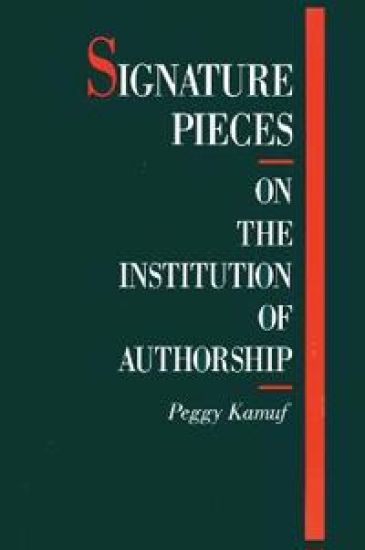
Signature Pieces

Signature Pieces

Peggy Kamuf

Cornell University Press
2018
pokkari
Some contemporary approaches to literature still accept the separation of historical, biographical, external concerns from formal, internal ones. On the borderline that lends this division between inside and outside its apparent coherence is signature. In Peggy Kamuf's view, studying signature will help us to rediscover some of the stakes of literary writing beyond the historicist/formalist opposition. Drawing on Derrida's extensive work on signatures and proper names, Kamuf investigates authorial signature in key writers from Rousseau to Woolf, as well as the implications of signature for the institutions of authorship and criticism.
The Marrano Specter

The Marrano Specter

Peggy Kamuf; Geoffrey Bennington

Fordham University Press
2017
pokkari
The Marrano Specter pursues the reciprocal influence between Jacques Derrida and Hispanism. On the one hand, Derrida's work has engendered a robust conversation among philosophers and critics in Spain and Latin America, where his work circulates in excellent translation, and where many of the terms and problems he addresses take on a distinctive meaning: nationalism and cosmopolitanism; spectrality and hauntology; the relation of subjectivity and truth; the university; disciplinarity; institutionality. Perhaps more remarkably, the influence is in a profound sense reciprocal: across his writings, Derrida grapples with the theme of marranismo, the phenomenon of Sephardic crypto-Judaism. Derrida's marranismo is a means of taking apart traditional accounts of identity; a way for Derrida to reflect on the status of the secret; a philosophical nexus where language, nationalism, and truth-telling meet and clash in productive ways; and a way of elaborating a critique of modern biopolitics. It is much more than a simple marker of his work's Hispanic identity, but it is also, and irreducibly, that. The essays collected in The Marrano Specter cut across the grain of traditional Hispanism, but also of the humanistic disciplines broadly conceived. Their vantage point—the theoretical, philosophically inflected critique of disciplinary practices—poses uncomfortable, often unfamiliar questions for both hispanophone studies and the broader theoretical humanities.
The Marrano Specter

The Marrano Specter

Peggy Kamuf; Geoffrey Bennington

FORDHAM UNIVERSITY PRESS
2017
sidottu
The Marrano Specter pursues the reciprocal influence between Jacques Derrida and Hispanism. On the one hand, Derrida's work has engendered a robust conversation among philosophers and critics in Spain and Latin America, where his work circulates in excellent translation, and where many of the terms and problems he addresses take on a distinctive meaning: nationalism and cosmopolitanism; spectrality and hauntology; the relation of subjectivity and truth; the university; disciplinarity; institutionality. Perhaps more remarkably, the influence is in a profound sense reciprocal: across his writings, Derrida grapples with the theme of marranismo, the phenomenon of Sephardic crypto-Judaism. Derrida's marranismo is a means of taking apart traditional accounts of identity; a way for Derrida to reflect on the status of the secret; a philosophical nexus where language, nationalism, and truth-telling meet and clash in productive ways; and a way of elaborating a critique of modern biopolitics. It is much more than a simple marker of his work's Hispanic identity, but it is also, and irreducibly, that. The essays collected in The Marrano Specter cut across the grain of traditional Hispanism, but also of the humanistic disciplines broadly conceived. Their vantage point—the theoretical, philosophically inflected critique of disciplinary practices—poses uncomfortable, often unfamiliar questions for both hispanophone studies and the broader theoretical humanities.
To Follow

To Follow

Peggy Kamuf

Edinburgh University Press
2012
nidottu
This book collects 10 years of Peggy Kamuf's writing on the work and friendship of Jacques Derrida. This study discusses the key aspects of Derrida's thought, either from a single work or across several texts. Kamuf engages with a broad array of his work, from the 1960s to the posthumous publication of his teaching seminars. She also considers press interviews and the collaboration on a film. These close readings are punctuated by brief recollections from their long friendship. The chapters trace a reflection that undergoes the sudden event of Derrida's death. Rather than take this interruption as its premise, however, the book sets out from Derrida's own teaching that mourning begins with friendship and not just at the death of the friend. Thus, the strict chronology of the chapters, from 2000 to 2010, highlights a general illusion of 'before' and 'after' that comes undone over the course of the sequence.
To Follow

To Follow

Peggy Kamuf

Edinburgh University Press
2010
sidottu
This book collects ten years of Peggy Kamuf's writing on the work and friendship of Jacques Derrida. The majority of the chapters discuss a key aspect of Derrida's thought, either from a single work or across several texts. Kamuf engages with a broad array of his work, from the 1960s to the posthumous publication of his teaching seminars. She also considers press interviews and the collaboration on a film. These close readings are punctuated by brief recollections from their long friendship. The chapters trace a reflection that undergoes the sudden event of Derrida's death. Rather than take this interruption as its premise, however, the book sets out from Derrida's own teaching that mourning begins with friendship and not just at the death of the friend. Thus, the strict chronology of the chapters, from 2000 to 2010, highlights a general illusion of 'before' and 'after' that comes undone over the course of the sequence.
Book of Addresses

Book of Addresses

Peggy Kamuf

Stanford University Press
2005
sidottu
This book consists of a series of essays that all turn around questions of the address of speech or writing. They argue and demonstrate that meaning is not just a matter of the active intention of a subject (for example, speaker, writer, or other signatory of a meaningful act) but also of its reception at another's address. The book's main concern is therefore with a theory of meaning and of action that is not centered on the intentional, self-conscious subject. The fifteen chapters explore this problematic within three broad areas: love, jealousy, and sexual difference; fiction or literature; and political or public discourse. The book engages principally with contemporary French thought and includes important new readings of work by Jacques Derrida, Hélène Cixous, Maurice Blanchot, and Jean-Luc Nancy.
Book of Addresses

Book of Addresses

Peggy Kamuf

Stanford University Press
2004
pokkari
This book consists of a series of essays that all turn around questions of the address of speech or writing. They argue and demonstrate that meaning is not just a matter of the active intention of a subject (for example, speaker, writer, or other signatory of a meaningful act) but also of its reception at another's address. The book's main concern is therefore with a theory of meaning and of action that is not centered on the intentional, self-conscious subject. The fifteen chapters explore this problematic within three broad areas: love, jealousy, and sexual difference; fiction or literature; and political or public discourse. The book engages principally with contemporary French thought and includes important new readings of work by Jacques Derrida, Hélène Cixous, Maurice Blanchot, and Jean-Luc Nancy.
The Division of Literature

The Division of Literature

Peggy Kamuf

University of Chicago Press
1997
sidottu
Where does the university begin and the "outside" end? How has literature become established as a separate domain within the university? Demonstrating that these questions of division are intricately related, Peggy Kamuf explores the space that the university devotes to the study of literature. Kamuf begins by analyzing the complex history of literary study within the modern university, critically reading developments from the French Revolution through the 19th century and beyond in Europe. She then turns to one of the most troubling works in the American literary canon - Melville's "The Confidence-Man" - to show how academic literary history has avoided confronting the implications of works in which meaning is never solely confined within a past.
The Division of Literature

The Division of Literature

Peggy Kamuf

University of Chicago Press
1997
nidottu
Where does the university begin and the "outside" end? How has literature become established as a separate domain within the university? Demonstrating that these questions of division are intricately related, Peggy Kamuf explores the space that the university devotes to the study of literature. Kamuf begins by analyzing the complex history of literary study within the modern university, critically reading developments from the French Revolution through the 19th century and beyond in Europe. She then turns to one of the most troubling works in the American literary canon - Melville's "The Confidence-Man" - to show how academic literary history has avoided confronting the implications of works in which meaning is never solely confined within a past.