Kirjojen hintavertailu. Mukana 12 459 402 kirjaa ja 12 kauppaa.

Kirjailija

Pekka Neittaanmäki

Kirjat ja teokset yhdessä paikassa: 29 kirjaa, julkaisuja vuosilta 1991-2022, suosituimpien joukossa Reliable Methods for Computer Simulation. Vertaile teosten hintoja ja tarkista saatavuus suomalaisista kirjakaupoista.

Mukana myös kirjoitusasut: Pekka Neittaanmaki

29 kirjaa

Kirjojen julkaisuhaarukka 1991-2022.

Reliable Methods for Computer Simulation

Reliable Methods for Computer Simulation

Pekka Neittaanmäki; Sergey R. Repin

Elsevier Science Ltd
2004
sidottu
Recent decades have seen a very rapid success in developing numerical methods based on explicit control over approximation errors. It may be said that nowadays a new direction is forming in numerical analysis, the main goal of which is to develop methods ofreliable computations. In general, a reliable numerical method must solve two basic problems: (a) generate a sequence of approximations that converges to a solution and (b) verify the accuracy of these approximations. A computer code for such a method must consist of two respective blocks: solver and checker. In this book, we are chiefly concerned with the problem (b) and try to present the main approaches developed for a posteriori error estimation in various problems. The authors try to retain a rigorous mathematical style, however, proofs are constructive whenever possible and additional mathematical knowledge is presented when necessary. The book contains a number of new mathematical results and lists a posteriori error estimation methods that have been developed in the very recent time.

Mitä tulisi tietää tekoälystä

Mitä tulisi tietää tekoälystä

Timo Siukonen; Pekka Neittaanmäki

Docendo
2019
sidottu
Ensimmäinen suomalainen yleisteos tekoälystä.Elämme uuden teknologisen vallankumouksen ensimmäistä vuosikymmentä. Digitaalisuus, nopeat tietoverkot ja tekoäly ovat muuttaneet maailmaa merkittävästi.Tämä kirja vie lukijan uusimman kehityksen ytimeen. Siinä etsitään vastauksia kysymyksiin: mitä tekoälystä ymmärretään ja ajatellaan, millaisia tekoälyn kehitysmahdollisuudet ja uhkatekijät ovat, miten tekoäly helpottaa elämää ja millaisiin rakenneuudistuksiin se johtaa työelämässä? Lukijalle tarjotaan myös aikamatka tekoälykehityksen alkuaskeleihin ja kehityshistoriaan.Tekoälyn avulla koneet, laitteet, ohjelmat ja järjestelmät pystyvät toimimaan tehtävän ja tilanteen mukaisesti järkevällä tavalla. Saatavilla olevan tiedon määrä on kasvanut dramaattisesti ja sen etsiminen helpottunut. Tietosanakirjojen, arkistojen ja puhelinluetteloiden selaamisen sijaan tieto oheisaineistoineen löytyy tekoälyyn perustuvien hakukoneiden avulla internetistä.Viimeisen kymmenen vuoden aikana digitalisaation kehitys on kiihtynyt ja erityisesti 2010-luvun jälkipuoliskolla tahti on ollut huima uusien tietoteknisten innovaatioiden ja järeiden globaalien toimijoiden ansiosta. Tietokoneiden laskuteho on kasvanut valtavasti, ja tekoälyllä toimivien ohjelmien opettamiseen tarvittavaa massadataa on nykyisin saatavilla paljon. Erityisesti amerikkalaiset ja kiinalaiset suuret toimijat kehittävät tekoälyyn perustuvia palveluitaan ja myyvät niitä maailmanlaajuisesti.Kiinnostus tekoälyä kohtaan on lisääntynyt räjähdysmäisesti. Uutiset kertovat päivittäin uhkista ja mahdollisuuksista. Tekoälysovelluksia on myynnissä satoja, ja yritysten arvioiden mukaan niiden liiketoimintapotentiaali on tuhansia miljardeja euroja. Johtavissa teollisuusmaissa tekoäly on nousut strategiseksi tutkimusalaksi ja yliopistojen yhteyteen on perustettu tekoälyyn liittyviä tutkimus- ja koulutusohjelmia.Yhtenä digitalisaation kärkimaana Suomella on erinomaiset mahdollisuudet hyötyä tekoälystä. Yliopistojen ja yritysten välisessä yhteistyössä kehitetään esimerkiksi terveydenhoitoon ja sairauksien diagnosointiin liittyviä sovelluksia kansalaisten hyvinvoinnin edistämiseksi.Timo Siukonen (s. 1952) on Helsingin Sanomien pitkäaikainen toimittaja ja tietokirjailija. Pekka Neittaanmäki (s. 1951) toimii tietotekniikan professorina Jyväskylän yliopistossa.
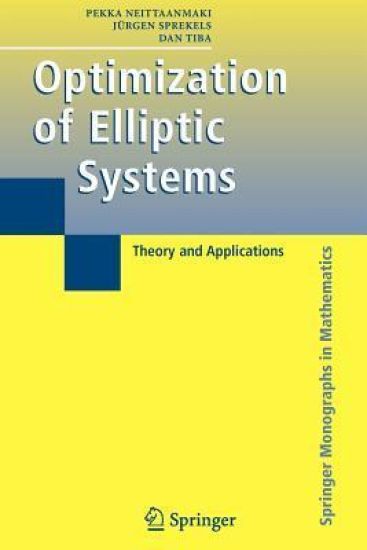
Optimization of Elliptic Systems

Optimization of Elliptic Systems

Pekka Neittaanmaki; Jürgen Sprekels; Dan Tiba

Springer-Verlag New York Inc.
2010
nidottu
The present monograph is intended to provide a comprehensive and accessible introduction to the optimization of elliptic systems. This area of mathematical research, which has many important applications in science and technology. has experienced an impressive development during the past two decades. There are already many good textbooks dealing with various aspects of optimal design problems. In this regard, we refer to the works of Pironneau [1984], Haslinger and Neittaanmaki [1988], [1996], Sokolowski and Zolksio [1992], Litvinov [2000], Allaire [2001], Mohammadi and Pironneau [2001], Delfour and Zolksio [2001], and Makinen and Haslinger [2003]. Already Lions [I9681 devoted a major part of his classical monograph on the optimal control of partial differential equations to the optimization of elliptic systems. Let us also mention that even the very first known problem of the calculus of variations, the brachistochrone studied by Bernoulli back in 1696. is in fact a shape optimization problem. The natural richness of this mathematical research subject, as well as the extremely large field of possible applications, has created the unusual situation that although many important results and methods have already been est- lished, there are still pressing unsolved questions. In this monograph, we aim to address some of these open problems; as a consequence, there is only a minor overlap with the textbooks already existing in the field.
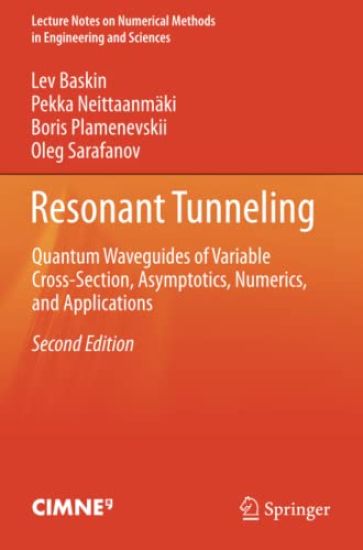
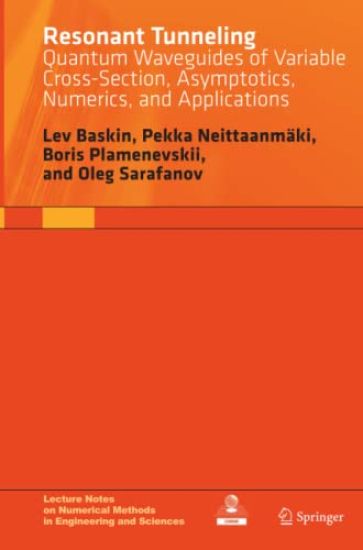
Resonant Tunneling

Resonant Tunneling

Lev Baskin; Pekka Neittaanmäki; Boris Plamenevskii; Oleg Sarafanov

Springer Nature Switzerland AG
2022
nidottu
This book studies electron resonant tunneling in two- and three-dimensional quantum waveguides of variable cross-sections in the time-independent approach. Mathematical models are suggested for the resonant tunneling and develop asymptotic and numerical approaches for investigating the models. Also, schemes are presented for several electronics devices based on the phenomenon of resonant tunneling. Compared to its first edition, this book includes four new chapters, redistributes the content between chapters and modifies the estimates of the remainders in the asymptotics of resonant tunneling characteristics. The book is addressed to mathematicians, physicists, and engineers interested in waveguide theory and its applications in electronics.
Transforming the Socio Economy with Digital innovation

Transforming the Socio Economy with Digital innovation

Chiho Watanabe; Yuji Tou; Pekka Neittaanmäki

Elsevier - Health Sciences Division
2021
nidottu
Transforming the Socio Economy with Digital Innovation explores the impacts of digital innovation on socioeconomic phenomena, resilience and governance. The book examines the limitation of using GDP as a measure of economic growth in digital societies, stressing how the Internet promotes a "free" culture that cannot be captured through GDP data. The book synthesizes multi-dimensional research consisting of digital platform ecosystems observations, theoretical appraisals, statistical methods development, in-depth empirical analysis, and database construction for analysis and outcomes compilation. Utilizing analysis from more than 500 global ICT leaders, this book identifies potential challenges and solutions for academic analysis, economic planning and policymaking.
Resonant Tunneling

Resonant Tunneling

Lev Baskin; Pekka Neittaanmäki; Boris Plamenevskii; Oleg Sarafanov

Springer Nature Switzerland AG
2021
sidottu
This book studies electron resonant tunneling in two- and three-dimensional quantum waveguides of variable cross-sections in the time-independent approach. Mathematical models are suggested for the resonant tunneling and develop asymptotic and numerical approaches for investigating the models. Also, schemes are presented for several electronics devices based on the phenomenon of resonant tunneling. Compared to its first edition, this book includes four new chapters, redistributes the content between chapters and modifies the estimates of the remainders in the asymptotics of resonant tunneling characteristics. The book is addressed to mathematicians, physicists, and engineers interested in waveguide theory and its applications in electronics.
Stability of Axially Moving Materials

Stability of Axially Moving Materials

Nikolay Banichuk; Alexander Barsuk; Juha Jeronen; Tero Tuovinen; Pekka Neittaanmäki

Springer Nature Switzerland AG
2020
nidottu
This book discusses the stability of axially moving materials, which are encountered in process industry applications such as papermaking. A special emphasis is given to analytical and semianalytical approaches. As preliminaries, we consider a variety of problems across mechanics involving bifurcations, allowing to introduce the techniques in a simplified setting. In the main part of the book, the fundamentals of the theory of axially moving materials are presented in a systematic manner, including both elastic and viscoelastic material models, and the connection between the beam and panel models. The issues that arise in formulating boundary conditions specifically for axially moving materials are discussed. Some problems involving axially moving isotropic and orthotropic elastic plates are analyzed. Analytical free-vibration solutions for axially moving strings with and without damping are derived. A simple model for fluid--structure interaction of an axially moving panel ispresented in detail. This book is addressed to researchers, industrial specialists and students in the fields of theoretical and applied mechanics, and of applied and computational mathematics.
Stability of Axially Moving Materials

Stability of Axially Moving Materials

Nikolay Banichuk; Alexander Barsuk; Juha Jeronen; Tero Tuovinen; Pekka Neittaanmäki

Springer Nature Switzerland AG
2019
sidottu
This book discusses the stability of axially moving materials, which are encountered in process industry applications such as papermaking. A special emphasis is given to analytical and semianalytical approaches. As preliminaries, we consider a variety of problems across mechanics involving bifurcations, allowing to introduce the techniques in a simplified setting. In the main part of the book, the fundamentals of the theory of axially moving materials are presented in a systematic manner, including both elastic and viscoelastic material models, and the connection between the beam and panel models. The issues that arise in formulating boundary conditions specifically for axially moving materials are discussed. Some problems involving axially moving isotropic and orthotropic elastic plates are analyzed. Analytical free-vibration solutions for axially moving strings with and without damping are derived. A simple model for fluid--structure interaction of an axially moving panel ispresented in detail. This book is addressed to researchers, industrial specialists and students in the fields of theoretical and applied mechanics, and of applied and computational mathematics.
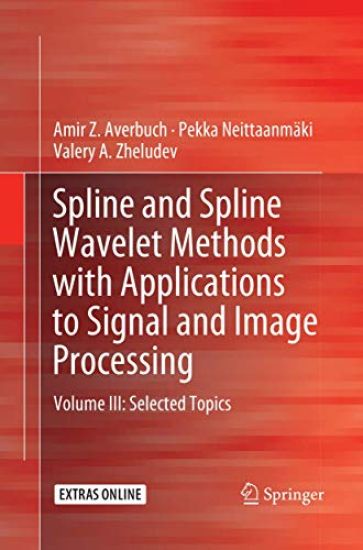
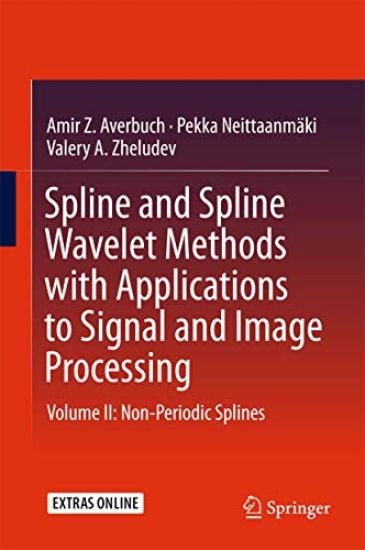
Spline and Spline Wavelet Methods with Applications to Signal and Image Processing

Spline and Spline Wavelet Methods with Applications to Signal and Image Processing

Amir Z. Averbuch; Pekka Neittaanmäki; Valery A. Zheludev

Springer Nature Switzerland AG
2019
nidottu
This book provides a practical guide, complete with accompanying Matlab software, to many different types of polynomial and discrete splines and spline-based wavelets, multiwavelets and wavelet frames in signal and image processing applications. In self-contained form, it briefly outlines a broad range of polynomial and discrete splines with equidistant nodes and their signal-processing-relevant properties. In particular, interpolating, smoothing, and shift-orthogonal splines are presented.
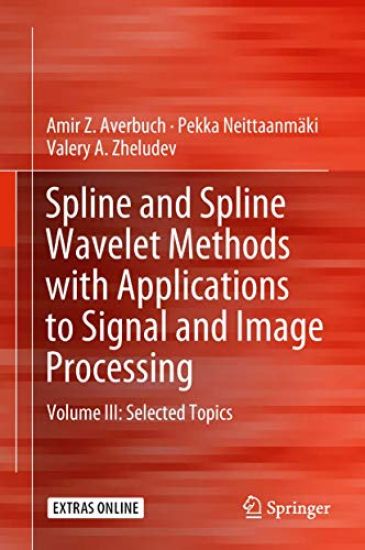
Spline and Spline Wavelet Methods with Applications to Signal and Image Processing

Spline and Spline Wavelet Methods with Applications to Signal and Image Processing

Amir Z. Averbuch; Pekka Neittaanmäki; Valery A. Zheludev

Springer International Publishing AG
2018
sidottu
This book provides a practical guide, complete with accompanying Matlab software, to many different types of polynomial and discrete splines and spline-based wavelets, multiwavelets and wavelet frames in signal and image processing applications. In self-contained form, it briefly outlines a broad range of polynomial and discrete splines with equidistant nodes and their signal-processing-relevant properties. In particular, interpolating, smoothing, and shift-orthogonal splines are presented.
Resonant Tunneling

Resonant Tunneling

Lev Baskin; Pekka Neittaanmäki; Boris Plamenevskii; Oleg Sarafanov

Springer International Publishing AG
2016
nidottu
This volume studies electron resonant tunneling in two- and three-dimensional quantum waveguides of variable cross-sections in the time-independent approach.Mathematical models are suggested for the resonant tunneling and develop asymptotic and numerical approaches for investigating the models. Also, schemes are presented for several electronics devices based on the phenomenon of resonant tunneling.Devices based on the phenomenon of electron resonant tunneling are widely used in electronics. Efforts are directed towards refining properties of resonance structures. There are prospects for building new nano size electronics elements based on quantum dot systems.However, the role of resonance structure can also be given to a quantum wire of variable cross-section. Instead of an "electrode - quantum dot - electrode" system, one can use a quantum wire with two narrows. A waveguide narrow is an effective potential barrier for longitudinal electron motion along a waveguide. The part of the waveguide between two narrows becomes a "resonator" , where electron resonant tunneling can occur. This phenomenon consists in the fact that, for an electron with energy E, the probability T(E) to pass from one part of the waveguide to the other part through the resonator has a sharp peak at E = Eres, where Eres denotes a "resonant" energy. Such quantum resonators can find applications as elements of nano electronics devices and provide some advantages in regard to operation properties and production technology.The book is addressed to mathematicians, physicists, and engineers interested in waveguide theory and its applications in electronics.
Spline and Spline Wavelet Methods with Applications to Signal and Image Processing

Spline and Spline Wavelet Methods with Applications to Signal and Image Processing

Amir Z. Averbuch; Pekka Neittaanmaki; Valery A. Zheludev

Springer
2016
nidottu
This volume provides universal methodologies accompanied by Matlab software to manipulate numerous signal and image processing applications. It is done with discrete and polynomial periodic splines. Various contributions of splines to signal and image processing from a unified perspective are presented. This presentation is based on Zak transform and on Spline Harmonic Analysis (SHA) methodology. SHA combines approximation capabilities of splines with the computational efficiency of the Fast Fourier transform. SHA reduces the design of different spline types such as splines, spline wavelets (SW), wavelet frames (SWF) and wavelet packets (SWP) and their manipulations by simple operations. Digital filters, produced by wavelets design process, give birth to subdivision schemes. Subdivision schemes enable to perform fast explicit computation of splines' values at dyadic and triadic rational points. This is used for signals and images up sampling. In addition to the design of a diverse library of splines, SW, SWP and SWF, this book describes their applications to practical problems. The applications include up sampling, image denoising, recovery from blurred images, hydro-acoustic target detection, to name a few. The SWF are utilized for image restoration that was degraded by noise, blurring and loss of significant number of pixels. The book is accompanied by Matlab based software that demonstrates and implements all the presented algorithms. The book combines extensive theoretical exposure with detailed description of algorithms, applications and software.The Matlab software can be downloaded from http://extras.springer.com
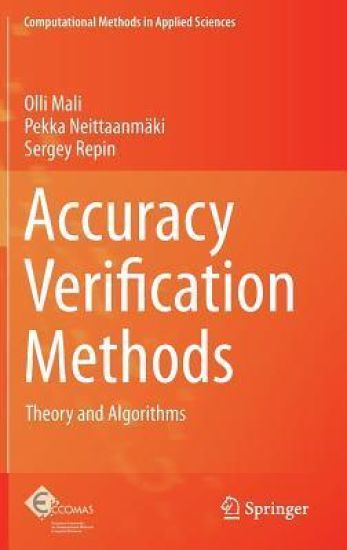
Accuracy Verification Methods

Accuracy Verification Methods

Olli Mali; Pekka Neittaanmäki; Sergey Repin

Springer
2016
nidottu
The importance of accuracy verification methods was understood at the very beginning of the development of numerical analysis. Recent decades have seen a rapid growth of results related to adaptive numerical methods and a posteriori estimates. However, in this important area there often exists a noticeable gap between mathematicians creating the theory and researchers developing applied algorithms that could be used in engineering and scientific computations for guaranteed and efficient error control. The goals of the book are to (1) give a transparent explanation of the underlying mathematical theory in a style accessible not only to advanced numerical analysts but also to engineers and students; (2) present detailed step-by-step algorithms that follow from a theory; (3) discuss their advantages and drawbacks, areas of applicability, give recommendations and examples.
Mechanics of Moving Materials

Mechanics of Moving Materials

Nikolay Banichuk; Juha Jeronen; Pekka Neittaanmäki; Tytti Saksa; Tero Tuovinen

Springer International Publishing AG
2016
nidottu
This book deals with theoretical aspects of modelling the mechanical behaviour of manufacturing, processing, transportation or other systems in which the processed or supporting material is travelling through the system. Examples of such applications include paper making, transmission cables, band saws, printing presses, manufacturing of plastic films and sheets, and extrusion of aluminium foil, textiles and other materials.The work focuses on out-of-plane dynamics and stability analysis for isotropic and orthotropic travelling elastic and viscoelastic materials, with and without fluid-structure interaction, using analytical and semi-analytical approaches. Also topics such as fracturing and fatigue are discussed in the context of moving materials. The last part of the book deals with optimization problems involving physical constraints arising from the stability and fatigue analyses, including uncertainties in the parameters.The book is intended for researchers and specialists in the field, providing a view of the mechanics of axially moving materials. It can also be used as a textbook for advanced courses on this specific topic. Considering topics related to manufacturing and processing, the book can also be applied in industrial mathematics.
Spline and Spline Wavelet Methods with Applications to Signal and Image Processing

Spline and Spline Wavelet Methods with Applications to Signal and Image Processing

Amir Z. Averbuch; Pekka Neittaanmäki; Valery A. Zheludev

Springer International Publishing AG
2015
sidottu
This book presents various contributions of splines to signal and image processing from a unified perspective that is based on the Zak transform (ZT). It expands the methodology from periodic splines, which were presented in the first volume, to non-periodic splines. Together, these books provide a universal toolbox accompanied by MATLAB software for manipulating polynomial and discrete splines, spline-based wavelets, wavelet packets and wavelet frames for signal/ image processing applications.In this volume, we see that the ZT provides an integral representation of discrete and polynomial splines, which, to some extent, is similar to Fourier integral. The authors explore elements of spline theory and design, and consider different types of polynomial and discrete splines. They describe applications of spline-based wavelets to data compression. These splines are useful for real-time signal processing and, in particular, real-time wavelet and frame transforms.Further topics addressed in this volume include: "global" splines, such as interpolating, self-dual and smoothing, whose supports are infinite; the compactly supported quasi-interpolating and smoothing splines including quasi-interpolating splines on non-uniform grids; and cubic Hermite splines as a source for the design of multiwavelets and multiwavelet frames.Readers from various disciplines including engineering, computer science and mathematical information technology will find the descriptions of algorithms, applications and software in this book especially useful.
Spline and Spline Wavelet Methods with Applications to Signal and Image Processing

Spline and Spline Wavelet Methods with Applications to Signal and Image Processing

Amir Z. Averbuch; Pekka Neittaanmaki; Valery A. Zheludev

Springer
2014
sidottu
This volume provides universal methodologies accompanied by Matlab software to manipulate numerous signal and image processing applications. It is done with discrete and polynomial periodic splines. Various contributions of splines to signal and image processing from a unified perspective are presented. This presentation is based on Zak transform and on Spline Harmonic Analysis (SHA) methodology. SHA combines approximation capabilities of splines with the computational efficiency of the Fast Fourier transform. SHA reduces the design of different spline types such as splines, spline wavelets (SW), wavelet frames (SWF) and wavelet packets (SWP) and their manipulations by simple operations. Digital filters, produced by wavelets design process, give birth to subdivision schemes. Subdivision schemes enable to perform fast explicit computation of splines' values at dyadic and triadic rational points. This is used for signals and images up sampling. In addition to the design of a diverse library of splines, SW, SWP and SWF, this book describes their applications to practical problems. The applications include up sampling, image denoising, recovery from blurred images, hydro-acoustic target detection, to name a few. The SWF are utilized for image restoration that was degraded by noise, blurring and loss of significant number of pixels. The book is accompanied by Matlab based software that demonstrates and implements all the presented algorithms. The book combines extensive theoretical exposure with detailed description of algorithms, applications and software.The Matlab software can be downloaded from http://extras.springer.com
Mechanics of Moving Materials

Mechanics of Moving Materials

Nikolay Banichuk; Juha Jeronen; Pekka Neittaanmäki; Tytti Saksa; Tero Tuovinen

Springer International Publishing AG
2013
sidottu
This book deals with theoretical aspects of modelling the mechanical behaviour of manufacturing, processing, transportation or other systems in which the processed or supporting material is travelling through the system. Examples of such applications include paper making, transmission cables, band saws, printing presses, manufacturing of plastic films and sheets, and extrusion of aluminium foil, textiles and other materials.The work focuses on out-of-plane dynamics and stability analysis for isotropic and orthotropic travelling elastic and viscoelastic materials, with and without fluid-structure interaction, using analytical and semi-analytical approaches. Also topics such as fracturing and fatigue are discussed in the context of moving materials. The last part of the book deals with optimization problems involving physical constraints arising from the stability and fatigue analyses, including uncertainties in the parameters.The book is intended for researchers and specialists in the field, providing a view of the mechanics of axially moving materials. It can also be used as a textbook for advanced courses on this specific topic. Considering topics related to manufacturing and processing, the book can also be applied in industrial mathematics.
Accuracy Verification Methods

Accuracy Verification Methods

Olli Mali; Pekka Neittaanmäki; Sergey Repin

Springer
2013
sidottu
The importance of accuracy verification methods was understood at the very beginning of the development of numerical analysis. Recent decades have seen a rapid growth of results related to adaptive numerical methods and a posteriori estimates. However, in this important area there often exists a noticeable gap between mathematicians creating the theory and researchers developing applied algorithms that could be used in engineering and scientific computations for guaranteed and efficient error control. The goals of the book are to (1) give a transparent explanation of the underlying mathematical theory in a style accessible not only to advanced numerical analysts but also to engineers and students; (2) present detailed step-by-step algorithms that follow from a theory; (3) discuss their advantages and drawbacks, areas of applicability, give recommendations and examples.
Mathematical Models in Electrical Circuits: Theory and Applications
One service mathematics has rendered the 'Et moi, ...si favait su comment en revenir, je n'y seTais point alle.' human race. It has put common sense back Jules Verne where it belongs. on the topmost shelf next to the dusty canister labelled 'discarded n- sense', The series is divergent; therefore we may be Eric T. Bell able to do something with it. O. Heaviside Mathematics is a tool for thought. A highly necessary tool in a world where both feedback and non- linearities abound. Similarly, all kinds of parts of mathematics serve as tools for other parts and for other sciences. Applying a simple rewriting rule to the quote on the right above one finds such statements as: 'One service topology has rendered mathematical physics ...'; 'One scrvice logic has rendered com- puter science ...'; 'One service category theory has rendcred mathematics ...'. All arguably true. And all statements obtainable this way form part of the raison d'e"tre of this scries.
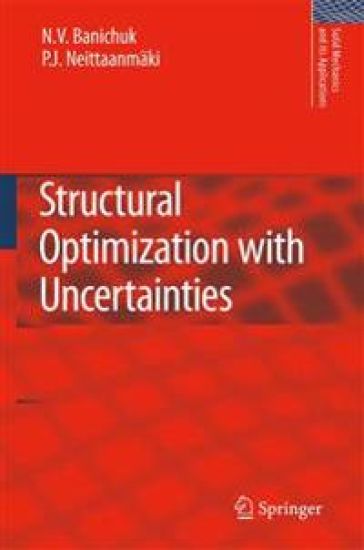
Structural Optimization with Uncertainties

Structural Optimization with Uncertainties

N.V. Banichuk; Pekka Neittaanmäki

Springer
2012
nidottu
Structural optimization is currently attracting considerable attention. Interest in - search in optimal design has grown in connection with the rapid development of aeronautical and space technologies, shipbuilding, and design of precision mach- ery. A special ?eld in these investigations is devoted to structural optimization with incomplete information (incomplete data). The importance of these investigations is explained as follows. The conventional theory of optimal structural design - sumes precise knowledge of material parameters, including damage characteristics and loadings applied to the structure. In practice such precise knowledge is seldom available. Thus, it is important to be able to predict the sensitivity of a designed structure to random ?uctuations in the environment and to variations in the material properties. To design reliable structures it is necessary to apply the so-called gu- anteed approach, based on a “worst case scenario” or a more optimistic probabilistic approach, if we have additional statistical data. Problems of optimal design with incomplete information also have consid- able theoretical importance. The introduction and investigations into new types of mathematical problems are interesting in themselves. Note that some ga- theoretical optimization problems arise for which there are no systematic techniques of investigation. This monograph is devoted to the exposition of new ways of formulating and solving problems of structural optimization with incomplete information. We recall some research results concerning the optimum shape and structural properties of bodies subjected to external loadings.