Kirjojen hintavertailu. Mukana 12 200 445 kirjaa ja 12 kauppaa.
Kirjailija
Peng Yang
Kirjat ja teokset yhdessä paikassa: 5 kirjaa, julkaisuja vuosilta 2007-2022, suosituimpien joukossa Millimeter-Wave Networks. Vertaile teosten hintoja ja tarkista saatavuus suomalaisista kirjakaupoista.
This book provides a comprehensive review and in-depth study on efficient beamforming design and rigorous performance analysis in mmWave networks, covering beam alignment, beamforming training and beamforming-aided caching. Due to significant beam alignment latency between the transmitter and the receiver in existing mmWave systems, this book proposes a machine learning based beam alignment algorithm for mmWave networks to determine the optimal beam pair with a low latency. Then, to analyze and enhance the performance of beamforming training (BFT) protocol in 802.11ad mmWave networks, an analytical model is presented to evaluate the performance of BFT protocol and an enhancement scheme is proposed to improve its performance in high user density scenarios. Furthermore, it investigates the beamforming-aided caching problem in mmWave networks, and proposes a device-to-device assisted cooperative edge caching to alleviate backhaul congestion and reduce content retrieval delay. This book concludes with future research directions in the related fields of study. The presented beamforming designs and the corresponding research results covered in this book, provides valuable insights for practical mmWave network deployment and motivate new ideas for future mmWave networking.This book targets researchers working in the fields of mmWave networks, beamforming design, and resource management as well as graduate students studying the areas of electrical engineering, computing engineering and computer science. Professionals in industry who work in this field will find this book useful as a reference.
Merging Optimization and Control in Power Systems A novel exploration of distributed control in power systems with insightful discussions of physical and cyber restrictions In Merging Optimization and Control in Power Systems an accomplished team of engineers deliver a comprehensive introduction to distributed optimal control in power systems. The book re-imagines control design within the framework of cyber-physical systems with restrictions in both the physical and cyber spaces, addressing operational constraints, non-smooth objective functions, rapid power fluctuations caused by renewable generations, partial control coverage, communication delays, and non-identical sampling rates. This book bridges the gap between optimization and control in two ways. First, optimization-based feedback control is explored. The authors describe feedback controllers which automatically drive system states asymptotically to specific, desired optimal working points. Second, the book discusses feedback-based optimization. Leveraging the philosophy of feedback control, the authors envision the online solving of complicated optimization and control problems of power systems to adapt to time-varying environments. Readers will also find: A thorough argument against the traditional and centralized hierarchy of power system control in favor of the merged approach described in the bookComprehensive explorations of the fundamental changes gripping the power system today, including the increasing penetration of renewable and distributed generation, the proliferation of electric vehicles, and increases in load demandData, tables, illustrations, and case studies covering realistic power systems and experimentsIn-depth examinations of physical and cyber restrictions, as well as the robustness and adaptability of the proposed model Perfect for postgraduate students and researchers with the prerequisite knowledge of power system analysis, operation, and dynamics, convex optimization theory, and control theory, Merging Optimization and Control in Power Systems is an advanced and timely treatment of distributed optimal controller design.
This book provides a comprehensive review and in-depth study on efficient beamforming design and rigorous performance analysis in mmWave networks, covering beam alignment, beamforming training and beamforming-aided caching. Due to significant beam alignment latency between the transmitter and the receiver in existing mmWave systems, this book proposes a machine learning based beam alignment algorithm for mmWave networks to determine the optimal beam pair with a low latency. Then, to analyze and enhance the performance of beamforming training (BFT) protocol in 802.11ad mmWave networks, an analytical model is presented to evaluate the performance of BFT protocol and an enhancement scheme is proposed to improve its performance in high user density scenarios. Furthermore, it investigates the beamforming-aided caching problem in mmWave networks, and proposes a device-to-device assisted cooperative edge caching to alleviate backhaul congestion and reduce content retrieval delay. This book concludes with future research directions in the related fields of study. The presented beamforming designs and the corresponding research results covered in this book, provides valuable insights for practical mmWave network deployment and motivate new ideas for future mmWave networking.This book targets researchers working in the fields of mmWave networks, beamforming design, and resource management as well as graduate students studying the areas of electrical engineering, computing engineering and computer science. Professionals in industry who work in this field will find this book useful as a reference.

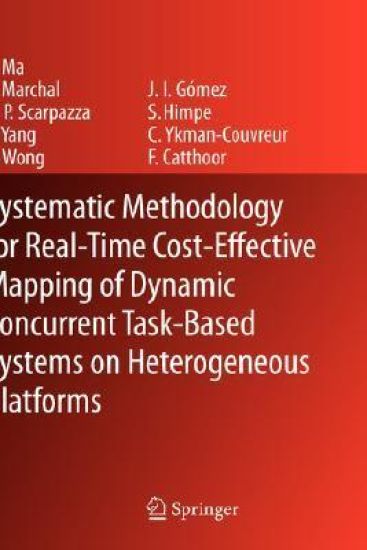
The main intention of this book is to give an impression of the state of the art in energy-aware task-scheduling-related issues for very dynamic emb- ded real-time processing applications. The material is based on research at IMEC in this area in the period 1999–2006, with a very extensive state-- the-art overview. It can be viewed as a follow-up of the earlier “Modeling, veri?cation and exploration of task-level concurrency in real-time embedded systems” book [234] that was published in 1999 based on the task-level m- eling work at IMEC. In order to deal with the stringent timing requirements, the cost-sensitivity and the dynamic characteristics of our target domain, we have again adopted a target architecture style (i. e. , heterogeneous mul- processor) and a systematic methodology to make the exploration and op- mization of such systems feasible. But this time our focus is mainly on p- viding practical work ?ow out of the (abstract) general ?ow from previous book and also the relevant scheduling techniques for each step of this ?ow. Our approach is very heavily application-driven which is illustrated by several realistic demonstrators. Moreover, the book addresses only the steps above the traditional real-time operating systems (RTOS), which are mainly focused on correct solutions for dispatching tasks. Our methodology is nearly fully independent of the implementations in the RTOS so it is va- able for the realization on those existing embedded systems where legacy applications and underlying RTOS have been developed.