Kirjojen hintavertailu. Mukana 12 595 353 kirjaa ja 12 kauppaa.

Kirjailija

Per Linell

Kirjat ja teokset yhdessä paikassa: 11 kirjaa, julkaisuja vuosilta 1979-2020, suosituimpien joukossa Multimodal interaktionsanalys. Vertaile teosten hintoja ja tarkista saatavuus suomalaisista kirjakaupoista.

11 kirjaa

Kirjojen julkaisuhaarukka 1979-2020.

Multimodal interaktionsanalys

Multimodal interaktionsanalys

Mathias Broth; Leelo Keevallik; Mattias Arvola; Asta Cekaite; Jakob Cromdal; Sara Dalgren; Anna Ekström; Katarina Eriksson Barajas; Ann-Carita Evaldsson; Marie Flinkfeldt; Clara Iversen; Gunilla Jansson; Jan Lindström; Oskar Lindwall; Per Linell; Charlotte Lundgren; Ali Reza Majlesi; Helen Melander Bowden; Nigel Musk; Catrin Norrby; Karin Osvaldsson Cromdal; Hannah Pelikan; Rasmus Persson; Charlotta Plejert; Maria Rydell; Christina Samuelsson; Lars Wallner; Sally Wiggins Young; Alexandra Weilenmann

Studentlitteratur AB
2020
nidottu
När vi kommunicerar och deltar i olika aktiviteter tolkar vi inte bara det som sägs, utan vi läser också av blickriktningar, kropps­position och mycket annat som finns närvarande i situationen. Ömsesidig förståelse åstadkoms alltså i flera dimensioner, eller modaliteter.Denna bok är den första på svenska som introducerar det mångfacetterade forskningsområde som kallas multimodal interaktionsanalys. Detta fält intresserar sig för hur människor tillsammans utför handlingar med hjälp av språkliga, kroppsliga och materiella resurser.Bokens första del presenterar perspektivets teoretiska grunder och förklarar hur en interaktionsanalytisk studie kan genomföras ”från ax till limpa”. Bokens andra del introducerar ett antal centrala kommunikativa resurser, från röst och gester till objekt och teknologier. I den tredje och mest omfångsrika delen ges en lång rad exempel på hur man genom multimodal interaktionsanalys kan nå nya insikter inom olika forskningsområden.Multimodal interaktionsanalys vänder sig till studenter och forskare som vill förstå hur det egentligen går till när människor agerar och skapar mening tillsammans.

The Construction of Professional Discourse

The Construction of Professional Discourse

B.L. Gunnarsson; Per Linell; Bengt Nordberg

Routledge
2016
sidottu
Internationally, there is increasing research and interest in the processes of the production and reception of texts for specific purposes and in the historical development of genres and registers within Languages for Specific Purposes (LSP), psycholinguistics, sociolinguistics, anthropology and the sociology of science. Studies of professional communication have traditionally been biased towards the written medium and have been carried out with little, if any, connection to LSP. Disciplinary boundaries and interest groupings have thus kept these different approaches to the study of professional communication and interaction separate. The editors of this volume unite these different perspectives and approaches and bring together recent research from linguistics, sociolinguistics, ethnography of communication, anthropology and sociology to provide an up-to-date analysis of different varieties of professional discourse and their historical development. Chapters written by leading exponents in the field deal with the core theoretical issue of how language, written genres and spoken discourse are constructed as a successive and continuous interplay between language and social realities. The volume includes chapters on the moral construction of discourse in the social care profession, the discourse of dispute negotiation, narrative accounts in clinical research, doctor-patient interaction, legal and other kinds of institutional discourse. A key text for students of applied linguistics and sociolinguistics at both advanced, undergraduate and MA levels.
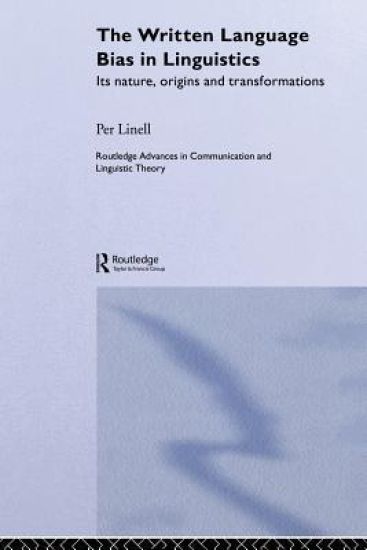
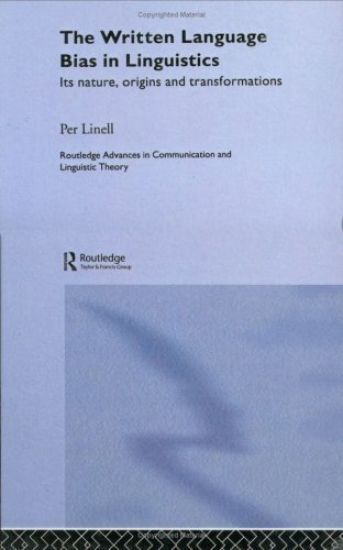
The Written Language Bias in Linguistics
Linguists routinely emphasise the primacy of speech over writing. Yet, most linguists have analysed spoken language, as well as language in general, applying theories and methods that are best suited for written language. Accordingly, there is an extensive 'written language bias' in traditional and present day linguistics and other language sciences. In this book, this point is argued with rich and convincing evidence from virtually all fields of linguistics.
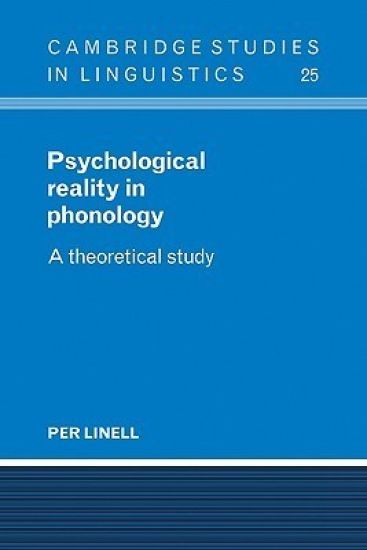
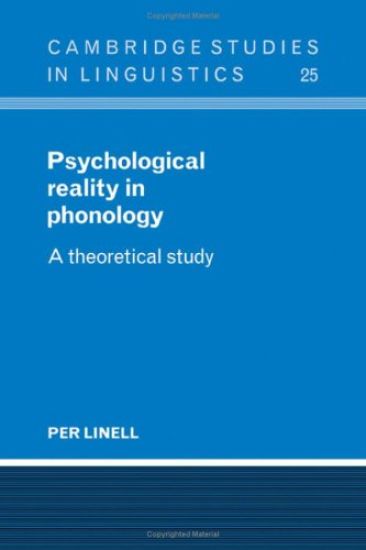
Psychological Reality in Phonology

Psychological Reality in Phonology

Per Linell

Cambridge University Press
2009
pokkari
Generative linguists have always claimed that the transformational models of language offer the best descriptive accounts of language. But they have often made a further and more ambitious claim for these models: that they have some psychological validity and represent our mental organisation of linguistic knowledge. The models are therefore supposed to explain at least some aspects of how, as speakers and listeners, we produce, perceive and understand all human utterances. Dr Linell attacks this claim and particularly its application to phonology and offers fundamental criticisms of the 'orthodox' school of generative phonology associated with Chomsky and Halle. His own positive proposals stress the importance of surface phenomena as opposed to abstract underlying forms and lead to a new typology of phonological rules and a new consideration of the relations between phonology and phonetics and between phonology and morphology. The book will interest a wide range of linguists and some psychologists as well as specialists in phonology and phonetics.
Dialogue in Focus Groups

Dialogue in Focus Groups

Ivana Markova; Per Linell; Michele Grossen; Anne Salazar Orvig

Equinox Publishing Ltd
2007
pokkari
In contrast to a vast literature that provides information and guides about focus groups as a methodological tool, this book is an introduction to understanding focus groups as analytical means exploring socially shared knowledge, e.g. social representations of AIDS, biotechnology or democracy, beliefs and lay explanations of social phenomena. The main emphasis of the book is to examine how to analyse interaction and ideas expressed in focus groups. The book considers, first, different kinds of dynamic interdependencies among participants who hold the diverse and heterogeneous positions. Second, it explores circulations of ideas and contents in focus groups. More generally, the book is concerned with: language in real social interactions and sense-making, which are embedded in history and culture; the ways people draw upon and transform social knowledge when they talk and think together in dialogue; the ways people generate heterogeneous meanings in the group dynamics; and communicative activities and genres represented by different kinds of focus groups. This original approach to understanding focus groups will be of interest to researchers and advanced students in social sciences, communication studies, psychology, and language sciences.
Dialogue in Focus Groups

Dialogue in Focus Groups

Ivana Markova; Per Linell; Michele Grossen; Anne Salazar Orvig

Equinox Publishing Ltd
2007
sidottu
In contrast to a vast literature that provides information and guides about focus groups as a methodological tool, this book is an introduction to understanding focus groups as analytical means exploring socially shared knowledge, e.g. social representations of AIDS, biotechnology or democracy, beliefs and lay explanations of social phenomena. The main emphasis of the book is to examine how to analyse interaction and ideas expressed in focus groups. The book considers, first, different kinds of dynamic interdependencies among participants who hold the diverse and heterogeneous positions. Second, it explores circulations of ideas and contents in focus groups. More generally, the book is concerned with: language in real social interactions and sense-making, which are embedded in history and culture; the ways people draw upon and transform social knowledge when they talk and think together in dialogue; the ways people generate heterogeneous meanings in the group dynamics; and communicative activities and genres represented by different kinds of focus groups. This original approach to understanding focus groups will be of interest to researchers and advanced students in social sciences, communication studies, psychology, and language sciences.
The Written Language Bias in Linguistics
Linguists routinely emphasise the primacy of speech over writing. Yet, most linguists have analysed spoken language, as well as language in general, applying theories and methods that are best suited for written language. Accordingly, there is an extensive 'written language bias' in traditional and present day linguistics and other language sciences. In this book, this point is argued with rich and convincing evidence from virtually all fields of linguistics.
The Construction of Professional Discourse

The Construction of Professional Discourse

B.L. Gunnarsson; Per Linell; Nordberg Bengt

Longman
1997
nidottu
Internationally, there is increasing research and interest in the processes of the production and reception of texts for specific purposes and in the historical development of genres and registers within Languages for Specific Purposes (LSP), psycholinguistics, sociolinguistics, anthropology and the sociology of science. Studies of professional communication have traditionally been biased towards the written medium and have been carried out with little, if any, connection to LSP. Disciplinary boundaries and interest groupings have thus kept these different approaches to the study of professional communication and interaction separate. The editors of this volume unite these different perspectives and approaches and bring together recent research from linguistics, sociolinguistics, ethnography of communication, anthropology and sociology to provide an up-to-date analysis of different varieties of professional discourse and their historical development. Chapters written by leading exponents in the field deal with the core theoretical issue of how language, written genres and spoken discourse are constructed as a successive and continuous interplay between language and social realities. The volume includes chapters on the moral construction of discourse in the social care profession, the discourse of dispute negotiation, narrative accounts in clinical research, doctor-patient interaction, legal and other kinds of institutional discourse.A key text for students of applied linguistics and sociolinguistics at both advanced, undergraduate and MA levels.
Psychological Reality in Phonology

Psychological Reality in Phonology

Per Linell

Cambridge University Press
1979
sidottu
Generative linguists have always claimed that the transformational models of language offer the best descriptive accounts of language. But they have often made a further and more ambitious claim for these models: that they have some psychological validity and represent our mental organisation of linguistic knowledge. The models are therefore supposed to explain at least some aspects of how, as speakers and listeners, we produce, perceive and understand all human utterances. Dr Linell attacks this claim and particularly its application to phonology and offers fundamental criticisms of the 'orthodox' school of generative phonology associated with Chomsky and Halle. His own positive proposals stress the importance of surface phenomena as opposed to abstract underlying forms and lead to a new typology of phonological rules and a new consideration of the relations between phonology and phonetics and between phonology and morphology. The book will interest a wide range of linguists and some psychologists as well as specialists in phonology and phonetics.