Kirjojen hintavertailu. Mukana 12 595 353 kirjaa ja 12 kauppaa.

Kirjailija

Per Lundberg

Kirjat ja teokset yhdessä paikassa: 7 kirjaa, julkaisuja vuosilta 1997-2024, suosituimpien joukossa Kontinuitet och förändring : essäer om spårbundenhet i samhället. Vertaile teosten hintoja ja tarkista saatavuus suomalaisista kirjakaupoista.

7 kirjaa

Kirjojen julkaisuhaarukka 1997-2024.

Kontinuitet och förändring : essäer om spårbundenhet i samhället

Kontinuitet och förändring : essäer om spårbundenhet i samhället

Joakim Wernberg; Henrik Szentes; Rolf Solli; Helena Stensöta; Mikael Sandberg; Anna Persson; Per Lundberg; Elisabeth Lindberg; Anders Kjellberg; Pär Isaksson; Oskar Hultin Bäckman; Jakob Heidbrink; Olof Hallonsten; Östen Dahl; Daniel Carelli; Bengt Brülde; Nils Björling

Timbro
2024
nidottu
Samtiden tycks besatt av det ögonblickliga: I kultur, politik och samhällsdebatt överdrivs individuella prestationer och snabba, omvälvande händelser. Detta trots att samhällsvetenskapen sedan länge har understrukit betydelsen av historiska utvecklingslinjer, och gång på gång visat att beslut idag är starkt präglade av tidigare händelser. Med andra ord: att samhällsutvecklingen är spårbunden. I denna bok samlas essäer av forskare, i allt från statsvetenskap och sociologi till språkvetenskap och stadsbyggnad, som alla undersöker spårbundenhet inom sina respektive discipliner . Boken ger begreppet spårbundenhet en välbehövlig renässans i en tid av kortsiktighet och synbar historielöshet. Olof Hallonsten är docent i sociologi och universitetslektor vid Ekonomihögskolan vid Lunds universitet. Hans forskning rör främst teoretiska och historiska perspektiv på samhällsutveckling. Anna Persson är docent i statsvetenskap och verksam som forskare och universitetslektor vid Statsvetenskapliga institutionen, Göteborgs universitet. Hennes forskning är inriktad mot jämförande politik och politisk ekonomi med särskilt fokus på hur formella och informella institutioner påverkar och samspelar med staters kapacitet inom centrala utvecklingsområden så som korruption, beskattning och välfärd.
Pillars of Evolution

Pillars of Evolution

Douglas W. Morris; Per Lundberg

Oxford University Press
2011
nidottu
Pillars of Evolution provides a fresh and provocative perspective on adaptive evolution. Readers new to the study of evolution will find a refreshing new insight that establishes evolutionary biology as a rigorous and predictive science, whilst practicing biologists will discover a provocative book that challenges traditional approaches. The book begins by leading readers through the mechanics of heredity, reproduction, movement, survival, and development. With that framework in place, it then explores the numerous ways that traits emerge from the interactions between genetics, development, and the environment. The key message is that adaptive changes in traits (and their underlying allelic frequencies) evolve through the traits' functions and their connection with fitness. The complex mappings from genes-to-traits-to-fitness are characterized in the structure of evolution. A single "structure matrix" describes why individuals vary in the values of adaptive traits, their ability to perform the function of those traits, and in the fitness they accrue. Fitness depends on how organisms interact with and perceive their environment in time and space. These relationships are made explicit in spatial, temporal, and organizational scale that also sets the stage for the crucially important role that ecology always plays in evolution. The ecological hallmarks of density- and frequency-dependent interactions allow the authors to explore new and exciting insights into evolution's dynamics. The theories and principles are then brought together in a final synthesis on adaptation. The book's unique approach unites genetic, development, and environmental influences into a single comprehensive treatment of the eco-evolutionary process.
Pillars of Evolution

Pillars of Evolution

Douglas W. Morris; Per Lundberg

Oxford University Press
2011
sidottu
Pillars of Evolution provides a fresh and provocative perspective on adaptive evolution. Readers new to the study of evolution will find a refreshing new insight that establishes evolutionary biology as a rigorous and predictive science, whilst practicing biologists will discover a provocative book that challenges traditional approaches. The book begins by leading readers through the mechanics of heredity, reproduction, movement, survival, and development. With that framework in place, it then explores the numerous ways that traits emerge from the interactions between genetics, development, and the environment. The key message is that adaptive changes in traits (and their underlying allelic frequencies) evolve through the traits' functions and their connection with fitness. The complex mappings from genes-to-traits-to-fitness are characterized in the structure of evolution. A single "structure matrix" describes why individuals vary in the values of adaptive traits, their ability to perform the function of those traits, and in the fitness they accrue. Fitness depends on how organisms interact with and perceive their environment in time and space. These relationships are made explicit in spatial, temporal, and organizational scale that also sets the stage for the crucially important role that ecology always plays in evolution. The ecological hallmarks of density- and frequency-dependent interactions allow the authors to explore new and exciting insights into evolution's dynamics. The theories and principles are then brought together in a final synthesis on adaptation. The book's unique approach unites genetic, development, and environmental influences into a single comprehensive treatment of the eco-evolutionary process.
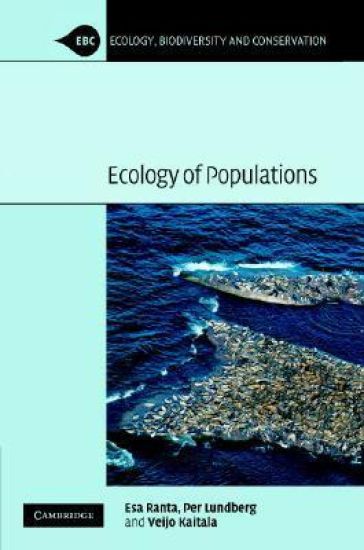
Ecology of Populations

Ecology of Populations

Esa Ranta; Per Lundberg; Veijo Kaitala

Cambridge University Press
2005
sidottu
The theme of the book is the distribution and abundance of organisms in space and time. The core of the book lies in how local births and deaths are tied to emigration and immigration processes, and how environmental variability at different scales affects population dynamics with stochastic processes and spatial structure and shows how elementary analytical tools can be used to understand population fluctuations, synchrony, processes underlying range distributions and community structure and species coexistence. The book also shows how spatial population dynamics models can be used to understand life history evolution and aspects of evolutionary game theory. Although primarily based on analytical and numerical analyses of spatial population processes, data from several study systems are also dealt with.
Ecology of Populations

Ecology of Populations

Esa Ranta; Per Lundberg; Veijo Kaitala

Cambridge University Press
2005
pokkari
The theme of the book is the distribution and abundance of organisms in space and time. The core of the book lies in how local births and deaths are tied to emigration and immigration processes, and how environmental variability at different scales affects population dynamics with stochastic processes and spatial structure and shows how elementary analytical tools can be used to understand population fluctuations, synchrony, processes underlying range distributions and community structure and species coexistence. The book also shows how spatial population dynamics models can be used to understand life history evolution and aspects of evolutionary game theory. Although primarily based on analytical and numerical analyses of spatial population processes, data from several study systems are also dealt with.
Individual Behavior and Community Dynamics

Individual Behavior and Community Dynamics

John Fryxell; Per Lundberg

Chapman and Hall
1997
nidottu
A book blending evolution and trophic dynamics, taking into account recent advances in both behavioral and population ecology, is long overdue. A central objective of this book is to consider whether adaptive behavioral decisions on the individual organism level might tend to stabilize trophic interactions. A second major goal of the book is to explore the implications of presumably adaptive behaviors on trophic dynamics and the implications of trophic dynamics for the evolution of adaptive behaviors. All evolutionary biologists, ecologists, and behavioral ecologists should find this exciting volume essential reading.