Kirjojen hintavertailu. Mukana 12 390 323 kirjaa ja 12 kauppaa.

Kirjailija

Perri 6

Kirjat ja teokset yhdessä paikassa: 11 kirjaa, julkaisuja vuosilta 2007-2025, suosituimpien joukossa International Cooperation When Mistrust Deepens. Vertaile teosten hintoja ja tarkista saatavuus suomalaisista kirjakaupoista.

11 kirjaa

Kirjojen julkaisuhaarukka 2007-2025.

International Cooperation When Mistrust Deepens

International Cooperation When Mistrust Deepens

Perri 6; Eva Heims

Oxford University Press
2025
sidottu
In the years leading up to the outbreak of war in 1914, Britain was collaborating closely with Germany on the development of an improved telegraph service, despite preparations for war also being made by both countries. This cooperation rested upon both states' intensive participation in the global regulatory regime for telecommunications. Why states commit to cooperating in such multilateral regimes with other states while their relationship struggles with deepening mistrust is a longstanding puzzle. As tensions rise among great powers today and international organisations struggle again, this puzzle is as important now as it was when international regulatory regimes first emerged. The book challenges many of the conventional explanations for this puzzling situation and draws on neo-Durkheimian institutional theory to develop a novel explanation. It examines the case of Britain's relationship with the first global regulatory regime, which was concerned with international telegraphy, submarine telegraph cables, and radiotelegraphy from the 1860s through to 1914. The regime was created in a time of European wars and growing imperial conflicts. Although Britain seriously contemplated leaving the International Telegraph Union in 1901-2, the state went on to deepen cooperation with other countries in telegraphy, including with Germany even as preparations for war advanced. Drawing on extensive archival sources, Perri 6 and Eva Heims show that social organisation in government can cultivate institutional buffering between aspects of external policy which can sustain commitment despite deepening conflict. In doing so, they show how a neo-Durkheimian approach provides a powerful explanation for deepening cooperation even as mistrust rises, which has significant implications for understanding state formation.
Mary Douglas

Mary Douglas

Paul Richards; Perri 6

BERGHAHN BOOKS
2023
sidottu
This handy, concise book covers the life of Mary Douglas, one of the most important anthropologists of the second half of the 20th century. Her work focused on how human groups classify one another, and how they resolve the anomalies that then arise. Classification, she argued, emerges from practices of social life, and is a factor in all deep and intractable human disputes. This biography offers an introduction to how her distinctive approach developed across a long and productive career and how it applies to current pressing issues of social conflict and planetary survival. From the Preface: The influence of Professor Dame Mary Douglas (1921-2007) upon each of the social sciences and many of the disciplines in the humanities is vast. The list of her works is also vast, and this presents a problem of choice for the many readers who want to get a general idea of what she wrote and its significance, but who are somewhat baffled about where to begin. Our book offers a short overview and suggests why her key writings remain significant today.
Mary Douglas

Mary Douglas

Paul Richards; Perri 6

BERGHAHN BOOKS
2023
nidottu
This handy, concise book covers the life of Mary Douglas, one of the most important anthropologists of the second half of the 20th century. Her work focused on how human groups classify one another, and how they resolve the anomalies that then arise. Classification, she argued, emerges from practices of social life, and is a factor in all deep and intractable human disputes. This biography offers an introduction to how her distinctive approach developed across a long and productive career and how it applies to current pressing issues of social conflict and planetary survival. From the Preface: The influence of Professor Dame Mary Douglas (1921-2007) upon each of the social sciences and many of the disciplines in the humanities is vast. The list of her works is also vast, and this presents a problem of choice for the many readers who want to get a general idea of what she wrote and its significance, but who are somewhat baffled about where to begin. Our book offers a short overview and suggests why her key writings remain significant today.
Mary Douglas

Mary Douglas

Perri 6; Paul Richards

Berghahn Books
2017
pokkari
Mary Douglas’s innovative explanations for styles of human thought and for the dynamics of institutional change have furnished a distinctive and powerful theory of how conflicts are managed, yet her work remains astonishingly poorly appreciated in social science disciplines. This volume introduces Douglas’s theories, and outlines the ways in which her work is of continuing importance for the future of the social sciences. Mary Douglas: Understanding Human Thought and Conflict shows how Douglas laid out the agenda for revitalizing social science by reworking Durkheim’s legacy for today, and reviews the growing body of research across the social sciences which has used, tested or developed her approach.
Mary Douglas

Mary Douglas

Perri 6; Paul Richards

Berghahn Books
2017
sidottu
Mary Douglas’s innovative explanations for styles of human thought and for the dynamics of institutional change have furnished a distinctive and powerful theory of how conflicts are managed, yet her work remains astonishingly poorly appreciated in social science disciplines. This volume introduces Douglas’s theories, and outlines the ways in which her work is of continuing importance for the future of the social sciences. Mary Douglas: Understanding Human Thought and Conflict shows how Douglas laid out the agenda for revitalizing social science by reworking Durkheim’s legacy for today, and reviews the growing body of research across the social sciences which has used, tested or developed her approach.
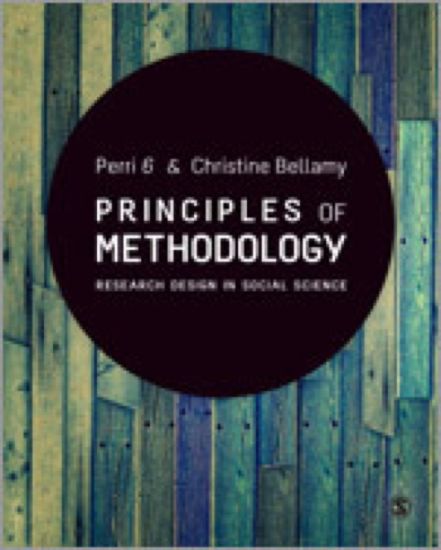
Principles of Methodology

Principles of Methodology

Perri 6; Christine Bellamy

SAGE Publications Ltd
2011
sidottu
This book provides a comprehensive, accessible guide to social science methodology. In so doing, it establishes methodology as distinct from both methods and philosophy. Most existing textbooks deal with methods, or sound ways of collecting and analysing data to generate findings. In contrast, this innovative book shows how an understanding of methodology allows us to design research so that findings can be used to answer interesting research questions and to build and test theories. Most important things in social research (e.g., beliefs, institutions, interests, practices and social classes) cannot be observed directly. This book explains how empirical research can nevertheless be designed to make sound inferences about their nature, effects and significance. The authors examine what counts as good description, explanation and interpretation, and how they can be achieved by striking intelligent trade-offs between competing design virtues. Coverage includes: • why methodology matters; • what philosophical arguments show us about inference; • competing virtues of good research design; • purposes of theory, models and frameworks; • forming researchable concepts and typologies; • explaining and interpreting: inferring causation, meaning and significance; and • combining explanation and interpretation. The book is essential reading for new researchers faced with the practical challenge of designing research. Extensive examples and exercises are provided, based on the authors' long experience of teaching methodology to multi-disciplinary groups. Perri 6 is Professor of Social Policy in the Graduate School in the College of Business, Law and Social Sciences at Nottingham Trent University. Chris Bellamy is Emeritus Professor of Public Administration in the Graduate School, Nottingham Trent University.
Trade, Regulation and Empire State-building in Britain

Trade, Regulation and Empire State-building in Britain

Martha Prevezer; Perri 6; Ed Legon

Springer International Publishing AG
2025
sidottu
This book explores the impact of the Board of Trade upon the British state from the early seventeenth century to the early twentieth century. The study argues that for too long historians have overlooked the Board, yet it was a critical force in shaping the British state and in developing its capacity both for economic regulation and for economic development. Focusing on the slave trade and on the textiles, shipping, and infrastructural industries, the authors examine the Board of Trade’s role in shaping, promoting, and protecting these industries and thereby in defining the British state’s economic interests. The book adds the notion of an imperial-corporate state to widely used concepts of fiscal-military and mercantilist state-building. Challenging the adequacy of the many theories which emphasise taxation and currency in state-building, this study stresses the importance of micro-economic interventions. It unpacks the distinctive character of the British state’s system of micro-economic governance by tracing one central department’s evolution and its relations with other departments, British businesses and infrastructure, and with the governance structures operating between state, company-states, colonies, and domestic business. Three sub-periods of the Board of Trade’s history are distinguished, each marked by a distinctive relationship with the domestic and imperial economies and by characteristic approaches to regulatory oversight. The book will be of interest to academics and students in business, economic, and political history, and all those interested in the structure of the British state, its legacies of running empires, its relationship with industrial policies and industrialisation, and how it developed its regulatory shape.
Explaining Political Judgement

Explaining Political Judgement

Perri 6

Cambridge University Press
2015
pokkari
What is political judgement? Why do politicians exhibit such contrasting thought styles in making decisions, even when they agree ideologically? What happens when governments with contrasting thought styles have to deal with each other? In this book Perri 6 presents a fresh, rigorous explanatory theory of judgement, its varieties and its consequences, drawing upon Durkheim and Douglas. He argues that policy makers will understand - and misunderstand - their problems and choices in ways that reproduce their own social organisation. This theory is developed by using the Cuban Missile Crisis of 1962 as an extended case study, examining the decision-making of the Kennedy, Castro and Khrushchev regimes. Explaining Political Judgement is the first comprehensive study to show what a neo-Durkheimian institutional approach can offer to political science and to the social sciences generally.
Principles of Methodology

Principles of Methodology

Perri 6; Christine Bellamy

SAGE Publications Ltd
2011
nidottu
This book provides a comprehensive, accessible guide to social science methodology. In so doing, it establishes methodology as distinct from both methods and philosophy. Most existing textbooks deal with methods, or sound ways of collecting and analysing data to generate findings. In contrast, this innovative book shows how an understanding of methodology allows us to design research so that findings can be used to answer interesting research questions and to build and test theories. Most important things in social research (e.g., beliefs, institutions, interests, practices and social classes) cannot be observed directly. This book explains how empirical research can nevertheless be designed to make sound inferences about their nature, effects and significance. The authors examine what counts as good description, explanation and interpretation, and how they can be achieved by striking intelligent trade-offs between competing design virtues. Coverage includes: • why methodology matters; • what philosophical arguments show us about inference; • competing virtues of good research design; • purposes of theory, models and frameworks; • forming researchable concepts and typologies; • explaining and interpreting: inferring causation, meaning and significance; and • combining explanation and interpretation. The book is essential reading for new researchers faced with the practical challenge of designing research. Extensive examples and exercises are provided, based on the authors' long experience of teaching methodology to multi-disciplinary groups. Perri 6 is Professor of Social Policy in the Graduate School in the College of Business, Law and Social Sciences at Nottingham Trent University. Chris Bellamy is Emeritus Professor of Public Administration in the Graduate School, Nottingham Trent University.
Explaining Political Judgement

Explaining Political Judgement

Perri 6

Cambridge University Press
2011
sidottu
What is political judgement? Why do politicians exhibit such contrasting thought styles in making decisions, even when they agree ideologically? What happens when governments with contrasting thought styles have to deal with each other? In this book Perri 6 presents a fresh, rigorous explanatory theory of judgement, its varieties and its consequences, drawing upon Durkheim and Douglas. He argues that policy makers will understand - and misunderstand - their problems and choices in ways that reproduce their own social organisation. This theory is developed by using the Cuban Missile Crisis of 1962 as an extended case study, examining the decision-making of the Kennedy, Castro and Khrushchev regimes. Explaining Political Judgement is the first comprehensive study to show what a neo-Durkheimian institutional approach can offer to political science and to the social sciences generally.
Digital State at the Leading Edge

Digital State at the Leading Edge

Sandford Borins; Kenneth Kernaghan; David Brown; Nick Bontis; Perri 6; Fred Thompson

University of Toronto Press
2007
pokkari
The impact of information technology (IT) on government in the last five years has been profound. Using the governments of Canada and Ontario (both recognized as international leaders in the use of IT) as case studies, Digital State at the Leading Edge is the first attempt to take a comprehensive view of the impact of IT upon the whole of government, including politics and campaigning, public consultation, service delivery, knowledge management, and procurement. Using the concepts of channel choice, procurement market analysis, organizational integration, and digital leadership, this study explores the inter-relationships among all these aspects of the application of IT to government and politics. The authors seek to understand how IT is transforming government and what the nature of that transformation is. In the process, they offer an explanation of Canada's relative success, and conclude with practical advice to politicians and public servants about how to manage IT in government more effectively. Based on new and original research undertaken over the last five years, the findings of this intriguing study will be of interest to those studying or working in the fields of public administration, political science, and information technology.