Kirjojen hintavertailu. Mukana 12 390 323 kirjaa ja 12 kauppaa.
Kirjailija
Peter A. Olsson
Kirjat ja teokset yhdessä paikassa: 10 kirjaa, julkaisuja vuosilta 2007-2018, suosituimpien joukossa Malignant Pied Pipers. Vertaile teosten hintoja ja tarkista saatavuus suomalaisista kirjakaupoista.
An experienced psychotherapist shares experiences from his clinical work and teaching for over fifty years. Dr. Olsson gives practical advice and recommended reading for young psychotherapists.
The author has found psychodrama group therapy to be very helpful in treating addictions, marital, vocational, family, and psychosomatic problems. Basic techniques of psychodrama like role-playing, role reversal, doubling, the soliloquy, empty chair, the narrator and magic shop can be helpful in group or individual therapy...even medical teaching. Classic Psychodrama involves a stage area (Preferably elevated), the director, protagonist(s), antagonists, the audience, alter-egos and doubles. Hospital staff and other patients are asked to assume roles in the patient situation on focus. Efforts are made to dramatize the actual emotional experience and conflicts in the patient's life situation. Such participation is essential to the therapeutic group process. The audience group is a vital part of the therapeutic group process. Unlike the Hollywood movie director who stays at a distance back of the camera it is crucial that the director stay close to the patient who has chosen to have his life situation on focus. In classic psychodrama, the director like the captain of a ship or airplane is in charge. Staff and other patients may occasionally make suggestions but the final clinical decision rests with the director. The director needs to stay in tune with the protagonist's facial expression, tension, emotions as he or she sets the scenes and implements various psychodrama techniques. The psychodrama techniques like the soliloquy, the empty chair (Where an important person in the patient's life is imagined to be sitting and be confronted), doubling of the patient's likely inner unconscious or preconscious thoughts, role-reversal with an antagonist and focus on a patient's dream or fantasy can be very powerful therapeutically...But, for a fragile, highly anxious or borderline psychotic patient care must be taken with dosing of conflicts confronted in the patient. More Detail about the Three Basic Psychodrama Techniques 1.Role Reversal---At the initiative of the director, the patient is asked to suddenly switch roles with the person to whom he is talking. For example, a husband embroiled with his wife in a heated conflict situation is abruptly instructed to take her role in the scene. This technique can jolt the patient with sudden stunning insight. 2.Doubling---The director asks a staff member or other patient in the group to stand close to or behind the patient and speak out clearly what the inner thoughts, feelings or perceptions of the patient apparently are. These thoughts are pretended not to be heard unless the patient choses to voice them. Doubling is often crucial at the time a role reversal is implemented by the director. 3.Soliloquy---The scene is halted by the director and a key person in the scene usually the patient on focus is urged to deliver a lengthy monologue about his feelings, doubts, fears, insights or contemplated plans of action. A double can assist the patient with this process. Classic psychodrama has five phases. Warm-up, Setting-the-scene, Rising action, Climax, Declining action /Resolution and Share-back.An actual stage or regularly designated stage area, stage furniture and props (If possible), are important to enliven the therapeutic process. At all times during the psychodrama the director needs to stay close to the patient protagonist. The director must set the scene(s) as accurately as possible, and always try to see the psychodrama stage- world as the patient is experiencing it. A scene may be shifted fluidly between past, present or future by the director. Past, present and future may even be represented simultaneously on the psychodrama therapy stage. A scene may be repeated several times (therapeutic instant- replays), in search of conflict resolution. Resolution and mastery of a conflict and changed behavior in actual action (not merely words) is celebrated and applauded.
For more than twenty years, I have studied destructive and apocalyptic cult leaders like Jim Jones, David Koresh (Waco), Shoko Asahara (Aum Shinriko), Marshall Applewhite (Heaven's Gate), Charles Manson (Helter Skelter Murderers), and Luc Jouret and Joseph DiMambro (Suicidal Solar Temple).These cult leaders, the mesmerizing Malignant Pied Pipers of our time, led idealistic, father-hungry, or disillusioned young people away from their homes and toward destruction.Having an understanding of cult mentality and the pathological personalities of cult leaders is essential, for there are striking similarities between these deadly leaders and the newest examples, Osama bin Laden and his Al Qaeda cult of ultimate terror. The death toll from Jonestown, the Branch Davidian disaster at Waco, and Al Qaeda/ISIS terror cults of the last 30 years is horrendous.My previous book, A Boyish God, is a troubling novel with deep insights. I was jolted to my core when I learned that a college friend's son died at the Rev. Jim Jones's side at Jonestown. Over 30 years later, I am still searching for answers, especially about terror prevention.About the Author: Psychiatrist and psychoanalyst Peter Olsson, M.D., trained at Baylor College of Medicine in Houston. Following his internship in mixed medicine at the University of Vermont, he took a psychiatry residency at Baylor, and later was a psychiatrist at Oakland Naval Hospital, where he ran the substance abuse unit and worked with POWs returning from Vietnamese prisons. Dr. Olsson graduated from the Houston-Galveston Psychoanalytic Institute in Houston, and practiced psychiatry and psychotherapy while teaching psychotherapy in Houston for 25 years. An assistant professor of psychiatry at Dartmouth Medical School and an adjunct professor of clinical psychiatry at Baylor College of Medicine, he is now retired.
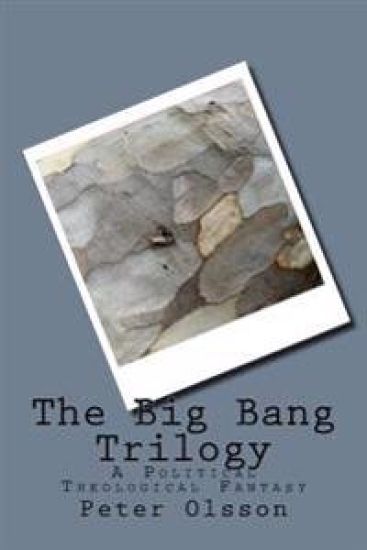
Cosmic spiritual presences swirl, emote, and cogitate in the long moments before the universe's Big Bang of origin. Where will the grandest of all creaturely psycho-social-spiritual experiments lead? How do God and the God Group, (The Grand Committee), plan things in the moments and eons just before the Big Bang occurs? Crucial disagreements about freedom, individual responsibility, power, control, dignity, love, prayer and destruction occur within The Grand Committee. BANG After millions of years post Big Bang, how does the God Group evaluate the project? Emergency measures must be taken due to dangers emerging at far flung planets. Particularly the earth project. Can the God Group solve the problems of his/their creation? Who can best lead the rescue efforts that are launched? CONTENTS IPRELUDE to the BIG BANG: An Overture to All Time IIPOSTLUDE to the BIG BANG: Confronting Past and Present Time IIIBIG BANG'S FINALE: An End to Time IVSEQUEL: Moonstar and Sonstar's Second Earth Missions *The Cast of Characters: Voce (The Formal LuceBluestone derives from Bluestone as comprises the stone in Stonehenge) also Voce = God The Grand Committee = God as Group, i.e., the group-self domain aspect of God's omnipresence, omnipotence, and omniscience. Only with the Grand Committee's approval can God voluntarily suspend omnipotence. Without God as group, the freedom thing would die. Luce (Formal LuceSulfur as linked to hellfumes) = Satan, Lucifer, the Devil Mikhail= the recorder and scribe=the archangel Gabriel Sonstar = Jesus Moonstar =Mohammad Marainbo = The Mother Mary MarEarthay = Mary Magdalene, purveyor of Earthy sexuality Novolin = the Holy Spirit. Derived from the videogame Captain Novolin. The author developed a word analogizing the internet as world-wide spiritual presence for good and evil.
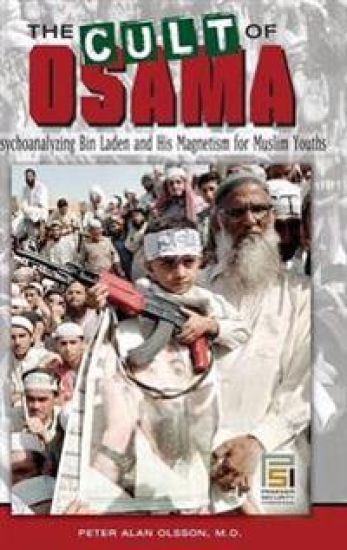
In The Cult of Osama, Psychiatrist Peter Olsson examines Osama bin Laden's early life experiences and explains, from a psychoanalytical perspective, how those created a mind filled with perverse rage at America, as well as why his way of thinking makes bin Laden in many cases a hero to Arab and Muslim youths. Many other writings totally demonize bin Laden, and therein strangely play into putting this troubled man onto a pedestal, says Olsson, who spent 25 years on a social psychological and psychoanalytical study of destructive cults and cult leaders. There are many journalistic, political, military, and intelligence books about bin Laden and his terror cult group. But this one offers a purely psychological and psychobiographical perspective on bin Laden and his mushrooming influence. Bin Laden's destructive Pied Piper appeal, leading youths to murder others and even themselves in suicide missions, stems from the peculiar and profoundly important synchrony of shared trauma and pain between bin Laden and Arab/Muslim youth, says Olsson. And we in the West neglect this topic, at our own peril.Among the insights Olsson provides as he traces the psychological threads of narcissistic wounds and unresolved grief from Osama's childhood are the death of his father when Osama was 10, separation from his mother even earlier, the humiliation of Osama as the son of a slave in his father's household, and his lifelong search for a surrogate older brother and father figures among radical Islamist teachers and mentors. Olsson also spotlights the idea that Osama experienced dark epiphanies as a young adult which further magnified and focused his unresolved disappointments and narcissistic rage. This psychobiography of one of the world's most notorious terrorists, written by an Assistant Professor at Dartmouth Medical School, shows how understanding the psychohistory and mindset of bin Laden could help prevent the development and actions of home-grown American and Western terrorists and their cells.