Kirjojen hintavertailu. Mukana 12 390 323 kirjaa ja 12 kauppaa.

Kirjailija

Peter Abbott

Kirjat ja teokset yhdessä paikassa: 8 kirjaa, julkaisuja vuosilta 1982-2014, suosituimpien joukossa Ukrainian Armies 1914–55. Vertaile teosten hintoja ja tarkista saatavuus suomalaisista kirjakaupoista.

8 kirjaa

Kirjojen julkaisuhaarukka 1982-2014.

Modern African Wars (4)

Modern African Wars (4)

Peter Abbott

Osprey Publishing
2014
nidottu
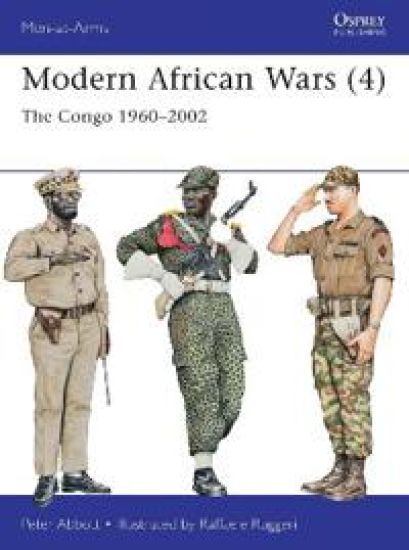
In the 1970s, during the ruinous 30-year dictatorship of General Mobutu, periodic rebellions led to the hasty insertion once again of Belgian and French paratroops to save European lives.From the mid-1990s the country split again, becoming the battleground for the largest African war in history, as armies and rebel groups from Rwanda, Angola, Zimbabwe, Uganda, Namibia and other countries crossed into the Congo to support one side or the other, or simply to loot the rich resources. Major operations ended – or paused – in 2002, but the old hatreds and constant lure of the Congo's natural resources continue to boil over into periodic outbreaks.Featuring specially commissioned full-colour artwork and rare photographs, this is the harrowing story of the wars that ravaged the Congo for four decades.
Ukrainian Armies 1914–55

Ukrainian Armies 1914–55

Eugene Pinak; Peter Abbott

Osprey Publishing
2004
nidottu
A detailed, illustrated study of the Ukrainian armed forces, their weapons, dress and equipment from the First to the Second World War and beyond. There can be no region in Europe whose history has been more tortured than Ukraine. During the 20th century Austria, Poland, Russia, Germany, Hungary, Czechoslovakia and Romania vied for power over parts of this vast and fragmented area; and its divided peoples rose time and again in vain attempts to win their independence. For the first time in the West, this book gives a succinct summary of all the different armed forces raised among the Ukrainians, and of their uniforms and insignia. These are illustrated in colour and in a selection of extremely rare photographs, dating from the Great War to the aftermath of World War II, when Ukrainian guerrillas continued to defy the Soviet authorities until the mid-1950s.
Armies in East Africa 1914–18

Armies in East Africa 1914–18

Peter Abbott

Osprey Publishing
2002
nidottu
During World War I a self-contained war was fought in the European colonies of East Africa, between the British (from Kenya, Rhodesia and Uganda), Belgians (from the Congo) and Portugese (from Mozambique), against the garrison from German East Africa. The German colonial army, led by the brilliant General Paul von Lettow-Vorbeck, spent much of the war running rings around the Allies, and Lettow-Vorbeck became world famous as a sort of "World War I Rommel" figure. In this title the weapons, tactics and logistics of this campaign are covered, along with the array of exotic uniforms worn.
Modern African Wars (2)

Modern African Wars (2)

Peter Abbott

Osprey Publishing
1988
nidottu
Portugal was both the first and the last of the huge European colonial powers.For 500 years Portugal had colonies in Africa. In 1960, as liberation movements swept across colonial Africa, the Portuguese flag still flew over vast expanses of territory across the continent. The spread of decolonization and the establishment of independent states whose governments were sympathetic to the cause of African nationalism led, in the early 1960s, to a series of wars in Angola, Guiné and Mozambique.This book details each of these liberation movements, focusing on the equipment, uniforms and organization of the Portuguese forces.
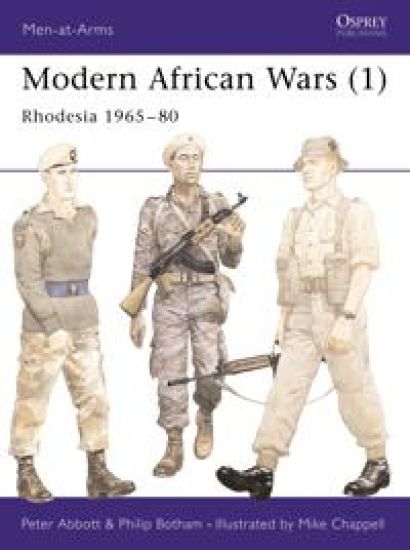
Modern African Wars (1)

Modern African Wars (1)

Peter Abbott; Philip Botham

Osprey Publishing
1986
nidottu
The Rhodesian War of 1965–80 was the battle for control of present day Zimbabwe.The former British colony of Southern Rhodesia rejected British moves towards majority rule and on 11 November 1965 the Rhodesian Prime Minister Ian Smith announced his country’s Unilateral Declaration of Independence from Great Britain. That act sparked a series of violent encounters between the traditional colonial army and the African guerrilla insurgents of the Patriotic Front.This book examines the successes and failures of the counter-insurgency campaign of Smith’s security forces and the eventual bloody birth of a modern African nation.
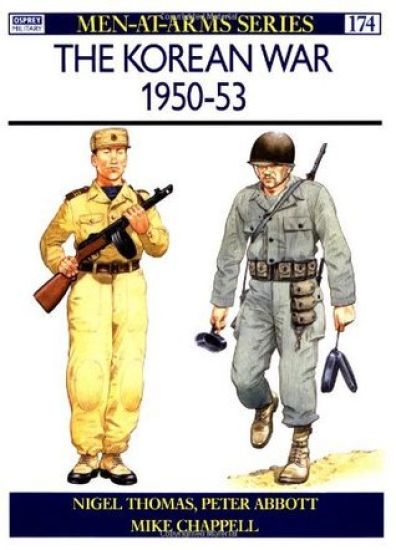
The Korean War 1950–53

The Korean War 1950–53

Nigel Thomas; Peter Abbott

Osprey Publishing
1986
nidottu
A concise illustrated study of the first military conflict of the Cold War. At 4am on Sunday 25 June 1950, powerful North Korean forces invaded South Korea, advancing down the Uijongbu Corridor towards the Southern Capital of Seoul. South Korean troops resisted bravely, but were crushed by overwhelming Northern superiority. Later that day, the United Nations Security Council condemned the aggression, and on 7 July appointed US General of the Army Douglas MacArthur to command UN forces which would be sent to save South Korea. Nigel Thomas and Peter Abbott explore the history of this conflict, which pitted UN forces against the People's Republic of China in a struggle that resulted in hundreds of thousands of casualties. The text is accompanied by black and white photographs, maps and diagrams, along with colour plates from artist Mike Chappell depicting uniforms and equipment of soldiers of North and South Korea, People's Republic of China, the United States and other UN forces.
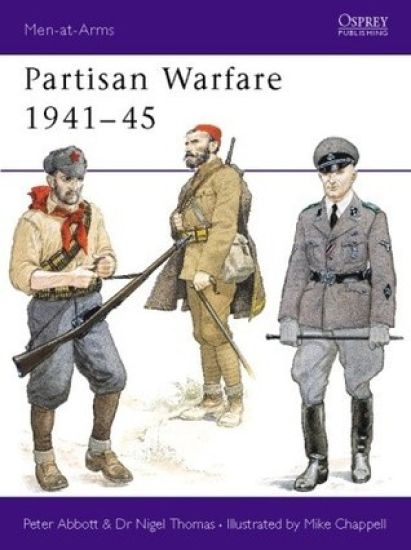
Partisan Warfare 1941–45

Partisan Warfare 1941–45

Nigel Thomas; Peter Abbott

Osprey Publishing
1983
nidottu
A compact volume on the history, organisation, uniforms and equipment of the Communist-led and non-Communist resistance groups resisting German occupation.During 1941 the Germans occupied first Greece and the former Yugoslavia, then enormous areas of European Russia. Once the front line troops had moved on the struggle continued as bands of resistance fighters waged war against the occupation forces until their final withdrawal. The term 'partisan' is associated with Communist-led bands and they were often the most fanatical defenders of the Soviet realm. However, there were also non-Communist resistance groups which were nationalist and broadly constitutionalist and as a result a complicated three-way war developed.This book details the guerrilla war which was waged in the various regions and the uniforms and equipment of the combatants.
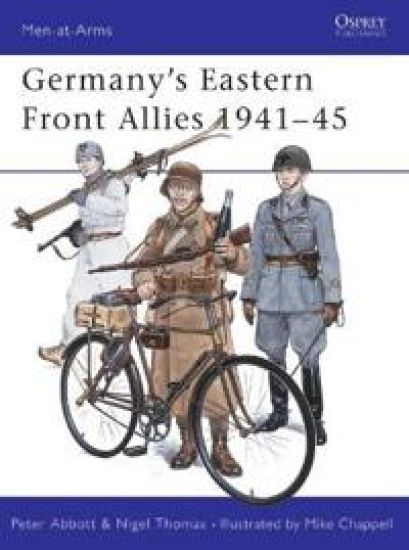
Germany's Eastern Front Allies 1941–45

Germany's Eastern Front Allies 1941–45

Peter Abbott; Nigel Thomas

Osprey Publishing
1982
nidottu
The 1930s were a time of growing tension for the smaller states of Eastern Europe. Since the end of the First World War they had enjoyed an independence which most of them had not known for centuries, but this was now threatened by the growing power of Nazi Germany and Soviet Russia. Instead of combining for self defence, they were bitterly divided. The Munich crisis showed how little reliance could be placed on the Western democracies, whose power to intervene militarily in Eastern Europe was negligible. In effect this left the smaller East European states with little alternative but to become clients of either Germany or Russia.