Kirjojen hintavertailu. Mukana 12 152 606 kirjaa ja 12 kauppaa.

Kirjailija

Peter Atkins

Kirjat ja teokset yhdessä paikassa: 49 kirjaa, julkaisuja vuosilta 1998-2024, suosituimpien joukossa Bangor University - Physical Chemistry Pack. Vertaile teosten hintoja ja tarkista saatavuus suomalaisista kirjakaupoista.

49 kirjaa

Kirjojen julkaisuhaarukka 1998-2024.

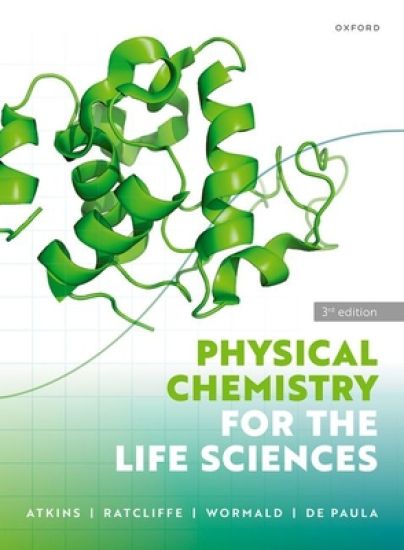
Physical Chemistry for the Life Sciences

Physical Chemistry for the Life Sciences

Peter Atkins; R. George Ratcliffe; Mark Wormald; Julio de Paula

Oxford University Press
2023
nidottu
Molecular assemblies, macromolecules, proteins, nucleic acids: they form a substantial part of all living organisms, from plants to humans. Indeed, they are critical for keeping them alive. But how do they operate? Chemical processes are at the core of life: understanding life means unveiling the physical principles on which it is built. From thermodynamics to molecular interactions, Physical Chemistry for the Life Sciences 3rd edition explains how the principles of physical chemistry apply to the processes of life. Offering worked examples and multiple case studies throughout, students are supported to master even the most complex concepts and how they apply in biological contexts, while acquiring key problem-solving and mathematical skills. Directly addressing the main challenges faced by students, its pedagogically rich approach provides an accessible and holistic guide The extended scope of this new edition includes the essential techniques that can be used to characterize biological systems, including biochemical spectroscopy, x-ray diffraction, and spectrometry.
Atkins Physical Chemistry V1

Atkins Physical Chemistry V1

Peter Atkins; Julio de Paula; James Keeler

Oxford University Press
2023
nidottu
Atkins' Physical Chemistry is widely acknowledged by students and lecturers around the globe to be the textbook of choice for studying physical chemistry. The exceptional quality of previous editions has been built upon to make the twelfth edition of Atkins' Physical Chemistry even more closely suited to the needs of both lecturers and students. The writing style has been refreshed in collaboration with current students of physical chemistry in order to retain the clarity for which the book is recognized while mirroring the way that students read and engage with information. The new edition is now available as an enhanced e-Book, which offers a richer, more dynamic learning experience. It does this by incorporating digital enhancements that are carefully curated and thoughtfully inserted at meaningful points to enhance the learning experience. In addition, it offers formative auto-graded assessment materials to provide students with regular opportunities to test their understanding. Digital enhancements introduced for the new edition include dynamic graphs, which students can interact with to explore how the manipulation of variables affects the results of the graphs; self-check questions at the end of every "Topic"; video content from physical chemists; and video tutorials that accompany the "Focus" features, which dig deeper into the key equations introduced. There is also a new foundational prologue entitled "Energy: A First Look," which summarizes key concepts that are best kept in mind right from the beginning of physical chemistry studies. The coupling of the broad coverage of the subject with a structure and use of pedagogy that is even more innovative will ensure that Atkins' Physical Chemistry remains the textbook of choice for studying physical chemistry.
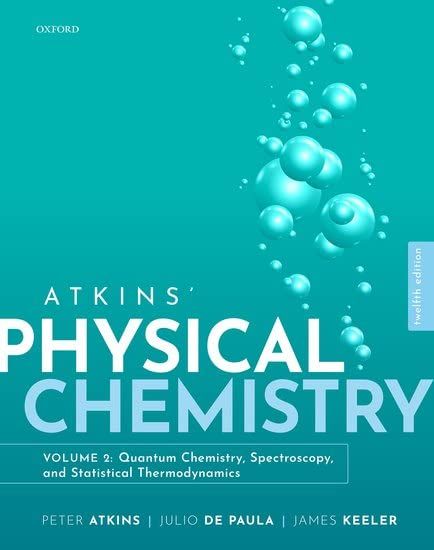
Atkins Physical Chemistry V2

Atkins Physical Chemistry V2

Peter Atkins; Julio de Paula; James Keeler

Oxford University Press
2023
nidottu
Atkins' Physical Chemistry is widely acknowledged by students and lecturers around the globe to be the textbook of choice for studying physical chemistry. The exceptional quality of previous editions has been built upon to make the twelfth edition of Atkins' Physical Chemistry even more closely suited to the needs of both lecturers and students. The writing style has been refreshed in collaboration with current students of physical chemistry in order to retain the clarity for which the book is recognized while mirroring the way that students read and engage with information. The new edition is now available as an enhanced e-Book, which offers a richer, more dynamic learning experience. It does this by incorporating digital enhancements that are carefully curated and thoughtfully inserted at meaningful points to enhance the learning experience. In addition, it offers formative auto-graded assessment materials to provide students with regular opportunities to test their understanding. Digital enhancements introduced for the new edition include dynamic graphs, which students can interact with to explore how the manipulation of variables affects the results of the graphs; self-check questions at the end of every "Topic"; video content from physical chemists; and video tutorials to accompany the "Focus" features, which dig deeper into the key equations introduced. There is also a new foundational prologue entitled "Energy: A First Look," which summarizes key concepts that are best kept in mind right from the beginning of physical chemistry studies. The coupling of the broad coverage of the subject with a structure and use of pedagogy that is even more innovative will ensure that Atkins' Physical Chemistry remains the textbook of choice for studying physical chemistry.
Conjuring the Universe

Conjuring the Universe

Peter Atkins

Oxford University Press
2020
nidottu
The marvellous complexity of the Universe emerges from several deep laws and a handful of fundamental constants that fix its shape, scale, and destiny. There is a deep structure to the world which at the same time is simple, elegant, and beautiful. Where did these laws and these constants come from? And why are the laws so fruitful when written in the language of mathematics? Peter Atkins considers the minimum effort needed to equip the Universe with its laws and its constants. He explores the origin of the conservation of energy, of electromagnetism, of classical and quantum mechanics, and of thermodynamics, showing how all these laws spring from deep symmetries. The revolutionary result is a short but immensely rich weaving together of the fundamental ideas of physics. With his characteristic wit, erudition, and economy, Atkins sketches out how the laws of Nature can spring from very little. Or arguably from nothing at all.
Atkins' Physical Chemistry 11e

Atkins' Physical Chemistry 11e

Peter Atkins

Oxford University Press
2019
nidottu
Atkins' Physical Chemistry: Molecular Thermodynamics and Kinetics is designed for use on the second semester of a quantum-first physical chemistry course. Based on the hugely popular Atkins' Physical Chemistry, this volume approaches molecular thermodynamics with the assumption that students will have studied quantum mechanics in their first semester.The exceptional quality of previous editions has been built upon to make this new edition of Atkins' Physical Chemistry even more closely suited to the needs of both lecturers and students. Re-organised into discrete 'topics', the text is more flexible to teach from and more readable for students. Now in its eleventh edition, the text has been enhanced with additional learning features and maths support to demonstrate the absolute centrality of mathematics to physical chemistry. Increasing the digestibility of the text in this new approach, the reader is brought to a question, then the math is used to show how it can be answered and progress made. The expanded and redistributed maths support also includes new 'Chemist's toolkits' which provide students with succinct reminders ofmathematical concepts and techniques right where they need them. Checklists of key concepts at the end of each topic add to the extensive learning support provided throughout the book, to reinforce the main take-home messages in each section. The coupling of the broad coverage of the subject with a structure and use of pedagogy that is even more innovative will ensure Atkins' Physical Chemistry remains the textbook of choice for studying physical chemistry.
Atkins' Physical Chemistry 11E: Volume 2: Quantum Chemistry, Spectroscopy, and Statistical Thermodynamics
Atkins' Physical Chemistry is widely acknowledged by both students and lecturers around the globe to be the textbook of choice for studying physical chemistry. Now in its eleventh edition, the text has been enhanced with additional learning features and math support, and re-organized into discrete Topics, to make the text more flexible to teach from and more readable for students.
Conjuring the Universe

Conjuring the Universe

Peter Atkins

Oxford University Press
2018
sidottu
The marvellous complexity of the Universe emerges from several deep laws and a handful of fundamental constants that fix its shape, scale, and destiny. There is a deep structure to the world which at the same time is simple, elegant, and beautiful. Where did these laws and these constants come from? And why are the laws so fruitful when written in the language of mathematics? Peter Atkins considers the minimum effort needed to equip the Universe with its laws and its constants. He explores the origin of the conservation of energy, of electromagnetism, of classical and quantum mechanics, and of thermodynamics, showing how all these laws spring from deep symmetries. The revolutionary result is a short but immensely rich weaving together of the fundamental ideas of physics. With his characteristic wit, erudition, and economy, Atkins sketches out how the laws of Nature can spring from very little. Or arguably from nothing at all.
Atkins' Physical Chemistry

Atkins' Physical Chemistry

Peter Atkins; Julio de Paula; James Keeler

Oxford University Press
2018
nidottu
Atkins' Physical Chemistry is widely acknowledged by both students and lecturers around the globe to be the textbook of choice for studying physical chemistry. Now in its eleventh edition, the text has been enhanced with additional learning features and math support and reorganized to make the text more flexible for instructors and more readable for students.
Elements of Physical Chemistry

Elements of Physical Chemistry

Peter Atkins; Julio de Paula

Oxford University Press
2017
sidottu
Elements of Physical Chemistry has been carefully developed to help students increase their confidence when using physics and mathematics to answer fundamental questions about the structure of molecules, how chemical reactions take place, and why materials behave the way they do. Featuring an appealing design and layout, this acclaimed text provides extensive mathematical and pedagogical support while also remaining concise and accessible. For the seventh edition, the material has been reorganized into short "Topics," which are grouped into thematic "Focuses" to make the text more digestible for students and more flexible for instructors. At the beginning of each Topic, three questions are posed, emphasizing why it is important, what the key idea is, and what students should already know. PEDAGOGICAL FEATURES * Detailed "justification" boxes help students understand the crucial mathematics that underpins physical chemistry * Chemist's Toolkits present the foundations of physics and mathematics exactly where they are needed in the text * Frequent worked examples, self-test questions, and end-of-chapter exercises help students to gain confidence and experience in solving problems * Notes on good practice, key concept checklists, and equation labels and annotations provide additional support for students * A Companion Website provides instructors with a Test Bank of multiple-choice questions and downloadable figures and tables of data from the text. It also contains multiple-choice questions and numerical answers to end-of-chapter questions for students.
Elements of Physical Chemistry

Elements of Physical Chemistry

Peter Atkins; Julio De Paula

Oxford University Press
2016
nidottu
The ideal course companion, Elements of Physical Chemistry is written specifically with the needs of undergraduate students in mind, and provides extensive mathematical and pedagogical support while remaining concise and accessible. For the seventh edition of this much-loved text, the material has been reorganized into short Topics, which are grouped into thematic Focus sections to make the text more digestible for students, and more flexible for lecturers to teach from. At the beginning of each topic, three questions are posed, emphasizing why it is important, what the key idea is, and what the student should already know. Throughout the text, equations are clearly labeled and annotated, and detailed 'justification' boxes are provided to help students understand the crucial mathematics which underpins physical chemistry. Furthermore, Chemist's Toolkits provide succinct reminders of key mathematical techniques exactly where they are needed in the text. Frequent worked examples, in addition to self-test questions and end-of-focus exercises, help students to gain confidence and experience in solving problems. This diverse suite of pedagogical features, alongside an appealing design and layout, make Elements of Physical Chemistry the ideal course text for those studying this core branch of chemistry for the first time. Online Resource Centre: For registered adopters of the book: · Figures and tables of data from the book, ready to download. · A test bank of additional multiple-choice questions, linked to relevant sections of the book For students: ·Multiple choice questions to support self-directed learning
People, Land and Time

People, Land and Time

Brian Roberts; Peter Atkins; Ian Simmons

Routledge
2015
sidottu
This major new text provides an introduction to the interaction of culture and society with the landscape and environment. It offers a broad-based view of this theme by drawing upon the varied traditions of landscape interpretation, from the traditional cultural geography of scholars such as Carl Sauer to the 'new' cultural geography which has emerged in the 1990s. The book comprises three major, interwoven strands. First, fundamental factors such as environmental change and population pressure are addressed in order to sketch the contextual variables of landscapes production. Second, the evolution of the humanised landscape is discussed in terms of processes such as clearing wood, the impact of agriculture, the creation of urban-industrial complexes, and is also treated in historical periods such as the pre-industrial, the modern and the post-modern. From this we can see the cultural and economic signatures of human societies at different times and places. Finally, examples of landscape types are selected in order to illustrate the ways in which landscape both represents and participates in social change.The authors use a wide range of source material, ranging from place-names and pollen diagrams to literature and heritage monuments. Superbly illustrated throughout, it is essential reading for first-year undergraduates studying historical geography, human geography, cultural geography or landscape history.
Chemistry

Chemistry

Peter Atkins

Oxford University Press
2015
nidottu
Most people remember chemistry from their schooldays as largely incomprehensible, a subject that was fact-rich but understanding-poor, smelly, and so far removed from the real world of events and pleasures that there seemed little point, except for the most introverted, in coming to terms with its grubby concepts, spells, recipes, and rules. Peter Atkins wants to change all that. In this Very Short Introduction to Chemistry, he encourages us to look at chemistry anew, through a chemist's eyes, in order to understand its central concepts and to see how it contributes not only towards our material comfort, but also to human culture. Atkins shows how chemistry provides the infrastructure of our world, through the chemical industry, the fuels of heating, power generation, and transport, as well as the fabrics of our clothing and furnishings. By considering the remarkable achievements that chemistry has made, and examining its place between both physics and biology, Atkins presents a fascinating, clear, and rigorous exploration of the world of chemistry - its structure, core concepts, and exciting contributions to new cutting-edge technologies. ABOUT THE SERIES: The Very Short Introductions series from Oxford University Press contains hundreds of titles in almost every subject area. These pocket-sized books are the perfect way to get ahead in a new subject quickly. Our expert authors combine facts, analysis, perspective, new ideas, and enthusiasm to make interesting and challenging topics highly readable.
Physical Chemistry

Physical Chemistry

Peter Atkins

Oxford University Press
2014
nidottu
With the development of a variety of exciting new areas of research involving computational chemistry, nano- and smart materials, and applications of the recently discovered graphene, there can be no doubt that physical chemistry is a vitally important field. It is also perceived as the most daunting branch of chemistry, being necessarily grounded in physics and mathematics and drawing as it does on quantum mechanics, thermodynamics, and statistical thermodynamics. With his typical clarity and hardly a formula in sight, Peter Atkins' Very Short Introduction explores the contributions physical chemistry has made to all branches of chemistry. Providing an insight into its central concepts Atkins reveals the cultural contributions physical chemistry has made to our understanding of the natural world. ABOUT THE SERIES: The Very Short Introductions series from Oxford University Press contains hundreds of titles in almost every subject area. These pocket-sized books are the perfect way to get ahead in a new subject quickly. Our expert authors combine facts, analysis, perspective, new ideas, and enthusiasm to make interesting and challenging topics highly readable.

Physical Chemistry

Physical Chemistry

Peter Atkins; Julio De Paula; Ronald S. Friedman

Oxford University Press
2013
nidottu
Physical Chemistry: Quanta, Matter, and Change 2nd edition takes an exciting and innovative molecular approach to the teaching of physical chemistry. The text focuses on our understanding of the properties of matter at the molecular level, and how these can be linked to the macroscopic world via statistical mechanics and thermodynamics. For the second edition the structure of the text has been radically re-organised. Instead of being in chapters, material is broken down into 97 short 'topics' and related 'topics' are organised into 20 'focus on' sections. 'Roadmaps' at the beginning of each Focus show how topics are interrelated and help students to forge connections between different subjects. This novel approach is designed to improve the digestibility of the text for students and be more flexible for lecturers teaching the subject. The distinguished author team presents the subject in a rigorous but accessible manner, allowing students to gain a thorough understanding of physical chemistry. The text includes numerous learning features, such as self-test questions, notes on good practice, online 'impact on' sections, and example boxes. Furthermore, the mathematics support has been significantly enhanced for this edition, by the inclusion of new 'chemist's toolkits', which link to the more in depth 'Mathematical background' sections. The ground-breaking approach of the second edition of Physical Chemistry: Quanta, Matter, and Change will enable students to gain a deep understanding of this fascinating and important subject area. Online Resources The online resources feature: For registered adopters of the book: · Figures and tables of data from the book, ready to download. · Instructor's Solutions Manual For students: · Web links to a range of additional physical chemistry resources on the internet. · Group theory tables, available for downloading. · Living Graphs · Molecular modelling problems · Impact sections linked to via QR codes in the text
What is Chemistry?

What is Chemistry?

Peter Atkins

Oxford University Press
2013
sidottu
Most people remember chemistry from their schooldays as a subject that was largely incomprehensible, fact-rich but understanding-poor, smelly, and so far removed from the real world of events and pleasures that there seemed little point, except for the most introverted, in coming to terms with its grubby concepts, spells, recipes, and rules. Peter Atkins wants to change all that. In What is Chemistry? he encourages us to look at chemistry anew, through a chemist's eyes, to understand its central concepts and to see how it contributes not only towards our material comfort, but also to human culture. Atkins shows how chemistry provides the infrastructure of our world, through the chemical industry, the fuels of heating, power generation, and transport, as well as the fabrics of our clothing and furnishings. By considering the remarkable achievements that chemistry has made, and examining its place between both physics and biology, Atkins presents a fascinating, clear, and rigorous exploration of the world of chemistry - its structure, core concepts, and exciting contributions to new cutting-edge technologies.
Reactions

Reactions

Peter Atkins

Oxford University Press
2013
nidottu
Peter Atkins captures the heart of chemistry in this book, through an innovative, closely integrated design of images and text, and his characteristically clear, precise, and economical exposition. Explaining the processes involved in chemical reactions, he begins by introducing a 'tool kit' of basic reactions, such as precipitation, corrosion, and catalysis, and concludes by showing how these building blocks are brought together in more complex processes such as photosynthesis, to provide a concise and intellectually rewarding introduction to the private life of atoms.
On Being

On Being

Peter Atkins

Oxford University Press
2012
nidottu
In this scientific 'Credo', Peter Atkins considers the universal questions of origins, endings, birth, and death to which religions have claimed answers. With his usual economy, wit, and elegance, unswerving before awkward realities, Atkins presents what science has to say. While acknowledging the comfort some find in belief, he declares his own faith in science's capacity to reveal the deepest truths.
Reactions

Reactions

Peter Atkins

Oxford University Press
2011
sidottu
Through an innovative, closely integrated design of images and text, and his characteristically clear, precise, and economical exposition, Peter Atkins explains the processes involved in chemical reactions. He begins by introducing a 'tool kit' of basic reactions, such as precipitation, corrosion, and catalysis, and concludes by showing how these building blocks are brought together in more complex processes such as photosynthesis.