Kirjojen hintavertailu. Mukana 12 595 353 kirjaa ja 12 kauppaa.

Kirjailija

Peter Boettke

Kirjat ja teokset yhdessä paikassa: 8 kirjaa, julkaisuja vuosilta 2006-2027, suosituimpien joukossa The Role of Government in the History of Economic Thought. Vertaile teosten hintoja ja tarkista saatavuus suomalaisista kirjakaupoista.

8 kirjaa

Kirjojen julkaisuhaarukka 2006-2027.

The Role of Government in the History of Economic Thought

The Role of Government in the History of Economic Thought

Steven G. Medema; Peter Boettke

Duke University Press
2006
sidottu
The Role of Government in the History of Economic Thought examines a controversial area of economic analysis: the appropriate role of government within the economic system. If the first two-thirds of the twentieth century were dominated by the active involvement of economists in government policymaking, blurring the lines between the spheres of economics and politics, then the last several decades have witnessed something of a reversion to the classical economics of Adam Smith and John Stuart Mill. This volume offers a comprehensive and integrated history of the evolution of the relationship between governments and economies, examining the British classical tradition, the American progressive movement, and corporatist ideology.

The Socialist Calculation Debate

The Socialist Calculation Debate

Peter Boettke; Rosolino A. Candela; Tegan Lindstrom Truitt

Cambridge University Press
2024
pokkari
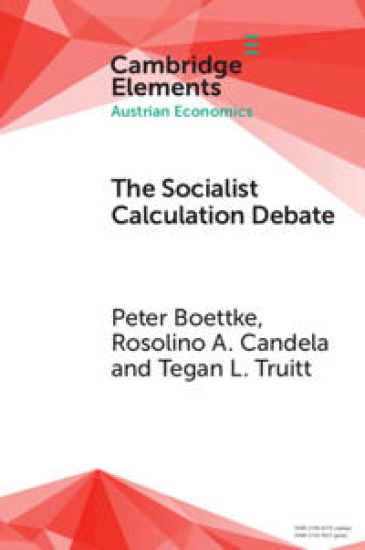
For over a generation, the collapse of communism in the Soviet Union and Eastern and Central Europe delegitimized the abolition of private property in the means of production and the practice of central planning as an effective way to achieve the ends of socialism. However, the aspiration of achieving the ends of socialism remains to this day. This Element provides a narrative of a century-long debate that was initiated by Ludwig von Mises in 1920. In so doing, it tells the history of the problem of economic calculation in the socialist commonwealth and its continuing relevance for developments in economics, political economy, and social philosophy.
The Socialist Calculation Debate

The Socialist Calculation Debate

Peter Boettke; Rosolino A. Candela; Tegan Lindstrom Truitt

Cambridge University Press
2024
sidottu
For over a generation, the collapse of communism in the Soviet Union and Eastern and Central Europe delegitimized the abolition of private property in the means of production and the practice of central planning as an effective way to achieve the ends of socialism. However, the aspiration of achieving the ends of socialism remains to this day. This Element provides a narrative of a century-long debate that was initiated by Ludwig von Mises in 1920. In so doing, it tells the history of the problem of economic calculation in the socialist commonwealth and its continuing relevance for developments in economics, political economy, and social philosophy.
Competition, Economic Planning & the Knowledge Problem

Competition, Economic Planning & the Knowledge Problem

Israel M Kirzner; Peter Boettke; Frédéric Sautet

Liberty Fund Inc
2018
sidottu
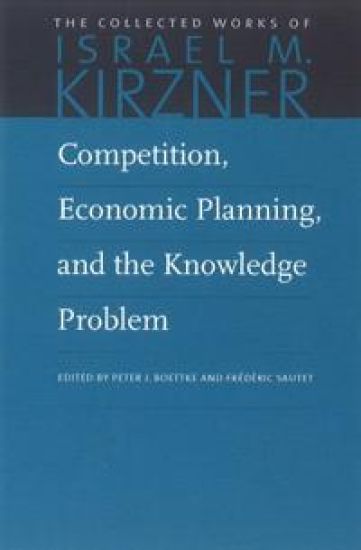
Competition, Economic Planning, and the Knowledge Problem expands on the ideas Kirzner first discussed in Competition and Entrepreneurshipthe role of the entrepreneur and its relation to the determination of prices and the coordination of individuals plansas well as economic planning, the knowledge problem, market-process theory, and the parts played by information, knowledge and advertising. It includes a paper on F. A. Hayeks theory of market coordination and the Austrian business-cycle theoryseen now for the first time in its original English. As a whole, the volume expresses Kirzners understanding that economics cannot be separated from its human element. Competition is a rivalrous process of entrepreneurial activity in which individuals and firms discover, innovate, and outdo each other. Kirzner discusses why this dynamic view of the economy is so important to understand, particularly in the contexts of economic planning and the workings of competitive markets. Over the course of this books nineteen articles and one monograph, Kirzner also stresses another point: though knowledge is present in all economic interaction, it is also dispersed in the economy such that no individual mind can ever centralize it all. This knowledge problem implies, as Mises and Hayek have argued, the impossibility of central planning. Kirzners contribution is to show that, ultimately, it is only the free, competitive entrepreneurial process that can overcome this problem through generation of knowledge that enables the most efficient allocation of scarce resources.
Competition, Economic Planning and the Knowledge Problem

Competition, Economic Planning and the Knowledge Problem

Israel M Kirzner; Peter Boettke; Frédéric Sautet

Liberty Fund Inc
2017
nidottu
Competition, Economic Planning, and the Knowledge Problem expands on the ideas Kirzner first discussed in Competition and Entrepreneurshipthe role of the entrepreneur and its relation to the determination of prices and the coordination of individuals plansas well as economic planning, the knowledge problem, market-process theory, and the parts played by information, knowledge and advertising. It includes a paper on F. A. Hayeks theory of market coordination and the Austrian business-cycle theoryseen now for the first time in its original English. As a whole, the volume expresses Kirzners understanding that economics cannot be separated from its human element. Competition is a rivalrous process of entrepreneurial activity in which individuals and firms discover, innovate, and outdo each other. Kirzner discusses why this dynamic view of the economy is so important to understand, particularly in the contexts of economic planning and the workings of competitive markets. Over the course of this books nineteen articles and one monograph, Kirzner also stresses another point: though knowledge is present in all economic interaction, it is also dispersed in the economy such that no individual mind can ever centralize it all. This knowledge problem implies, as Mises and Hayek have argued, the impossibility of central planning. Kirzners contribution is to show that, ultimately, it is only the free, competitive entrepreneurial process that can overcome this problem through generation of knowledge that enables the most efficient allocation of scarce resources.
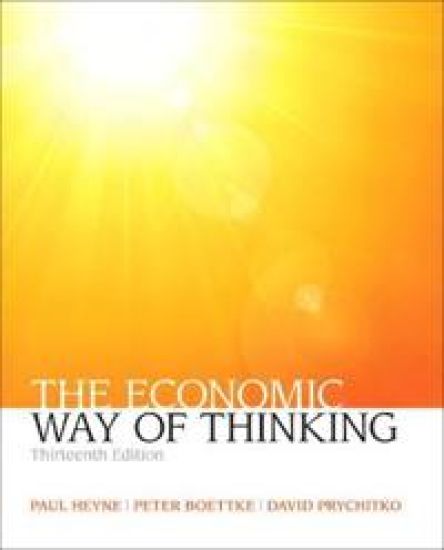
Economic Way of Thinking, The

Economic Way of Thinking, The

Paul Heyne; Peter Boettke; David Prychitko

Prentice Hall
2014
nidottu
Intended primarily for one semester survey courses in general economics, this text also provides practical content to current and aspiring industry professionals. Learn how to think like an economist. The Economic Way of Thinking goes beyond explaining the basic principles of micro- and macroeconomic analysis by showing readers a method of reasoning that teaches them how to apply these principles as tools. The authors expose readers to a method of reasoning that makes them think like an economist through example and application and also shows them how not to think, by exposing errors in popular economic reasoning. The latest edition has been thoroughly updated with current material.