Kirjojen hintavertailu. Mukana 12 390 323 kirjaa ja 12 kauppaa.

Kirjailija

Peter Brown

Kirjat ja teokset yhdessä paikassa: 110 kirjaa, julkaisuja vuosilta 1989-2027, suosituimpien joukossa The Beatles - Omin sanoin. Vertaile teosten hintoja ja tarkista saatavuus suomalaisista kirjakaupoista.

110 kirjaa

Kirjojen julkaisuhaarukka 1989-2027.

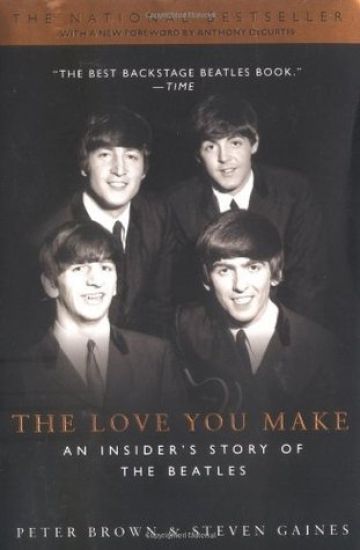
The Love You Make: An Insider's Story of the Beatles

The Love You Make: An Insider's Story of the Beatles

Peter Brown; Steven Gaines

BERKLEY BOOKS
2002
nidottu
Here is the national bestseller that Newsday called "the most authoritative and candid look yet at the personal lives...of the oft-scrutinized group." In The Love You Make, Peter Brown, a close friend of and business manager for the band--and the best man at John and Yoko's wedding--presents a complete look at the dramatic offstage odyssey of the four lads from Liverpool who established the greatest music phenomenon of the twentieth century. Written with the full cooperation of each of the group's members and their intimates, this book tells the inside story of the music and the madness, the feuds and the drugs, the marriages and the affairs--from the greatest heights to the self-destructive depths of the Fab Four. In-depth and definitive, The Love You Make is an astonishing account of four men who transformed the way a whole generation of young people thought and lived. It reigns as the most comprehensive, revealing biography available of John, Paul, George, and Ringo. Includes 32 pages of rare and revealing photosA Literary Guild(R) Alternate Selection
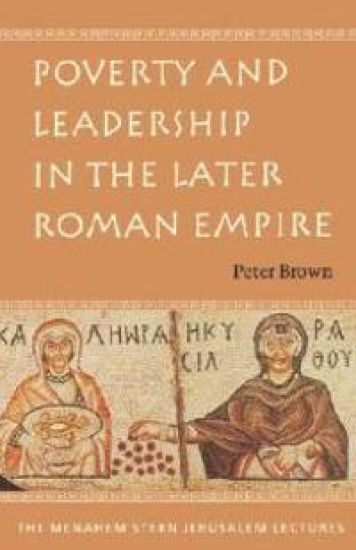
Poverty and Leadership in the Later Roman Empire

Poverty and Leadership in the Later Roman Empire

Peter Brown

Brandeis University Press
2001
nidottu
In three magisterial essays, Peter Brown, one of the world's foremost scholars of the society and culture of late antiquity, explores the emergence in late Roman society of "the poor" as a distinct social class, one for which the Christian church claimed a special responsibility. It is the story of how a society came to see itself as responsible for the care of a particular class of people -- a class that had not previously been cared for -- and of who benefited from that shift in interests. In his characteristically elegant and lucid prose, Brown seeks to recover the pre-Christian status of poor people, the actual nature of the relations between the Christian church and the poor, and the true motivations -- sometimes sincere, sometimes self-serving -- behind Christian rhetoric of love for the poor. He draws not only on the standard Greek and Latin sources for the later Roman Empire, but also on Jewish sources to document the interactions between Middle Eastern provincial societies and classical Roman traditions. Brown gracefully illuminates a crucial transition from classical to Christian culture: the emergence of a new understanding of what society -- and the Church -- owes to the poor that continues to resonate.
Late Antiquity

Late Antiquity

Peter Brown

The Belknap Press
1998
nidottu
In this history of the late antique period, which appeared earlier in the five-volume series A History of Private Life, Peter Brown shows the slow shift from one form of public community to another--from the ancient city to the Christian church. In the four centuries between Marcus Aurelius (161-180) and Justinian (527-565), the Mediterranean world passed through a series of profound transmutations that affected the rhythms of life, the moral sensibilities, and the sense of the self of the inhabitants of its cities, and of the countryside around them.
Authority and the Sacred

Authority and the Sacred

Peter Brown

Cambridge University Press
1997
pokkari
The Christianisation of the Roman world lies at the root of modern Europe, yet at the time it was a tentative and piecemeal process. Peter Brown's fascinating study examines the factors which proved decisive and the compromises which made the emergence of the Christian 'thought world' possible: how the the old gods of the Roman Empire could be reinterpreted as symbols to further the message of the Church. Peter Brown also shows how Christian holy men were less representative of a triumphant faith than negotiators of a working compromise between the new faith and traditional ways of dealing with the supernatural worlds.
Index of Middle English Prose volumes I-X

Index of Middle English Prose volumes I-X

Ralph Hanna; G.A. Lester; Patrick J. Horner; Laurel Braswell; Peter Brown; Elton D. Higgs; Oliver S Pickering; Susan Powell; James Simpson; Sarah Ogilvie-Thomson; L.M. Eldredge; Irma Taavitseinen

D.S. Brewer
1995
muu
The Index of Middle English Prose is an international collaborative project which will ultimately locate, identify and record all extant Middle English prose texts composed between c.1200 and c.1500, in both manuscript andprinted form in medieval and post-medieval versions. The first step towards this goal has been this series of Handlists, each recording the holdings of a major library or group of libraries. Compiled by scholars, Handlists include detailed descriptions ofeach prose item with identifications, categorisations and full bibliographical data. Every Handlist will also contain a series of indexes including listings of opening and closing lines, authors, titles, subject matter and rubrics. For students of the middle ages Handlists provide essential bibliographical tools and shed light on a wide range of subjects.
Chaucer at Work

Chaucer at Work

Peter Brown

Longman
1994
nidottu
Chaucer at Work is a new kind of introduction to the Canterbury Tales. It avoids excessive amounts of background information and involves the reader in the discovery of how Chaucer composed his famous work. It presents a series of sources and contexts to be considered in conjunction with key passages from Chaucer's poems. It includes sets of questions to encourage the reader to examine the text in detail and to build on his or her observations. This well-informed and practical guide will prove invaluable reading to those studying medieval literature at undergraduate level and English literature at A level.
The Making of Late Antiquity

The Making of Late Antiquity

Peter Brown

Harvard University Press
1993
nidottu
Peter Brown presents a masterly history of Roman society in the second, third, and fourth centuries. Brown interprets the changes in social patterns and religious thought, breaking away from conventional modern images of the period.
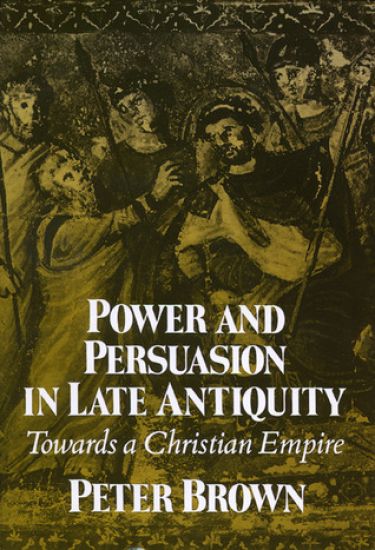
Power and Persuasion in Late Antiquity

Power and Persuasion in Late Antiquity

Peter Brown

University of Wisconsin Press
1992
nidottu
Peter Brown, a known authority on Mediterranean civilisation in late antiquity, traces the growing power of early Christian bishops as they wrested influence from the philosophers who had traditionally advised the rulers of Graeco-Roman society. In the new ""Christian empire"", the ancient bonds of citizen to citizen and of each city to its benefactors were replaced by a common loyalty to a distant, Christian autocrat. This transformation of the Roman Empire from an ancient to a medieval society, Brown argues, is among the most far-reaching consequences of the rise of Christianity. In the last centuries of the Roman Empire, the power of the emperors depended on collaboration with the local elites. The shared ideals of Graeco-Roman culture (""paideia""), which were inculcated among the elite by their education, acted as unwritten constitution. The philosophers, as representives of this cultural tradition and as critics and advisors of the powerful, upheld the ideals of just rule and prevented the abuses of power. Between the conversion of Emperor Constantine to Christianity in 312 and the reign of Theodosius (379-395), however, both Christian bishops and uneducated monks emerged as competitors to the traditional educated elites. Claiming as Christians to be the ""true philosophers"", they asserted their own role in swaying the emperors to mercy and just rule. Brown shows how charity to the urban poor gave bishops such as Saint Ambrose a novel power base - the restless lower classes of the empire. The lines of power that led from local society to the imperial court increasingly fell into the hands of the church, as clerics exercised their power to ensure the peace in cities, secure amnesties, and convey to the emperor the wishes of his subjects. Brown also points out how churchmen expressed their new local power through violence against rivals: Jewish synagogues and Roman Temples were destroyed, and Hypatia, one of the few women with a public role as a philosopher, was lynched in Alexandria. Brown demonstrates how Christian teaching provided a model for a more autocratic, hierarchial empire: the ancient ideals of democracy and citizenship gave way to the image of a glorious ruler showing mercy to his lowly and grateful subjects. Drawing upon a wealth of material - newly discovered letters and sermons of Saint Augustine, archaeological evidence, manuscripts in Coptic and Syriac - he provides a portrait of a turbulent and fascinating era.
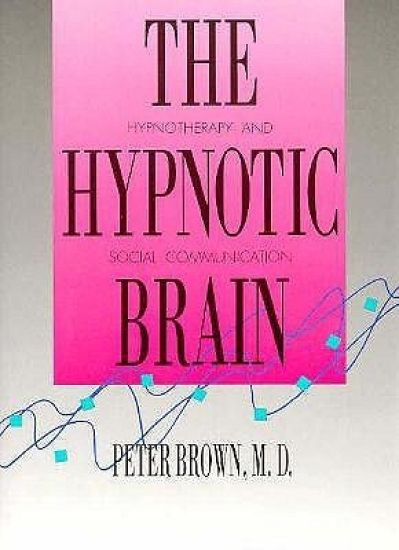
The Hypnotic Brain

The Hypnotic Brain

Peter Brown

Yale University Press
1991
sidottu
Hypnosis has recently experienced a surge of popularity in the scientific community and the general public and is currently being used to deal with a wide range of disorders. IN this elegantly written book, Dr. Peter Brown draws on the latest developments in cognitive psychology, anthropology, ethnology, and neuroscience to offer a new explanation for how hypnosis works and how it can be applied. Brown argues that the ability to hypnotized and be hypnotized is closely related to brain functions that are uniquely human—especially to our ability to communicate with others. He begins by looking at the way communication has evolved, especially our use of facial expression and the tonal aspects of speech to synchronize interactions. These features were particularly important for the transmission of culture in oral societies before the advent of writing. He next considers the changes the brain undergoes during hypnosis, proposing that hypnotherapy can be understood as the interaction between two fundamental brain functions: the rhythmic alteration in level of consciousness that the brain undergoes throughout the course of the day, and the capacity to use metaphor, imagery, and analogy to understand ourselves and the world. Brown discusses some of the clinical uses of hypnotherapy, in particular the exploration of multiple personality disorder (which can be characterized as spontaneous self-hypnosis as a means of coping with trauma) and the role of hypnosis in treating medical illness. In his final chapter he deals with how language may be used in hypnotherapy, with examples from the work of eth late Milton Erickson, one of the most influential clinicians and teacher sin contemporary hypnosis.
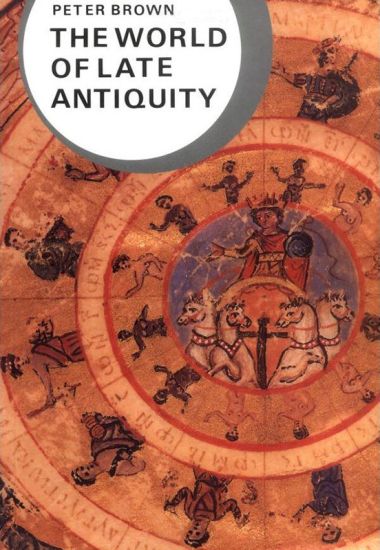
The World of Late Antiquity

The World of Late Antiquity

Peter Brown

W. W. Norton Company
1989
nidottu
These centuries, as the author demonstrates, were the era in which the most deeply rooted of ancient institutions disappeared for all time. By 476 the Roman empire had vanished from western Europe; by 655 the Persian empire had vanished from the Near East. Mr. Brown, Professor of History at Princeton University, examines these changes and men's reactions to them, but his account shows that the period was also one of outstanding new beginnings and defines the far-reaching impact both of Christianity on Europe and of Islam on the Near East. The result is a lucid answer to a crucial question in world history; how the exceptionally homogeneous Mediterranean world of c. 200 A.D. became divided into the three mutually estranged societies of the Middle Ages: Catholic Western Europe, Byzantium, and Islam. We still live with the results of these contrasts.