

Kirjailija
Peter Bryant
Kirjat ja teokset yhdessä paikassa: 16 kirjaa, julkaisuja vuosilta 1985-2025, suosituimpien joukossa Red Alert. Vertaile teosten hintoja ja tarkista saatavuus suomalaisista kirjakaupoista.
16 kirjaa
Kirjojen julkaisuhaarukka 1985-2025.
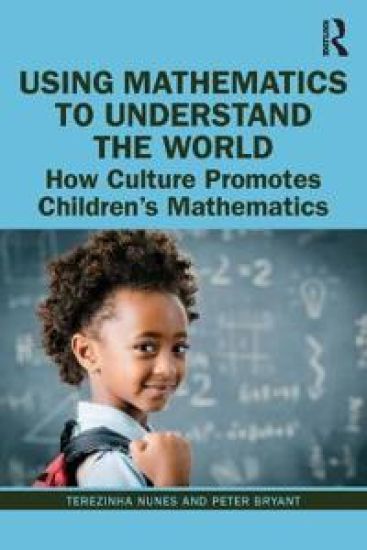
Using Mathematics to Understand the World: How Culture Promotes Children's Mathematics offers fundamental insight into how mathematics permeates our lives as a way of representing and thinking about the world. Internationally renowned experts Terezinha Nunes and Peter Bryant examine research into children’s mathematical development to show why it is important to distinguish between quantities, relations and numbers. Using Mathematics to Understand the World presents a theory about the development of children’s quantitative reasoning and reveals why and how teaching about quantitative reasoning can be used to improve children’s mathematical attainment in school. It describes how learning about the analytical meaning of numbers is established as part of mathematics at school but quantitative reasoning is emphasized less even though it is increasingly acclaimed as essential for thinking mathematically and for using mathematics to understand the world.This essential text is for all students of mathematics education, developmental psychology and cognitive psychology. By including activities for parents and professionals to try themselves, it may help you to recognize your own quantitative reasoning.
Using Mathematics to Understand the World: How Culture Promotes Children's Mathematics offers fundamental insight into how mathematics permeates our lives as a way of representing and thinking about the world. Internationally renowned experts Terezinha Nunes and Peter Bryant examine research into children’s mathematical development to show why it is important to distinguish between quantities, relations and numbers. Using Mathematics to Understand the World presents a theory about the development of children’s quantitative reasoning and reveals why and how teaching about quantitative reasoning can be used to improve children’s mathematical attainment in school. It describes how learning about the analytical meaning of numbers is established as part of mathematics at school but quantitative reasoning is emphasized less even though it is increasingly acclaimed as essential for thinking mathematically and for using mathematics to understand the world.This essential text is for all students of mathematics education, developmental psychology and cognitive psychology. By including activities for parents and professionals to try themselves, it may help you to recognize your own quantitative reasoning.

Crypto Profit: Your Expert Guide to Financial Freedom through Cryptocurrency Investing
Peter Bryant
Peter Bryant
2020
nidottu
Originally published in 1974: ‘This book sets forth a theory of cognitive development based on simple but powerful processes of inference. The theory is applied with great ingenuity and freshness to complex phenomena found during intellectual development. Dr Bryant has written an important and original book.’ (J.S. Bruner)‘In this elegant, timely and brief volume, Dr Bryant produces strong experimental evidence which not only challenges Piaget’s ideas, but even more importantly synthesizes the old and new findings into a newer theory of perceptual development.The importance of this book lies both in its demonstration of elegant experimental techniques in working with young children, and in the optimism it will eventually bring to all concerned with their education. Realizing that children can make deductive inferences at an early age, educators will have to rethink some of their approaches to the teaching of young children. The studies related to the understanding of number have crucial implications for the future teaching of mathematics. This book will cause many people to take fresh thoughts on the subjects here dealt with, and so it can be strongly recommended for all students of child development.’ (William Yule, British Journal of Psychiatry)

Every minute of every hour of every day, there are American Bombers in the air, loaded with nuclear weapons, ready to fly into action at the mere spark of the right radio sign al.These are the planes of the Strategic Air Command. What happens once that signal flashes is described vividly in this tensely dramatic novel. The command came to the men of the 843rd Wing, high in the air near the Russian border. Asking no questions, obeying their standing orders, they headed straight towards their assigned targets. Had America already been attacked?Or was it the action of a single determined general, and unauthorized by the pentagon and the president? RED ALERT is the story of the two tensest hours in human history.
Originally published in 1974: ‘This book sets forth a theory of cognitive development based on simple but powerful processes of inference. The theory is applied with great ingenuity and freshness to complex phenomena found during intellectual development. Dr Bryant has written an important and original book.’ (J.S. Bruner)‘In this elegant, timely and brief volume, Dr Bryant produces strong experimental evidence which not only challenges Piaget’s ideas, but even more importantly synthesizes the old and new findings into a newer theory of perceptual development.The importance of this book lies both in its demonstration of elegant experimental techniques in working with young children, and in the optimism it will eventually bring to all concerned with their education. Realizing that children can make deductive inferences at an early age, educators will have to rethink some of their approaches to the teaching of young children. The studies related to the understanding of number have crucial implications for the future teaching of mathematics. This book will cause many people to take fresh thoughts on the subjects here dealt with, and so it can be strongly recommended for all students of child development.’ (William Yule, British Journal of Psychiatry)
In this classic edition of their ground-breaking work, Usha Goswami and Peter Bryant revisit their influential theory about how phonological skills support the development of literacy. The book describes three causal factors which can account for children’s reading and spelling development: pre-school phonological knowledge of rhyme and alliteration the impact of alphabetic instruction on knowledge about phonemes links between early spelling and later reading. This classic edition includes a new introduction from the authors which evaluates research from the past 25 years. Examining new evidence from auditory neuroscience, statistical modelling and orthographic database analyses, as well as new data from cognitive developmental psychology and educational studies, the authors consider how well their original ideas have stood up to the test of time.Phonological Skills and Learning to Read will continue to be essential reading for students and researchers in language and literacy development, and those involved in teaching children to read.
In this classic edition of their ground-breaking work, Usha Goswami and Peter Bryant revisit their influential theory about how phonological skills support the development of literacy. The book describes three causal factors which can account for children’s reading and spelling development: pre-school phonological knowledge of rhyme and alliteration the impact of alphabetic instruction on knowledge about phonemes links between early spelling and later reading. This classic edition includes a new introduction from the authors which evaluates research from the past 25 years. Examining new evidence from auditory neuroscience, statistical modelling and orthographic database analyses, as well as new data from cognitive developmental psychology and educational studies, the authors consider how well their original ideas have stood up to the test of time.Phonological Skills and Learning to Read will continue to be essential reading for students and researchers in language and literacy development, and those involved in teaching children to read.
Children's Reading and Spelling
Terezinha Nunes; Peter Bryant
Wiley-Blackwell (an imprint of John Wiley Sons Ltd)
2009
nidottu
This book extends models of early literacy, analyzing how children’s reading and spelling skills develop throughout their school career. An account of how a child’s reading and spelling develop which goes beyond the early yearsShows that there are radical changes in the way children read and spell as they get olderDescribes a new theory about the learning that goes on in the later stages of reading and spellingMakes clear the educational implications of this theoryThe authors' research has previously contributed to the 'literacy hour' – a government initiative to improve the teaching of literacy skills in UK schools
Children's Reading and Spelling
Terezinha Nunes; Peter Bryant
Wiley-Blackwell (an imprint of John Wiley Sons Ltd)
2009
sidottu
This book extends models of early literacy, analyzing how children’s reading and spelling skills develop throughout their school career. An account of how a child’s reading and spelling develop which goes beyond the early yearsShows that there are radical changes in the way children read and spell as they get olderDescribes a new theory about the learning that goes on in the later stages of reading and spellingMakes clear the educational implications of this theoryThe authors' research has previously contributed to the 'literacy hour' – a government initiative to improve the teaching of literacy skills in UK schools
With reports from several studies showing the benefits of teaching young children about morphemes, this book is essential reading for anyone concerned with helping children to read and write. By breaking words down into chunks of meaning that can be analyzed as complete units rather than as strings of individual letters, children are better able to make sense of the often contradictory spelling and reading rules of English. As a result, their enjoyment of learning about words increases, and their literacy skills improve. Written by leading researchers for trainee teachers, practising teachers and interested parents, this highly accessible and innovative book provides sound, evidence-based advice and materials that can be used to help teach children about morphemes, and highlights the beneficial effects of this approach.
With reports from several studies showing the benefits of teaching young children about morphemes, this book is essential reading for anyone concerned with helping children to read and write. By breaking words down into chunks of meaning that can be analyzed as complete units rather than as strings of individual letters, children are better able to make sense of the often contradictory spelling and reading rules of English. As a result, their enjoyment of learning about words increases, and their literacy skills improve. Written by leading researchers for trainee teachers, practising teachers and interested parents, this highly accessible and innovative book provides sound, evidence-based advice and materials that can be used to help teach children about morphemes, and highlights the beneficial effects of this approach.
Children Doing Mathematics provides a reliable and up to date review of the substantial recent work in children' mathematical understanding. The authors also present important new research on children's understanding of number, measurement, arithmetic operation and fractions both in and out of school. The central theme of Children Doing Mathematics is that there are crucial conditions for children's mathematical learning. Firstly, children have to come to grips with conventional mathematical systems. Secondly, but equally important, they have to be able to present mathematical knowledge in a way that solves problems. The book also discusses how mathematical activities and knowledge involve much more than what is currently viewed as mathematics in the school curriculum. Most recent work illustrates how children can be successful in mathematical activities outside school whereas they fail in similar activities in the classroom. Through these two underlying themes the authors bring together discussions on conventional mathematical learning and on real life mathematical success. In so doing, they also highlight new and better ways of analysing children's abilities and of advancing their learning in school.
Phonological Skills and Learning to Read
Usha Goswami; Peter Bryant
Psychology Press Ltd
1990
nidottu
This book sets out to integrate recent exciting research on the precursors of reading and early reading strategies adopted by children in the classroom. It aims to develop a theory about why early phonological skills are crucial in learning to read, and shows how phonological knowledge about rhymes and other units of sound helps children learn about letter sequences when beginning to be taught to read.The authors begin by contrasting theories which suggest that children's phonological awareness is a result of the experience of learning to read and those that suggest that phonological awareness precedes, and is a causal determinant of, reading. The authors argue for a version of the second kind of theory and show that children are aware of speech units, called onset and rime, before they learn to read and spell. An important part of the argument is that children make analogies and inferences about these letter sequences in order to read and write new words.
A surprisingly large number of otherwise `normal' children have problems learning to read, and these difficulties can produce disastrous consequences. Can we isolate the causes of reading problems? How can we best help backward readers? Peter Bryant and Lynette Bradley, in a trenchant and convincingly argued critique, show that many of the existing psychological explanations of reading problems are based on flawed research and on entirely inadequate evidence.