Kirjojen hintavertailu. Mukana 12 595 353 kirjaa ja 12 kauppaa.

Kirjailija

Peter Bürgisser

Kirjat ja teokset yhdessä paikassa: 6 kirjaa, julkaisuja vuosilta 1996-2015, suosituimpien joukossa Completeness and Reduction in Algebraic Complexity Theory. Vertaile teosten hintoja ja tarkista saatavuus suomalaisista kirjakaupoista.

6 kirjaa

Kirjojen julkaisuhaarukka 1996-2015.

Condition

Condition

Peter Bürgisser; Felipe Cucker

Springer-Verlag Berlin and Heidelberg GmbH Co. K
2015
nidottu
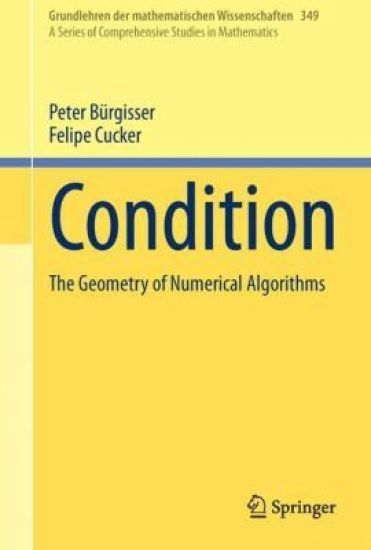
This book gathers threads that have evolved across different mathematical disciplines into seamless narrative. It deals with condition as a main aspect in the understanding of the performance ---regarding both stability and complexity--- of numerical algorithms. While the role of condition was shaped in the last half-century, so far there has not been a monograph treating this subject in a uniform and systematic way. The book puts special emphasis on the probabilistic analysis of numerical algorithms via the analysis of the corresponding condition. The exposition's level increases along the book, starting in the context of linear algebra at an undergraduate level and reaching in its third part the recent developments and partial solutions for Smale's 17th problem which can be explained within a graduate course. Its middle part contains a condition-based course on linear programming that fills a gap between the current elementary expositions of the subject based on the simplex method and those focusing on convex programming.
Condition

Condition

Peter Bürgisser; Felipe Cucker

Springer-Verlag Berlin and Heidelberg GmbH Co. K
2013
sidottu
This book gathers threads that have evolved across different mathematical disciplines into seamless narrative. It deals with condition as a main aspect in the understanding of the performance ---regarding both stability and complexity--- of numerical algorithms. While the role of condition was shaped in the last half-century, so far there has not been a monograph treating this subject in a uniform and systematic way. The book puts special emphasis on the probabilistic analysis of numerical algorithms via the analysis of the corresponding condition. The exposition's level increases along the book, starting in the context of linear algebra at an undergraduate level and reaching in its third part the recent developments and partial solutions for Smale's 17th problem which can be explained within a graduate course. Its middle part contains a condition-based course on linear programming that fills a gap between the current elementary expositions of the subject based on the simplex method and those focusing on convex programming.
Algebraic Complexity Theory

Algebraic Complexity Theory

Peter Bürgisser; Michael Clausen; Mohammad A. Shokrollahi

Springer-Verlag Berlin and Heidelberg GmbH Co. K
2010
nidottu
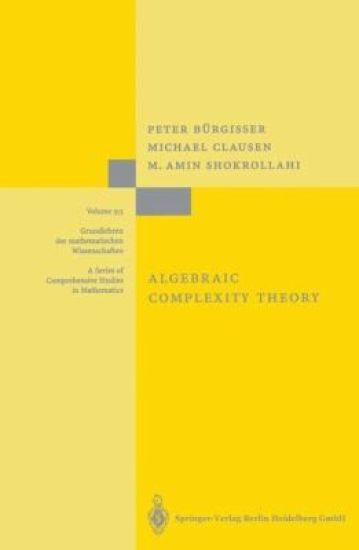
The algorithmic solution of problems has always been one of the major concerns of mathematics. For a long time such solutions were based on an intuitive notion of algorithm. It is only in this century that metamathematical problems have led to the intensive search for a precise and sufficiently general formalization of the notions of computability and algorithm. In the 1930s, a number of quite different concepts for this purpose were pro­ posed, such as Turing machines, WHILE-programs, recursive functions, Markov algorithms, and Thue systems. All these concepts turned out to be equivalent, a fact summarized in Church's thesis, which says that the resulting definitions form an adequate formalization of the intuitive notion of computability. This had and continues to have an enormous effect. First of all, with these notions it has been possible to prove that various problems are algorithmically unsolvable. Among of group these undecidable problems are the halting problem, the word problem theory, the Post correspondence problem, and Hilbert's tenth problem. Secondly, concepts like Turing machines and WHILE-programs had a strong influence on the development of the first computers and programming languages. In the era of digital computers, the question of finding efficient solutions to algorithmically solvable problems has become increasingly important. In addition, the fact that some problems can be solved very efficiently, while others seem to defy all attempts to find an efficient solution, has called for a deeper under­ standing of the intrinsic computational difficulty of problems.
Completeness and Reduction in Algebraic Complexity Theory

Completeness and Reduction in Algebraic Complexity Theory

Peter Bürgisser

Springer-Verlag Berlin and Heidelberg GmbH Co. K
2010
nidottu
One of the most important and successful theories in computational complex­ ity is that of NP-completeness. This discrete theory is based on the Turing machine model and achieves a classification of discrete computational prob­ lems according to their algorithmic difficulty. Turing machines formalize al­ gorithms which operate on finite strings of symbols over a finite alphabet. By contrast, in algebraic models of computation, the basic computational step is an arithmetic operation (or comparison) of elements of a fixed field, for in­ stance of real numbers. Hereby one assumes exact arithmetic. In 1989, Blum, Shub, and Smale [12] combined existing algebraic models of computation with the concept of uniformity and developed a theory of NP-completeness over the reals (BSS-model). Their paper created a renewed interest in the field of algebraic complexity and initiated new research directions. The ultimate goal of the BSS-model (and its future extensions) is to unite classical dis­ crete complexity theory with numerical analysis and thus to provide a deeper foundation of scientific computation (cf. [11, 101]). Already ten years before the BSS-paper, Valiant [107, 110] had proposed an analogue of the theory of NP-completeness in an entirely algebraic frame­ work, in connection with his famous hardness result for the permanent [108]. While the part of his theory based on the Turing approach (#P-completeness) is now standard and well-known among the theoretical computer science com­ munity, his algebraic completeness result for the permanents received much less attention.
Completeness and Reduction in Algebraic Complexity Theory

Completeness and Reduction in Algebraic Complexity Theory

Peter Bürgisser

Springer-Verlag Berlin and Heidelberg GmbH Co. K
2000
sidottu
One of the most important and successful theories in computational complex­ ity is that of NP-completeness. This discrete theory is based on the Turing machine model and achieves a classification of discrete computational prob­ lems according to their algorithmic difficulty. Turing machines formalize al­ gorithms which operate on finite strings of symbols over a finite alphabet. By contrast, in algebraic models of computation, the basic computational step is an arithmetic operation (or comparison) of elements of a fixed field, for in­ stance of real numbers. Hereby one assumes exact arithmetic. In 1989, Blum, Shub, and Smale [12] combined existing algebraic models of computation with the concept of uniformity and developed a theory of NP-completeness over the reals (BSS-model). Their paper created a renewed interest in the field of algebraic complexity and initiated new research directions. The ultimate goal of the BSS-model (and its future extensions) is to unite classical dis­ crete complexity theory with numerical analysis and thus to provide a deeper foundation of scientific computation (cf. [11, 101]). Already ten years before the BSS-paper, Valiant [107, 110] had proposed an analogue of the theory of NP-completeness in an entirely algebraic frame­ work, in connection with his famous hardness result for the permanent [108]. While the part of his theory based on the Turing approach (#P-completeness) is now standard and well-known among the theoretical computer science com­ munity, his algebraic completeness result for the permanents received much less attention.
Algebraic Complexity Theory

Algebraic Complexity Theory

Peter Bürgisser; Michael Clausen; Mohammad A. Shokrollahi

Springer-Verlag Berlin and Heidelberg GmbH Co. K
1996
sidottu
The algorithmic solution of problems has always been one of the major concerns of mathematics. For a long time such solutions were based on an intuitive notion of algorithm. It is only in this century that metamathematical problems have led to the intensive search for a precise and sufficiently general formalization of the notions of computability and algorithm. In the 1930s, a number of quite different concepts for this purpose were pro­ posed, such as Turing machines, WHILE-programs, recursive functions, Markov algorithms, and Thue systems. All these concepts turned out to be equivalent, a fact summarized in Church's thesis, which says that the resulting definitions form an adequate formalization of the intuitive notion of computability. This had and continues to have an enormous effect. First of all, with these notions it has been possible to prove that various problems are algorithmically unsolvable. Among of group these undecidable problems are the halting problem, the word problem theory, the Post correspondence problem, and Hilbert's tenth problem. Secondly, concepts like Turing machines and WHILE-programs had a strong influence on the development of the first computers and programming languages. In the era of digital computers, the question of finding efficient solutions to algorithmically solvable problems has become increasingly important. In addition, the fact that some problems can be solved very efficiently, while others seem to defy all attempts to find an efficient solution, has called for a deeper under­ standing of the intrinsic computational difficulty of problems.