Kirjojen hintavertailu. Mukana 12 595 353 kirjaa ja 12 kauppaa.
Kirjailija
Peter Christen
Kirjat ja teokset yhdessä paikassa: 7 kirjaa, julkaisuja vuosilta 2012-2025, suosituimpien joukossa Die Berner Alpenbahn-Gesellschaft Bern-Lötschberg-Simplon BLS. Vertaile teosten hintoja ja tarkista saatavuus suomalaisista kirjakaupoista.
Angesichts der in Europa aufziehenden grossen Kriegsgefahr und der massiven Aufr stung im nationalsozialistischen Deutschland beschloss das Eidgen ssische Parlament im Jahr 1936 ein grosses ausserordentliches R stungsprogramm von 235 Millionen Franken. Dieses wurde initiiert vom popul ren Vorsteher des Eidgen ssischen Milit rdepartementes Bundesrat Rudolf Minger. Zur Finanzierung griff der Bundesrat nicht etwa in die Staatskasse, sondern gab eine neuartige Wehranleihe heraus: ein Wertpapier, mit dem der B rger direkt in die Aufr stung der Armee investieren konnte. Das Buch erkl rt das schwierige politische, wirtschaftliche, finanzielle sowie milit rische Umfeld der Schweiz in den 1930er Jahren, das zur Ausgabe dieser Anleihe f hrte. Es erkl rt detailliert alle Aspekte der Wehranleihe, stellt die einzelnen Zertifikate genauer dar und zeigt die mit der Ausgabe verbundenen riesigen und noch nie gesehenen Propaganda-Massnahmen. Das Buch erl utert die folgenschweren Ereignisse w hrend der Emissionsperiode, welche in der drastischen Abwertung des Schweizer Frankens gipfelten. An die ffentlichkeit gelangte sogar ein Skandal um die Verwendung der gesammelten Gelder, die den Bundesrat zur Stellungnahme zwang. Schliesslich werden auch die weiteren numismatischen und philatelistischen Leckerbissen dargestellt, welche nur dank der Wehranleihe entstanden sind und noch heute die Sammler begeistern.
Seit bald 40 Jahren ist der Regionalverkehr Bern-Solothurn RBS in der Agglomeration Stadt Bern t tig. Die Geschichte des Berner ffentlichen Nahverkehrs ist jedoch bedeutend lter. Sie geht zur ck ins 19. Jahrhundert und umfasst nicht weniger als neun verschiedene Eisenbahngesellschaften. Dieses Buch geht in die Urspr nge des ffentlichen Nahverkehrs und zu den technologischen Voraussetzungen f r einen erfolgreichen Verkehrsbetrieb. Es beschreibt weiter die Anf nge des Nahverkehrs in der Schweiz. Im Zentrum ist die wechselvolle Geschichte des Regionalverkehrs in der Agglomeration Bern. Das Buch erkl rt detailliert die technische, finanzielle und betriebliche Entwicklung der einzelnen Vorg ngerbahnen und stellt deren Initianten und wichtigsten Pers nlichkeiten vor, welche die Entstehung des heutigen Regionalverkehrs Bern-Solothurn RBS berhaupt erm glichten. Es legt dabei das Hauptmerk auf die Finanzgeschichte dieser Unternehmungen und stellt alle bekannten Historische Wertpapiere vor.
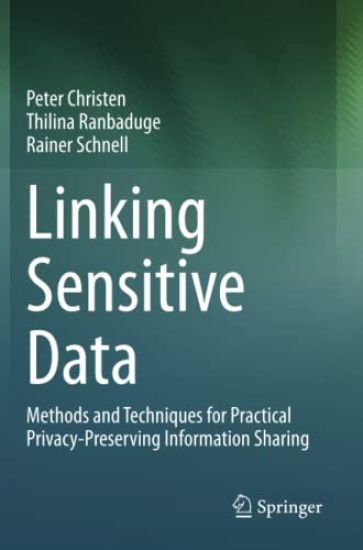
This book provides modern technical answers to the legal requirements of pseudonymisation as recommended by privacy legislation. It covers topics such as modern regulatory frameworks for sharing and linking sensitive information, concepts and algorithms for privacy-preserving record linkage and their computational aspects, practical considerations such as dealing with dirty and missing data, as well as privacy, risk, and performance assessment measures. Existing techniques for privacy-preserving record linkage are evaluated empirically and real-world application examples that scale to population sizes are described. The book also includes pointers to freely available software tools, benchmark data sets, and tools to generate synthetic data that can be used to test and evaluate linkage techniques. This book consists of fourteen chapters grouped into four parts, and two appendices. The first part introduces the reader to the topic of linking sensitive data, the second part coversmethods and techniques to link such data, the third part discusses aspects of practical importance, and the fourth part provides an outlook of future challenges and open research problems relevant to linking sensitive databases. The appendices provide pointers and describe freely available, open-source software systems that allow the linkage of sensitive data, and provide further details about the evaluations presented. A companion Web site at https://dmm.anu.edu.au/lsdbook2020 provides additional material and Python programs used in the book. This book is mainly written for applied scientists, researchers, and advanced practitioners in governments, industry, and universities who are concerned with developing, implementing, and deploying systems and tools to share sensitive information in administrative, commercial, or medical databases.The Book describes how linkage methods work and how to evaluate their performance. It covers all the major concepts and methods and also discusses practical matters such as computational efficiency, which are critical if the methods are to be used in practice - and it does all this in a highly accessible way!David J. Hand, Imperial College, London
This book provides modern technical answers to the legal requirements of pseudonymisation as recommended by privacy legislation. It covers topics such as modern regulatory frameworks for sharing and linking sensitive information, concepts and algorithms for privacy-preserving record linkage and their computational aspects, practical considerations such as dealing with dirty and missing data, as well as privacy, risk, and performance assessment measures. Existing techniques for privacy-preserving record linkage are evaluated empirically and real-world application examples that scale to population sizes are described. The book also includes pointers to freely available software tools, benchmark data sets, and tools to generate synthetic data that can be used to test and evaluate linkage techniques. This book consists of fourteen chapters grouped into four parts, and two appendices. The first part introduces the reader to the topic of linking sensitive data, the second part coversmethods and techniques to link such data, the third part discusses aspects of practical importance, and the fourth part provides an outlook of future challenges and open research problems relevant to linking sensitive databases. The appendices provide pointers and describe freely available, open-source software systems that allow the linkage of sensitive data, and provide further details about the evaluations presented. A companion Web site at https://dmm.anu.edu.au/lsdbook2020 provides additional material and Python programs used in the book. This book is mainly written for applied scientists, researchers, and advanced practitioners in governments, industry, and universities who are concerned with developing, implementing, and deploying systems and tools to share sensitive information in administrative, commercial, or medical databases.The Book describes how linkage methods work and how to evaluate their performance. It covers all the major concepts and methods and also discusses practical matters such as computational efficiency, which are critical if the methods are to be used in practice - and it does all this in a highly accessible way!David J. Hand, Imperial College, London
Data matching (also known as record or data linkage, entity resolution, object identification, or field matching) is the task of identifying, matching and merging records that correspond to the same entities from several databases or even within one database. Based on research in various domains including applied statistics, health informatics, data mining, machine learning, artificial intelligence, database management, and digital libraries, significant advances have been achieved over the last decade in all aspects of the data matching process, especially on how to improve the accuracy of data matching, and its scalability to large databases.Peter Christen’s book is divided into three parts: Part I, “Overview”, introduces the subject by presenting several sample applications and their special challenges, as well as a general overview of a generic data matching process. Part II, “Steps of the Data Matching Process”, then details its main steps like pre-processing, indexing, field and record comparison, classification, and quality evaluation. Lastly, part III, “Further Topics”, deals with specific aspects like privacy, real-time matching, or matching unstructured data. Finally, it briefly describes the main features of many research and open source systems available today.By providing the reader with a broad range of data matching concepts and techniques and touching on all aspects of the data matching process, this book helps researchers as well as students specializing in data quality or data matching aspects to familiarize themselves with recent research advances and to identify open research challenges in the area of data matching. To this end, each chapter of the book includes a final section that provides pointers to further background and research material. Practitioners will better understand the current state of the art in data matching as well as the internal workings and limitations of current systems. Especially,they will learn that it is often not feasible to simply implement an existing off-the-shelf data matching system without substantial adaption and customization. Such practical considerations are discussed for each of the major steps in the data matching process.
Data matching (also known as record or data linkage, entity resolution, object identification, or field matching) is the task of identifying, matching and merging records that correspond to the same entities from several databases or even within one database. Based on research in various domains including applied statistics, health informatics, data mining, machine learning, artificial intelligence, database management, and digital libraries, significant advances have been achieved over the last decade in all aspects of the data matching process, especially on how to improve the accuracy of data matching, and its scalability to large databases.Peter Christen’s book is divided into three parts: Part I, “Overview”, introduces the subject by presenting several sample applications and their special challenges, as well as a general overview of a generic data matching process. Part II, “Steps of the Data Matching Process”, then details its main steps like pre-processing, indexing, field and record comparison, classification, and quality evaluation. Lastly, part III, “Further Topics”, deals with specific aspects like privacy, real-time matching, or matching unstructured data. Finally, it briefly describes the main features of many research and open source systems available today.By providing the reader with a broad range of data matching concepts and techniques and touching on all aspects of the data matching process, this book helps researchers as well as students specializing in data quality or data matching aspects to familiarize themselves with recent research advances and to identify open research challenges in the area of data matching. To this end, each chapter of the book includes a final section that provides pointers to further background and research material. Practitioners will better understand the current state of the art in data matching as well as the internal workings and limitations of current systems. Especially,they will learn that it is often not feasible to simply implement an existing off-the-shelf data matching system without substantial adaption and customization. Such practical considerations are discussed for each of the major steps in the data matching process.