Kirjojen hintavertailu. Mukana 12 390 323 kirjaa ja 12 kauppaa.

Kirjailija

Peter D. Little

Kirjat ja teokset yhdessä paikassa: 12 kirjaa, julkaisuja vuosilta 2003-2023, suosituimpien joukossa Somalia. Vertaile teosten hintoja ja tarkista saatavuus suomalaisista kirjakaupoista.

12 kirjaa

Kirjojen julkaisuhaarukka 2003-2023.

Advanced Introduction to Economic Anthropology

Advanced Introduction to Economic Anthropology

Peter D. Little

EDWARD ELGAR PUBLISHING LTD
2023
sidottu
Elgar Advanced Introductions are stimulating and thoughtful introductions to major fields in the social sciences, business and law, expertly written by the world’s leading scholars. Designed to be accessible yet rigorous, they offer concise and lucid surveys of the substantive and policy issues associated with discrete subject areas.Expertly navigating the interdisciplinary field of economic anthropology, Peter D. Little illustrates how an anthropological perspective can deepen understandings of customary and global markets; different types of money; diversified livelihoods of the poor; gendered and racialized labor; climate change and other global issues. By questioning common dichotomies, such as the informal versus formal sectors and customary versus modern institutions, the book uncovers those hidden connections, power relations, and economic actors and processes that underpin real economies throughout the world.Key Features:Highlights the significance of neglected and unwaged economic activitiesFocuses on the role of social trust in both low- and high-income economiesCovers in depth how decisions in financial institutions are impacted by cultural factorsCritically analyzes seminal literature in economic anthropology and related disciplinesThis erudite Advanced Introduction is an indispensable resource for academics, researchers, and students in economics and finance, behavioral and experimental economics, economic history, anthropology, development studies, international and global studies, and cultural and social economy studies.
Advanced Introduction to Economic Anthropology

Advanced Introduction to Economic Anthropology

Peter D. Little

EDWARD ELGAR PUBLISHING LTD
2023
nidottu
Elgar Advanced Introductions are stimulating and thoughtful introductions to major fields in the social sciences, business and law, expertly written by the world’s leading scholars. Designed to be accessible yet rigorous, they offer concise and lucid surveys of the substantive and policy issues associated with discrete subject areas.Expertly navigating the interdisciplinary field of economic anthropology, Peter D. Little illustrates how an anthropological perspective can deepen understandings of customary and global markets; different types of money; diversified livelihoods of the poor; gendered and racialized labor; climate change and other global issues. By questioning common dichotomies, such as the informal versus formal sectors and customary versus modern institutions, the book uncovers those hidden connections, power relations, and economic actors and processes that underpin real economies throughout the world.Key Features:Highlights the significance of neglected and unwaged economic activitiesFocuses on the role of social trust in both low- and high-income economiesCovers in depth how decisions in financial institutions are impacted by cultural factorsCritically analyzes seminal literature in economic anthropology and related disciplinesThis erudite Advanced Introduction is an indispensable resource for academics, researchers, and students in economics and finance, behavioral and experimental economics, economic history, anthropology, development studies, international and global studies, and cultural and social economy studies.
Reconsidering Resilience in African Pastoralism

Reconsidering Resilience in African Pastoralism

Shinya Konaka; Peter D. Little; Greta Semplici

TRANS PACIFIC PRESS
2023
sidottu
What does resilience mean? This is a question frequently asked and one that this book challenges and turns on its head. This book interrogates the increasingly overused concept of resilience by examining its application to a series of case studies focused on pastoralists in Africa. Through anthropological approaches, the book prioritises the localisation of resilience in context and practice; how to promote 'thinking resilience' in place of the typical 'resilience thinking' approach. Anthropology has the power to raise the vantage point of people and places, make them speak, breath, and live. And this gives to resilience more grounded and quotidian framings: local, relational, political and ever evolving.The authors ask whether development assistance and government intervention enhance the resilience of African pastoralists, while discussing critical topics, such as political power, land privatization, gender, human-animal identities, local networks, farmer-pastoralist relations, and norms and values. The epilogue, in turn, highlights important theoretical and empirical connections between the different case studies and shows how they provide a much more nuanced, culturally and politically meaningful approach to resilience than its common definition of 'bounce back.'By approaching resilience from relational and contextual perspectives, the book showcases a counter-narrative to guide more effective humanitarian and development framing and shed light on new avenues of understanding and practicing resilience in this uncertain world.
Lands At Risk In The Third World

Lands At Risk In The Third World

Peter D. Little

Routledge
2019
sidottu
This book presents important case studies highlighting social, economic, political, and biological dimensions of environmental degradation in the Third World. Focusing on areas identified as experiencing or at risk for deterioration, the studies are drawn from nearly every continent and cover most of the larger ecosystems of the Third World, including arid and semiarid rangelands, tropical rain forests, steep-sloped mountains and hills, tropical river basins, and coastal lowlands. The authors use local data to examine, test, and refine larger explanatory models and theories, showing how comparisons of case-specific data can sharpen our knowledge about resource use in areas at risk. In doing so, the authors address two critical questions: How can land degradation processes be identified and how can the human role in land degradation be separated from the effects of climate and other natural actions?
Risk and Social Change in an African Rural Economy

Risk and Social Change in an African Rural Economy

John G. McPeak; Peter D. Little; Cheryl R. Doss

Routledge
2016
nidottu
Pastoralists’ role in contemporary Africa typically goes underappreciated and misunderstood by development agencies, external observers, and policymakers. Yet, arid and semi-arid lands (ASAL), which are used predominantly for extensive livestock grazing, comprise nearly half of the continent’s land mass, while a substantial proportion of national economies are based on pastoralist activities. Pastoralists use these drylands to generate income for themselves through the use of livestock and for the coffers of national trade and revenue agencies. They are frequently among the continent’s most contested and lawless regions, providing sanctuary to armed rebel groups and exposing residents to widespread insecurity and destructive violence. The continent’s millions of pastoralists thus inhabit some of Africa’s harshest and most remote, but also most ecologically, economically, and politically important regions.This study summarizes the findings of a multi-year interdisciplinary research project in pastoral areas of Kenya and Ethiopia. The cultures and ecology of these areas are described, with a particular focus on the myriad risks that confront people living in these drylands, and how these risks are often triggered by highly variable rainfall conditions. The authors examine the markets used by residents of these areas to sell livestock and livestock products and purchase consumer goods before turning to an analysis of evolving livelihood strategies. Furthermore, they focus on how well-being is conditioned upon access to livestock and access to the cash economy, gender patterns within households and the history of development activities in the area. The book concludes with a report on how these activities are assessed by people in the area and what activities they prioritize for the future. Policy in pastoral areas is often formulated on the basis of assumptions and stereotypes, without adequate empirical foundations. This book provides evidence on livelihood strategies being followed in pastoral areas, and investigates patterns in decision making and well being. It indicates the importance of livestock to the livelihoods of people in these areas, and identifies the critical and widespread importance of access to the cash economy, concluding that future development activities need to be built on the foundation of the livestock economy, instead of seeking to replace it.
Economic and Political Reform in Africa

Economic and Political Reform in Africa

Peter D. Little

Indiana University Press
2013
pokkari
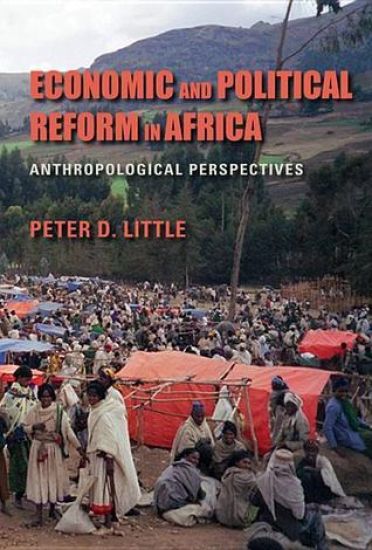
What are the local effects of major economic and political reforms in Africa? How have globalized pro-market and pro-democracy reforms impacted local economics and communities? Examining case studies from The Gambia, Ghana, Mozambique, Kenya, Ethiopia, and Somalia, Peter D. Little shows how rural farmers and others respond to complex agendas of governments, development agencies, and non-governmental organizations. The book explores the contradictions between what policy reforms were supposed to do and what actually happened in local communities. Little's bold vision of development challenges common narratives of African poverty, dependency, and environmental degradation and suggests that sustainable development in Africa can best be achieved by strengthening local livelihoods, markets, and institutions.
Economic and Political Reform in Africa

Economic and Political Reform in Africa

Peter D. Little

Indiana University Press
2013
sidottu
What are the local effects of major economic and political reforms in Africa? How have globalized pro-market and pro-democracy reforms impacted local economics and communities? Examining case studies from The Gambia, Ghana, Mozambique, Kenya, Ethiopia, and Somalia, Peter D. Little shows how rural farmers and others respond to complex agendas of governments, development agencies, and non-governmental organizations. The book explores the contradictions between what policy reforms were supposed to do and what actually happened in local communities. Little's bold vision of development challenges common narratives of African poverty, dependency, and environmental degradation and suggests that sustainable development in Africa can best be achieved by strengthening local livelihoods, markets, and institutions.
Risk and Social Change in an African Rural Economy

Risk and Social Change in an African Rural Economy

John G. McPeak; Peter D. Little; Cheryl R. Doss

Routledge
2011
sidottu
Pastoralists’ role in contemporary Africa typically goes underappreciated and misunderstood by development agencies, external observers, and policymakers. Yet, arid and semi-arid lands (ASAL), which are used predominantly for extensive livestock grazing, comprise nearly half of the continent’s land mass, while a substantial proportion of national economies are based on pastoralist activities. Pastoralists use these drylands to generate income for themselves through the use of livestock and for the coffers of national trade and revenue agencies. They are frequently among the continent’s most contested and lawless regions, providing sanctuary to armed rebel groups and exposing residents to widespread insecurity and destructive violence. The continent’s millions of pastoralists thus inhabit some of Africa’s harshest and most remote, but also most ecologically, economically, and politically important regions.This study summarizes the findings of a multi-year interdisciplinary research project in pastoral areas of Kenya and Ethiopia. The cultures and ecology of these areas are described, with a particular focus on the myriad risks that confront people living in these drylands, and how these risks are often triggered by highly variable rainfall conditions. The authors examine the markets used by residents of these areas to sell livestock and livestock products and purchase consumer goods before turning to an analysis of evolving livelihood strategies. Furthermore, they focus on how well-being is conditioned upon access to livestock and access to the cash economy, gender patterns within households and the history of development activities in the area. The book concludes with a report on how these activities are assessed by people in the area and what activities they prioritize for the future. Policy in pastoral areas is often formulated on the basis of assumptions and stereotypes, without adequate empirical foundations. This book provides evidence on livelihood strategies being followed in pastoral areas, and investigates patterns in decision making and well being. It indicates the importance of livestock to the livelihoods of people in these areas, and identifies the critical and widespread importance of access to the cash economy, concluding that future development activities need to be built on the foundation of the livestock economy, instead of seeking to replace it.
Somalia

Somalia

Peter D. Little

Indiana University Press
2003
sidottu
In the wake of the collapse of the Somali government in 1991, a "second" or "informal" economy based on trans-border trade and smuggling is thriving. While focusing primarily on pastoral and agricultural markets, Peter D. Little demonstrates that the Somalis are resilient and opportunistic and that they use their limited resources effectively. While it is true that many Somalis live in the shadow of brutal warlords and lack access to basic health care and education, Little focuses on those who have managed to carve out a productive means of making ends meet under difficult conditions and emphasizes the role of civic culture even when government no longer exists. Exploring questions such as, Does statelessness necessarily mean anarchy and disorder? Do money, international trade, and investment survive without a state? Do pastoralists care about development and social improvement? This book describes the complexity of the Somali situation in the light of international terrorism.
Somalia

Somalia

Peter D. Little

Indiana University Press
2003
pokkari
In the wake of the collapse of the Somali government in 1991, a "second" or "informal" economy based on trans-border trade and smuggling is thriving. While focusing primarily on pastoral and agricultural markets, Peter D. Little demonstrates that the Somalis are resilient and opportunistic and that they use their limited resources effectively. While it is true that many Somalis live in the shadow of brutal warlords and lack access to basic health care and education, Little focuses on those who have managed to carve out a productive means of making ends meet under difficult conditions and emphasizes the role of civic culture even when government no longer exists. Exploring questions such as, Does statelessness necessarily mean anarchy and disorder? Do money, international trade, and investment survive without a state? Do pastoralists care about development and social improvement? This book describes the complexity of the Somali situation in the light of international terrorism.
Somalia

Somalia

Peter D. Little

James Currey
2003
pokkari
Amaury Talbot Prize Winner Shows that Somalia is an extreme case of an economy without a government. Does statelessness necessarily mean anarchy and disorder? Clan elders, religious leaders and businessmen have worked together to provide stability and security in large parts of Somalia. Urban centres continue to suffer violence, political chaos and economic disruption. Do money, international trade and investment survive without a state? Somalia has been without a state, a Ministry of Finance, or a central bank, but the Somali Shilling wasmore stable during the second half of the 1990s than during the 1980s. Economic agreements with transnational firms and sovereign states go ahead. Do town-dwellers fare as well as pastoralists? With the collapse of the state, herders and traders have benefited from reduced restrictions on movement and there is a booming unofficial export and import trade. Settled populations have fared less well. Do pastoralists care about development and socialimprovement? Throughout the Horn western-funded development projects have had disastrous results. Nevertheless the Somalis have selectively accepted certain elements; phone and internet services are surprisingly cheap. Published in association with the International African Institute North America: Indiana U Press