Kirjojen hintavertailu. Mukana 12 522 172 kirjaa ja 12 kauppaa.

Kirjailija

Peter Dickens

Kirjat ja teokset yhdessä paikassa: 12 kirjaa, julkaisuja vuosilta 1992-2025, suosituimpien joukossa Housing, States and Localities. Vertaile teosten hintoja ja tarkista saatavuus suomalaisista kirjakaupoista.

12 kirjaa

Kirjojen julkaisuhaarukka 1992-2025.

Housing, States and Localities

Housing, States and Localities

Peter Dickens; Simon Duncan; Mark Goodwin; Fred Gray

TAYLOR FRANCIS LTD
2025
sidottu
A continual problem in modern societies is how housing of a good standard can be provided for all those who need it. Some countries, and some local areas within any one country, have clearly succeeded better than others. Originally published in 1985, Housing, States and Localities shows how and why success and failure in housing provision come about. It does this using comparative analysis of two countries – Britain and Sweden – and four localities within Britain – Sheffield, rural Norfolk, Crawley and Brighton. Variation in the levels and forms of housing provision are explained by variations in how housing is built, how state policies are formed, and how consumers react to their housing. But the nature of these social relations varies from place to place, and the book also relates differences in housing provision to the different characteristics of these states and localities.It is very much an argument of the book that success and failure in housing can only be understood in the context of wider social conflicts and social orders. The book also examines the strengths and weaknesses of comparative methodology and establishes a general strategy for urban and regional research – one that recognizes the similar structures and processes encountered in capitalist societies but at the same time can deal with the actual situations specific to particular places at particular times.
Capital and the Cosmos

Capital and the Cosmos

Peter Dickens

Springer International Publishing AG
2023
nidottu
This book offers a new understanding of society’s relations with the cosmos. Entrepreneurs such as Jeff Bezos and Elon Musk receive a great deal of publicity, but offer unlikely and implausible visions of space tourism for the general public. Meanwhile, asteroids are seen as ‘rare materials’ which will be extracted and used to produce untold riches for earthbound citizens. The reality is rather different. First, there is no evidence that owners of capital are attempting to extract ‘rare’ materials in the cosmos. The costs would be ‘out of this world’. But capital, not governments, is determining how outer space should be used. Capital’s investments in aerospace companies are actively determining forms of military interventions and the equipment used. And satellite television pumps out forms of culture aimed at a global audience. But these are being ignored and subverted by, for example, indigenous peoples. In short, this book setsout a new understanding of our relations with the cosmos. The forces of capital are certainly powerful but at the same time they are being challenged, subverted and even overturned.
Cosmic Society

Cosmic Society

Peter Dickens; James Ormrod

Routledge
2009
nidottu
An original vision and a pedagogical text on a major issue of our time and, even more, of our childen´s.Göran Therborn is University Professor of Sociology at Uppsala University, Sweden, and Professor and Chair of Sociology at the University of Cambridge, UK. Arguably the most important and certainly the most ambitious book of recent sociology.Bryan Turner, Editor of the Cambridge Dictionary of Sociology. Space weaponry, satellite surveillance and communications, and private space travel are all means in which outer space is being humanized: incorporated into society’s projects. But what are the political implications of society not only being globalized, but becoming ‘cosmic’? Our ideas about society have long affected, and been affected by, our understanding of the universe: large sections of our economy and society are now organized around humanity’s use of outer space. Our view of the universe, our increasingly ‘cosmic’ society, and even human consciousness are being transformed by new relations with the cosmos. As the first sociological book to tackle humanity’s relationship with the universe, this fascinating volume links social theory to classical and contemporary science, and proposes a new ‘cosmic’ social theory. Written in a punchy, student-friendly style, this timely book engages with a range of topical issues, including cyberspace, terrorism, tourism, surveillance and globalization.
Cosmic Society

Cosmic Society

Peter Dickens; James Ormrod

Routledge
2007
sidottu
An original vision and a pedagogical text on a major issue of our time and, even more, of our childen´s.Göran Therborn is University Professor of Sociology at Uppsala University, Sweden, and Professor and Chair of Sociology at the University of Cambridge, UK. Arguably the most important and certainly the most ambitious book of recent sociology.Bryan Turner, Editor of the Cambridge Dictionary of Sociology. Space weaponry, satellite surveillance and communications, and private space travel are all means in which outer space is being humanized: incorporated into society’s projects. But what are the political implications of society not only being globalized, but becoming ‘cosmic’? Our ideas about society have long affected, and been affected by, our understanding of the universe: large sections of our economy and society are now organized around humanity’s use of outer space. Our view of the universe, our increasingly ‘cosmic’ society, and even human consciousness are being transformed by new relations with the cosmos. As the first sociological book to tackle humanity’s relationship with the universe, this fascinating volume links social theory to classical and contemporary science, and proposes a new ‘cosmic’ social theory. Written in a punchy, student-friendly style, this timely book engages with a range of topical issues, including cyberspace, terrorism, tourism, surveillance and globalization.
Society and Nature

Society and Nature

Peter Dickens

Polity Press
2004
sidottu
Society and Nature is a lively and highly accessible introduction to the sociology of the environment. The book provides a comprehensive guide to contemporary issues and current debates – including society, nature and the enlightenment, industry and environmental transformation, commodification, consumption, the network society and human identity, human biology, citizenship and new social movements. Combining insights from contemporary sociology, politics, developmental biology and psychology, Peter Dickens suggests that environmental degradation is largely due to humanity’s narcissistic demand that the environment be made into a commodity to be consumed. Meanwhile, human biology is also being modified: people’s bodies are being rebuilt in ways that reflect their class positions. People and their surroundings have always adapted according to the demands of society. But modern capitalist society is changing the environment and its people in profound, potentially catastrophic, ways, shaping both human and non-human nature in its own image. The book contains a number of student features to interest and guide the reader as well as an attractive and clear layout. It will be particularly useful for students and teachers of sociology, human ecology, environmental studies and social theory. Dickens' insight won his work the American Sociological Association's Outstanding Publication Award 2006, in the Environment and Technology section.
Society and Nature

Society and Nature

Peter Dickens

Polity Press
2004
nidottu
A comprehensive guide to contemporary issues and current debates including society, nature and the enlightenment, industry and environmental transformation, commodification, consumption, the network society and human identity, human biology, citizenship and new social movements.
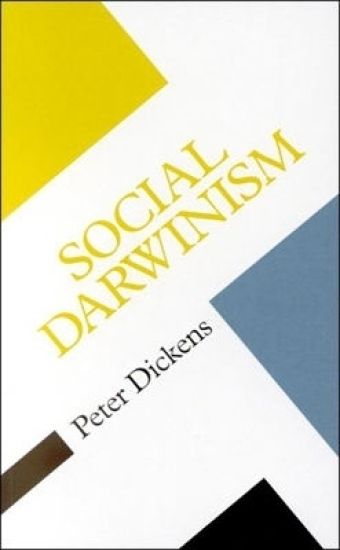
SOCIAL DARWINISM

SOCIAL DARWINISM

Peter Dickens

Open University Press
2000
nidottu
* What is the value of evolutionary thought to social theory - and vice-versa?* How has human nature evolved and is it realized or constrained by modern society?* Are there parallels between social evolution and evolution in the natural world?Social Darwinism is the extension of Darwin's evolutionary ideas to human society. Over the past two centuries it has been argued that the 'fittest' in terms of physical and mental prowess are most likely to survive and reproduce. It has also been suggested that the increasingly complex structure of human society mirrors the increasing complexity of nature. This highly original text examines whether these extensions from nature to society are justified, and considers how dangerous they may be in implying the systematic neglect - or even destruction - of the least 'fit'. It asks what, in any case, is 'fitness' as applied to human beings? It also questions whether human nature is constrained by modern society and whether people evolved as essentially competitive or collaborative. Written in a clear and accessible style, with text boxes to explain key ideas and little or no biological knowledge required of the reader, this book suggests a new way in which evolutionary thought and social theory can be combined. Dickens argues that the difficulties and prejudices associated with the field can be avoided by combining historical materialism with aspects of contemporary biology to create a 'Social Darwinism' for the twenty-first century.
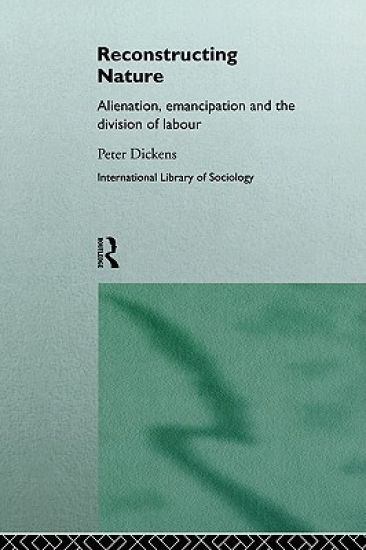
Reconstructing Nature

Reconstructing Nature

Peter Dickens

Routledge
1996
nidottu
One of the main features of the contemporary environmental crisis is that no one has a clear idea of what is going on. The author uses an extension of Marx's theory of alienation to explain why people find it so difficult to relate their different knowledges of the natural and social world. He argues that nevertheless it is possible to relate these to the abstractions of ecological discourse. Emancipation can come only through embracing science and rationality rather than rejecting them and, in the process, humanity as well as the non-human world will benefit.
Reconstructing Nature

Reconstructing Nature

Peter Dickens

Routledge
1996
sidottu
One of the main features of the contemporary environmental crisis is that no one has a clear idea of what is going on. The author uses an extension of Marx's theory of alienation to explain why people find it so difficult to relate their different knowledges of the natural and social world. He argues that nevertheless it is possible to relate these to the abstractions of ecological discourse. Emancipation can come only through embracing science and rationality rather than rejecting them and, in the process, humanity as well as the non-human world will benefit.
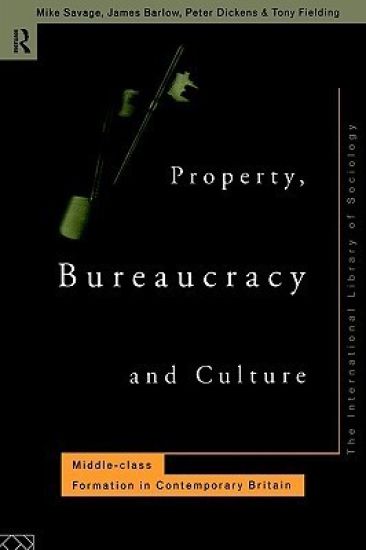
Property, Bureaucracy and Culture

Property, Bureaucracy and Culture

Michael Savage; James Barlow; Peter Dickens; Tom Fielding

Routledge
1995
nidottu
This assured and powerful study explores the condition of the middle classes in Britain today. The authors outline a new theoretical perspective for exploring the middle classes and provide the reader with up-to-date empirical information on the class structure.
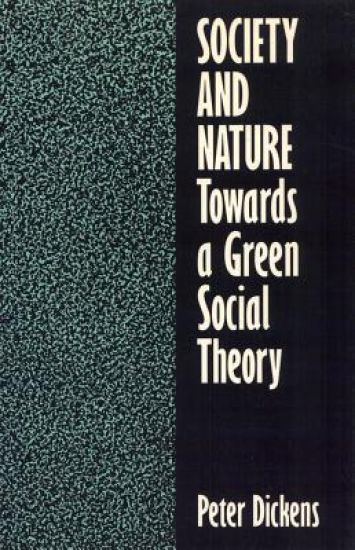
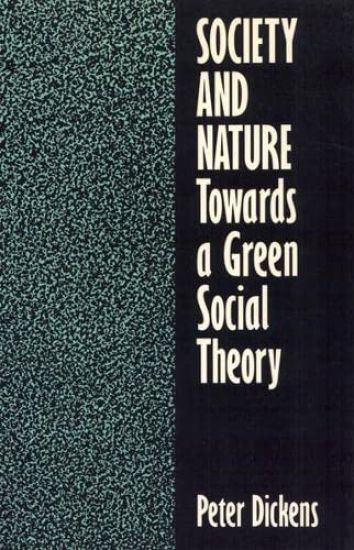
Society and Nature

Society and Nature

Peter Dickens

Temple University Press,U.S.
1992
nidottu
In this wide - ranging effort to theorize about the relationships between society and nature, Peter Dickens attempts to reconstruct social theory in a way that enables it to speak to contemporary environmental issues. After reviewing existing sociological traditions, he draws on the early work of Karl Marx to suggest that processes and relations in the workplace are the main source of people's separation from nature. In addition, people's understanding of "nature" tends to mirror their experience of the social world. Redefining the work of Anthony Giddens in an ecological direction, Dickens analyzes developments in biological thinking that seem consistent with this approach. He considers the role of culture, and he critiques the contemporary "deep green" and "deep ecology" movements. Focusing on the alienation of human begins from the natural world and the place of nature in their "deep mental structures," the author works in part from a Marxist perspective but draws a wide variety of social psychological, and biological theories into the discussion. Society and Nature not only addresses a central debate in contemporary social science regarding this interrelationship but also responds to the intellectual challenge presented by natural scientific concepts of environmental problems that oversimplify or ignore their political or social relational dimensions. Author note: Peter Dickens is Senior Lecturer in Urban Studies and Social Policy at the University of Sussex (UK) and the author of Urban Sociology: Society, Locality and Human Nature.