Kirjojen hintavertailu. Mukana 12 595 353 kirjaa ja 12 kauppaa.

Kirjailija

Peter Drahos

Kirjat ja teokset yhdessä paikassa: 13 kirjaa, julkaisuja vuosilta 1996-2021, suosituimpien joukossa A Philosophy of Intellectual Property. Vertaile teosten hintoja ja tarkista saatavuus suomalaisista kirjakaupoista.

13 kirjaa

Kirjojen julkaisuhaarukka 1996-2021.

Survival Governance

Survival Governance

Peter Drahos

Oxford University Press Inc
2021
sidottu
To deal with the climate crisis we need a new paradigm of technological and social development aimed at the restoration of ecological systems--the bio-digital energy paradigm--and China is the world power best positioned to lead this change. The climate and energy crisis requires a strong state to change the direction, speed, and scale of innovation in world capitalism. There are only a few possible contenders for catalyzing this governance of survival: China, the European Union, India, and the United States. While China is an improbable leader--and in fact the world's biggest emitter of greenhouse gasses--Peter Drahos explains in Survival Governance why this authoritarian state is actually more likely to implement systemic change swiftly and effectively than any other power. Drawing on more than 250 interviews, carried out in 17 countries--including the world's four largest carbon emitters--Drahos shows what China is doing to make its vast urban network sustainable and why all states must work toward a "bio-digital energy paradigm" based on a globalized, city-based network of innovation. As Drahos explains, America is incapable of reducing the power of its fossil fuel industry. For its part, the European Union's approach is too incremental and slowed by complex internal negotiations to address a crisis that demands a rapid response. India's capacity to be a global leader on energy innovation is questionable. To be sure, China faces hurdles too. Its coal-based industrial system is enormous, and the US, worried about losing technological superiority, is trying to slow China's development. Even so, China is currently urbanizing innovation on a historically unprecedented scale, building eco-cities, hydrogen cities, forest cities, and sponge cities (designed to cope with flooding). This has the potential to move cities into a new relationship with their surrounding ecosystems. China--given the size of its economy and the central government's ability to dictate thoroughgoing policy change--is, despite all of its flaws, presently our best hope for implementing the sort of policy overhaul that can begin to slow climate change.
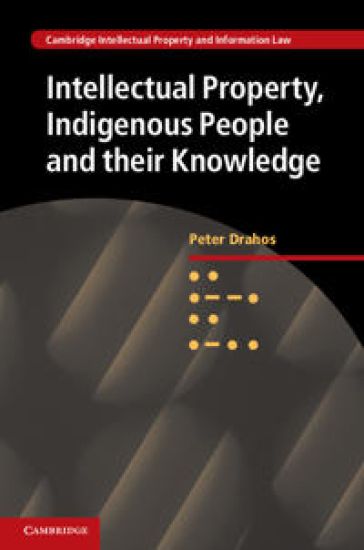
Intellectual Property, Indigenous People and their Knowledge
After colonization, indigenous people faced an extractive property rights regime for both their land and knowledge. This book outlines that regime, and how the symbolic function of international intellectual property continues today to assist states to enclose indigenous peoples' knowledge. Drawing on more than 200 interviews, Peter Drahos examines the response of indigenous people to the colonizer's non-developmental property rights. The case studies reveal how they have adapted to the state's extractive order through a process of regulatory bricolage. In order to create a new developmental future for themselves, indigenous developmental networks have been forged - high trust networks that include partnerships with science. Intellectual Property, Indigenous People and their Knowledge argues for a developmental intellectual property order for indigenous people based on a combination of simple rules, principles and a process of regulatory convening.
A Philosophy of Intellectual Property
Are intellectual property rights like other property rights? More and more of the world’s knowledge and information is under the control of intellectual property owners. What are the justifications for this? What are the implications for power and for justice of allowing this property form to range across social life? Can we look to traditional property theory to supply the answers or do we need a new approach? Intellectual property rights relate to abstract objects - objects like algorithms and DNA sequences. The consequences of creating property rights in such objects are far reaching. A Philosophy of Intellectual Property argues that lying at the heart of intellectual property are duty-bearing privileges. We should adopt an instrumentalist approach to intellectual property and reject a proprietarian approach - an approach which emphasizes the connection between labour and property rights. The analysis draws on the history of intellectual property, legal materials, the work of Grotius, Pufendorf, Locke, Marx and Hegel, as well as economic, sociological and legal theory. The book is designed to be accessible to specialists in a number of fields as well as students. It will interest philosophers, political scientists, economists, legal scholars as well as those professionals concerned with policy issues raised by modern technologies and the information society.
Intellectual Property, Indigenous People and their Knowledge
After colonization, indigenous people faced an extractive property rights regime for both their land and knowledge. This book outlines that regime, and how the symbolic function of international intellectual property continues today to assist states to enclose indigenous peoples' knowledge. Drawing on more than 200 interviews, Peter Drahos examines the response of indigenous people to the colonizer's non-developmental property rights. The case studies reveal how they have adapted to the state's extractive order through a process of regulatory bricolage. In order to create a new developmental future for themselves, indigenous developmental networks have been forged - high trust networks that include partnerships with science. Intellectual Property, Indigenous People and their Knowledge argues for a developmental intellectual property order for indigenous people based on a combination of simple rules, principles and a process of regulatory convening.
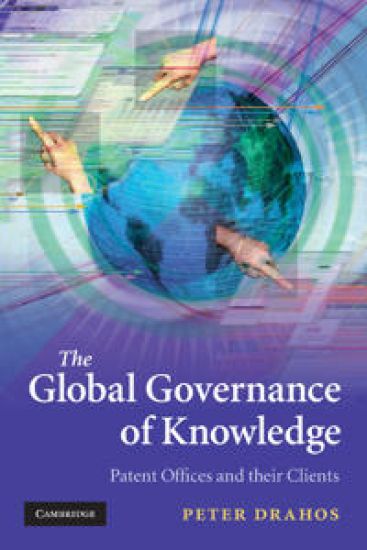
The Global Governance of Knowledge

The Global Governance of Knowledge

Peter Drahos

Cambridge University Press
2010
sidottu
Patent offices around the world have granted millions of patents to multinational companies. Patent offices are rarely studied and yet they are crucial agents in the global knowledge economy. Based on a study of forty-five rich and poor countries that takes in the world's largest and smallest offices, Peter Drahos argues that patent offices have become part of a globally integrated private governance network, which serves the interests of multinational companies, and that the Trilateral Offices of Europe, the USA and Japan make developing country patent offices part of the network through the strategic fostering of technocratic trust. By analysing the obligations of patent offices under the patent social contract and drawing on a theory of nodal governance, the author proposes innovative approaches to patent office administration that would allow developed and developing countries to recapture the public spirit of the patent social contract.
The Global Governance of Knowledge

The Global Governance of Knowledge

Peter Drahos

Cambridge University Press
2010
pokkari
Patent offices around the world have granted millions of patents to multinational companies. Patent offices are rarely studied and yet they are crucial agents in the global knowledge economy. Based on a study of forty-five rich and poor countries that takes in the world's largest and smallest offices, Peter Drahos argues that patent offices have become part of a globally integrated private governance network, which serves the interests of multinational companies, and that the Trilateral Offices of Europe, the USA and Japan make developing country patent offices part of the network through the strategic fostering of technocratic trust. By analysing the obligations of patent offices under the patent social contract and drawing on a theory of nodal governance, the author proposes innovative approaches to patent office administration that would allow developed and developing countries to recapture the public spirit of the patent social contract.
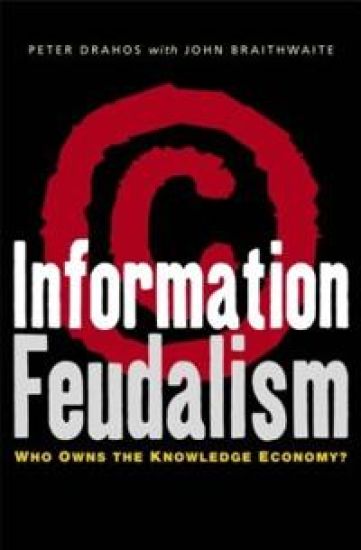
Information Feudalism: Who Owns the Knowledge Economy?
In a few short years, the battle over intellectual property rights has emerged from obscurity to become front-page news. The continent-hopping, three-year court battle fought by activists to bring cheap versions of desperately needed AIDS drugs to South Africa is but one example of how this seemingly arcane area of international regulation has become a crucial battleground in the twenty-first century and is animating activists the world over.This powerful book is the definitive history of how the new global intellectual property regime--the rulebook for the knowledge economy--came to be. Drawing on more than five years of research and more than five hundred interviews with key figures--including negotiators for First and Third World countries, leaders of multinational corporations, and public-interest experts, Information Feudalism uncovers the story of how a small coterie of multinational corporations wrote the charter for the global information order.Information Feudalism is an authoritative history of the demise of the world's intellectual commons, and a potent call for democratic property rights.
Information Feudalism

Information Feudalism

Peter Drahos; John Braithwaite

Earthscan Ltd
2002
sidottu
New intellectual property regimes are entrenching new inequalities. Access to information is fundamental to the exercise of human rights and marketplace competition, but patents are being used to lock up vital educational, software, genetic and other information, creating a global property order dominated by a multinational elite. How did intellectual property rules become part of the World Trade Organization's free trade agreements? How have these rules changed the knowledge game for international business? What are the consequences for the ownership of biotechnology and digital technology, and for all those who have to pay for what was once shared information? Based on extensive interviews with key players, this book tells the story of these profound transformations in information ownership. The authors argue that in the globalized information society, the rich have found new ways to rob the poor, and shows how intellectual property rights can be more democratically defined.
Information Feudalism

Information Feudalism

Peter Drahos; John Braithwaite

Earthscan Ltd
2002
nidottu
Based on extensive interviews with key players, this text shows how the "knowledge economy" is making serfs of everyone bar a few multinational companies. The authors argue that in the globalized information society, the rich have found new ways to rob the poor, using intellectual property rules.
Global Business Regulation

Global Business Regulation

John Braithwaite; Peter Drahos

Cambridge University Press
2000
sidottu
Across an amazing sweep of the critical areas of business regulation - from contract, intellectual property and corporations law, to trade, telecommunications, labour standards, drugs, food, transport and environment - this book confronts the question of how the regulation of business has shifted from national to global institutions. Based on interviews with 500 international leaders in business and government, this book examines the role played by global institutions such as the WTO, the OECD, IMF, Moody’s and the World Bank, as well as various NGOs and significant individuals. The authors argue that effective and decent global regulation depends on the determination of individuals to engage with powerful agendas and decision-making bodies that would otherwise be dominated by concentrated economic interests. This book will become a standard reference for readers in business, law, politics and international relations.
Global Business Regulation

Global Business Regulation

John Braithwaite; Peter Drahos

Cambridge University Press
2000
pokkari
Across an amazing sweep of the critical areas of business regulation - from contract, intellectual property and corporations law, to trade, telecommunications, labour standards, drugs, food, transport and environment - this book confronts the question of how the regulation of business has shifted from national to global institutions. Based on interviews with 500 international leaders in business and government, this book examines the role played by global institutions such as the WTO, the OECD, IMF, Moody’s and the World Bank, as well as various NGOs and significant individuals. The authors argue that effective and decent global regulation depends on the determination of individuals to engage with powerful agendas and decision-making bodies that would otherwise be dominated by concentrated economic interests. This book will become a standard reference for readers in business, law, politics and international relations.
A Philosophy of Intellectual Property

A Philosophy of Intellectual Property

Peter Drahos

Dartmouth Publishing Co Ltd
1996
sidottu
Are intellectual property rights like other property rights? More and more of the world’s knowledge and information is under the control of intellectual property owners. What are the justifications for this? What are the implications for power and for justice of allowing this property form to range across social life? Can we look to traditional property theory to supply the answers or do we need a new approach? Intellectual property rights relate to abstract objects - objects like algorithms and DNA sequences. The consequences of creating property rights in such objects are far reaching. A Philosophy of Intellectual Property argues that lying at the heart of intellectual property are duty-bearing privileges. We should adopt an instrumentalist approach to intellectual property and reject a proprietarian approach - an approach which emphasizes the connection between labour and property rights. The analysis draws on the history of intellectual property, legal materials, the work of Grotius, Pufendorf, Locke, Marx and Hegel, as well as economic, sociological and legal theory. The book is designed to be accessible to specialists in a number of fields as well as students. It will interest philosophers, political scientists, economists, legal scholars as well as those professionals concerned with policy issues raised by modern technologies and the information society.