Kirjojen hintavertailu. Mukana 12 595 353 kirjaa ja 12 kauppaa.

Kirjailija

Peter E. Davies

Kirjat ja teokset yhdessä paikassa: 44 kirjaa, julkaisuja vuosilta 2000-2026, suosituimpien joukossa Douglas D-558. Vertaile teosten hintoja ja tarkista saatavuus suomalaisista kirjakaupoista.

44 kirjaa

Kirjojen julkaisuhaarukka 2000-2026.

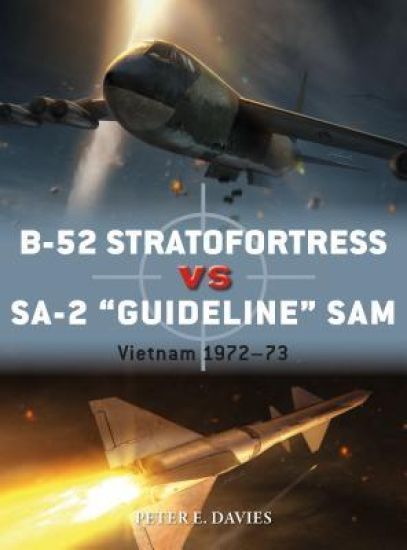
B-52 Stratofortress vs SA-2 "Guideline" SAM

B-52 Stratofortress vs SA-2 "Guideline" SAM

Peter E. Davies

Osprey Publishing
2018
nidottu
Ever since its introduction in the late 1950s, the B-52 Stratofortress has been the United States’ primary heavy bomber and a powerful symbol of its immense military might. Its powerful electronic countermeasures equipment (ECM) was thought to make the B-52 immune to ground-to-air missile attack, but in Vietnam, and later conflicts such as Operation Desert Storm in 1991, it came up against the Soviet-designed SA-2 SAM which used heavy salvoes of missiles to bring down the bombers.The losses of several of its most feared, powerful and supposedly invincible bombers per night to a torrent of Soviet missiles during the closing stages of the Vietnam War was sobering to Americans, but the B-52s’ crushing attacks virtually eliminated North Vietnam’s defences and forced a peace settlement. This fascinating book analyses the roles of the SA-2 operators and the B-52 Electronic Warfare Officers (EWOs) using specially commissioned artwork as well as first-hand accounts, and traces the cat-and-mouse tactics that each side employed.
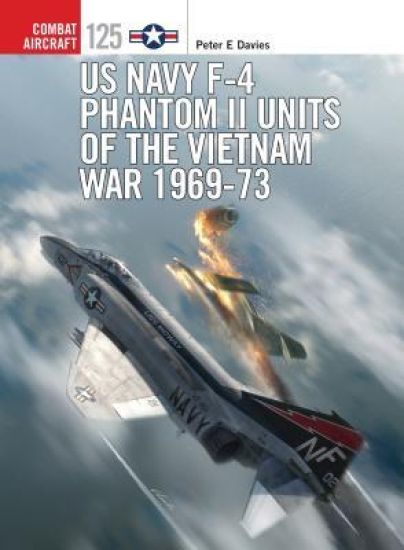
US Navy F-4 Phantom II Units of the Vietnam War 1969-73
A detailed study of one of the US's most famous post-war aircraft, the F-4 Phantom, which saw service in three branches of the US military during the Vietnam War.Although the F-4 Phantom II was the most important fighter-bomber to see action with all three American services during the Vietnam War, it was essentially a U.S. Navy design, and the carrier-borne squadron crews were its main operators in combat. The aircraft pioneered the use of long-range, radar-guided missiles in combat, although the majority of its Vietnam missions involved ground-attack with a variety of innovative ordnance. From 1968 to 1973 the Phantom II was the standard U.S. Navy fighter in Southeast Asia, having replaced several other types. Its performance and versatility enabled it to perform a variety of different missions, and switch roles as necessary, in the assault on some of the world’s most heavily defended territory.Including detailed colour profiles and first-person commentary from active participants in the F-4’s naval combat history, this is a detailed study of the U.S. armed services’ most famous post-war fighter.
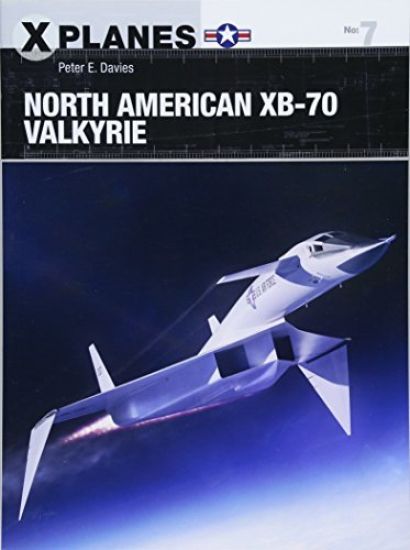
North American XB-70 Valkyrie

North American XB-70 Valkyrie

Peter E. Davies

Osprey Publishing
2018
nidottu
Of the many futuristic military aircraft concepts created in the 1950s the North American XB-70 still stands out as the most awe-inspiring. With its huge, white partially-folding delta wing, its fuselage resembling a striking cobra and its extraordinary performance, it was one of the foremost technological achievements of the 20th Century. A strategic bomber built to outrun any Soviet fighter jet, it could reach Mach 3 with a full nuclear payload - as fast as the legendary SR-71 Blackbird but more than three times the size. However, its role as a nuclear bomber was limited after the introduction of Intercontinental Ballistic Missiles, and defence cuts eventually led to the project being scrapped in the mid-1960s.The Valkyrie had a brief, costly decade of life but it proved the continuing value of developing manned bombers. However, almost half a century after the XB-70 its predecessor, the B-52, continues in service. Using full colour artwork and rigorous analysis, this is the complete story of the ultimate US Cold War military X-plane.
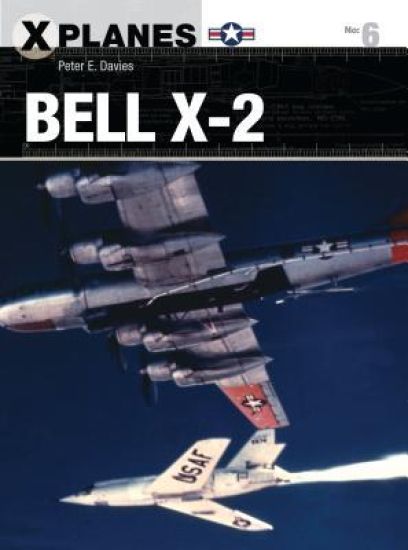
Bell X-2

Bell X-2

Peter E. Davies

Osprey Publishing
2017
nidottu
Packed with photos and spectacular new artwork, this book traces the supersonic career and lasting influence of the record-breaking Bell X-2 rocket plane. A must-have for aviation enthusiasts, especially those interested in the thrilling, hi-tech world of the early Jet Age.Even before the spectacular success of its X-1 rocket-powered aircraft in breaking the ‘sound barrier’, the adventurous Bell Aircraft Corporation was already pushing ahead with a parallel project to build a second aircraft capable of far higher speeds. The X-2 (or Model 52) explored the equally uncertain technology of swept-back wings. Now common in modern conventional fighter aircraft, the Bell X-2 was revolutionary in using this type of airframe to probe Mach 3 and research the effects of extreme aerodynamic friction heat on airframes. Although both X-2s were destroyed in crashes after only 20 flights, killing two test pilots, the knowledge gained from the programme was invaluable in developing aircraft that could safely fly at such speeds. Using stunning artwork and historical photographs, this is the story of the plane that ultimately made the Lockheed Blackbird and Concorde possible.
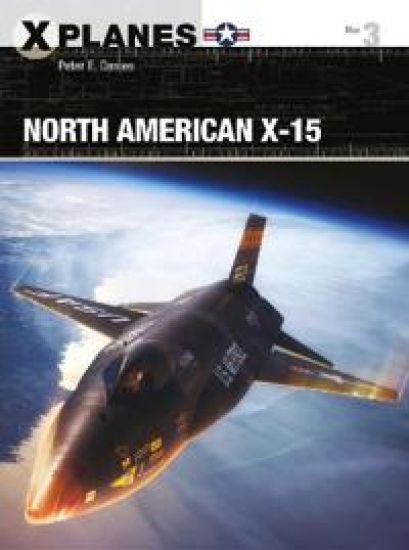
North American X-15

North American X-15

Peter E. Davies

Osprey Publishing
2017
nidottu
The revolutionary X-15 remains the fastest manned aircraft ever to fly. Built in the two decades following World War II, it was the most successful of the high-speed X-planes. The only recently broken ‘sound barrier’ was smashed completely by the X-15, which could hit Mach 6.7 and soar to altitudes above 350,000ft, beyond the edge of space. Several pilots qualified as astronauts by flying above 50 miles altitude in the X-15, including Neil Armstrong, the first man on the Moon. The three X-15s made 199 flights, testing new technologies and techniques which greatly eased America’s entry into manned space travel, and made the Apollo missions and Space Shuttle viable propositions. With historical photographs and stunning digital artwork, this is the story of arguably the greatest of the X-Planes.
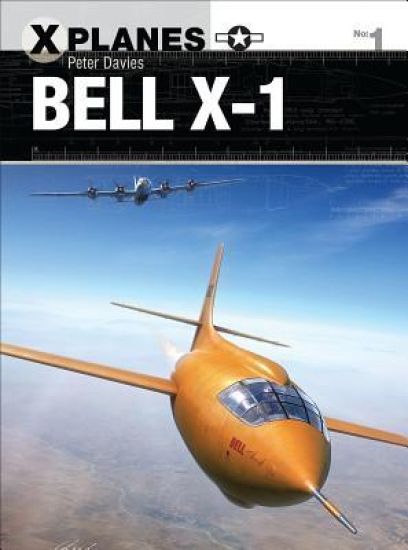
Bell X-1

Bell X-1

Peter E. Davies

Osprey Publishing
2016
nidottu
A detailed history of the pioneering Bell X-1, the first manned craft to break the sound barrier. Brought to life with dazzling digital art, this rocket-powered aircraft launches Osprey's new 'X-Planes' series and brings the reader into the dangerous and thrilling world of experimental aircraft.In 1947, no one knew if it was possible to break the 'sound barrier'. The Bell X-1 was the tiny, rocket-powered craft that finally broke it. It was the result of innovative designers and engineers turning their attention from the pioneering jets of World War II to a new task – an aircraft designed purely to fly faster than sound. Legendary pilots rallied to the cause, with World War II ace Chuck Yeager piloting the X-1 when it finally achieved supersonic flight in 1947, the first manned craft to reach such speeds.With historical photographs and meticulously researched digital art, Peter Davies traces the whole career of the pioneering Bell X-1, from its early development through to the influence it had on military and civilian jets in the second half of the 20th century.
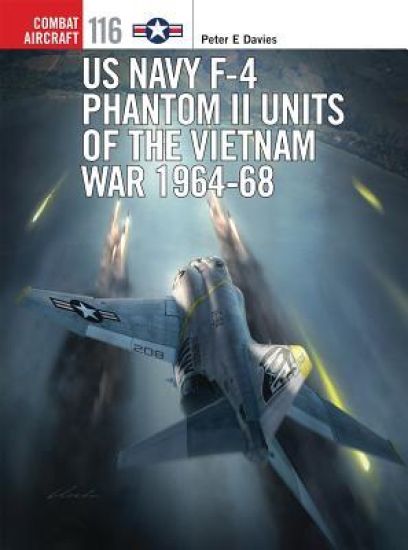
US Navy F-4 Phantom II Units of the Vietnam War 1964-68
The F-4 Phantom II is perhaps the most famous post-war fighter. Primarily used as a land-based fighter-bomber and reconnaissance platform, its naval origins and the immense contribution made to the US war effort in Vietnam by its original carrier-based versions began its legend.This title examines the unique aspects of the Phantom that made it so crucial to US Navy pilots during the Vietnam War – its massive engine power, long range, speed, the most powerful airborne search and fire-control radar installed in a fighter at the time, and of course its versatility as a ground attack and air-to-air platform. Packed with first hand accounts, unique profile artwork and rare photographs this is the history of one of the most important aircraft to be stationed on carriers off Southeast Asia during the war.
USN McDonnell Douglas F-4 Phantom II

USN McDonnell Douglas F-4 Phantom II

Peter E. Davies

Osprey Publishing
2016
nidottu
An in-depth technical study of the USN and export variants of the McDonnell–Douglas F-4 Phantom – sure to appeal to modelers, veterans, and aviation enthusiasts.Originally designed as a carrier-borne long-range interceptor armed with radar-guided missiles and tasked with defence against missile-launching bombers, the Phantom II went on to establish itself as one of the most important multi-role fighter, attack and reconnaissance aircraft of the 20th century.Arguably the United States' most important aircraft in the Vietnam War, where it played the role of workhorse as well as being a deadly MiG interceptor, the Phantom was also a mainstay of Atlantic Fleet operations intercepting Soviet bomber and reconnaissance aircraft and turning them away from the carrier groups at the height of the Cold War.This book reveals the design and development history of the naval Phantom, its variants and the exported designs adopted by other NATO countries. Packed with illustrations, photographs and first-hand accounts, it provides a technical history of one of the most famous aircraft ever built.
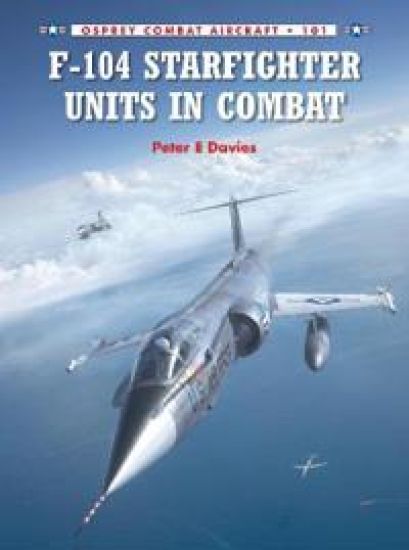
F-104 Starfighter Units in Combat

F-104 Starfighter Units in Combat

Peter E. Davies

Osprey Publishing
2014
nidottu
This richly-illustrated title covers the technical characteristics of the F-104 Starfighter, one of the most widely-used and popular aircraft in history.Although built in small numbers for the USAF, the F-104C fought and survived for almost three years in Vietnam. There, it was engaged in some of the war's most famous battles including the legendary operation Bolo, where seven North Vietnamese MiGs were destroyed without the loss of a single US fighter. This small, tough and very fast fighter, dubbed 'The Missile with a Man in It', was called upon to do things it was not specifically designed for, and did them admirably.Aside from its protracted use in Vietnam with the USAF, the F-104 also saw limited action with the Pakistani air force during the Indo-Pakistan wars in the 1960s and early 1970s, and with the Taiwanese air force in clashes with communist Chinese MiG-19s.Featuring illustrations and photographs detailing the variety of nose-paint schemes and weapons configurations, this comprehensive appraisal of the F-104 Starfighter is ideal for modelling and aviation enthusiasts alike.
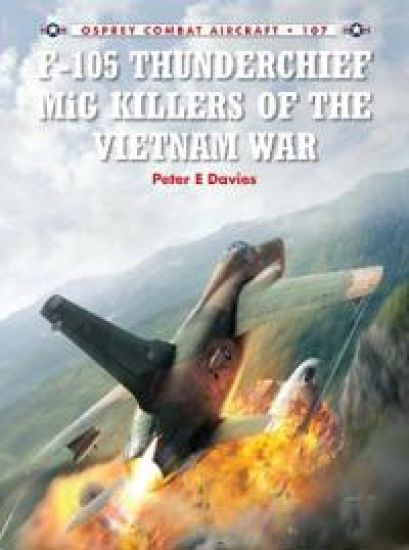
F-105 Thunderchief MiG Killers of the Vietnam War

F-105 Thunderchief MiG Killers of the Vietnam War

Peter E. Davies

Osprey Publishing
2014
nidottu
An illustrated history of the F-105’s success against MiGs, a relatively little-known aspect of the Vietnam War and a testament to the jet’s versatility and the skill of the pilots involved.Despite its ‘F-for-fighter’ designation, the F-105 was designed and purchased to give the USAF an aircraft capable of the delivery of nuclear weapons at very high speed, long range and below-the-radar altitudes. However, when the Vietnam War began it also emerged as USAF’s best available tactical bomber for a ‘limited conventional’ war as well. Extensively targeted by MiG-17s and MiG-21s the F-105 pilots developed innovative tactics that allowed them to compete in air-to-air duels with their smaller, more manoeuvrable enemies.Illustrated throughout with extensive photographs detailing weapon loads, internal features and action shots of actual engagements, this volume examines the conduct of the Rolling Thunder strike missions and the tactics used for attack and defence by the attack, escort fighter and radar monitoring elements within strike formations.
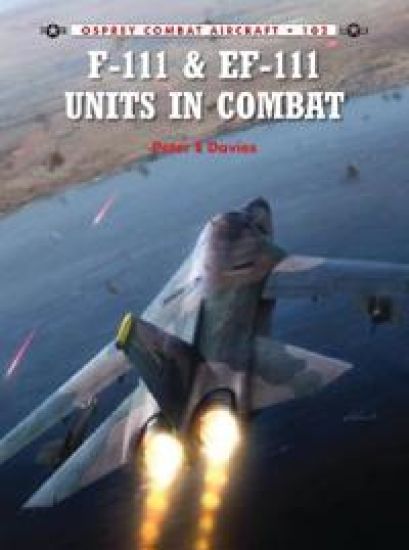
F-111 & EF-111 Units in Combat

F-111 & EF-111 Units in Combat

Peter E. Davies

Osprey Publishing
2014
nidottu
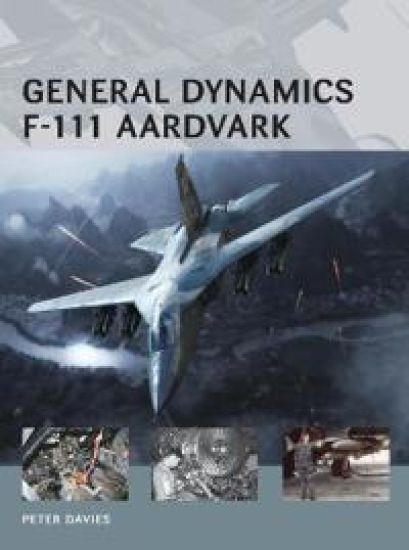
F-111s based in England flew the longest fighter combat mission in history against the Libyan capital Tripoli in 1986, and in 1991 the aircraft was one of the most important Coalition warplanes in the successful Desert Storm campaign.The General Dynamics F-111 was one of the most technically innovative designs among military aircraft, introducing the variable-sweep wing, terrain-following radar, military-rated afterburning turbofan engines and a self-contained escape module among other features. Designed as a cost-saving, multi-role interceptor, naval fighter and strike bomber, its evolution prioritised the latter role and it became the USAF’s most effective long-range strike aircraft during three decades of service.Rushed into combat in Vietnam before some of its structural issues were fully understood, the type suffered several early losses and gained an unfairly negative reputation that dogged it for the rest of its career, and restricted funding for more advanced versions of the design, Peter E Davis argues. However, in Operation Linebacker in 1972 the F-111 flew 4000 nocturnal under-the-radar missions, delivering, with unprecedented accuracy, many decisive blows that would have resulted in heavy losses for any other attack aircraft.Featuring illustrations throughout, this volume is ideal for fans of later twentieth-century combat aviation.
General Dynamics F-111 Aardvark

General Dynamics F-111 Aardvark

Peter E. Davies

Osprey Publishing
2013
nidottu
Despite its uncertain start the F-111 proved to be one of the most successful and influential designs of the 1960s.Its radical ‘swing wing’ was adopted by the F-14 Tomcat, Panavia Tornado and Rockwell B-1B Lancer while its turbofan-type engines became standard in many combat aircraft. F-111 crews pioneered tactics using terrain-following and laser targeting devices that made the F-15E Eagle’s missions possible. Its 4,000 low-altitude penetration missions during Operation Linebacker in Vietnam showed how individual aircraft can deliver crippling blows to enemy capability without loss to themselves.The first Osprey book on the subject, Peter Davies' volume charts the history of this aircraft type, in the wake of its retirement of the F-111 from Australian service.
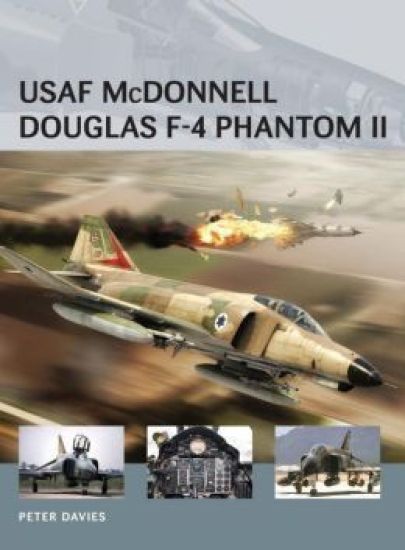
USAF McDonnell Douglas F-4 Phantom II

USAF McDonnell Douglas F-4 Phantom II

Peter E. Davies

Osprey Publishing
2013
nidottu
A definitive technical guide to the USAF and foreign variants of the McDonnell–Douglas F4 Phantom.In many respects the most successful, versatile and widely-used combat aircraft of the post-war era the F-4 Phantom II was quickly adopted by the USAF after its spectacular US Navy introduction. Its introduction to USAF squadrons happened just in time for the Vietnam conflict where USAF F-4Cs took over MiG-fighting duties from the F-100 Super Sabre. Although the F-4 was never intended as a dog-fighter to tangle with light, nimble, gun-armed MiGs it was responsible for destroying 109 MiGs in aerial combat. At the end of their careers many of the survivors from the 3,380 ‘land-based’ Phantoms were converted into target drones for training purposes. New aircraft were also built for West Germany, Iran and Israel.As Peter Davies outlines in this illustrated history, the USAF’s experience with the Phantom showed clearly that the air-to-air fighter was still a necessity. Its decision to fund its successor, the McDonnell-Douglas F-15 Eagle (as well as the F-16 Fighting Falcon and F-22A Raptor) was heavily influenced by the lessons of US and other Phantom pilots in combat.
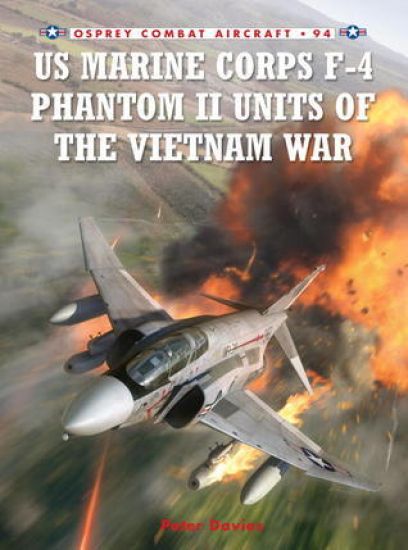
US Marine Corps F-4 Phantom II Units of the Vietnam War
Although designed as a carrier-borne interceptor, the F-4 Phantom II was a very successful ground-attack aircraft for the US Marines, paving the way for it use in this capacity by the USAF and many other air forces. It was closely involved in some of the toughest battles of the Vietnam War.Twenty-five US Marine Corps squadrons flew versions of the Phantom II and 11 of them used the aircraft in South-East Asia from May 1965 through to early 1973. Rather than the air-to-air missiles that were the main component in the original F-4 armament, these aircraft carried an ever-expanding range of weaponry. Some toted 24,500-lb bombs and others strafed with up to three 20 mm gun pods, while most flew daily sorties delivering napalm, Snakeye bombs and big Zuni rockets. Many US Marines holding small outpost positions in Laos and South Vietnam against heavy Viet Cong attack owed their lives to the Phantom II pilots who repeatedly drove off the enemy.Featuring stunning profile illustrations and photographs throughout, this book examines these missions in the context of US Marine Corps close-support doctrine, using the direct experience of a selection of the aircrew who flew and organised those missions.
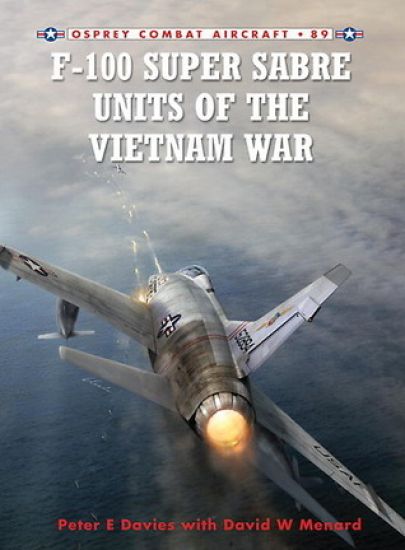
F-100 Super Sabre Units of the Vietnam War

F-100 Super Sabre Units of the Vietnam War

Peter E. Davies; David Menard

Osprey Publishing
2011
nidottu
Featuring first-hand accounts from the men flying it, and the men on the ground relying on it for protection, an illustrated history of the unique role played by this aircraft in the war in Vietnam, right up to its possible role in a tactical nuclear strike and as a mobile nuclear deterrent.The F-100 Super Sabre may have been superseded by the superior technology of the F-105 Thunderchief and the F-4 Phantom, but by the Vietnam War it remained in service. The Super Sabre was deployed as an air defence fighter, and was later given nuclear capability. The F-100's toughness, adaptability and reliability made it ideal for the incessant missions that were demanded by close support and counter-insurgency missions. 242 Super Sabres and 87 aircrew were lost during the war but their role, particularly in developing the tactics used for discovering and destroying SAM sites, was invaluable.This book describes some of the most important actions that the F-100 took part in, looks at the pilots who flew it and analyses the impact of the aircraft on the war.
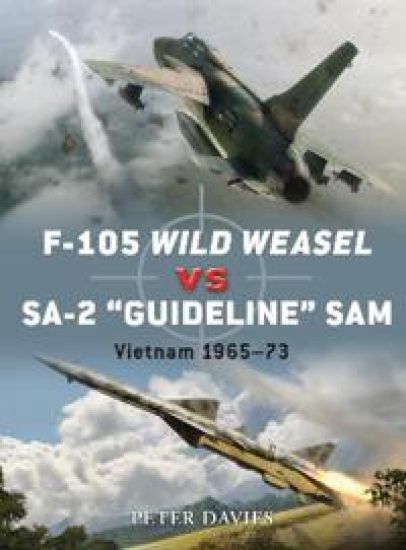
F-105 Wild Weasel vs SA-2 ‘Guideline’ SAM

F-105 Wild Weasel vs SA-2 ‘Guideline’ SAM

Peter E. Davies

Osprey Publishing
2011
nidottu
A detailed account of the suppression of North Vietnam's surface-to-air missile defences during the Vietnam War, initiating a totally new concept of air war.The Vietnam War was the first conflict that saw extensive use of surface-to-air anti-aircraft missiles, and thus became a training ground for the tactics of this new type of battle, as USAF pilots battled with supersonic Soviet ground-to-air missiles.Featuring illustrations throughout, this instalment in Osprey's Duel series presents this story in the context of two of the main opponents: America's top fighter-bomber and the NVA's best anti-aircraft missile.
F-105 Thunderchief Units of the Vietnam War

F-105 Thunderchief Units of the Vietnam War

Peter E. Davies

Osprey Publishing
2010
nidottu
Facing the most formidably concentrated air defences in history, pilots of the F-105D flew against North Vietnamese targets day after day during the 43 months of Operation Rolling Thunder. Despite its limited maneuverability and the lack of self-sealing fuel tanks, which made it susceptible to combat damage, the 'bombers' shot down 27 MiG fighters in 1966 - 67. This book illustrates the importance of the Thunderchief in the Rolling Thunder campaign, including the pioneering suppression of enemy air defences (SEAD) methods developed by the F-105 'Wild Weasel' crews. Discussing the aircraft's strengths and weaknesses and using first-hand narratives, Peter Davies captures the essence of flying the 'Thud' against heavy defences, and describes the development of wartime tactics and the heroic accomplishments of a selection of its aircrew.
USN F-4 Phantom II vs VPAF MiG-17/19

USN F-4 Phantom II vs VPAF MiG-17/19

Peter E. Davies

Osprey Publishing
2009
nidottu
The Vietnam War placed unexpected demands upon American military forces and equipment. The principal US naval fighter, the McDonnell F-4 Phantom, had originally been designed to defend the Fleet from air attack at long range. However, its tremendous power and bomb-carrying capacity made it an obvious candidate for the attack mission in Vietnam from 1965 onwards. Its opponent was the MiG-17, a direct descendant of the MiG-15, which had given USAF Sabre jets a hard fight in the Korean War. This book brings to life their dangerous duels and includes detailed cockpit views and other specially commissioned artwork to highlight the benefits and shortcomings of each plane type. It was in the skies over Vietnam that many of the techniques of air combat evolved as pilots learned how to use and to defeat supersonic fighters for the first time.
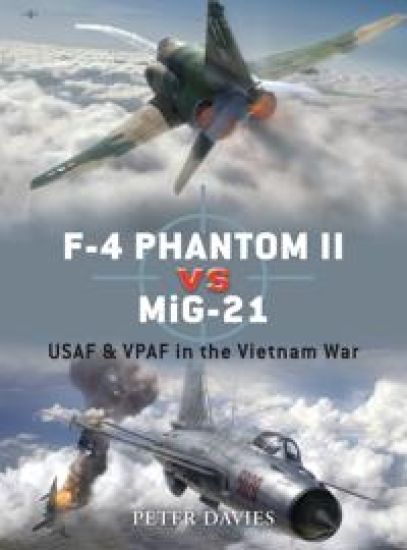
F-4 Phantom II vs MiG-21

F-4 Phantom II vs MiG-21

Peter E. Davies

Osprey Publishing
2008
nidottu
A gripping account of the mighty F-4 Phantom II, icon of the Cold War and ultimate American fighter of the 1960s, versus the nimble, agile and abundant MiG-21, which was a communist icon of the period. Influential leaders and tacticians are profiled to provide a comparative evaluation of their contrasting skills. This book also reveals the technical specifications of each jet with an analysis of the weaponry, avionics and survival devices of the F-4 Phantom II as flown by the USAF and the MiG-21. The fighters' strengths and weaknesses are also compared, including turn radius, performance at altitude, range and structural integrity.Featuring first-person extracts reflect on the dangers of these aerial duels, as USAF pilots and their counterparts struggled to overcome each plane's shortcomings, this book draws us into the dangerous world braved by American and North Vietnamese airmen in the skies over Vietnam.
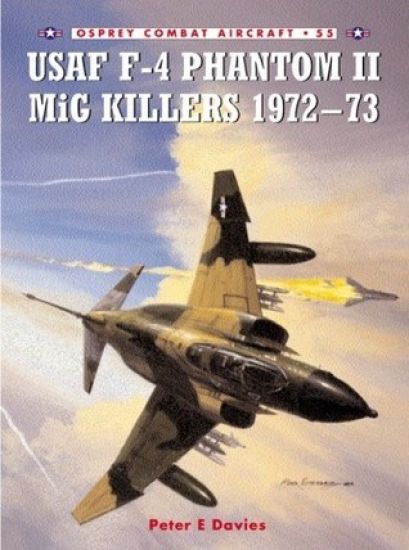
USAF F-4 Phantom II MiG Killers 1972–73

USAF F-4 Phantom II MiG Killers 1972–73

Peter E. Davies

Osprey Publishing
2005
nidottu
The F-4 Phantom II was the USAF workhorse fighter-bomber for the Linebacker campaign, which eventually saw US forces withdraw from Vietnam 'with honour' in 1973. This book covers the F-4 attacks on numerous targets in North Vietnamese cities such as Hanoi and Haiphong, as well as its engagements with Vietnamese MiG-19s and MiG-21s hell-bent on defending the north from 'Yankee air pirates'. The USAF's only ace crew, which scored their five kills during 1972, is also covered in a book containing many detailed photographs, a large proportion of which haven't been published before.