Kirjojen hintavertailu. Mukana 12 390 323 kirjaa ja 12 kauppaa.
Kirjailija
Peter E. Kloeden
Kirjat ja teokset yhdessä paikassa: 8 kirjaa, julkaisuja vuosilta 1992-2026, suosituimpien joukossa Attractors of Caputo Fractional Differential Equations. Vertaile teosten hintoja ja tarkista saatavuus suomalaisista kirjakaupoista.
This book provides a lively and accessible introduction to the numerical solution of stochastic differential equations with the aim of making this subject available to the widest possible readership. It presents an outline of the underlying convergence and stability theory while avoiding technical details. Key ideas are illustrated with numerous computational examples and computer code is listed at the end of each chapter. The authors include 150 exercises, with solutions available online, and 40 programming tasks.Although introductory, the book covers a range of modern research topics, including Itô versus Stratonovich calculus, implicit methods, stability theory, nonconvergence on nonlinear problems, multilevel Monte Carlo, approximation of double stochastic integrals, and tau leaping for chemical and biochemical reaction networks.An Introduction to the Numerical Simulation of Stochastic Differential Equations is appropriate for undergraduates and postgraduates in mathematics, engineering, physics, chemistry, finance, and related disciplines, as well as researchers in these areas. The material assumes only a competence in algebra and calculus at the level reached by a typical first-year undergraduate mathematics class, and prerequisites are kept to a minimum. Some familiarity with basic concepts from numerical analysis and probability is also desirable but not necessary.
This book is intended to make recent results on the derivation of higher order numerical schemes for random ordinary differential equations (RODEs) available to a broader readership, and to familiarize readers with RODEs themselves as well as the closely associated theory of random dynamical systems. In addition, it demonstrates how RODEs are being used in the biological sciences, where non-Gaussian and bounded noise are often more realistic than the Gaussian white noise in stochastic differential equations (SODEs). RODEs are used in many important applications and play a fundamental role in the theory of random dynamical systems. They can be analyzed pathwise with deterministic calculus, but require further treatment beyond that of classical ODE theory due to the lack of smoothness in their time variable. Although classical numerical schemes for ODEs can be used pathwise for RODEs, they rarely attain their traditional order since the solutions of RODEs do not have sufficient smoothness to have Taylor expansions in the usual sense. However, Taylor-like expansions can be derived for RODEs using an iterated application of the appropriate chain rule in integral form, and represent the starting point for the systematic derivation of consistent higher order numerical schemes for RODEs. The book is directed at a wide range of readers in applied and computational mathematics and related areas as well as readers who are interested in the applications of mathematical models involving random effects, in particular in the biological sciences.The level of this book is suitable for graduate students in applied mathematics and related areas, computational sciences and systems biology. A basic knowledge of ordinary differential equations and numerical analysis is required.
This book is intended to make recent results on the derivation of higher order numerical schemes for random ordinary differential equations (RODEs) available to a broader readership, and to familiarize readers with RODEs themselves as well as the closely associated theory of random dynamical systems. In addition, it demonstrates how RODEs are being used in the biological sciences, where non-Gaussian and bounded noise are often more realistic than the Gaussian white noise in stochastic differential equations (SODEs). RODEs are used in many important applications and play a fundamental role in the theory of random dynamical systems. They can be analyzed pathwise with deterministic calculus, but require further treatment beyond that of classical ODE theory due to the lack of smoothness in their time variable. Although classical numerical schemes for ODEs can be used pathwise for RODEs, they rarely attain their traditional order since the solutions of RODEs do not have sufficient smoothness to have Taylor expansions in the usual sense. However, Taylor-like expansions can be derived for RODEs using an iterated application of the appropriate chain rule in integral form, and represent the starting point for the systematic derivation of consistent higher order numerical schemes for RODEs. The book is directed at a wide range of readers in applied and computational mathematics and related areas as well as readers who are interested in the applications of mathematical models involving random effects, in particular in the biological sciences.The level of this book is suitable for graduate students in applied mathematics and related areas, computational sciences and systems biology. A basic knowledge of ordinary differential equations and numerical analysis is required.
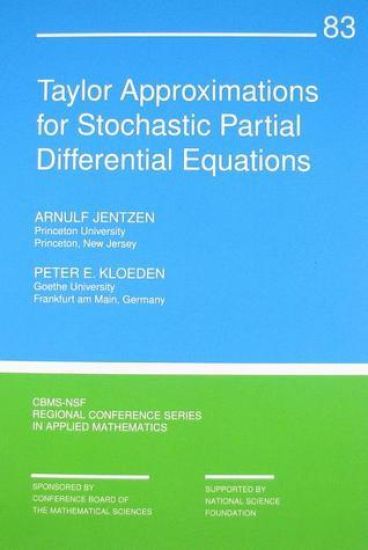
Presents a systematic theory of Taylor expansions of evolutionary-type stochastic partial differential equations (SPDEs). The authors show how Taylor expansions can be used to derive higher order numerical methods for SPDEs, with a focus on pathwise and strong convergence. In the case of multiplicative noise, the driving noise process is assumed to be a cylindrical Wiener process, while in the case of additive noise the SPDE is assumed to be driven by an arbitrary stochastic process with Holder continuous sample paths. Recent developments on numerical methods for random and stochastic ordinary differential equations are also included since these are relevant for solving spatially discretised SPDEs as well as of interest in their own right. The authors include the proof of an existence and uniqueness theorem under general assumptions on the coefficients as well as regularity estimates in an appendix.
The theory of nonautonomous dynamical systems in both of its formulations as processes and skew product flows is developed systematically in this book. The focus is on dissipative systems and nonautonomous attractors, in particular the recently introduced concept of pullback attractors. Linearization theory, invariant manifolds, Lyapunov functions, Morse decompositions and bifurcations for nonautonomous systems and set-valued generalizations are also considered as well as applications to numerical approximations, switching systems and synchronization. Parallels with corresponding theories of control and random dynamical systems are briefly sketched. With its clear and systematic exposition, many examples and exercises, as well as its interesting applications, this book can serve as a text at the beginning graduate level. It is also useful for those who wish to begin their own independent research in this rapidly developing area.
The aim of this book is to provide an accessible introduction to stochastic differ ential equations and their applications together with a systematic presentation of methods available for their numerical solution. During the past decade there has been an accelerating interest in the de velopment of numerical methods for stochastic differential equations (SDEs). This activity has been as strong in the engineering and physical sciences as it has in mathematics, resulting inevitably in some duplication of effort due to an unfamiliarity with the developments in other disciplines. Much of the reported work has been motivated by the need to solve particular types of problems, for which, even more so than in the deterministic context, specific methods are required. The treatment has often been heuristic and ad hoc in character. Nevertheless, there are underlying principles present in many of the papers, an understanding of which will enable one to develop or apply appropriate numerical schemes for particular problems or classes of problems.
The aim of this book is to provide an accessible introduction to stochastic differ ential equations and their applications together with a systematic presentation of methods available for their numerical solution. During the past decade there has been an accelerating interest in the de velopment of numerical methods for stochastic differential equations (SDEs). This activity has been as strong in the engineering and physical sciences as it has in mathematics, resulting inevitably in some duplication of effort due to an unfamiliarity with the developments in other disciplines. Much of the reported work has been motivated by the need to solve particular types of problems, for which, even more so than in the deterministic context, specific methods are required. The treatment has often been heuristic and ad hoc in character. Nevertheless, there are underlying principles present in many of the papers, an understanding of which will enable one to develop or apply appropriate numerical schemes for particular problems or classes of problems.