Kirjojen hintavertailu. Mukana 12 595 353 kirjaa ja 12 kauppaa.

Kirjailija

Peter Fitzpatrick

Kirjat ja teokset yhdessä paikassa: 13 kirjaa, julkaisuja vuosilta 1992-2020, suosituimpien joukossa Foucault's Law. Vertaile teosten hintoja ja tarkista saatavuus suomalaisista kirjakaupoista.

13 kirjaa

Kirjojen julkaisuhaarukka 1992-2020.

Foucault's Law

Foucault's Law

Ben Golder; Peter Fitzpatrick

Routledge Cavendish
2009
sidottu
Foucault’s Law is the first book in almost fifteen years to address the question of Foucault’s position on law. Many readings of Foucault’s conception of law start from the proposition that he failed to consider the role of law in modernity, or indeed that he deliberately marginalized it. In canvassing a wealth of primary and secondary sources, Ben Golder and Peter Fitzpatrick rebut this argument. They argue that rather than marginalize law, Foucault develops a much more radical, nuanced and coherent theory of law than his critics have acknowledged. For Golder and Fitzpatrick, Foucault’s law is not the contained creature of conventional accounts, but is uncontainable and illimitable. In their radical re-reading of Foucault, they show how Foucault outlines a concept of law which is not tied to any given form or subordinated to a particular source of power, but is critically oriented towards alterity, new possibilities and different ways of being.Foucault’s Law is an important and original contribution to the ongoing debate on Foucault and law, engaging not only with Foucault’s diverse writings on law and legal theory, but also with the extensive interpretive literature on the topic. It will thus be of interest to students and scholars working in the fields of law and social theory, legal theory and law and philosophy, as well as to students of Foucault’s work generally.
Foucault's Law

Foucault's Law

Ben Golder; Peter Fitzpatrick

Routledge Cavendish
2009
nidottu
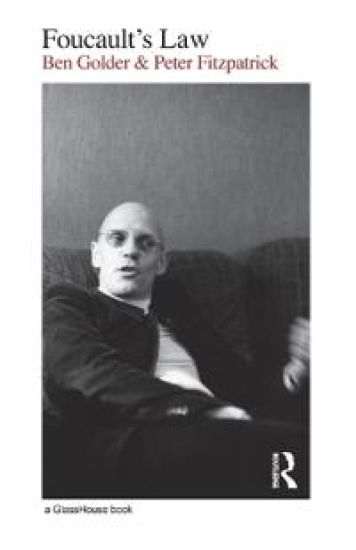
Foucault’s Law is the first book in almost fifteen years to address the question of Foucault’s position on law. Many readings of Foucault’s conception of law start from the proposition that he failed to consider the role of law in modernity, or indeed that he deliberately marginalized it. In canvassing a wealth of primary and secondary sources, Ben Golder and Peter Fitzpatrick rebut this argument. They argue that rather than marginalize law, Foucault develops a much more radical, nuanced and coherent theory of law than his critics have acknowledged. For Golder and Fitzpatrick, Foucault’s law is not the contained creature of conventional accounts, but is uncontainable and illimitable. In their radical re-reading of Foucault, they show how Foucault outlines a concept of law which is not tied to any given form or subordinated to a particular source of power, but is critically oriented towards alterity, new possibilities and different ways of being.Foucault’s Law is an important and original contribution to the ongoing debate on Foucault and law, engaging not only with Foucault’s diverse writings on law and legal theory, but also with the extensive interpretive literature on the topic. It will thus be of interest to students and scholars working in the fields of law and social theory, legal theory and law and philosophy, as well as to students of Foucault’s work generally.
Europe's Other

Europe's Other

Peter Fitzpatrick; James Henry Bergeron

Routledge
2020
nidottu
First published in 1998, this volume focuses critically on the European identity of the law of the European Union, of national law and the law of human rights. It is primarily concerned with the ways in which European identity is created through the rejection of a malign Other constituted in opposition to all that a virtuous Europe and its law, are supposed to be. The construction of this Other is explored in claims of the EU legal order to a unity and coherence transcending the nation-state; in the assertion of a European identity through laws effecting cultural, immigration and security policies; and in the claims to a lofty 'European-ness' made by national law and the European Convention on Human Rights. A major contribution to the understanding of European Law in the terms of the debates over modernity and postmodernity, this book will interest those involved with studies of the European Union and its law, with critical legal studies and also with socio-legal studies.
Europe's Other

Europe's Other

Peter Fitzpatrick; James Henry Bergeron

Routledge
2019
sidottu
First published in 1998, this volume focuses critically on the European identity of the law of the European Union, of national law and the law of human rights. It is primarily concerned with the ways in which European identity is created through the rejection of a malign Other constituted in opposition to all that a virtuous Europe and its law, are supposed to be. The construction of this Other is explored in claims of the EU legal order to a unity and coherence transcending the nation-state; in the assertion of a European identity through laws effecting cultural, immigration and security policies; and in the claims to a lofty 'European-ness' made by national law and the European Convention on Human Rights. A major contribution to the understanding of European Law in the terms of the debates over modernity and postmodernity, this book will interest those involved with studies of the European Union and its law, with critical legal studies and also with socio-legal studies.
The Mythology of Modern Law

The Mythology of Modern Law

Peter Fitzpatrick

Routledge
2016
sidottu
The Mythology of Modern Law is a radical reappraisal of the role of myth in modern society. Peter Fitzpatrick uses the example of law, as an integral category of modern social thought, to challenge the claims of modernity which deny the relevance of myth to modern society.
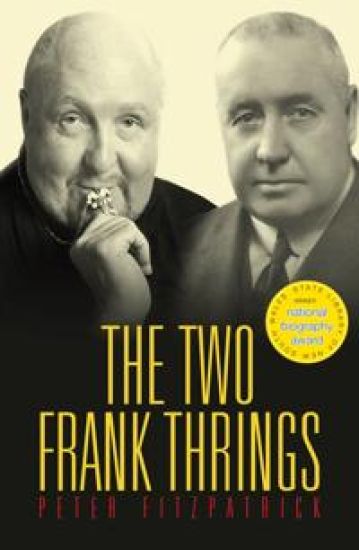
Two Frank Thrings

Two Frank Thrings

Peter Fitzpatrick

Monash University Publishing
2015
nidottu
**WINNER of the National Biography Award 2013 (Australia)** They shared a name and their physical resemblance was startling. And, both Frank Thrings were huge figures in the landscape of 20th-century Australian theatre and film. But, in many ways, they could hardly have been more different. Frank Thring the father (1882-1936) began his career as a sideshow conjuror, and he wheeled, dealed, and occasionally married his way into becoming the legendary "F.T." - an impresario, speculator, and owner of Efftee Films, Australia's first 'talkies' studio. He built for himself an image of grand patriarchal respectability, a sizeable fortune, and all the makings of a dynasty. Frank Thring the son (1926-1994) squandered the fortune and derailed the dynasty in the course of creating his own persona - a unique presence that could make most stages and foyers seem small. He won fame playing tyrants in togas in Hollywood blockbusters (perhaps his most famous role was that of Pontius Pilate in Ben-Hur 1959]), then, suddenly, he came home to Melbourne to play perhaps his finest role - that of Frank Thring, actor and personality extraordinaire. Central to this role was that Frank the son was unapologetically and outrageously gay. In this compelling dual biography, author Peter Fitzpatrick tells the story of two remarkable characters. It's a kind of detective story, following the lives of two men who did all they could to cover their tracks, and to conceal 'the self: ' Frank the father used secrecy and sleight-of-hand as strategies for self-protection; Frank the son masked a thoroughly reclusive personality with flamboyant self-parody. It's also the tale of a lost relationship - and of the power a father may have had, even over a son who hardly knew him. *** In Fitzpatrick's expert hands, their stories count among the saddest as well as the most scintillating in our annals. -- Ian Britain, Australian Book Review *** In exploring what made each man tick, and so adroitly placing them in their personal and professional contexts, Fitzpatrick gives a vivid sense of the shifting contours of Australian cultural life across most of a century. -- Brian McFarlane, The Age *** I]nformed and immensely readable...Their detailed and engrossing double biographies are a welcome contribution both to regional history and to international studies of twentieth-century entertainment careers. -- Theatre Research International *** Few books gave me more pleasure this year than Peter Fitzpatrick's The Two Frank Thrings, not because of any particular veneration for either Frank, but because it is a superbly executed biographical account of them. It is elegantly written, spiked with wit and insight, immaculately researched, and structured with a style and originality that enable the reader to get inside the lives of these two disparate Thrings. -- Brian McFarlane, 'Best Books of 2013', Australian Book Review *** Librarians: ebook available on ProQuest and EBSCO (Series: Biography) Subject: Biography, Theatre Studies, Film Studies, Australian Studies
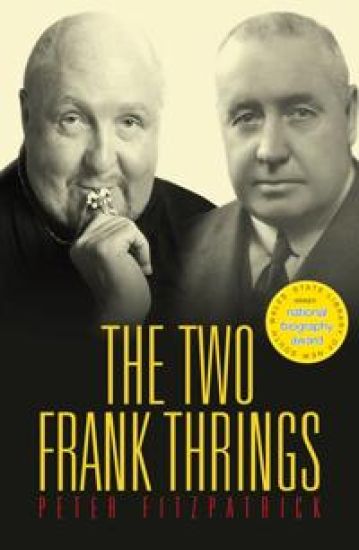
Two Frank Thrings

Two Frank Thrings

Peter Fitzpatrick

Monash University Publishing
2012
sidottu
They shared a name and their physical resemblance was startling. And, both Frank Thrings were huge figures in the landscape of 20th-century Australian theatre and film. But, in many ways, they could hardly have been more different. Frank Thring the father (1882-1936) began his career as a sideshow conjuror, and he wheeled, dealed, and occasionally married his way into becoming the legendary "F.T." - an impresario, speculator, and owner of Efftee Films, Australia's first 'talkies' studio. He built for himself an image of grand patriarchal respectability, a sizeable fortune, and all the makings of a dynasty. Frank Thring the son (1926-1994) squandered the fortune and derailed the dynasty in the course of creating his own persona - a unique presence that could make most stages and foyers seem small. He won fame playing tyrants in togas in Hollywood blockbusters (perhaps his most famous role was that of Pontius Pilate in Ben-Hur 1959]), then, suddenly, he came home to Melbourne to play perhaps his finest role - that of Frank Thring, actor and personality extraordinaire. Central to this role was that Frank the son was unapologetically and outrageously gay. In this compelling dual biography, author Peter Fitzpatrick tells the story of two remarkable characters. It's a kind of detective story, following the lives of two men who did all they could to cover their tracks, and to conceal 'the self: ' Frank the father used secrecy and sleight-of-hand as strategies for self-protection; Frank the son masked a thoroughly reclusive personality with flamboyant self-parody. It's also the tale of a lost relationship - and of the power a father may have had, even over a son who hardly knew him. "This is a superbly constructed biography, finding a shape in the lives it explores after impeccable research." The Sydney Morning Herald, October 27, 2012 In August 2013, this book won the National Biography Award, Australia's pre-eminent prize for biographical writing and memoir
Law as Resistance

Law as Resistance

Peter Fitzpatrick

Ashgate Publishing Limited
2008
sidottu
The scandal of this collection lies not just in its equating law and resistance but also in its consequent revision of those critical, realist, social, and even positivist theories that would constitute law in its dependence on sovereign or society, on some surpassing power, or on the state of the judge's digestion. There is as well a further provocation offered by the collection in that the most marginalized of resistances through law are found to be the most destabilizing of standard paradigms of legal authority. Instances of such seeming marginality explored here include the resistances of colonized and indigenous peoples and resistance pursued through international law. What this 'marginal' focus also reveals is the constituent connection between modernism, imperialism and that legalism produced by the ready reduction of law in terms of sovereign, society and such. In all, the collection makes a radical contribution to social, political and postcolonial theories of law.
Modernism and the Grounds of Law

Modernism and the Grounds of Law

Peter Fitzpatrick

Cambridge University Press
2001
pokkari
Existing approaches to the relation of law and society have for a long time seen law as either autonomous or grounded in society. Drawing on untapped resources in social theory, Fitzpatrick finds law pivotally placed in and beyond modernity. Being itself of the modern, law takes impetus and identity from modern society and, through incorporating 'pre-modern' elements of savagery and the sacred, it comes to constitute that very society. When placing law in such a crucial position for modernity, Fitzpatrick ranges widely from the colonizations of the Americas, through the thought of the European Enlightenment, and engages finally with contemporary arrogations of the 'global'. By extending his previous work on the origins of modernity, this book makes a significant contribution to continuing developments in law and society, legal philosophy, and jurisprudence.
Modernism and the Grounds of Law

Modernism and the Grounds of Law

Peter Fitzpatrick

Cambridge University Press
2001
sidottu
Existing approaches to the relation of law and society have for a long time seen law as either autonomous or grounded in society. Drawing on untapped resources in social theory, Fitzpatrick finds law pivotally placed in and beyond modernity. Being itself of the modern, law takes impetus and identity from modern society and, through incorporating 'pre-modern' elements of savagery and the sacred, it comes to constitute that very society. When placing law in such a crucial position for modernity, Fitzpatrick ranges widely from the colonizations of the Americas, through the thought of the European Enlightenment, and engages finally with contemporary arrogations of the 'global'. By extending his previous work on the origins of modernity, this book makes a significant contribution to continuing developments in law and society, legal philosophy, and jurisprudence.
Pioneer Players

Pioneer Players

Peter Fitzpatrick

Cambridge University Press
1995
sidottu
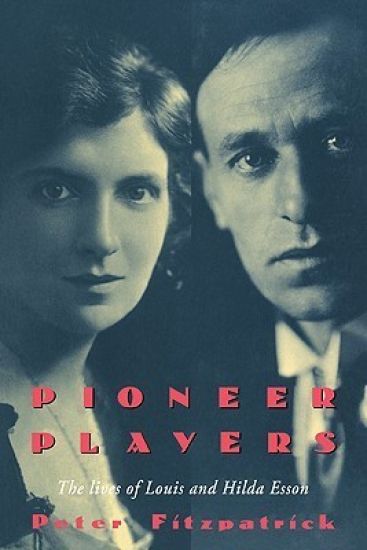
This is a dual biography, the story of Louis Esson, the distinguished playwright who has been called ‘the father of Australian drama’, and his wife Hilda, who did her own pioneering in the theatre and in public health. The plays they wrote and performed reflected the drama of their lives: creative angst, intellectual conflict, untimely death, romantic entanglement, jealousy and despair. Yet Peter Fitzpatrick's book is more than a good read. As a critical appraisal of Louis Esson's plays and an exploration of the relationships the Essons had with well known literary and theatrical figures in Australia and overseas, the book is an exploration of a developing Australian culture and identity. It is also about the dynamics of a marriage between two brilliant people, reflecting not only the patterns of gender relationships in their own time, but universal passions and strategies.
Pioneer Players

Pioneer Players

Peter Fitzpatrick

Cambridge University Press
1995
pokkari
This is a dual biography, the story of Louis Esson, the distinguished playwright who has been called 'the father of Australian drama', and his wife Hilda, who did her own pioneering in the theatre and in public health. The plays they wrote and performed reflected the drama of their lives: creative angst, intellectual conflict, untimely death, romantic entanglement, jealousy and despair. Yet Peter Fitzpatrick's book is more than a good read. As a critical appraisal of Louis Esson's plays and an exploration of the relationships the Essons had with well-known literary and theatrical figures in Australia and overseas, the book is an exploration of a developing Australian culture and identity. It is also about the dynamics of a marriage between two brilliant people, reflecting not only the patterns of gender relationships in their own time, but universal passions and strategies.
The Mythology of Modern Law

The Mythology of Modern Law

Peter Fitzpatrick

Routledge
1992
nidottu
The Mythology of Modern Law is a radical reappraisal of the role of myth in modern society. Peter Fitzpatrick uses the example of law, as an integral category of modern social thought, to challenge the claims of modernity which deny the relevance of myth to modern society.