Kirjojen hintavertailu. Mukana 12 595 353 kirjaa ja 12 kauppaa.

Kirjailija

Peter Flaschel

Kirjat ja teokset yhdessä paikassa: 34 kirjaa, julkaisuja vuosilta 1993-2021, suosituimpien joukossa Macrodynamics. Vertaile teosten hintoja ja tarkista saatavuus suomalaisista kirjakaupoista.

34 kirjaa

Kirjojen julkaisuhaarukka 1993-2021.

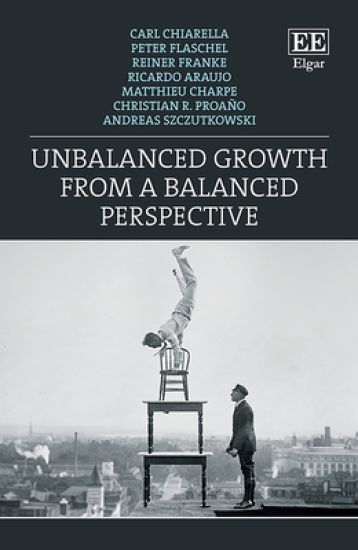
Unbalanced Growth from a Balanced Perspective

Unbalanced Growth from a Balanced Perspective

Carl Chiarella; Peter Flaschel; Reiner Franke; Ricardo Araujo; Matthieu Charpe; Christian R. Proaño; Andreas Szczutkowski

Edward Elgar Publishing Ltd
2021
sidottu
Synthesising Marx’s, Keynes’s and Schumpeter’s theories on wage-price dynamics, effective demand, real innovations and financial markets into a coherent whole, this book goes significantly beyond a consideration of their work in isolation. It focuses on exploring and analysing Goodwin’s integrated Marx-Keynes-Schumpeter system (MKS), approaching this from a historical perspective.Chapters start from Harrod’s and Kaldor’s work, reconsidering prominent demand- and supply-side approaches to Keynesian macro-dynamics, supplemented by Goodwin’s distributive cycle. The book presents a baseline MKS-type model, considering the rigorous treatment of uncertainty, opinion dynamics, the movement from flexicurity to social capitalism and democracy, and a high-order MKS macro-model.The exploration of the MKS model from a historical basis will make this a useful book for macroeconomics and history of economics scholars and students. It will also be helpful for those looking at macrodynamics in more depth.
Reconstructing Keynesian Macroeconomics Volume 3

Reconstructing Keynesian Macroeconomics Volume 3

Carl Chiarella; Peter Flaschel; Willi Semmler

Routledge
2020
nidottu
This book represents the third of three volumes offering a complete reinterpretation and restructuring of Keynesian macroeconomics and a detailed investigation of the disequilibrium adjustment processes characterizing the financial, the goods and the labour markets and their interaction.This book offers a full treatment of the interlinkages between the real and the financial markets, including an analysis of banking, credit, and endogenous money and asset markets. It remains critical of quite frequently used conventional macro models that have dropped the tradition of studying the macroeconomic feedback channels, well-known in the history of macroeconomics. Those feedback mechanisms are known to have the potential for instabilities with respect to real markets, price dynamics and financial markets. In this volume a particular emphasis is given to the financial-real interaction. The research in this book with its focus on Keynesian propagation mechanisms provides a unique alternative to the black-box shock-absorber approaches that dominate modern macroeconomics. The main conclusion of the work is that policy makers need to reconsider Keynesian ideas, but in the modern form in which they are expressed in this volume. Reconstructing Keynesian Macroeconomics will be of interest to students and researchers who want to look at alternatives to the mainstream macrodynamics that emerged from the Monetarist critique of Keynesianism. This book will also engage central bankers and macroeconomic policy makers.
Value, Competition and Exploitation

Value, Competition and Exploitation

Jonathan F. Cogliano; Peter Flaschel; Reiner Franke; Nils Fröhlich; Roberto Veneziani

Edward Elgar Publishing Ltd
2018
sidottu
The 2008 financial crisis presented the opportunity to overturn and rethink much of the stale or misguided parts of economic theory and, in so doing, build a rich and empirically meaningful social science. This never happened. By reconsidering the classical-Marxian tradition using modern tools of economic analysis, this book offers an alternative to the mainstream understanding of notions of value, price, and competition, concepts which serve as the foundation for a theoretically and empirically robust economic theory. Providing a unique synthesis of modern input-output analysis and classical political economics, this book combines current economic theory with historical economic thought. In this way, Value, Competition and Exploitation offers a deeper and more nuanced understanding of today's economic problems than can be gained through mainstream approaches. With a rigorous and empirically informed approach to classical theories of value and price, this book demonstrates that Marx's labor theory of value remains a valuable tool in understanding the structure and dynamics of capitalist economies. Written in an accessible style and presented with a clear structure, this book will be invaluable to economics students of all levels. The topics analyzed will also be of interest to scholars of classical and Marxian economics, as well as scholars of economics more widely.
Financial Assets, Debt and Liquidity Crises

Financial Assets, Debt and Liquidity Crises

Matthieu Charpe; Carl Chiarella; Peter Flaschel; Willi Semmler

Cambridge University Press
2015
pokkari
The macroeconomic development of most major industrial economies is characterised by boom-bust cycles. Normally such boom-bust cycles are driven by specific sectors of the economy. In the financial meltdown of the years 2007–9 it was the credit sector and the real-estate sector that were the main driving forces. This book takes on the challenge of interpreting and modelling this meltdown. In doing so it revives the traditional Keynesian approach to the financial-real economy interaction and the business cycle, extending it in several important ways. In particular, it adopts the Keynesian view of a hierarchy of markets and introduces a detailed financial sector into the traditional Keynesian framework. The approach of the book goes beyond the currently dominant paradigm based on the representative agent, market clearing and rational economic agents. Instead it proposes an economy populated with heterogeneous, rationally bounded agents attempting to cope with disequilibria in various markets.
Reconstructing Keynesian Macroeconomics Volume 2

Reconstructing Keynesian Macroeconomics Volume 2

Carl Chiarella; Peter Flaschel; Willi Semmler

Routledge
2015
nidottu
This book represents the second of three volumes offering a complete reinterpretation and restructuring of Keynesian macroeconomics and a detailed investigation of the disequilibrium adjustment processes characterizing the financial, the goods and the labour markets and their interaction.In this second volume the authors present a detailed analysis and comparison of two competing types of approaches to Keynesian macroeconomics, one that integrates goods, labour and financial markets, and another from the perspective of a conventional type of LM-analysis or interest-rate policy of the central bank. The authors employ rigorous dynamic macro-models of a descriptive and applicable nature, which will be of interest to all macroeconomists who use formal model-building in their investigations.The research in this book with its focus on Keynesian propagation mechanisms provides a unique alternative to the black-box shock-absorber approaches that dominate modern macroeconomics. The main conclusion of the work is that policy makers need to reconsider Keynesian ideas, but in the modern form in which they are expressed in this volume.Reconstructing Keynesian Macroeconomics will be of interest to students and researchers who want to look at alternatives to the mainstream macrodynamics that emerged from the Monetarist critique of Keynesianism. This book will also engage central bankers and macroeconomic policy makers.
Reconstructing Keynesian Macroeconomics Volume 3

Reconstructing Keynesian Macroeconomics Volume 3

Carl Chiarella; Peter Flaschel; Willi Semmler

Routledge
2014
sidottu
This book represents the third of three volumes offering a complete reinterpretation and restructuring of Keynesian macroeconomics and a detailed investigation of the disequilibrium adjustment processes characterizing the financial, the goods and the labour markets and their interaction.This book offers a full treatment of the interlinkages between the real and the financial markets, including an analysis of banking, credit, and endogenous money and asset markets. It remains critical of quite frequently used conventional macro models that have dropped the tradition of studying the macroeconomic feedback channels, well-known in the history of macroeconomics. Those feedback mechanisms are known to have the potential for instabilities with respect to real markets, price dynamics and financial markets. In this volume a particular emphasis is given to the financial-real interaction. The research in this book with its focus on Keynesian propagation mechanisms provides a unique alternative to the black-box shock-absorber approaches that dominate modern macroeconomics. The main conclusion of the work is that policy makers need to reconsider Keynesian ideas, but in the modern form in which they are expressed in this volume. Reconstructing Keynesian Macroeconomics will be of interest to students and researchers who want to look at alternatives to the mainstream macrodynamics that emerged from the Monetarist critique of Keynesianism. This book will also engage central bankers and macroeconomic policy makers.
Topics in Classical Micro- and Macroeconomics

Topics in Classical Micro- and Macroeconomics

Peter Flaschel

Springer-Verlag Berlin and Heidelberg GmbH Co. K
2014
nidottu
This book on Classical micro- and macrodynamics includes revised versions of papers which were written between 1983 and 2000, some jointly with co-authors, and it supplements them with recent work on the issues which are raised and treated in them. It attempts to demonstrate to the reader that themes of Classical economics, in particular in the tradition of Smith, Ricardo and Marx, can be synthesized into a coherent whole, from the perspective of formal model building. This is accomplished by means of mathematical techniques which, on the one hand, provide a consistent accounting framework (labor values and prices of p- duction) as point of reference for Classical micro- and macro-dynamics and which, on the other hand, attempt to apply these accounting schemes – or suitable ext- sions of them – by showing their usefulness as tools of analysis of the implications of technological change (labor values) and as potential tools for understanding the dynamics of market prices and of income distribution around their centers of gravity (production prices and the wage-pro?t curve).
Reconstructing Keynesian Macroeconomics Volume 1

Reconstructing Keynesian Macroeconomics Volume 1

Carl Chiarella; Peter Flaschel; Willi Semmler

Routledge
2014
nidottu
This book represents the first of three volumes offering a complete reinterpretation and restructuring of Keynesian macroeconomics and a detailed investigation of the disequilibrium adjustment processes characterizing the financial, the goods and the labour markets and their interaction. It questions in a radical way the evolution of Keynesian macroeconomics after World War II and focuses on the limitations of the traditional Keynesian approach until it fell apart in the early 1970s, as well as the inadequacy of the new consensus in macroeconomics that emerged from the Monetarist critique of Keynesianism.Professors Chiarella, Flaschel and Semmler investigate basic methodological issues, the pitfalls of the Rational Expectations School, important feedback channels in the tradition of Tobin’s work, and theories of the wage-price spiral and the evidences for them. The book uses primarily partial approaches, the integration of which will be the subject of subsequent volumes. With its focus on Keynesian propagation mechanisms, the research in this book provides a unique alternative to the black-box shock-absorber approaches that dominate modern macroeconomics. Reconstructing Keynesian Macroeconomics should be of interest to students and researchers who want to look at alternatives to the mainstream macrodynamics that emerged from the Monetarist critique of Keynesianism.
Monetary Macrodynamics

Monetary Macrodynamics

Toichiro Asada; Carl Chiarella; Peter Flaschel; Reiner Franke

Routledge
2013
nidottu
This book investigates the interaction of effective goods demand with the wage-price spiral, and the impact of monetary policy on financial and the real markets from a Keynesian perspective. Endogenous business fluctuations are studied in the context of long-run distributive cycles in an advanced, rigorously formulated and quantitative setup. The material is developed by way of self-contained chapters on three levels of generality, an advanced textbook level, a research-oriented applied level and on a third level that shows how the interaction of real with financial markets has to be modelled from a truly integrative Keynesian perspective.Monetary Macrodynamics shows that the balanced growth path of a capitalist economy is unlikely to be attracting and that the cumulative forces that surround it are controlled in the large by changes in the behavioural factors that drive the wage-price spiral and the financial markets. Such behavioural changes can in fact be observed in actual economies in the interaction of demand-driven business fluctuations with supply-driven wage and price dynamics as they originate from the conflict over income distribution between capital and labour. The book is a detailed critique of US mainstream macroeconomics and uses rigorous dynamic macro-models of a descriptive and applicable nature. It will be of particular relevance to postgraduate students and researchers interested in disequilibrium processes, real wage feedback channels, financial markets and portfolio choice, financial accelerator mechanisms and monetary policy.
Reconstructing Keynesian Macroeconomics Volume 2

Reconstructing Keynesian Macroeconomics Volume 2

Carl Chiarella; Peter Flaschel; Willi Semmler

Routledge
2012
sidottu
This book represents the second of three volumes offering a complete reinterpretation and restructuring of Keynesian macroeconomics and a detailed investigation of the disequilibrium adjustment processes characterizing the financial, the goods and the labour markets and their interaction.In this second volume the authors present a detailed analysis and comparison of two competing types of approaches to Keynesian macroeconomics, one that integrates goods, labour and financial markets, and another from the perspective of a conventional type of LM-analysis or interest-rate policy of the central bank. The authors employ rigorous dynamic macro-models of a descriptive and applicable nature, which will be of interest to all macroeconomists who use formal model-building in their investigations.The research in this book with its focus on Keynesian propagation mechanisms provides a unique alternative to the black-box shock-absorber approaches that dominate modern macroeconomics. The main conclusion of the work is that policy makers need to reconsider Keynesian ideas, but in the modern form in which they are expressed in this volume.Reconstructing Keynesian Macroeconomics will be of interest to students and researchers who want to look at alternatives to the mainstream macrodynamics that emerged from the Monetarist critique of Keynesianism. This book will also engage central bankers and macroeconomic policy makers.
Flexicurity Capitalism

Flexicurity Capitalism

Peter Flaschel; Alfred Greiner

Oxford University Press Inc
2012
sidottu
An intense debate has played out in recent years regarding how to implement a so-called "flexicurity system"-a labor market reform that combines flexibility, particularly in the hiring and firing process of firms, with security in the employment and income of the workforce. In Flexicurity Capitalism, Flaschel and Greiner lay out the macroeconomic structure of this system, providing the detailed mathematical models necessary to ponder seriously how such a system can work. Their book rests on three pillars of thought: Marx, Kalecki-Keynes, and Schumpeter. The authors highlight the relevant contributions from the work of each and build upon it. They in turn provide a basic framework for flexicurity capitalism and then compare their economic system to pure capitalism to determine the best and most practical way forward. Their scope is ambitious: to address the shortcomings of a narrow focus on mass unemployment, selective-schooling systems, property rights based solely on ownership without qualified business decision-making expertise, financial markets that do not of channel savings properly into real investment, and innovations that ignore human rights or moral sentiments. Flaschel and Greiner's Flexicurity Capitalism provides serious discussion and feasible mathematical models necessary to consider moving in this direction.
Financial Markets and the Macroeconomy

Financial Markets and the Macroeconomy

Carl Chiarella; Peter Flaschel; Reiner Franke; Willi Semmler

Routledge
2012
nidottu
The financial instability and its spillover to the real sector have become a great challenge to macro-economic theory. The book takes a Keynesian theoretical perspective, representing an attempt to revive what Keynes stressed in his General Theory, namely the role of the financial market in macroeconomic outcomes. Although this book is inspired and motivated by the Asian currency and financial crises in the years 1997-8 and the experiences of the currently evolving U.S. financial disruptions, it also focuses on reviving a modeling tradition that provides a theoretical framework that throws light on recent financial market episodes and disturbances and their macroeconomic effects. It brings to the forefront, as Keynes has suggested, the role of financial market stability for growth and macroeconomics. It criticizes theories that see economic disruptions and shocks rooted solely in the real side of the economy. It stresses the financial real interaction as the major source for macroeconomic instability and disruptions.This important new book from a group of Keynesian, but nonetheless technically oriented economists would be of most interest to specialists and graduate students in macroeconomics and financial economics, especially those with an interest in US and European financial markets, emerging market analysis, and dynamic economic modeling.
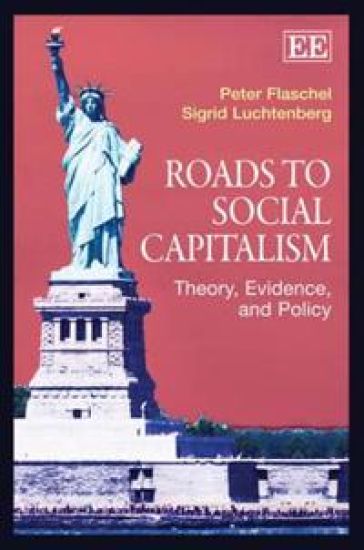
Roads to Social Capitalism

Roads to Social Capitalism

Peter Flaschel; Sigrid Luchtenberg

Edward Elgar Publishing Ltd
2012
sidottu
The current crises in the financialization of capitalism, and their repercussions on the financial viability of entire countries, severely question the achievements of mainstream economics and its disregard of Keynes's theory of effective demand and finance. In view of this, Peter Flaschel and Sigrid Luchtenberg consider roads to a type of capitalism that could eventually be considered as 'social' in nature. The authors underpin their study with theory, empirical evidence, and policy from a positive as well as a normative perspective. As points of departure for their concept of social capitalism, the theoretical framework provides a synthesis of the work of Marx, Keynes, and Schumpeter on ruthless capitalism, regulated capitalism, and competitive socialism. This challenging book will prove a thought-provoking and much needed alternative for academics and students of economics, heterodox economics and the history of economic thought, as well as for individuals interested in the understanding and reshaping of capitalism.
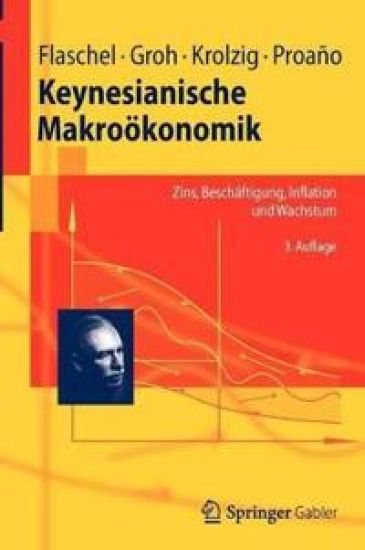
Keynesianische Makroökonomik

Keynesianische Makroökonomik

Peter Flaschel; Gangolf Groh; Hans-Martin Krolzig; Christian Proaño

Springer-Verlag Berlin and Heidelberg GmbH Co. K
2012
nidottu
Dieses Lehrbuch zur makroökonomischen Theorie betrachtet die Einkommens-, Zins- und Beschäftigungstheorie, die Analyse von Inflation und Unterbeschäftigung und die Wachstumstheorie durchgängig aus keynesianscher Sicht. Es konfrontiert die dabei erzielten Aussagen und Ergebnisse insbesondere mit den Resultaten der Neo- und Neuklassik, des Monetarismus wie auch der Theorie realer Konjunkturzykeln und des momentan vorherrschenden Ansatzes der New-Keynesians. Dieses Textbuch stellt deshalb ein wichtiges Supplement zu allen Lehrbüchern dar, die Inflations- und Wachstumsprozesse primär aus neoklassischer Sicht analysieren. Sein erster Teil kann als Einführung in makroökonomische Sichtweisen verwendet werden, während Teil II die Integration von Inflations- und Wachstumstheorie mit der keynesianischen Analyse von Einkommen, Zins und Beschäftigung vorbehalten ist.
Disequilibrium, Growth and Labor Market Dynamics

Disequilibrium, Growth and Labor Market Dynamics

Carl Chiarella; Peter Flaschel; Gangolf Groh; Willi Semmler

Springer-Verlag Berlin and Heidelberg GmbH Co. K
2011
nidottu
In this book on disequilibrium, growth and labor market dynamics we take predominantly a macroeconomic perspective. We present a working model that can easily be varied in different directions in order to subsume innovations in the literature on macroeconomics, old and new, and to contribute to important currently discussed macroeconomic issues. Our working model is set up in a way that there is a close relationship between our presented dynamic models and modern macro econometric models with disequilibrium both in the labor and the goods markets. One of our objectives is, therefore, to narrow the gap between theoretical and applied structural macrodynamic model building. We hope that the book will be a useful reference for all researchers, academic teachers and practitioners of macroeconomic and macro econometric model building who are interested in economic dynamics, independently of whether they use equilibrium or disequilibrium methods in their own research. We base this hope on the fact that our approach contains a number of unique features. The emphasis on the identification and analysis of the basic feedback mechanisms at work in modern macro economies. A detailed study of the partial as well as integrated dynamic interaction between these feedback mechanisms that consti­ tute the interdependence of markets and sectors of the modern macro economy. The rela­ tionship between the macroeconomic framework of our working model and the Walrasian, Non-Walrasian and New-Keynesian reformulations of macroeconomics.
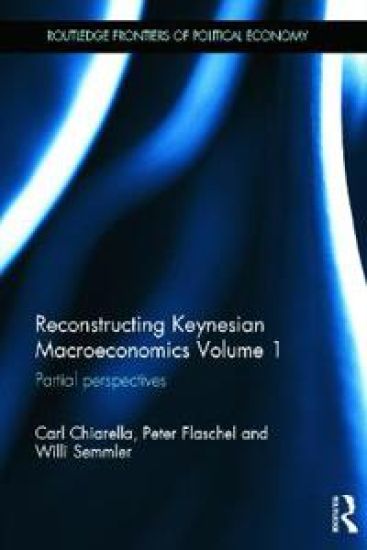
Reconstructing Keynesian Macroeconomics Volume 1

Reconstructing Keynesian Macroeconomics Volume 1

Carl Chiarella; Peter Flaschel; Willi Semmler

Routledge
2011
sidottu
This book represents the first of three volumes offering a complete reinterpretation and restructuring of Keynesian macroeconomics and a detailed investigation of the disequilibrium adjustment processes characterizing the financial, the goods and the labour markets and their interaction. It questions in a radical way the evolution of Keynesian macroeconomics after World War II and focuses on the limitations of the traditional Keynesian approach until it fell apart in the early 1970s, as well as the inadequacy of the new consensus in macroeconomics that emerged from the Monetarist critique of Keynesianism.Professors Chiarella, Flaschel and Semmler investigate basic methodological issues, the pitfalls of the Rational Expectations School, important feedback channels in the tradition of Tobin’s work, and theories of the wage-price spiral and the evidences for them. The book uses primarily partial approaches, the integration of which will be the subject of subsequent volumes. With its focus on Keynesian propagation mechanisms, the research in this book provides a unique alternative to the black-box shock-absorber approaches that dominate modern macroeconomics. Reconstructing Keynesian Macroeconomics should be of interest to students and researchers who want to look at alternatives to the mainstream macrodynamics that emerged from the Monetarist critique of Keynesianism.
A Future for Capitalism

A Future for Capitalism

Peter Flaschel; Alfred Greiner

Edward Elgar Publishing Ltd
2011
sidottu
This book builds on the Marx-Keynes-Schumpeter (MKS) approach to understanding the evolution of capitalism. It does so by focusing on current frameworks that study macro-dynamical systems in the tradition of the Classical, the Neoclassical and the Keynesian interpretation of the working of modern capitalist economies, and of the societies that are built upon them. The distinguished authors concentrate on different paradigms of economic conjecture in terms of their applicability to labor market problems and their implications for growing capitalist economies. They present material clearly related to current macroeconomic research which goes beyond the New Consensus macroeconomics, and which can also be related to the discussion between practitioners and politicians on the reform of both financial and labor markets. A Future for Capitalism will prove a challenging and thought provoking read for heterodox economists and broad-minded mainstream macroeconomists with a special interest in alternatives to general equilibrium macroeconomics.Contents: Introduction Part I: Stabilizing an Unstable Economy: The Challenge in Place 1. Real Financial Market Interactions and the Choice of Policy Measures Part II: Classical Unbalanced Growth and Social Evolution 2. Income Security within the Bounds of the Reserve Army Mechanism 3. Segmented Labor Markets and Low Income Work 4. Atypical Employment and Smooth Factor Substitution Part III: Unemployment and Welfare Issues in Models of Endogenous Growth 5. Economic Growth with an Employer of Last Resort: A Simple Model of Flexicurity Capitalism 6. Economic Policy in a Growth Model with Human Capital, Heterogenous Agents and Unemployment 7. Public Debt, Public Expenditures and Endogenous Growth with Real Wage Rigidities Part IV: The Road to Full-Employment Capitalism 8. Flexicurity: A Baseline Supply Side Model 9. Factor Substitution, Okun s Law and Gradual Wage Adjustments 10. Skill Formation, Heterogeneous Labor and Investment-driven Business Fluctuations 11. Leashing Capitalism: Monetary Fiscal Policy Measures and Labor Market Reforms Some Useful Stability Theorems References Index
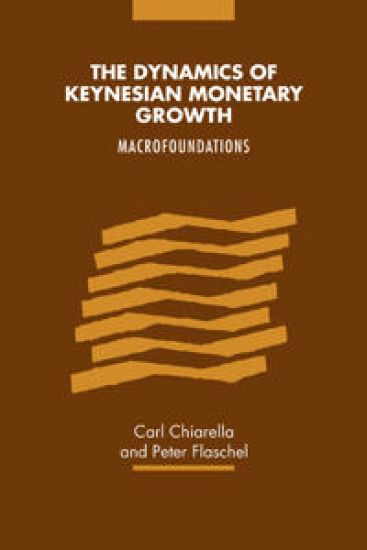
The Dynamics of Keynesian Monetary Growth

The Dynamics of Keynesian Monetary Growth

Carl Chiarella; Peter Flaschel

Cambridge University Press
2011
pokkari
Originally published in 2000, this book is in the tradition of non-market-clearing approaches to macrodynamic approaches. It builds a series of integrated disequilibrium growth models of increasing complexity, which display the economic interaction between households, firms and government across labour, goods, money, bonds and equities markets. Chiarella and Flaschel demonstrate how macrodynamics can be developed in a hierarchical way from economically simple structures to more advanced ones. In addition it investigates complex macrodynamic feedback mechanisms.
Open Economy Macrodynamics

Open Economy Macrodynamics

Toichiro Asada; Carl Chiarella; Peter Flaschel; Reiner Franke

Springer-Verlag Berlin and Heidelberg GmbH Co. K
2010
nidottu
In the first part of this book, we treat interacting and small open economies. We do this from an historical perspective, starting from the Classical model of the gold standard and the specie-flow mechanism and aim to show there that the Dornbusch IS-LM-PC approach, with or without rational expectations, can still be considered as a (if not the) core contribution to contemporaneous open economy macrodynamics, also on the level of structural macroeconometric model building. In the second part we then extend this analysis to the incorporation of more disequilibrium on the real markets, prominent further feedback channels of the macrodynamic literature and integrated macromodel building. We start from the closed economy, consider large open economies in a fixed exchange rate system, small open economies subject to high capital mobility, and finally two large interacting economies like the USA and Euroland. Our macrofounded approach extends and integrates non-market clearing traditions to macrodynamics and can be usefully compared with the New Keynesian approaches which are generally rigorously microfounded, but often much more limited in scope in capturing full market and agent interactions.
Topics in Applied Macrodynamic Theory

Topics in Applied Macrodynamic Theory

Peter Flaschel; Gangolf Groh; Christian Proano; Willi Semmler

Springer-Verlag Berlin and Heidelberg GmbH Co. K
2010
nidottu
This book is about the study of topics in macro dynamics from an applied, empirical perspective. The modeling philosophy behind most of the chapters ofthisbookisofKeynesiannature,representinganattempttorevivethist- oreticalperspectiveontheworkingofthemacroeconomy. Themacroeconomic research pursued here is somewhat di?erent from the mainstream literature using the Dynamic Stochastic General Equilibrium (DSGE) approach as the basic modeling device. The main features of the latter are the assumptions of intertemporally optimizing agents, rational expectations, competitive m- kets and price mediated market clearing through su?ciently ?exible prices and wages. The New Keynesian approach to macroeconomics has, in the last decade or so, to a large extent, also adopted the DSGE framework, building on intertemporally optimizing agents and market clearing, but favoring more the concept of monopolistic competition, sticky wages and prices and nominal as well as real rigidities. An path breaking work of this type is the recent book by Woodford (2003). However, it is well known that the intertemporal approach of smoothly optimizing agents and fast adjustments in order to establish temporal or - tertemporal marginal conditions in the product market, labor and capital markets, has not been very successful to match certain stylized facts on those markets. A further de?ciency of those intertemporal decision models is that macroeconomic feedback e?ects—and their stabilizing or destabilizing impact on the macroeconomy—have rarely been considered in those models. Yet, those feedback mechanisms, relevant for the interaction of all three markets, have been theoretically and empirically explored since the 1930s.