

Kirjailija
Peter Green
Kirjat ja teokset yhdessä paikassa: 35 kirjaa, julkaisuja vuosilta 1993-2026, suosituimpien joukossa Andrei Tarkovsky. Vertaile teosten hintoja ja tarkista saatavuus suomalaisista kirjakaupoista.
35 kirjaa
Kirjojen julkaisuhaarukka 1993-2026.
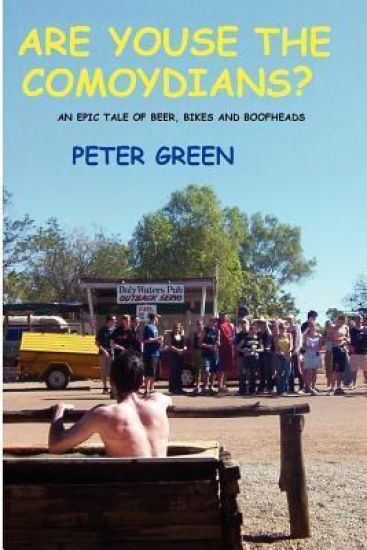
The true story of the Last Legs Comedy Tour, four stand-up comedians cycling around Australia raising money for cancer research. "" Can't believe you're still alive. It was as funny as it was feral. One adventure after another - the way life should be!""

It's true! A gluten-free diet can help you shed those stubborn pounds for good--and you don't even have to have celiac disease to benefit.Dieting can be difficult, but here nutritionist Gini Warner lays out a 7-day meal plan that makes going gluten-free surprisingly simple, and chef Ross Harris delivers gourmet meals that guarantee weight loss. Inside, you'll find 200 recipes that taste so good you won't even realize you're leaving something out, including:Sweet Potato Hash Brown Egg CupsSpinach and Mushroom MezzalunasSea Scallops and Roasted Corn SaladRoasted Garlic Chicken Breast ProvencalCarob-Coated Mascarpone and Honey-Filled FigsGluten-filled foods can derail even the best-intentioned diets, but these gourmet recipes give you the edge you need to get the weight-loss results that last. Best of all, you don't have to give up the foods you love to get there!
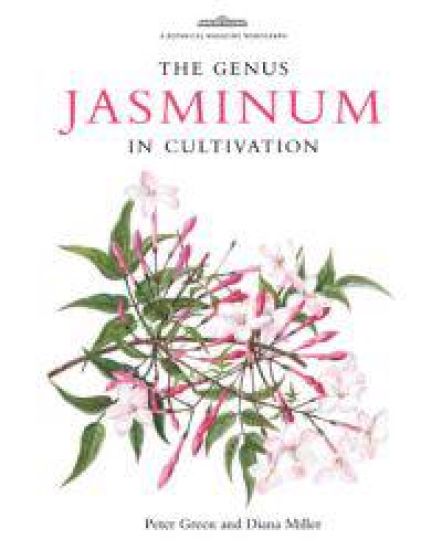
Botanical Magazine Monograph. The Genus Jasminum in Cultivation
Peter Green; Diana Miller
Kew Publishing
2009
sidottu
A new publication from the Botanical Magazine Monograph series, Hardy Heathers is a fully illustrated monograph that describes all Calluna, Daboecia and those Erica species that grow naturally in the northern hemisphere. Distribution, history, conservation, classification and cultivation are covered in detail, making this an indispensable book for the heather enthusiast, professional nurseryman, landscape architect, gardener, botanist, ecologist and conservationist with interests in heaths and heath lands. The close collaboration between the author and the renowned botanical artist Christabel King make this book an outstanding contribution to the art of botanical illustration.
A lively combination of scholarship and unorthodoxy makes these studies in ancient history and literature unusually rewarding. Few of the objects of conventional admiration gain much support from Peter Green (Pericles and the "democracy" of fifth-century Athens are treated to a very cool scrutiny) but he has a warm regard for the real virtues of antiquity and for those who spoke with "an individual voice." The studies cover both history and literature, Greece and Rome. They range from the real nature of Athenian society to poets as diverse as Sappho and Juvenal, and all of them, without laboring any parallels, make the ancient world immediately relevant to our own. (There is, for example, a very perceptive essay on how classical history often becomes a vehicle for the historian's own political beliefs and fantasies of power.) The student of classical history will find plenty in this book to enrich his own studies. The general reader will enjoy the vision of a classical world which differs radically from what he probably expects.


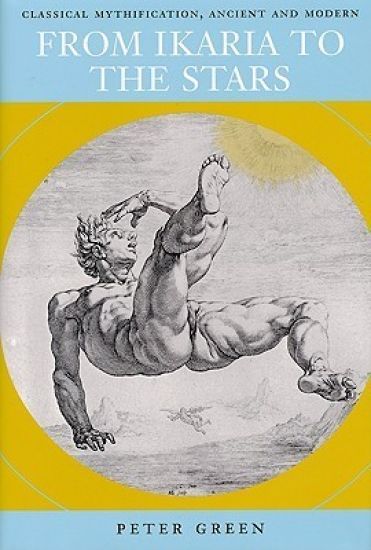
"I hadn't, till I really started digging, gauged the fierce intensity of the need for myth in the human psyche, of any age, or sensed the variety of motives dictating that need," writes Peter Green in the introduction to this wide-ranging collection of essays on classical mythology and the mythic experience. Using the need for myth as the starting point for exploring a number of topics in Greek mythology and history, Green advances new ideas about why the human urge to make myths persists across the millennia and why the borderland between mythology and history can sometimes be hard to map. Green looks at both specific problems in classical mythology and larger theoretical issues. His explorations underscore how mythic expression opens a door into non-rational and quasi-rational modes of thought in which it becomes possible to rewrite painful truths and unacceptable history-which is, Green argues, a dangerous enterprise. His study of the intersections between classical mythology and Greek history ultimately drives home a larger point, "the degree of mythification and deception (of oneself no less than of others) of which the human mind is capable."

This is a reissue, with a new introduction and an update to the bibliography, of the original edition, published in 1970 as The Year of Salamis in England and as Xerxes at Salamis in the U.S. The long and bitter struggle between the great Persian Empire and the fledgling Greek states reached its high point with the extraordinary Greek victory at Salamis in 480 B.C. The astonishing sea battle banished forever the specter of Persian invasion and occupation. Peter Green brilliantly retells this historic moment, evoking the whole dramatic sweep of events that the Persian offensive set in motion. The massive Greek victory, despite the Greeks' inferior numbers, opened the way for the historic evolution of the Greek states in a climate of creativity, independence, and democracy, one that provided a model and an inspiration for centuries to come. Green's accounts of both Persian and Greek strategies are clear and persuasive; equally convincing are his everyday details regarding the lives of soldiers, statesmen, and ordinary citizens. He has first-hand knowledge of the land and sea he describes, as well as full command of original sources and modern scholarship. With a new foreword, The Greco-Persian Wars is a book that lovers of fine historical writing will greet with pleasure.
In this collection of sixteen literary and historical essays, Peter Green informs, entertains, and stimulates. He covers a wide range of subjects, from Greek attitudes toward death to the mysteries of the Delphic Oracle, from Tutankhamun and the gold of Egypt to sex in ancient literature, from the island of Lesbos (where he once lived) to the challenges of translating Ovid's wit and elegant eroticism into present-day English verse, from Victorian pederastic aesthetics to Marxism's losing battle with ancient history. This third volume of Green's essays (several previously unpublished) reveals throughout his serious concern that we are, in a very real sense, losing the legacy of antiquity through the corrosive methodologies of modern academic criticism.

Object Oriented Computer Systems Engineering
Derrick Morris; David Evans; Peter Green; Colin Theaker
Springer-Verlag Berlin and Heidelberg GmbH Co. K
1996
nidottu
This book addresses issues concerning the engineering of system prod ucts that make use of computing technology. These systems may be prod ucts in their own right, for example a computer, or they may be the computerised control systems inside larger products, such as factory automation systems, transportation systems and vehicles, and personal appliances such as portable telephones. In using the term engineering the authors have in mind a development process that operates in an integrated sequence of steps, employing defined techniques that have some scientific basis. Furthermore we expect the operation of the stages to be subject to controls and standards that result in a product fit for its intended purpose, both in the hands of its users and as a business venture. Thus the process must take account of a wide range of requirements relating to function, cost, size, reliabili ty and so on. It is more difficult to define the meaning of computing technology. These days this involves much more than computers and software. For example, many tasks that might be performed by software running in a general purpose computer can also be performed directly by the basic technology used to construct a computer, namely digital hardware. However, hardware need not always be digital; we live in an analogue world, hence analogue signals appear on the boundaries of our systems and it can sometimes be advantageous to allow them to penetrate further.
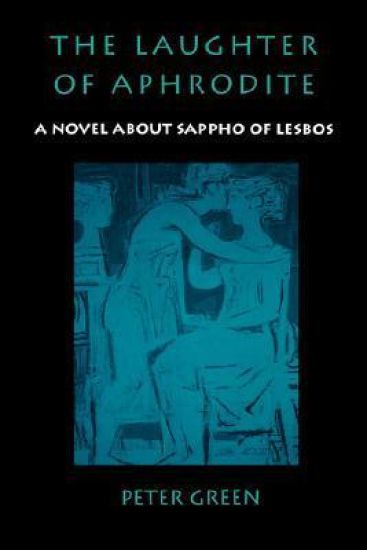
Best-selling classicist Peter Green recreates the life and times of the Greek lyric poet Sappho in this beautifully conceived, sharply detailed work of historical imagination. We meet Sappho at the age of fifty, when she is shaken by her fatal and final love affair with Phaon. She narrates her own story from the vantage point of self-questioning middle age, and her candid meditations make intimate, engrossing reading. Only fragments of Sappho's poetry survive. In imagining Sappho's life, Green found his task 'rather like that of an archaeologist reassembling some amphora from hundreds of shards - of which more than half are missing'. Yet, in his synthesis of historical evidence and ebullient invention, Green produces a seamless, moving, and persuasive portrait. He recreates Sappho's life by interweaving her surviving poetry into the narrative, not as quotations, but as her own imagined speeches and thoughts. Sappho's life spanned one of the most exciting periods in Greek history. Green's novel, full of details about daily life on ancient Lesbos, draws the reader into the political and social climate of her world: the civil strife accompanying the transition from aristocracy to mercantilism, the household relations between slave and aristocrat, the details of sea travel in the Aegean. Green wrote the novel while living on Lesbos, and his graceful rendering of the landscape, the rhythms of the seasons, and the varied flora of Sappho's island pervades the narrative. Sappho's poetry reveals a direct, spontaneous woman who eschewed artifice and embellishment. Green's extraordinary talent captures those qualities and brings this woman of unflinching honesty very much to life.

The Hellenistic Age, the three extraordinary centuries from the death of Alexander in 323 B. C. to Octavian's final defeat of Antony and Cleopatra at the Battle of Actium, has offered a rich and variegated field of exploration for historians, philosophers, economists, and literary critics. Yet few scholars have attempted the daunting task of seeing the period whole, of refracting its achievements and reception through the lens of a single critical mind. Alexander to Actium was conceived and written to fill that gap. In this monumental work, Peter Green--noted scholar, writer, and critic--breaks with the traditional practice of dividing the Hellenistic world into discrete, repetitious studies of Seleucids, Ptolemies, Antigonids, and Attalids. He instead treats these successor kingdoms as a single, evolving, interrelated continuum. The result clarifies the political picture as never before. With the help of over 200 illustrations, Green surveys every significant aspect of Hellenistic cultural development, from mathematics to medicine, from philosophy to religion, from literature to the visual arts.Green offers a particularly trenchant analysis of what has been seen as the conscious dissemination in the East of Hellenistic culture, and finds it largely a myth fueled by Victorian scholars seeking justification for a no longer morally respectable imperialism. His work leaves us with a final impression of the Hellenistic Age as a world with haunting and disturbing resemblances to our own. This lively, personal survey of a period as colorful as it is complex will fascinate the general reader no less than students and scholars.
The Fourth Dimension
Yannis Ritsos; Peter Green; Beverly (TRN) Bardsley
Princeton University Press
1993
pokkari
In the dramatic monologues that make up The Fourth Dimension--especially those based on the grim history of Mycenae and its royal protagonists--the celebrated modern Greek poet Yannis Ritsos presents a timeless poetic paradigm of the condition of Greece, past and present. The volume also contains a group of modern narratives, including the famous, and much-anthologized, "Moonlight Sonata." Ritsos, rightly, regarded the The Fourth Dimension as his finest achievement. It is now presented to English- speaking readers for the first time in its entirety. From "Philoctetes" All the speeches of great men, about the dead and about heroes. Astonishing, awesome words, pursued us even in our sleep, slipping beneath closed doors, from the banqueting hallwhere glasses and voices sparkled, and the veilof an unseen dancer rippled silentlylike a diaphanous, whirling wallbetween life and death. This throbbingour childhood nights, lightening the shadows of shieldsetched on white walls by slow moonlight.