Kirjojen hintavertailu. Mukana 12 390 323 kirjaa ja 12 kauppaa.

Kirjailija

Peter H. Hassrick

Kirjat ja teokset yhdessä paikassa: 7 kirjaa, julkaisuja vuosilta 2007-2017, suosituimpien joukossa Painted Journeys. Vertaile teosten hintoja ja tarkista saatavuus suomalaisista kirjakaupoista.

7 kirjaa

Kirjojen julkaisuhaarukka 2007-2017.

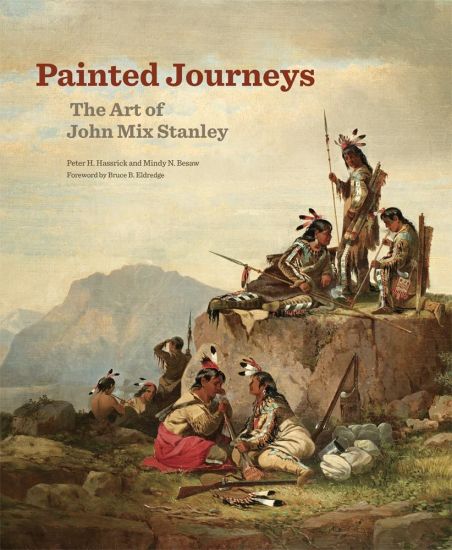
Painted Journeys

Painted Journeys

Peter H. Hassrick; Mindy N. Besaw; Bruce B. Eldredge

University of Oklahoma Press
2015
sidottu
Artist-explorer John Mix Stanley (1814-1872), one of the most celebrated chroniclers of the American West in his time, was in a sense a victim of his own success. So highly regarded was his work that more than two hundred of his paintings were held at the Smithsonian Institution - where in 1865 a fire destroyed all but seven of them. This volume, featuring a comprehensive collection of Stanley's extant art, reproduced in full color, offers an opportunity - and ample reason - to rediscover the remarkable accomplishments of this outsize figure of nineteenth-century American culture. Originally from New York State, Stanley journeyed west in 1842 to paint Indian life. During the U.S.-Mexican War, he joined a frontier military expedition and traveled from Santa Fe to California, producing sketches and paintings of the campaign along the way - work that helped secure his fame in the following decades. He was also appointed chief artist for Isaac Stevens's survey of the 48th parallel for a proposed transcontinental railroad. The essays in this volume, by noted scholars of American art, document and reflect on Stanley's life and work from every angle. The authors consider the artist's experience on government expeditions; his solo tours among the Oregon settlers and western and Plains Indians; and his career in Washington and search for government patronage, as well as his individual works. With contributions by Emily C. Burns, Scott Manning Stevens, Lisa Strong, Melissa Speidel, Jacquelyn Sparks, and Emily C. Wilson, the essays in this volume convey the full scope of John Mix Stanley's artistic accomplishment and document the unfolding of that uniquely American vision throughout the artist's colorful life. Together they restore Stanley to his rightful place in the panorama of nineteenth-century American life and art.
Beyond Madness

Beyond Madness

Norman A. Geske; Peter H. Hassrick

University of Nebraska Press
2007
sidottu
This book, featuring the life and works of Ralph Blakelock, situates him in the context of American art. Representing over twenty years of study and the examination of several thousand works attributed to him, Beyond Madness reveals the unusual nature of Blakelock's life story as it offers clear parallels to his painting. Largely self-taught and supported by few patrons, Blakelock regularly struggled with the financial pressures of supporting his nine children and pursuing his art. Called both brilliant and doomed, and institutionalized on and off for the last decade of his life, he nonetheless created some of the most beloved—and some of the most frequently forged—paintings in the American canon. As in the author's own time, modern assessments of his work are often colored by notions of Blakelock the man, leading to a paradoxical legacy of suffering and hope, obscurity and prominence. Taking Blakelock's art on its merits, Beyond Madness stands as a testament to the indefatigable spirit of art scholarship as well as a tribute to the artist and his enduring passion for the creative process. It finally casts new light on the life and character of Blakelock and on the nature of the incomparable art he contributed to the American tradition.
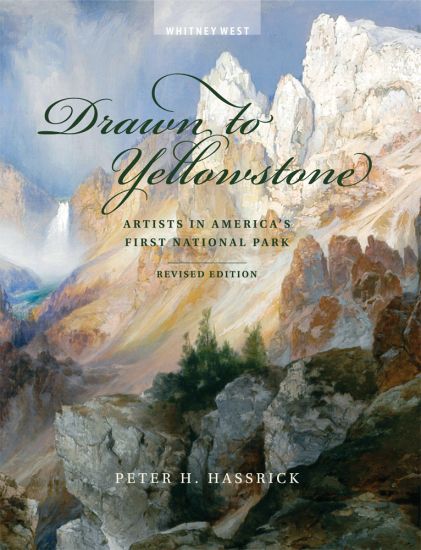
Drawn to Yellowstone

Drawn to Yellowstone

Peter H. Hassrick

Buffalo Bill Center of the West
2016
nidottu
Old Faithful Geyser, Emerald Spring, the magnificent canyons and falls of the Yellowstone River--these and other sites, familiar to the millions of visitors who travel through Yellowstone National Park each year, have been an inspiration to generations of artists. Thomas Moran, Albert Bierstadt, Frederic Remington, Louis Comfort Tiffany, and dozens of other artists have braved difficult conditions to capture the splendors of Yellowstone in many media, from delicate watercolors and pen-and-ink sketches to powerful oils and popular lithographs. They have portrayed the animals that lived there, the humans who passed through, and above all the remarkable features that have made Yellowstone a wonderland to so many artists and observers. From the moment of its inception in 1872 as the first national park in the world, Yellowstone National Park has been perceived as a vast visual spectacle. By the 1890s it was known as "the Nation's Art Gallery." Peter H. Hassrick traces the artistic history of the park from its earliest explorers to the present day in this new edition of Drawn to Yellowstone, a richly illustrated account of the artists who traveled to and were inspired by Yellowstone. Yellowstone is simultaneously an aesthetic experience and a potent force in America's search for national identity. Visitors made comparisons between the castles of Europe and the gleaming spires of Yellowstone to prove that America, too, had its history and its grandeur. Like the waters pulsing from its geysers, from Yellowstone flows an artistic energy that at once captivates a nation and contributes to its philosophical and aesthetic history.
Painted Journeys

Painted Journeys

Peter H. Hassrick; Mindy N. Besaw; Bruce B. Eldredge

University of Oklahoma Press
2015
nidottu
Artist-explorer John Mix Stanley (1814-1872), one of the most celebrated chroniclers of the American West in his time, was in a sense a victim of his own success. So highly regarded was his work that more than two hundred of his paintings were held at the Smithsonian Institution - where in 1865 a fire destroyed all but seven of them. This volume, featuring a comprehensive collection of Stanley's extant art, reproduced in full color, offers an opportunity - and ample reason - to rediscover the remarkable accomplishments of this outsize figure of nineteenth-century American culture. Originally from New York State, Stanley journeyed west in 1842 to paint Indian life. During the U.S.-Mexican War, he joined a frontier military expedition and traveled from Santa Fe to California, producing sketches and paintings of the campaign along the way - work that helped secure his fame in the following decades. He was also appointed chief artist for Isaac Stevens's survey of the 48th parallel for a proposed transcontinental railroad. The essays in this volume, by noted scholars of American art, document and reflect on Stanley's life and work from every angle. The authors consider the artist's experience on government expeditions; his solo tours among the Oregon settlers and western and Plains Indians; and his career in Washington and search for government patronage, as well as his individual works. With contributions by Emily C. Burns, Scott Manning Stevens, Lisa Strong, Melissa Speidel, Jacquelyn Sparks, and Emily C. Wilson, the essays in this volume convey the full scope of John Mix Stanley's artistic accomplishment and document the unfolding of that uniquely American vision throughout the artist's colorful life. Together they restore Stanley to his rightful place in the panorama of nineteenth-century American life and art.
Charles Deas and 1840s America

Charles Deas and 1840s America

Carol Clark; Peter H. Hassrick; Lewis I. Sharp

University of Oklahoma Press
2009
sidottu
Charles Deas (1818-67), an enigmatic figure on the edge of mainstream artistic circles in mid-nineteenth-century New York, went west to explore new opportunities and subjects in 1840. From his adopted hometown of St. Louis, Deas sent his iconic paintings of fur trappers and Indians back east for exhibition and sale, briefly winning the recognition that had earlier eluded him.This handsome volume - featuring more than 150 illustrations, 70 in color - is the first book exclusively devoted to Deas. In two major essays, Carol Clark presents Deas's haunting biography and complex art - works that embodied Americans' uncertainty about the future of their rapidly expanding nation, especially in the contested spaces of the West. Ranging from Indian genre scenes to more violent and bizarre themes drawn from literature and his own imagination, Deas's images reverberate with the racial tensions and cut-throat economic competition of the period. Three additional essayists examine the historical, political, and social context of Deas's art and discuss in detail two of his major paintings, Walking the Chalk and Long Jakes, ""the Rocky Mountain Man.""The volume also includes Clark's catalogue of Deas's paintings, watercolors, and drawings - the most extensive recovery and documentation to date of the work of this important but little-known artist. Charles Deas and 1840s America will constitute the definitive reference on the painter for years to come.
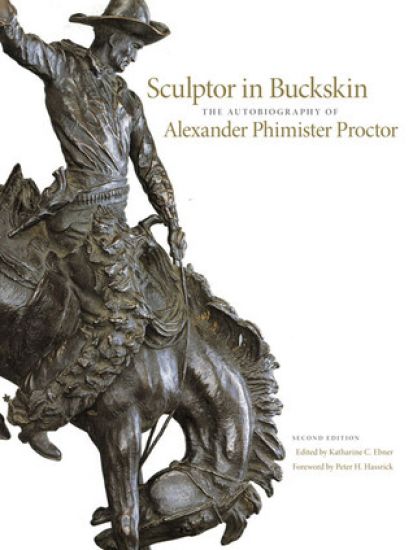
Sculptor in Buckskin

Sculptor in Buckskin

Peter H. Hassrick; Alexander Phimister Proctor

University of Oklahoma Press
2009
sidottu
Two disparate worlds met in the life of Alexander Phimister Proctor: the art world centered in the eastern United States and the world of the western frontier. Proctor was a remarkable amalgam: a big-game hunter and intrepid explorer who felt at home in Paris or New York, and an academically trained artist who painted and sculpted the characters and wild creatures of the West.This new edition of Proctor's autobiography provides a thorough introduction to a distinctively American artist whose monumental sculptures and statues adorn parks, public buildings, and museums, as well as private homes and businesses across the country. The text, begun in the late 1930s, when Proctor was in his seventies, takes the reader on a far-flung journey from his birth in Ontario and childhood in Denver to his travels as a young man throughout the United States and eventually to Paris.A new selection of more than 125 illustrations - many in full color - includes historical photographs and reproductions of Proctor's sketches, paintings, and sculptures, tracing the development of his magnificent artistry. Here are the trembling fawns, slinking mountain lions, stalwart warriors, and rearing mustangs that made him famous. Art historian Katharine C. Ebner has annotated the autobiography and restored previously unpublished portions of the original manuscript.""What is beauty?"" Proctor asks at the beginning of his narrative. It was a question that resonated throughout his life. Through the words and the work of this remarkable artist, we come to understand his answer.