Kirjojen hintavertailu. Mukana 12 595 353 kirjaa ja 12 kauppaa.

Kirjailija

Peter Heinegg

Kirjat ja teokset yhdessä paikassa: 10 kirjaa, julkaisuja vuosilta 2005-2014, suosituimpien joukossa Crazy Culture. Vertaile teosten hintoja ja tarkista saatavuus suomalaisista kirjakaupoista.

10 kirjaa

Kirjojen julkaisuhaarukka 2005-2014.

Dim and Dimmer

Dim and Dimmer

Peter Heinegg

Hamilton Books
2014
nidottu
In today's world, we are witnessing both the spread of a hopeful secular humanism and the persistence of cultural traditions that mindlessly glorify humans and are paving the path to environmental collapse. Peter Heinegg addresses how we are now on a collision course heading toward ecological catastrophe—the one solution to this being a true “agonizing reappraisal” of who we are and how we do things. In Dim and Dimmer, Peter Heinegg tackles the question: “Can the ‘New Enlightenment’ already dawning save the day?”
Airy Nothings

Airy Nothings

Peter Heinegg

University Press of America
2013
nidottu
Even as the number of unbelievers continues to rise, religion in America still gets unwarrantably good press. The tenets and teachings, however nonsensical, of each and every “community of faith” may not be attacked. Secular academics who would never be caught in a synagogue, church, or mosque seldom fail to manifest politically correct reverence for the creeds, codes, and cults of the religious. Unfortunately, the central religious concept of the “sacred” proves, upon closer inspection, to be fictitious. The understandably popular “holy” times, places, deities, peoples, books, laws, and scenarios for the afterlife are fantasies projected into everyday experience by human beings trapped in time and unwilling to accept their own transiency and long-term insignificance. This book surveys the various traditional “fortresses” of the sacred and finds them all empty and indefensible.
Crazy Culture

Crazy Culture

Peter Heinegg

University Press of America
2011
nidottu
Crazy Culture is a series of broadsides against many widely held misconceptions in both academe and the general public, who is often seen clustering under the politically correct banner of multiculturalism. Heinegg confronts the notion that all culture—especially that of non-westerners and oppressed minorities—is somehow good in itself and that outsiders have no right to criticize or condemn any cultures except their own. He also challenges the view that the term “culture” applies primarily to a handful of masterpieces, as opposed to the great bulk of artistic products and folkways, and that the proper attitude toward the vast spectrum of culture, past and present, is sentimental admiration. Surveying both the history and ideology of cultural realms such as our treatment of animals, religion, sexual norms, politics, economics, urban life, the arts, and athletics, Heinegg deftly identifies and explains ubiquitous traces of cultural sins by humanity.
Bitter Scrolls

Bitter Scrolls

Peter Heinegg

University Press of America
2010
nidottu
Bitter Scrolls is a broad survey of our "sacred texts," both Holy Writ (Hebrew Bible, New Testament, Qur'an) and secular masterpieces, from the Epic of Gilgamesh to the work of William Butler Yeats and D.H. Lawrence, whose canonical status often exempts them from the sort of hardnosed, commonsense criticism that we uniformly apply to contemporary literature and art. A frank look at this literature reveals a stunning combination of bias and blindness toward women. Acknowledging this would, in any case, be painful and depressing; but confronting it in some of our greatest minds-Homer, Aeschylus, Virgil, Boccaccio, Rabelais, Shakespeare, Milton, Pope, Wordsworth, and so on-must inevitably give rise to profound, if no longer unusual, culture shock. With few exceptions, we can no more remake the canon than we can redesign our family tree, but we need to come to terms with the toxic contents of our art.
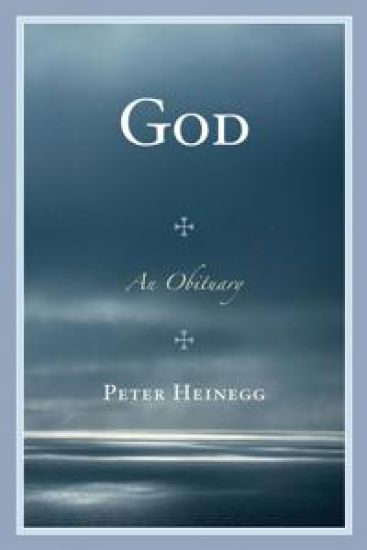
God

God

Peter Heinegg

Hamilton Books
2009
nidottu
God: An Obituary is a satirical-analytical view of monotheism in our time. Building on the work of both the great traditional unbelievers—Hume, Mill, Nietzsche, and Freud, among others—and contemporary critics—Richard Dawkins, Daniel Dennett, Ibn Warraq, etc.—Heinegg exposes the intellectual and moral bankruptcy of Judaism, Christianity, and Islam. In a series of thematic reflections, the author remarks on the absurdity of continuing to worship a being whose existence is attested to almost exclusively by the ravings of hallucinatory "prophets," and whose track record was and is marked by violence, oppression, and nonsense. Heinegg argues that the best way to dispose of God once and for all is to subject "him" —and "his" devotees—to a steady enfilade of pointed rational mockery.
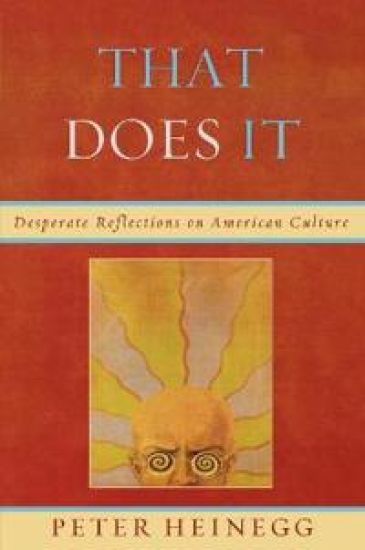
That Does It

That Does It

Peter Heinegg

Hamilton Books
2008
nidottu
That Does It: Desperate Reflections on American Culture is an enfilade of critical attacks on the absurdities, stupidities, and crimes of present-day American life. It's targets are dumb-but-dangerous politicians, infantile-but-invasive preachers, saccharine-but-poisonous clichés, mindless entertainment, spineless media, and a national lifestyle marked by manic consumption and extravagant wastefulness, narcissistic complacency, pseudo-patriotism, and the idiotic worship of more idols than you could throw a verbal IED at. The book provides a handy checklist of ills, from the life threatening to the merely obnoxious, afflicting the American psyche and body politic, which it then proceeds to submerge in satirical acid. This probably doomed assault on American cluelessness is recommended to all readers who have recently found themselves snorting indignantly at the nonsense dripping out of TV sets, car radios, talk shows, cineplexes, and White House news briefings.
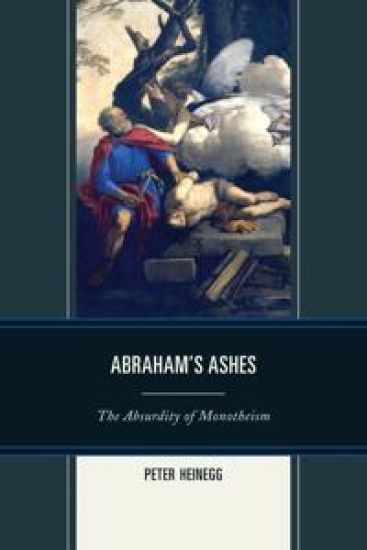
Abraham's Ashes

Abraham's Ashes

Peter Heinegg

University Press of America
2012
nidottu
“Abrahamic religion” has long been a buzzword in ecumenical discourse. It is the notion that Judaism, Christianity, and Islam, despite their profound differences, are united in their reverence for Abraham—not just as the progenitor of Israel, but as a universal father in the faith. Abraham’s Ashes offers a forceful critique of the biblical and Qur’anic views of Abraham, showing how at the heart of all prophetic religions lies an untenable myth of suprarational magical thinking about “revelation.” This myth involves communiqués to a privileged male from a mysterious patriarchal God who demands, and in the case of Jesus, actually receives the tribute of human sacrifice. This cruel story proves to be an apt introduction to the bizarre, contradictory, and oppressive fantasy known as monotheism.
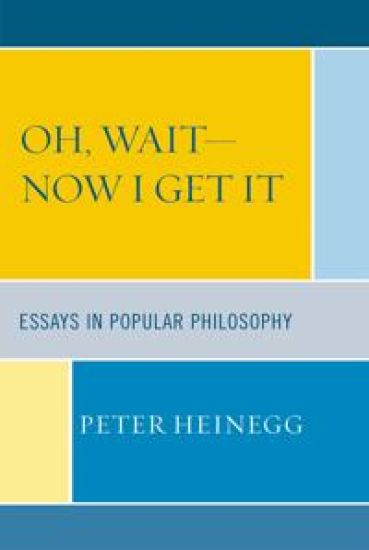
Oh, Wait-Now I Get It

Oh, Wait-Now I Get It

Peter Heinegg

Hamilton Books
2007
nidottu
Like war and politics, philosophy is too important to be left to professionals. Oh Wait—Now I Get It illustrates this basic truth by tackling a broad spectrum of issues, which include: history, religion, government, sex, family, and death. In fact, the entire contemporary cultural scene from the perspective of a thoughtful amateur philosopher is brought forth within this book. Recalling Neitzsche's dictum that all philosophy is also confession, Professor Peter Heinegg begins with some autobiographical pieces on his background, which include seven years in Jesuit seminaries and doctoral studies at Harvard. He then offers approximately three-dozen brief, pointed, and witty essays that focus on present-day issues, but draw upon a lifetime of reading, teaching, and writing about the great literary and philosophical classics.
Good God! (And Other Follies)

Good God! (And Other Follies)

Peter Heinegg

Hamilton Books
2006
nidottu
Good God! (And Other Follies) takes a critical and satirical look at the wave of religiosity now sweeping the country. From faith-based initiatives to bans on stem cell research, from public postings of the Ten Commandments to attacks on evolution, American godliness has apparently never had it so good. Much of this behavior and even more of the God-talk accompanying it, whether fueled by passionate faith, cultural resentment, or political opportunism, is intellectually absurd. This book points out this absurdity and explores the underlying fallacies, contradictions and, at times, sheer nonsense that beset not only Christianity, but Judaism and Islam as well.
Better than Both

Better than Both

Peter Heinegg

Hamilton Books
2005
nidottu
Better Than Both: The Case for Pessimism is an experiment in "popular philosophy." It presents and discusses (literally) life-and-death issues in non-technical, everyday language. This new work sees pessimism not as a kind of depressed moodiness or self-indulgent negativity, but as the inevitable result of any fair-minded survey of the world we actually live in. It reaches this conclusion by looking into basic human psychology, the record of history, the experience of aging and death, the failure of religion, and many features of both ancient and modern culture. Acknowledging the truth of pessimism, as opposed to optimistic self-deception, serves both to inoculate us against the suffering that is either bound or liable to come our way, and to help us enjoy the pleasures that life can afford. Realistic pessimism—unlike "silly pessimism," also described here—never denies the deep, intense joys of life, without whose seductive appeal the human race would long ago have vanished from the planet. It simply cautions, since probability is the best guide to decision-making, against basing any belief-system or choosing any course of action on delusively long odds. The book refers to a broad spectrum of writers and thinkers, such as Nietzsche, Mark Twain, and King Solomon for insight.