Kirjojen hintavertailu. Mukana 12 152 606 kirjaa ja 12 kauppaa.

Kirjailija

Peter J. Olver

Kirjat ja teokset yhdessä paikassa: 10 kirjaa, julkaisuja vuosilta 1995-2025, suosituimpien joukossa Introduction to Partial Differential Equations. Vertaile teosten hintoja ja tarkista saatavuus suomalaisista kirjakaupoista.

10 kirjaa

Kirjojen julkaisuhaarukka 1995-2025.

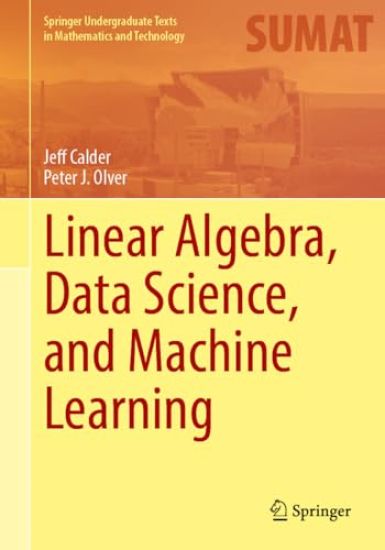
Linear Algebra, Data Science, and Machine Learning

Linear Algebra, Data Science, and Machine Learning

Jeff Calder; Peter J. Olver

Springer International Publishing AG
2025
sidottu
This text provides a mathematically rigorous introduction to modern methods of machine learning and data analysis at the advanced undergraduate/beginning graduate level. The book is self-contained and requires minimal mathematical prerequisites. There is a strong focus on learning how and why algorithms work, as well as developing facility with their practical applications. Apart from basic calculus, the underlying mathematics — linear algebra, optimization, elementary probability, graph theory, and statistics — is developed from scratch in a form best suited to the overall goals. In particular, the wide-ranging linear algebra components are unique in their ordering and choice of topics, emphasizing those parts of the theory and techniques that are used in contemporary machine learning and data analysis. The book will provide a firm foundation to the reader whose goal is to work on applications of machine learning and/or research into the further development of this highly active field of contemporary applied mathematics. To introduce the reader to a broad range of machine learning algorithms and how they are used in real world applications, the programming language Python is employed and offers a platform for many of the computational exercises. Python notebooks complementing various topics in the book are available on a companion GitHub site specified in the Preface, and can be easily accessed by scanning the QR codes or clicking on the links provided within the text. Exercises appear at the end of each section, including basic ones designed to test comprehension and computational skills, while others range over proofs not supplied in the text, practical computations, additional theoretical results, and further developments in the subject. The Students’ Solutions Manual may be accessed from GitHub. Instructors may apply for access to the Instructors’ Solutions Manual from the link supplied on the text’s Springer website. The book can be used in a junior or senior level course for students majoring in mathematics with a focus on applications as well as students from other disciplines who desire to learn the tools of modern applied linear algebra and optimization. It may also be used as an introduction to fundamental techniques in data science and machine learning for advanced undergraduate and graduate students or researchers from other areas, including statistics, computer science, engineering, biology, economics and finance, and so on.
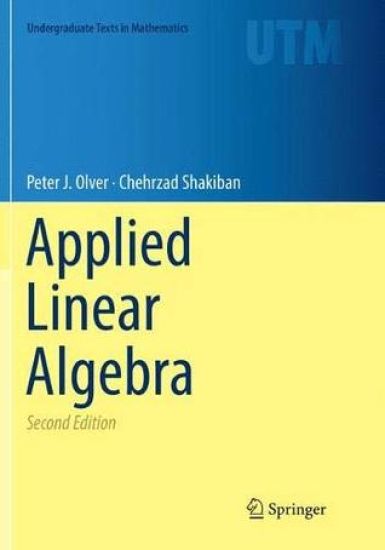
Applied Linear Algebra

Applied Linear Algebra

Peter J. Olver; Chehrzad Shakiban

Springer Nature Switzerland AG
2019
nidottu
This textbook develops the essential tools of linear algebra, with the goal of imparting technique alongside contextual understanding. Applications go hand-in-hand with theory, each reinforcing and explaining the other. This approach encourages students to develop not only the technical proficiency needed to go on to further study, but an appreciation for when, why, and how the tools of linear algebra can be used across modern applied mathematics. Students may visit the following website to obtain the freely available student solutional manual: https://www-users.cse.umn.edu/~olver/ala.html. Providing an extensive treatment of essential topics such as Gaussian elimination, inner products and norms, and eigenvalues and singular values, this text can be used for an in-depth first course, or an application-driven second course in linear algebra. In this second edition, applications have been updated and expanded to include numerical methods, dynamical systems, data analysis, and signal processing, while the pedagogical flow of the core material has been improved. Throughout, the text emphasizes the conceptual connections between each application and the underlying linear algebraic techniques, thereby enabling students not only to learn how to apply the mathematical tools in routine contexts, but also to understand what is required to adapt to unusual or emerging problems. No previous knowledge of linear algebra is needed to approach this text, with single-variable calculus as the only formal prerequisite. However, the reader will need to draw upon some mathematical maturity to engage in the increasing abstraction inherent to the subject. Once equipped with the main tools and concepts from this book, students will be prepared for further study in differential equations, numerical analysis, data science and statistics, and a broad range of applications. The first author’s text, Introduction to Partial Differential Equations, is an ideal companion volume, forming a natural extension of the linear mathematical methods developed here.
Applied Linear Algebra

Applied Linear Algebra

Peter J. Olver; Chehrzad Shakiban

Springer International Publishing AG
2018
sidottu
This textbook develops the essential tools of linear algebra, with the goal of imparting technique alongside contextual understanding. Applications go hand-in-hand with theory, each reinforcing and explaining the other. This approach encourages students to develop not only the technical proficiency needed to go on to further study, but an appreciation for when, why, and how the tools of linear algebra can be used across modern applied mathematics. Students may visit the following website to obtain the freely available student solutional manual: https://www-users.cse.umn.edu/~olver/ala.html. Providing an extensive treatment of essential topics such as Gaussian elimination, inner products and norms, and eigenvalues and singular values, this text can be used for an in-depth first course, or an application-driven second course in linear algebra. In this second edition, applications have been updated and expanded to include numerical methods, dynamical systems, data analysis, and signal processing, while the pedagogical flow of the core material has been improved. Throughout, the text emphasizes the conceptual connections between each application and the underlying linear algebraic techniques, thereby enabling students not only to learn how to apply the mathematical tools in routine contexts, but also to understand what is required to adapt to unusual or emerging problems. No previous knowledge of linear algebra is needed to approach this text, with single-variable calculus as the only formal prerequisite. However, the reader will need to draw upon some mathematical maturity to engage in the increasing abstraction inherent to the subject. Once equipped with the main tools and concepts from this book, students will be prepared for further study in differential equations, numerical analysis, data science and statistics, and a broad range of applications. The first author’s text, Introduction to Partial Differential Equations, is an ideal companion volume, forming a natural extension of the linear mathematical methods developed here.
Introduction to Partial Differential Equations

Introduction to Partial Differential Equations

Peter J. Olver

Springer International Publishing AG
2016
nidottu
This textbook is designed for a one year course covering the fundamentals of partial differential equations, geared towards advanced undergraduates and beginning graduate students in mathematics, science, engineering, and elsewhere. The exposition carefully balances solution techniques, mathematical rigor, and significant applications, all illustrated by numerous examples. Extensive exercise sets appear at the end of almost every subsection, and include straightforward computational problems to develop and reinforce new techniques and results, details on theoretical developments and proofs, challenging projects both computational and conceptual, and supplementary material that motivates the student to delve further into the subject. No previous experience with the subject of partial differential equations or Fourier theory is assumed, the main prerequisites being undergraduate calculus, both one- and multi-variable, ordinary differential equations, and basic linear algebra. While the classical topics of separation of variables, Fourier analysis, boundary value problems, Green's functions, and special functions continue to form the core of an introductory course, the inclusion of nonlinear equations, shock wave dynamics, symmetry and similarity, the Maximum Principle, financial models, dispersion and solutions, Huygens' Principle, quantum mechanical systems, and more make this text well attuned to recent developments and trends in this active field of contemporary research. Numerical approximation schemes are an important component of any introductory course, and the text covers the two most basic approaches: finite differences and finite elements.
Introduction to Partial Differential Equations

Introduction to Partial Differential Equations

Peter J. Olver

Springer International Publishing AG
2013
sidottu
This textbook is designed for a one year course covering the fundamentals of partial differential equations, geared towards advanced undergraduates and beginning graduate students in mathematics, science, engineering, and elsewhere. The exposition carefully balances solution techniques, mathematical rigor, and significant applications, all illustrated by numerous examples. Extensive exercise sets appear at the end of almost every subsection, and include straightforward computational problems to develop and reinforce new techniques and results, details on theoretical developments and proofs, challenging projects both computational and conceptual, and supplementary material that motivates the student to delve further into the subject. No previous experience with the subject of partial differential equations or Fourier theory is assumed, the main prerequisites being undergraduate calculus, both one- and multi-variable, ordinary differential equations, and basic linear algebra. While the classical topics of separation of variables, Fourier analysis, boundary value problems, Green's functions, and special functions continue to form the core of an introductory course, the inclusion of nonlinear equations, shock wave dynamics, symmetry and similarity, the Maximum Principle, financial models, dispersion and solutions, Huygens' Principle, quantum mechanical systems, and more make this text well attuned to recent developments and trends in this active field of contemporary research. Numerical approximation schemes are an important component of any introductory course, and the text covers the two most basic approaches: finite differences and finite elements.
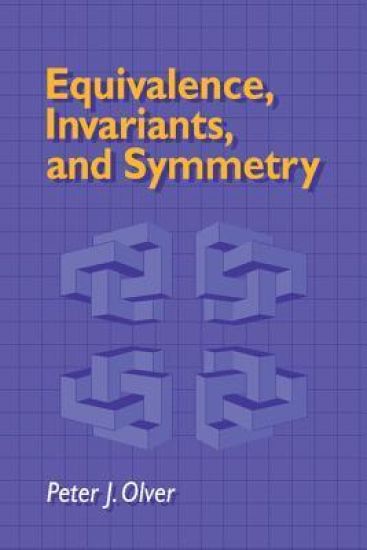
Equivalence, Invariants and Symmetry

Equivalence, Invariants and Symmetry

Peter J. Olver

Cambridge University Press
2009
pokkari
Drawing on a wide range of mathematical disciplines, including geometry, analysis, applied mathematics and algebra, this book presents an innovative synthesis of methods used to study problems of equivalence and symmetry which arise in a variety of mathematical fields and physical applications. Systematic and constructive methods for solving equivalence problems and calculating symmetries are developed and applied to a wide variety of mathematical systems, including differential equations, variational problems, manifolds, Riemannian metrics, polynomials and differential operators. Particular emphasis is given to the construction and classification of invariants, and to the reductions of complicated objects to simple canonical forms. This book will be a valuable resource for students and researchers in geometry, analysis, algebra, mathematical physics and other related fields.
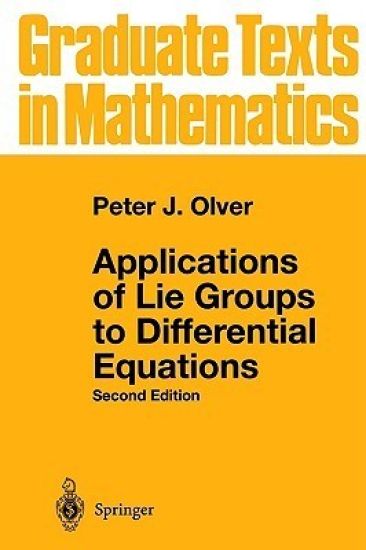
Applications of Lie Groups to Differential Equations

Applications of Lie Groups to Differential Equations

Peter J. Olver

Springer-Verlag New York Inc.
2000
nidottu
Symmetry methods have long been recognized to be of great importance for the study of the differential equations. This book provides a solid introduction to those applications of Lie groups to differential equations which have proved to be useful in practice. The computational methods are presented so that graduate students and researchers can readily learn to use them. Following an exposition of the applications, the book develops the underlying theory. Many of the topics are presented in a novel way, with an emphasis on explicit examples and computations. Further examples, as well as new theoretical developments, appear in the exercises at the end of each chapter.
Classical Invariant Theory

Classical Invariant Theory

Peter J. Olver

Cambridge University Press
1999
sidottu
There has been a resurgence of interest in classical invariant theory driven by several factors: new theoretical developments; a revival of computational methods coupled with powerful new computer algebra packages; and a wealth of new applications, ranging from number theory to geometry, physics to computer vision. This book provides readers with a self-contained introduction to the classical theory as well as modern developments and applications. The text concentrates on the study of binary forms (polynomials) in characteristic zero, and uses analytical as well as algebraic tools to study and classify invariants, symmetry, equivalence and canonical forms. It also includes a variety of innovations that make this text of interest even to veterans of the subject. Aimed at advanced undergraduate and graduate students the book includes many exercises and historical details, complete proofs of the fundamental theorems, and a lively and provocative exposition.
Classical Invariant Theory

Classical Invariant Theory

Peter J. Olver

Cambridge University Press
1999
pokkari
There has been a resurgence of interest in classical invariant theory driven by several factors: new theoretical developments; a revival of computational methods coupled with powerful new computer algebra packages; and a wealth of new applications, ranging from number theory to geometry, physics to computer vision. This book provides readers with a self-contained introduction to the classical theory as well as modern developments and applications. The text concentrates on the study of binary forms (polynomials) in characteristic zero, and uses analytical as well as algebraic tools to study and classify invariants, symmetry, equivalence and canonical forms. It also includes a variety of innovations that make this text of interest even to veterans of the subject. Aimed at advanced undergraduate and graduate students the book includes many exercises and historical details, complete proofs of the fundamental theorems, and a lively and provocative exposition.
Equivalence, Invariants and Symmetry

Equivalence, Invariants and Symmetry

Peter J. Olver

Cambridge University Press
1995
sidottu
Drawing on a wide range of mathematical disciplines, including geometry, analysis, applied mathematics and algebra, this book presents an innovative synthesis of methods used to study problems of equivalence and symmetry which arise in a variety of mathematical fields and physical applications. Systematic and constructive methods for solving equivalence problems and calculating symmetries are developed and applied to a wide variety of mathematical systems, including differential equations, variational problems, manifolds, Riemannian metrics, polynomials and differential operators. Particular emphasis is given to the construction and classification of invariants, and to the reductions of complicated objects to simple canonical forms. This book will be a valuable resource for students and researchers in geometry, analysis, algebra, mathematical physics and other related fields.