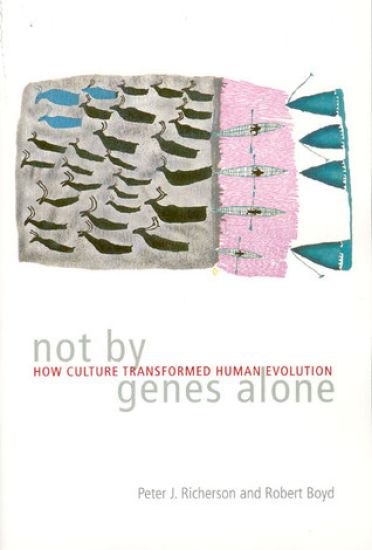
Humans are a striking anomaly in the natural world. While we are similar to other mammals in many ways, our behavior sets us apart. Our unparalleled ability to adapt has allowed us to occupy virtually every habitat on earth, and our societies are larger, more complex, and more cooperative than any other mammal's. In "Not by Genes Alone", Peter J. Richerson and Robert Boyd argue that only a Darwinian theory of cultural evolution can explain these unique characteristics. "Not by Genes Alone" offers a radical interpretation of human evolution, arguing that our ecological dominance and our singular social systems stem from a psychology uniquely adapted to create complex culture. Richerson and Boyd consider culture to be essential to human adaptation, as much a part of human biology as bipedal locomotion. Drawing on work in the fields of anthropology, political science, sociology, and economics - and building their case with such fascinating examples as kayaks, clever knots, and yams that require twelve men to carry them - Richerson and Boyd convincingly demonstrate that culture and biology are inextricably linked. In abandoning the nature-versus-nurture debate as fundamentally misconceived, "Not by Genes Alone" is a truly original and groundbreaking theory of the role of culture in evolution and a book to be reckoned with for generations to come.