Kirjojen hintavertailu. Mukana 12 595 353 kirjaa ja 12 kauppaa.

Kirjailija

Peter Janich

Kirjat ja teokset yhdessä paikassa: 6 kirjaa, julkaisuja vuosilta 2006-2018, suosituimpien joukossa Mundwerk Ohne Handwerk?: Ein Vergesssenes Rationalitatsprinzip Und Die Geistesgeschichtlichen Folgen. Vertaile teosten hintoja ja tarkista saatavuus suomalaisista kirjakaupoista.

6 kirjaa

Kirjojen julkaisuhaarukka 2006-2018.

What Is Information?

What Is Information?

Peter Janich

University of Minnesota Press
2018
nidottu
A novel way of looking at information challenges longstanding dogmas-from a preeminent German thinker It is widely agreed that we live in an “information age,” but what exactly is information? This small, seemingly facile question is in fact surprisingly difficult, and it has occupied many of the best philosophical minds of the modern age. In this wholly original addition to the quest to understand information, German philosopher Peter Janich argues that our understanding of information is based in the much broader history of scientific naturalism-the belief that science is a fundamental aspect of the world and not a human contrivance. His novel critique of this widespread dogma grounds science in human life practices and wrestles with the very fundamentals of the scientific way of understanding reality.Offering new perspectives on the major contemporary fields of communications technology, neurobiology, and artificial intelligence, What Is Information? provides a deep look into humanity in an information age. Its arguments show ways of reconciling the sciences and the humanities, shining new light on the relationship of science to the natural world.
What Is Information?

What Is Information?

Peter Janich

University of Minnesota Press
2018
sidottu
A novel way of looking at information challenges longstanding dogmas—from a preeminent German thinker It is widely agreed that we live in an “information age,” but what exactly is information? This small, seemingly facile question is in fact surprisingly difficult, and it has occupied many of the best philosophical minds of the modern age. In this wholly original addition to the quest to understand information, German philosopher Peter Janich argues that our understanding of information is based in the much broader history of scientific naturalism—the belief that science is a fundamental aspect of the world and not a human contrivance. His novel critique of this widespread dogma grounds science in human life practices and wrestles with the very fundamentals of the scientific way of understanding reality.Offering new perspectives on the major contemporary fields of communications technology, neurobiology, and artificial intelligence, What Is Information? provides a deep look into humanity in an information age. Its arguments show ways of reconciling the sciences and the humanities, shining new light on the relationship of science to the natural world.
Mundwerk Ohne Handwerk?: Ein Vergesssenes Rationalitatsprinzip Und Die Geistesgeschichtlichen Folgen
Wissenschaftliches Wissen in sprachlicher Darstellung ist nicht nur auf Koharenz und Konsistenz von Semantik und Syntax angewiesen. Es verdankt sich auch nichtsprachlichen Handlungen, deren Gelingen und Erfolg von der Reihenfolge in Handlungsketten - einer "methodischen Ordnung" - abhangen. Dies legitimiert ein "Prinzip der methodischen Ordnung", die sprachliche Ordnung an den nichtsprachlichen Ordnungs-Sachzwangen auszurichten. Am Beispiel der Geschichte des Parallelen-Problems der Geometrie zeigt Peter Janich, dass die Vernachlassigung der methodischen Ordnung eine Fulle ungeloster Probleme in Geometrie, Physik und Philosophie von Euklid bis Einstein nach sich gezogen hat, und stellt eine methodische Losung vor. Auch an der Mechanik Isaac Newtons und sogar an den jungen Kommunikations- und Informationswissenschaften lasst sich belegen, dass die Vernachlassigung des herstellenden Handelns fur die Bestimmung von Grundbegriffen und Grundsatzen (Axiomen) weit reichende Probleme erkenntnistheoretischer, ethischer und politischer Art nach sich zieht. Diese lassen sich durch eine methodische Umorientierung der mathematisch-naturwissenschaftlichen Wissenserzeugung beheben.
Baustelle Informationsgesellschaft Und Universität Heute: Eine Vortragsreihe

Baustelle Informationsgesellschaft Und Universität Heute: Eine Vortragsreihe

Peter Janich; Ludwig Nastanky; Dorothee Meister

Brill Schoningh
2011
nidottu
Informationstechnologie und elektronische Medien sind zum Bestandteil unserer Alltagskultur geworden. Sie bestimmen unser Handeln, Verhalten und Kommunikation. Die moderne Universit t muss zur Weiterentwicklung von Wissenschaft, zur Generierung neuen Wissens und dessen Vermittlung die Informationstechnologien als Mittel und Zweck ausbauen. Aber sie ist auch ma gebliche Instanz, diesen Prozess kritisch zu begleiten. Zu beiden Aufgabenfeldern leisten Beitr ge: der Philosoph Peter Janich, der Wirtschaftswissenschaftler Ludwig Nastansky, die P dagogin Dorothee Meister, der Nachrichtentechniker Reinhold H b-Umbach, die Informatikerin Christiane Floyd und der Germanist und Vorsitzende des Wissenschaftsrates Peter Strohschneider.
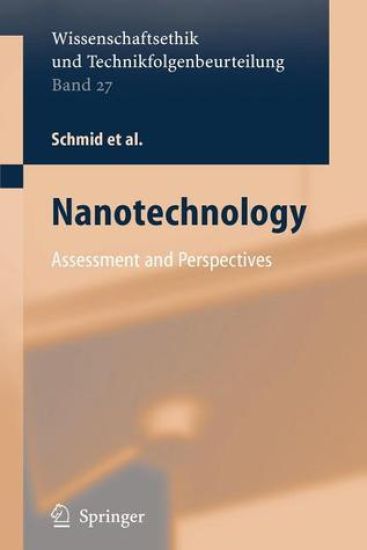
Nanotechnology

Nanotechnology

Harald Brune; Holger Ernst; Armin Grunwald; Werner Grünwald; Heinrich Hofmann; Harald Krug; Peter Janich; Marcel Mayor; Wolfgang Rathgeber; Günter Schmid; Ulrich Simon; Viola Vogel; Daniel Wyrwa

Springer-Verlag Berlin and Heidelberg GmbH Co. K
2010
nidottu
Since nanotechnology is considered a key for the 21st century, its promises have been assessed by various scientific communities. By meeting at the nanoscale, various disciplines, from physics via chemistry to biology, from engineering to medicine, contribute synergetically to the newly created knowledge base and the resulting technological advances. Considering that large societal sectors will be impacted, the unique aspect of this two-year study was to assess nanotechnology from various interrelated perspectives: scientific progress, industrial relevance, economic potential, educational needs, potential adverse health effects, and philosophical aspects. The goal of this study was to derive integrated recommendations which consider the large range of societal implications reflecting the different views in an integrative manner. The study attempts to link previously isolated statements, bundling the various concepts and giving unified recommendations to decision makers in relevant society sectors such as politics, economy and research. Special attention was given to the European situation with respect to commercial consequences, an aspect that has not yet received the attention it deserves so far.
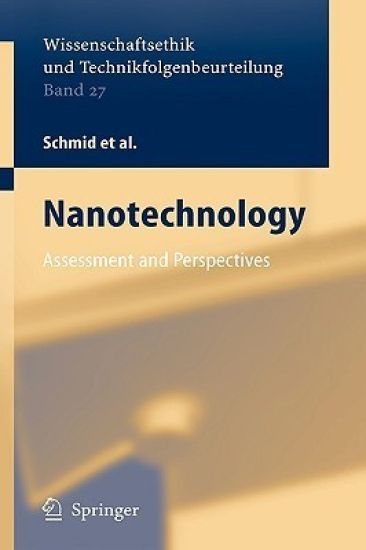
Nanotechnology

Nanotechnology

Harald Brune; Holger Ernst; Armin Grunwald; Werner Grünwald; Heinrich Hofmann; Harald Krug; Peter Janich; Marcel Mayor; Wolfgang Rathgeber; Günter Schmid; Ulrich Simon; Viola Vogel; Daniel Wyrwa

Springer-Verlag Berlin and Heidelberg GmbH Co. K
2006
sidottu
Since nanotechnology is considered a key for the 21st century, its promises have been assessed by various scientific communities. By meeting at the nanoscale, various disciplines, from physics via chemistry to biology, from engineering to medicine, contribute synergetically to the newly created knowledge base and the resulting technological advances. Considering that large societal sectors will be impacted, the unique aspect of this two-year study was to assess nanotechnology from various interrelated perspectives: scientific progress, industrial relevance, economic potential, educational needs, potential adverse health effects, and philosophical aspects. The goal of this study was to derive integrated recommendations which consider the large range of societal implications reflecting the different views in an integrative manner. The study attempts to link previously isolated statements, bundling the various concepts and giving unified recommendations to decision makers in relevant society sectors such as politics, economy and research. Special attention was given to the European situation with respect to commercial consequences, an aspect that has not yet received the attention it deserves so far.